Climate Communicators Say the Audience Is Already There — The Content Isn't
Climate Week NYC • United NationsSeptember 24, 2026
Locunity is an independent informational service and is not an official government page for this commission. All information is sourced from public footage and an analysis of official agendas with the aid of responsible, fact-checked AI. to report an error or omission.
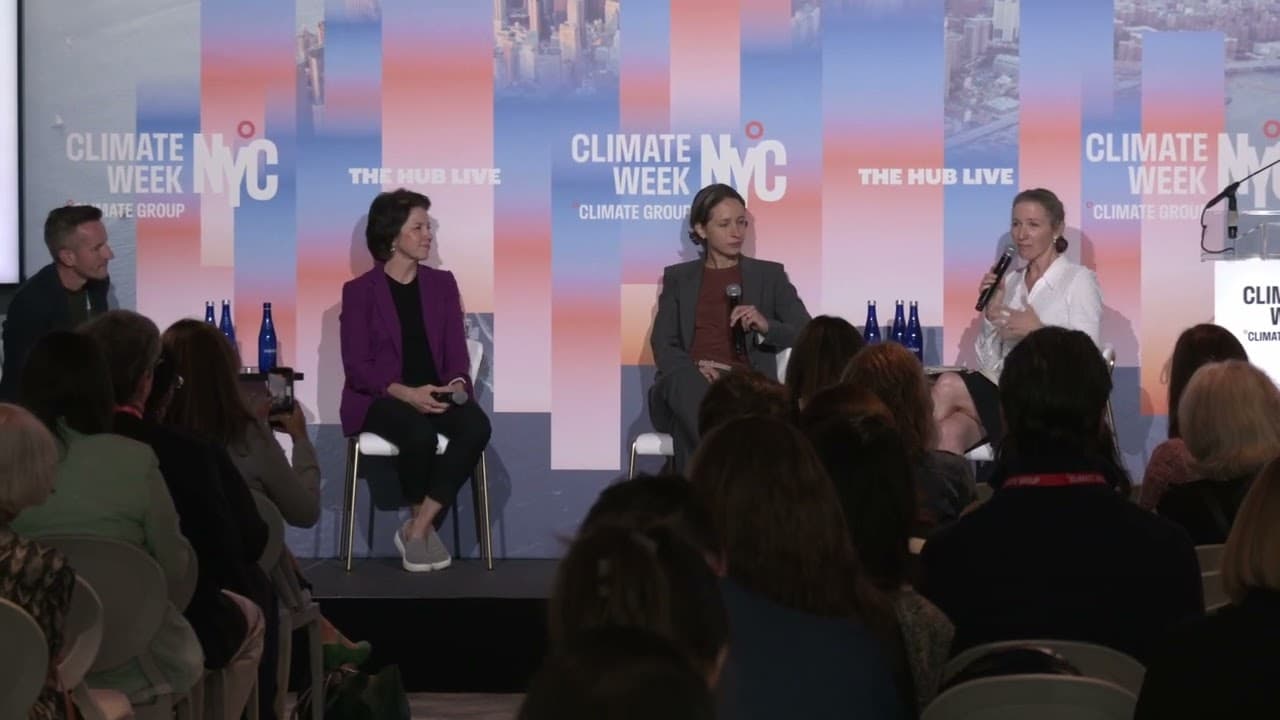
A panel of climate communication leaders at Climate Week NYC made the case that the real barrier to climate progress is not public apathy but a supply-side failure: audiences overwhelmingly want climate stories and solutions, yet communicators, writers, and policymakers aren't meeting them where they are. A hackathon winning team offered a practical example of what meeting the moment looks like — an AI-powered tool to build climate resilience into hospitals from day one.
- New assessment maps gaps in climate communication across the U.S. and Canada as the Talking Climate Collaborative launches
- Yale/George Mason data shows over 50% of Americans alarmed or concerned about climate; only 10% are dismissive — yet that vocal minority dominates the conversation
- Only 0.2% of TV series touch climate despite 84% of Netflix audiences watching sustainability-tagged titles and 89% globally wanting action
- ClimateSpring funds screenwriters to weave climate into entertainment, with breakout hits reaching conservative and older audiences
- Hackathon team builds AI tool for climate-resilient hospital design, selected from 17 competing teams at a UNFCCC-partnered event
The Communication Gap Is the Climate Gap
The Talking Climate Collaborative launched just one day before this Climate Week NYC panel, and its founder wasted no time making its thesis clear: the climate movement has a communication problem, not a public opinion problem.
Why it matters: A first-of-its-kind landscape assessment — available at talkingclimate.com — maps who is communicating about climate across the U.S. and Canada, to whom, through what channels, and where the gaps remain. For advocates, policymakers, and funders, it offers the most systematic look yet at where outreach is working and where it's falling short.
Where things stand: Bernadette Woods Plackey, Executive Director of the Talking Climate Collaborative, built the assessment after 13 years at Climate Central, where she developed programs with TV meteorologists to localize climate science. She outlined a practical communication framework: know your audience, meet people where they are, connect on shared values, simplify without dumbing down, tell stories — and don't be afraid.
"Don't be afraid. You have public opinion and science on your side. Most people genuinely have questions, and the biggest piece of misinformation is that we think others don't care, but they do," she said.
Drawing on Yale and George Mason University's Global Warming Six Americas research — which segments the American public into six groups from "alarmed" to "dismissive" — Woods Plackey noted that the alarmed and concerned together exceed half the population. The dismissive segment that dominates social media attacks? About 10%.
"There is so much more that connects us than divides us, and so much is focused on the edges," she said. "Unfortunately, one of the edges has a lot of political power right now, but the vast majority of people are not in that space."
Hannah Safford, Associate Director of Climate Environment at the Federation of American Scientists, reinforced the point. She pushed back against the hand-wringing over whether communicators should even use the word "climate" with politically diverse audiences.
"When we are agonizing about how much we use or don't use the word climate, that conversation I find very frustrating because it's a conversation really about what is the title rather than what is the story," Safford said. Her approach: use the word, but adapt the substance — solar in Arizona, wind in New England — so the story connects to people's lived experience.
Safford also drew a critical distinction on the trust question. Pew data shows public trust in government at about 30%, but she argued that doesn't mean people have stopped trusting expertise altogether. "People still retain trust in experts, especially experts who they can connect to, even as they've lost touch with institutions," she said.
Woods Plackey was blunter about the threats. While trust in doctors and technology remains relatively high, she flagged that trust in climate science has been deliberately targeted — and the attacks are accelerating. "We can't ignore that it is intentionally being attacked right now and gutted, and in some big ways from our government straight down to how what universities can bring in, how they're having a hard time getting grad students in," she said.
Hollywood's Massive Climate Blind Spot
Emma Stewart, Global Director of ClimateSpring and former chief sustainability officer at Netflix, presented perhaps the session's most striking data point: a yawning gap between what audiences want and what they're being offered.
The basics: Popular culture — film, TV, music, sports, social media, games — shapes kitchen-table conversations more than policy papers ever will. Yet the entertainment industry has barely touched climate.
"What's interesting is this massive market failure where you have 0.2% of television series and less than 1% of films touching on climate in any way, whether it's solutions or even just as a backdrop," Stewart said. "And in contrast, when I was at Netflix, we had 84% of audiences watching titles that we had designated as sustainability stories."
Global audience research tells a similar story: "You have what some people are calling a silent majority of 89% on average around the world," she said, citing surveys showing overwhelming demand for climate action from both public and private sectors.
Where things stand: The bottleneck isn't studios — it's writers. Stewart explained that screenwriters feel disempowered to pitch climate stories, assuming the topic is too technocratic, too partisan, or too earnest. "It turns out the market gap is because writers don't feel empowered for the most part to weave this into their craft," she said.
ClimateSpring addresses this through workshops, peer learning, producer attachment, and pre-production financing. Stewart described herself as "a reformed scold" who was once taught that shaming people into action was the way forward and that emotion was contradictory to data — before discovering that neuroscience and behavioral science tell a very different story about how society evolves.
Three story categories are driving ClimateSpring's slate:
-
Justice stories: ITV's "After the Flood," a police procedural that reveals corporate greed behind a devastating flood. "It was incredibly popular with conservative audiences and older audiences," Stewart said. "It reached people who would never perhaps seek out something that had climate or sustainability in the logline, but they felt such injustice that the greed of this upstream developer ended up taking out their town."
-
Journey stories: BBC's "The Rapture," a psychological thriller set during a heat wave amid the clean energy transition, now BBC's second most popular drama.
-
World-building stories: A Civic Studios microdrama — a romance about a restaurateur and organic farmer — that hit 2 million views in under a week.
Why it matters: The panel's consensus was clear: the partisanship narrative around climate lives mostly in headlines, not living rooms. The data suggests audiences are hungry for climate content — if it's wrapped in a good story, not a lecture.
Influencers, Cupcakes, and Heat Policy
Hannah Safford described how the Federation of American Scientists is rethinking how science reaches the public. FAS has moved beyond delivering research papers to policymakers and now treats lived experience as a co-equal input into policy.
Its extreme heat campaign was organized around four pillars designed to be immediately relatable: safe schools, safe communities, safe homes, and safe workplaces. Rather than relying on institutional channels alone, FAS partnered with the organization Drumbeat to distribute scientifically grounded content through social media influencers — generating hundreds of thousands of views.
"Somebody did a Halloween cupcake cooking video while voicing over heat resilience solutions, which was wild," Safford said. "That is the kind of communication that we can be building towards."
Why it matters: With institutional trust at historic lows, the FAS model suggests a path forward: let trusted individual voices carry the science, even — especially — when those voices are baking cupcakes.
Hackathon Team Builds AI Tool for Climate-Resilient Hospitals
The session closed with the winners of a 48-hour hackathon organized alongside the UNFCCC, introduced by Seema, Lead of Health and Climate AI, and her colleague Dr. Chittan Sarabu.
"We bring together diverse players with a focus on putting health at the center of climate action," Seema said. "Part of that is through storytelling, but part of it is through the action we do in these hackathons."
The hackathon drew clinicians, public health professionals, climate experts, anthropologists, and AI/machine learning specialists. The winning team — Mustafa, Victor, Divyesh, Bowen, and Pranav, selected from 17 teams — built a software suite called "Brick."
"We've created a software suite that allows all sorts of professionals involved in the lifespan of a building's cycle, from pre-planning to maintenance, to incorporate resilience into the planning, into the development, into the maintenance," Mustafa said. The tool specifically targets hospitals, which have disproportionately high energy usage and significant energy waste.
Divyesh highlighted the human-centered design approach, and Victor said the team hadn't yet decided whether to continue development but expressed hope to do so.
What's next: Whether "Brick" moves from hackathon prototype to real-world deployment remains an open question, but the concept addresses a concrete gap: helping facility managers integrate flood risk, air quality, and energy resilience into building design before disasters strike — starting with healthcare facilities where the stakes are highest.