Climate Week NYC - Sep 21, 2026 - Meeting
Climate Week NYC • United NationsSeptember 21, 2026
Locunity is an independent informational service and is not an official government page for this commission. All information is sourced from public footage and an analysis of official agendas with the aid of responsible, fact-checked AI. to report an error or omission.
World Leaders, Corporate Giants Converge on Climate Week With Calls for Bolder Action
Climate Week NYC 2026 opened with a parade of world leaders and Fortune 500 executives delivering a unified but urgent message: the clean energy transition is winning on economics, but political silence, fossil fuel subsidies, and a broken financial architecture threaten to stall progress at the moment it matters most. Australia set the pace with a new 2035 emissions target, the UK reframed climate as a national security crisis, and Apple, Nike, and L'Oréal showed in hard numbers that decoupling growth from emissions is already happening.
- Australia pledges 62–70% emissions cut by 2035 as renewables hit half the national grid at peak
- UK reframes climate breakdown as a national security threat, with world-leading carbon budgets targeting 87% reduction by 2040
- European Investment Bank announces plans to double adaptation finance and launch a €20 billion Global Green Bond Initiative
- Apple reveals 60% emissions cut while revenue grew 78%, now requiring all suppliers to run on renewables
- Paul Polman warns CEOs that waiting on climate is "corporate suicide" as sustainable companies outperform across every metric
- Miami mayor says $1 in adaptation returns $10, with BlackRock exec warning investors will walk away from infrastructure without built-in resilience
- UN deputy secretary-general calls for $1.3 trillion in climate finance, warning that brown energy is growing alongside green
Three Fibs and a Challenge: Climate Group CEO Opens the Largest Climate Week Ever
Climate Group CEO Helen Clarkson opened her 10th annual ceremony with a pointed message for the thousands of delegates, government officials, and business leaders in the room: stop lying to yourselves.
Why it matters: With renewables having overtaken coal as the world's largest power source and solar now the cheapest electricity in history, Clarkson argued the climate movement's biggest threat is no longer the science — it's the stories leaders tell themselves to avoid harder fights.
Where things stand: Clarkson identified three "fibs" that she said are enabling inaction. First, the belief that good economics will automatically produce good policy. "Good economics don't inevitably lead to good policy, not when vested interests are pushing back and people are making so much money on short-termism," she said. Second, the idea that climate action can advance without saying the word "climate" — a strategy she called dangerous. "Silence isn't neutral, it's dangerous. Silence enables inaction, and inaction leads to more climate change, more flooding, more fires, more empty supermarket shelves, more pollution, more uninsurable homes."
Her third target was broader than the usual suspects. Beyond big oil and gas companies, she pointed to social media platforms, ragebait media, and right-wing pundits spreading misinformation about renewables as forces slowing progress.
"The truth is, we've been making ourselves smaller and quieter at the exact moment we should be bigger and louder," Clarkson said.
The ceremony, hosted by BBC News Anchor and Correspondent Carl Nasman, featured headline sponsorship from Trane Technologies and Takeda as the Hub Live partner.
Australia Sets Ambitious 2035 Target, Positions Itself as Pacific Climate Leader
Why it matters: Australian Prime Minister Anthony Albanese used the Climate Week stage to announce a new nationally determined contribution under the Paris Agreement: a 62–70% emissions reduction by 2035, based on 2005 levels. The announcement positions Australia as a key player heading into COP31, which the country will co-host with Pacific Island nations Tuvalu and Fiji.
Where things stand: Albanese presented a rapid transformation already underway. When his government took office, renewables accounted for one-third of Australia's energy grid; at peak, they now supply half. Australian households are installing 10,000 home batteries per week — more than half a million in the past year — and the country has added enough wind and solar capacity to power 6 million of its 28 million households.
"Our 2035 target is to reduce emissions by 62 to 70% on 2005 levels. It is ambitious, but it is also achievable," Prime Minister Albanese said.
The prime minister detailed Australia's Pacific climate investments, including $100 million toward the Pacific Resilience Facility, which targets $1.5 billion and represents the first Pacific-led regional climate financing mechanism. Australia has also committed $350 million for climate-resilient Pacific infrastructure, backed Palau's first large-scale solar and battery project — displacing 1 million litres of diesel annually — and launched the Renew Pacific program, which Albanese said has improved 300,000 lives.
"We established the Pacific Resilience Facility. It is the first Pacific-led regional climate financing mechanism. It is also a promise to our Pacific family that they won't face the climate crisis alone," he said, noting the Pacific is "a region where those who have contributed the least to the climate crisis are among the most vulnerable to its consequences."
Albanese also highlighted the Filippina Union Treaty with Tuvalu, described as a world-first agreement providing migration pathways for climate-vulnerable Pacific Islanders. He was introduced by Climate Group Board Chair Mike Rand.
UK Foreign Secretary Makes the Case for Climate as National Security
Why it matters: UK Foreign Secretary Ed Miliband, formerly energy secretary, argued that climate breakdown must move from the margins of environmental policy to the center of national security planning — a framing that signals how the UK intends to wield its upcoming G20 presidency.
Where things stand: Miliband opened by noting a striking investment gap that has now reversed: "In 2026, we're going to see $2.2 trillion invested in clean energy against $1.2 trillion in fossil fuels."
He laid out three implications of treating climate as a security threat: embedding climate risk in national security threat assessments and contingency planning; managing cross-border shocks through early warning systems and disaster risk finance; and pursuing more ambitious domestic action to limit the severity of impacts.
On the domestic front, Miliband pointed to concrete UK commitments. "The UK has passed world-leading 1.5-degree-aligned carbon budgets for an 87% reduction in emissions by 2040," he said. The UK has also committed £400 million to the Tropical Forests Forever facility and is pursuing a plan to deliver a clean power system by 2030.
"Climate breakdown, in my view, must be an issue for foreign ministers and prime ministers as well as energy and climate ministers. The security community, not just the activist community. The generals, not just the green campaigners," Foreign Secretary Miliband said.
He offered a cautiously optimistic long view: "When I left the Copenhagen Climate Summit, which didn't go so well for those of you with short memories, in 2009, we were heading for a 4-degree world. Now we're heading for something like a 2.5-degree world." The UK plans to press this agenda through Climate Week, the UN General Assembly, World Bank/IMF annual meetings, COP31, and its G20 presidency.
UN Deputy Secretary-General Warns Brown Energy Growing Alongside Green
Why it matters: UN Deputy Secretary-General Amina Mohammed delivered a blunt warning that the clean energy story being told at Climate Week is only half the picture. While developing countries are building green energy capacity, fossil fuel infrastructure is expanding simultaneously — and the international financial system is not structured to fix it.
Where things stand: Mohammed identified a $4 trillion financing gap for the Sustainable Development Goals, with $1.3 trillion tied directly to climate. She called for fundamental reform of the global financial architecture to unlock resources for developing nations.
"We see many of the statistics that tell us how much more many of our developing countries are transitioning to green, but the truth is, in parallel, brown is growing too," she said.
Mohammed defended multilateralism as essential, calling it "the global town hall that we come to as a family." She argued that moments of disruption — the Middle East conflict, fossil fuel chokepoint vulnerabilities — should accelerate rather than slow the green transition. She also flagged that AI infrastructure's massive energy demands create new urgency for both renewable deployment and financial reform.
"$4 trillion for the Sustainable Development Agenda, $1.3 trillion of it is climate. So let's not lose sight of the financial architecture that needs to change to allow those resources to come to countries so they can invest in it," Deputy Secretary-General Mohammed said. She cited the World Bank's M300 initiative and stressed the importance of equitable investment in critical minerals essential to the energy transition.
EIB to Double Adaptation Finance, Launch €20 Billion Green Bond Initiative
Why it matters: European Investment Bank President Nadia Calviño announced two major financial commitments that signal Europe's climate bank is scaling up just as the global financing gap widens.
Where things stand: The EIB, which already devotes over 50% of its financing to the green transition, will adopt a new adaptation plan at its next board meeting to double finance for climate adaptation. Calviño also announced the launch of the Global Green Bond Initiative, a partnership with the European Commission and national development banks.
"In our next board meeting, we will be adopting our adaptation plan so that we can double finance for adaptation to the impact of climate change, given the high-rising and fast-rising costs of the disasters," President Calviño said.
The green bond program targets €20 billion in green bond issuance worldwide. "Sign a partnership agreement together with the European Commission and national development banks and other international partners on the Global Green Bond Initiative, to mobilize €20 billion to invest in the issuance of green bonds around the world," she said.
Calviño cited the Ukraine war and Middle East escalation as reasons to break free from fossil fuel dependence — echoing the national security framing laid out earlier by Miliband. She announced the EIB will chair the multilateral development bank family in 2027, with a focus on water, sustainability, health, critical minerals, and AI. She also noted productive exchanges with Canadian Prime Minister Mark Carney, signaling transatlantic coordination on green finance.
Polman to CEOs: Delay Is Corporate Suicide
Why it matters: Paul Polman, former Unilever CEO and co-founder of the Planetary Guardians, used a fireside chat with CEO Helen Clarkson to argue that the business case for sustainability is no longer theoretical — and that executives who wait for political certainty are destroying shareholder value.
Where things stand: Polman presented a cascade of evidence across four levels. At the brand level, sustainable brands grow five times faster in the US. At the company level, the sustainable company index is the second-best performing after IT over 10 years. At the industry level, sectors moving faster on sustainability are better valued by markets.
"Industries that are moving faster and positioning themselves for the future are better valued, and then at country level, look at China, 5% growth, 1.5% to 2% of that is entirely due to the green economy," Polman said. He added that 90% of US energy investment over the past decade has been green.
The other side: Polman identified three categories of CEO response — denial, silence, and active leadership — and reserved his sharpest critique for the silent majority. He called for an end to $2.6 trillion in global fossil fuel subsidies and challenged the "less bad" mindset that he said dominates corporate sustainability.
"Less bad is not good anymore. I used to kill 10 people, I was a bad murderer. Now I only kill 5 people, I'm a better murderer. It doesn't work to me," he said, arguing companies must shift from incremental CSR to regenerative business models.
"Waiting for greater certainty is certainly probably the wrong thing to do and increases your risks and obviously consequences of that. I'd call it in this environment a little bit of corporate suicide," Polman warned.
He cited Johan Rockström's finding that seven of nine planetary boundaries are now breached and noted that CEO turnover is running at 25% annually with average tenure down to 4.5 years — a churn rate he argued is putting the wrong leaders in charge at the wrong moment. His closing challenge to the room: "Do one thing more courageously in the core of your business that you weren't doing before you came here today."
Miami and BlackRock Agree: No Resilience, No Investment
A Golden Age — With Conditions
Why it matters: A panel moderated by Time Senior Correspondent Justin Warland brought together Miami Mayor Eileen Higgins and Senior Managing Director Matthew Harris of Global Infrastructure Partners (BlackRock) to explore a question with enormous consequences for cities and investors: how do you keep infrastructure investable when climate risk is accelerating?
Where things stand: Mayor Higgins presented Miami as a case study in how aggressive adaptation unlocks private capital rather than scaring it away. "Our building code is the most intense hurricane building code in the country," she said, describing elevated floor standards, parks designed as stormwater sponges, 3D-printed concrete seawalls using biomimicry, and a stormwater master plan launching 10 new projects in 10 neighborhoods annually.
She pointed to the Underline, a signature resilience project: "We have what's called the Underline. It's a 10-mile linear park. Most of the construction of that park happened underground because the way we designed that to be completely a bioswale" — a park that stays dry after 10 inches of rain. Private sector investment, she argued, continues precisely because of these resilience measures, not despite them.
Harris framed the broader landscape as a "golden age of infrastructure" driven by AI, electrification, reshoring of manufacturing, and the refurbishment of aging systems. But he drew a hard line for investors.
"Investors are not going to invest in infrastructure that is subject climate risks or other risks. They're going to want to see resiliency and other things built into the design," Harris said. He noted that "55% of global GDP is dependent on ecosystem services around the world," arguing that infrastructure must be designed in partnership with nature.
Decisions: Both speakers converged on the return-on-investment case for adaptation. "$1 in adaptation strategies pays off $10 in the future, so it is a good return on investment, but we all need to communicate that message," Mayor Higgins said.
What's next: Harris called for permitting reform and stronger public-private partnerships, saying the sector needs "permitting, government support, and partnership" to get projects to final investment decisions and get them built.
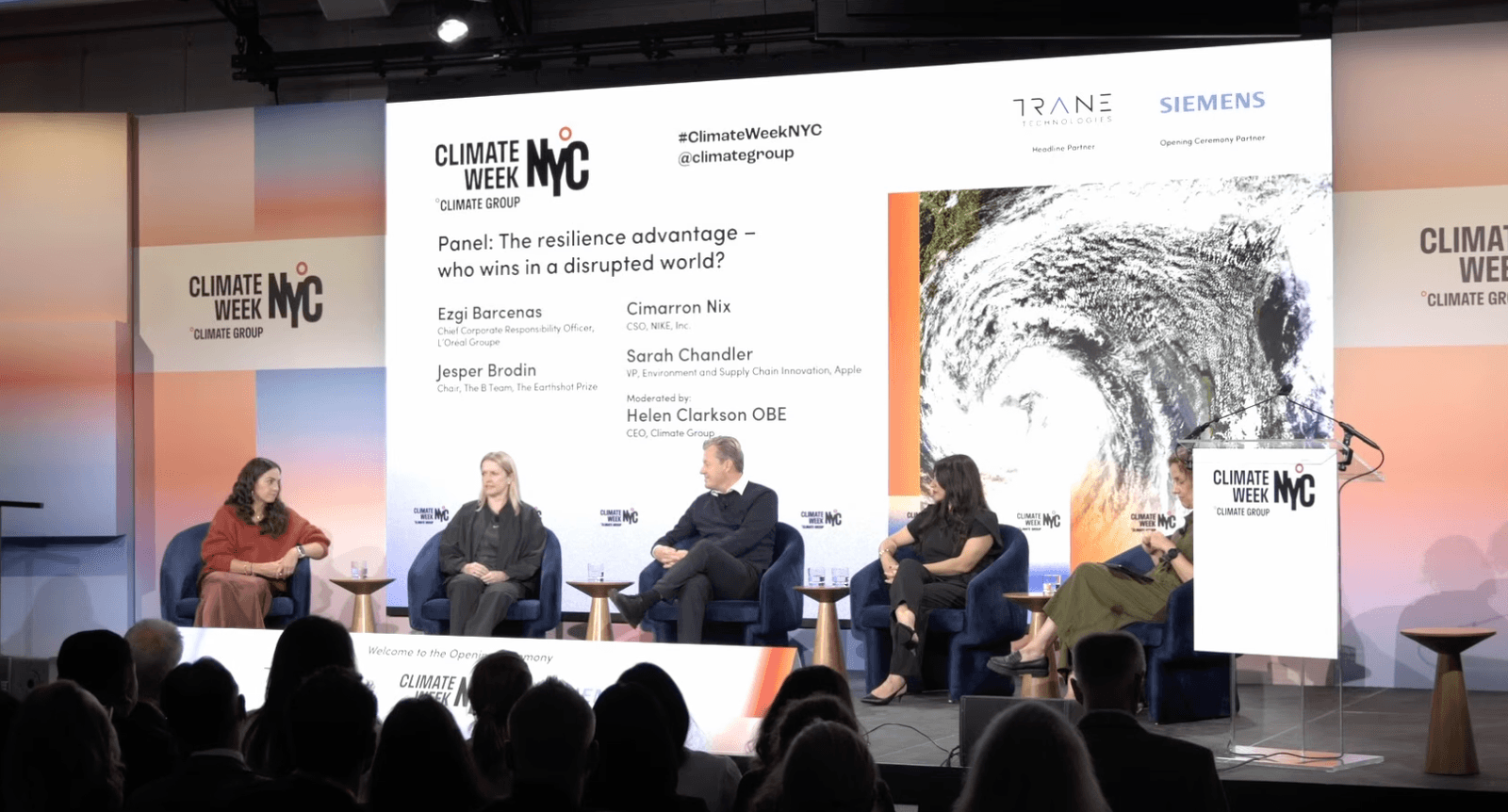
Apple, Nike, L'Oréal Prove Decoupling Growth From Emissions at Scale
The Evidence Panel
Why it matters: If the morning's keynotes made the political and financial case for climate action, the closing panel — moderated by CEO Helen Clarkson — delivered the corporate receipts. Leaders from Apple, Nike, and L'Oréal presented hard data showing that sustainability investments are strengthening, not burdening, some of the world's most valuable brands.
B Team and Earthshot Prize Chair Jesper Brodin set the frame: "According to BCG, there are only 20% of the industries left that don't have an opportunity to scale things to an economic advantage."
Apple: 60% Emissions Cut, Revenue Up 78%
Vice President, Environment and Supply Chain Innovation Sarah Chandler revealed numbers that challenge the conventional trade-off narrative. "We've actually cut our emissions by 60% from our 2015 baseline, and that's before we get to offsets. And yeah, I think very importantly, at the same time, revenue has actually grown 78%," she said.
The innovations are tangible. "All of the titanium enclosures on our new Apple Watch and Apple Watch Ultra are made not just of 3D-printed titanium. It's also 100% recycled titanium, which has never been done before," Chandler said. Apple now uses "100% recycled cobalt in all of the batteries we design and 100% rare earths in all of our magnets."
Perhaps most consequentially for global supply chains, Apple has made renewable energy a condition of doing business. "If you're going to manufacture for Apple, then you have to run that manufacturing on renewable energy," Chandler said — a mandate covering 20 gigawatts of clean energy now online across Apple's supplier network.
Nike: 100% Renewables, Supply Chain Transformation
Chief Sustainability Officer Simran Nix described Nike's 35-year sustainability arc, which has reached a major milestone: "We've been able to hit 100% renewable across our owned and operated facilities around the world" through the RE100 initiative.
The harder work — decarbonizing supply chains — is also progressing. Nike has extended its efforts through the Supplier Climate Action Program (now transitioned to CASCAL), the Asia Clean Energy Coalition, and the Zemba shipping partnership. "Around 40% renewable energy in our manufacturing operations with our strategic suppliers and a 47% reduction in emissions across manufacturing and transportation relative to FY20," Nix said.
L'Oréal: Rethinking Products for a Warming World
Chief Corporate Responsibility Ezgi Barcenas brought the perspective of a 115-year-old company adapting to a hotter, water-stressed planet. She described L'Oréal's Climate Emergency Fund — €20 million renewed through 2030 — and the Sources Fund for supply chain partner decarbonization.
The company's most ambitious bet is L'Accélérateur, a €100 million sustainable innovation accelerator. "We launched L'Accélérateur, our sustainable innovation accelerator program last year, and that with €100 million," Barcenas said. The program is now in its second cohort of 13 startups. She posed a question that she said is reshaping product development: "What does that mean for the future of shampoo? What does it mean for the future of face care, face wash?"
The Courage Gap
Chair Brodin closed the panel by calling for cross-border policy alignment, consistency over time, and the courage to defend progress. "We need to raise our level of courage to stand up for what's right," he said.
Minor Items
- Trane Technologies served as the headline sponsor of Climate Week NYC 2026, with Takeda as the Hub Live partner and Siemens among featured sponsors.
- COP31 planning is underway with Australia co-hosting alongside Tuvalu and Fiji; a pre-COP Leaders' Event was announced by PM Albanese.
- EIB will chair the multilateral development bank family in 2027, with priorities including water, health, critical minerals, and AI.
- The Filippina Union Treaty between Australia and Tuvalu was highlighted as a world-first agreement creating migration pathways for climate-vulnerable Pacific Islanders.