
Byron Connector Leads as SR 239 Faces $1 Billion-Plus Mitigation Bill
Citizens Advisory Committee (CAC) • Contra Costa Transportation AuthoritySeptember 24, 2026
Locunity is an independent informational service and is not an official government page for this commission. All information is sourced from public footage and an analysis of official agendas with the aid of responsible, fact-checked AI. to report an error or omission.
The proposed 17-mile State Route 239 would add 92 million to 104 million vehicle miles a year. Under state rules, offsetting that new driving could cost about $1 billion to $1.3 billion, roughly what it would cost to build the highway itself. The Contra Costa Transportation Authority's Citizens Advisory Committee heard that update Sept. 23, 2026, along with news that the Navy had signed the Concord Naval Weapons Station term sheet that day. The committee lacked a quorum, so it took no votes.
- SR 239 mitigation could reach $1B–$1.3B because the highway is projected to induce 92 million to 104 million vehicle miles a year.
- A $185M Byron connector emerges as the practical first phase, with no opposition reported from the town of Byron.
- The full corridor has no funding path yet. Staff said state money is unlikely and federal dollars are more probable.
- The Navy signed the Concord term sheet, clearing the way for specific plan work on 12,272 homes, 25% of them affordable.
- Construction at the Concord base is years away, with council approval of the specific plan targeted for late 2029.
SR 239: The Road Is Cheap Compared With the Driving
The basics: VMT means vehicle miles traveled. State law now measures a road project's impact by how much new driving it induces, not by traffic delay. Projects must offset that new driving.
Why it matters: The mitigation bill for SR 239 is roughly equal to the $1.2 billion to $1.3 billion cost of building the full corridor. That pushes the near-term focus to a smaller connector near Byron.
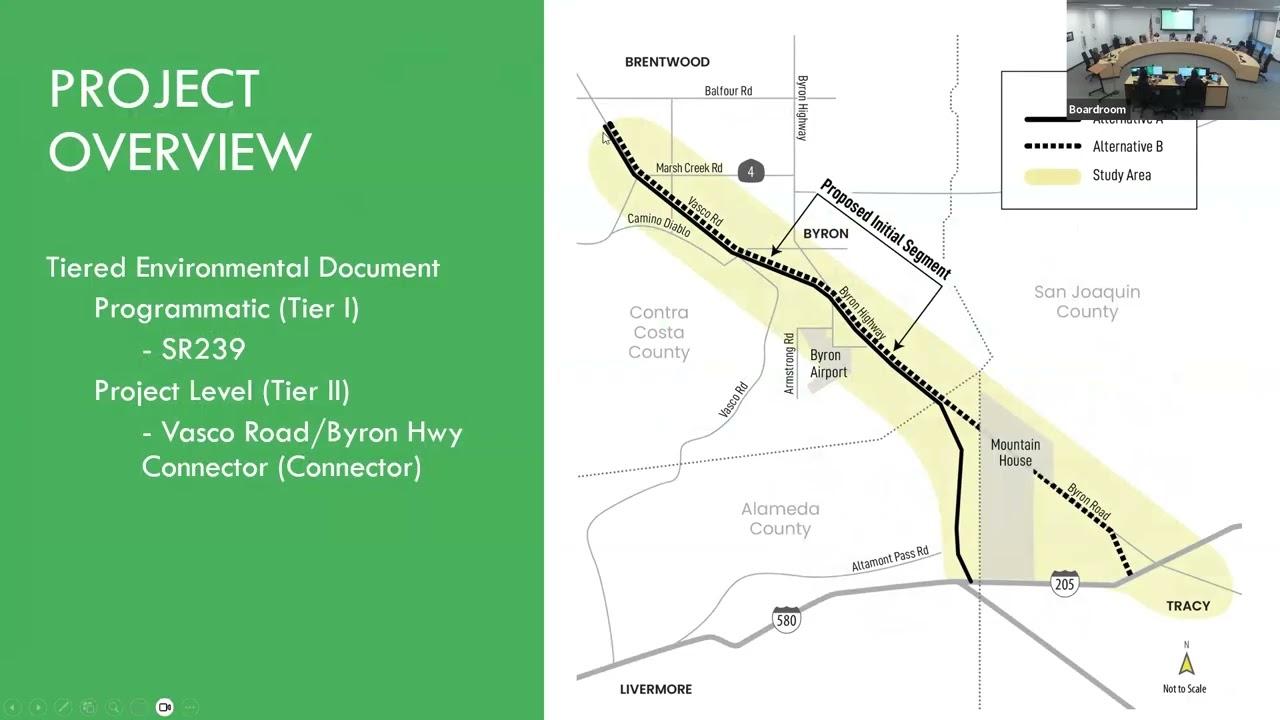
Where things stand: CCTA Director of Projects Stephanie Hu described a corridor running from Highway 4 near Marsh Creek Road to I-205 or I-580. The route was designated in 1959 and has been studied since a 2014 feasibility study. A federal earmark the county secured requires a 20% local match. Caltrans is the lead agency for the environmental review under both state law (CEQA) and federal law (NEPA).
The review is tiered. A program-level Tier 1 study covers the full corridor, and a project-level Tier 2 study covers the Byron connector.
"The project will need to fully mitigate, or we have committed to fully mitigate for this induced VMT," said Hu.
At $14 per vehicle mile through a state mitigation bank, the bill comes to about $1 billion to $1.3 billion. That money would fund affordable housing. A transit market study did not produce meaningful offsets.
"That's why it's going to be a very expensive project to mitigate, because even the normally expensive things like transit don't even pencil out at reducing the VMT," said CCTA Director of Planning Matt Kelly.
Consultant Gary Kenneally, WSP project manager supporting CCTA, flagged two other hurdles:
- Brushy Creek floodway: Crossing it triggers a strict "no-rise" rule, which essentially requires bridging over the floodway.
- Wildlife study: An 18-month wildlife connectivity study is required.
The connector case: Kenneally put the Byron connector at about $185 million, not counting mitigation. Staff described it as VMT-neutral, meaning it is not expected to add net driving. Hu said Byron residents are eager for the connector to end cut-through truck traffic, and no opposition from Byron businesses has been heard. The concerns raised so far are mostly environmental, and the most recent formal scoping was in 2022.
"I think the people in Byron, the businesses have risen their voice and are very happy to have us get the traffic out of their local neighborhoods," said Committee Member Jared Asch.
The other side: Members pushed on timing and money. Committee Member Chris Sanders stressed he was "a big supporter, so I'm not against it at all." When asked whether the full corridor is 10 or 50 years out, Hu answered, "A lot of years out."
Hu gave this funding picture:
- San Joaquin County jurisdictions favor the project but have not committed funds.
- $10 million in Regional Measure 3 money could support development of the connector.
- Federal dollars are more likely than state funding.
A member who lives in Brentwood suggested comparing the project to improvements on Vasco Road. Kelly said Vasco widening is not an option because an Alameda County growth limit blocks widening on its side of the county line.
Decisions and stakeholder impacts: The item was informational, and no vote was taken. CAC Chair Dennis Esselsagoe asked, "Has Caltrans committed in writing to accept and maintain the Route once built?"
Hu said Caltrans takes over only after the entire route is built. If only the connector is built, it remains a county facility. Two Caltrans districts, D4 and D10, are involved. In practice, the county could own and maintain the connector for the long term, and Byron residents get relief before the region gets a highway.
What's next: Technical studies should finish by the end of the year. Hu said staff hope to release a draft environmental document in mid-2027, with the environmental phase, known as PAED, done by the end of 2027.
Concord Base Reuse Clears a Federal Hurdle
Why it matters: Kelly called the project foundational for Concord, with transportation effects that may be even larger for East County. It is one of the county's largest development projects.
Where things stand: Joe Guerra, the master plan developer representative for Brookfield Properties, made the announcement. "The U.S. Navy did sign the term sheet today," he said.
The plan, based on Concord's 2012 area plan, includes:
- 12,272 homes, 25% of them affordable
- 6 million square feet of commercial space
- a tournament sports park, plus parks and schools
- a new regional park to be maintained by the East Bay Regional Park District, according to Meredith Rupp, the City of Concord's community reuse area planner, who is a month into her role
The specific plan process starts late this year or early next year, with city council approval targeted for late 2029. Guerra said "we do not expect anyone to be swinging a hammer until 2033." In the same remarks, he also mentioned no vertical construction until 2030 and possible tractors on site in 2031.
Money and phasing: The project is set up in five phases, and each must stand on its own financially. City funding is not available for early infrastructure. "The home sales are what are paying for all of this," Guerra said.
The term sheet includes an economic-delay clause. Guerra said it covers large economic shocks and would most likely delay the start of a later phase. Navy and city payments follow a set schedule.
The other side: Members and one public commenter raised four concerns:
- Local hiring. The chair asked about the goal of 40% Concord-first hiring: "How is that even enforceable?" Guerra said the goal was an RFP requirement and that Brookfield has signed a project labor agreement with the Building Trades Council.
- Navy cleanup. Committee Member Sanders asked about the risk that cleanup could be delayed. Guerra said phases 4 and 5 need the longest cleanup lead time. Cleanup is built into federal budgets under CERCLA, the federal Superfund law, and earlier phases do not depend on later ones. Still, he acknowledged the company is worried about it. He said Brookfield is $5 million to $6 million into the project and described Navy staff as on board.
- Transit. Committee Member Joanna Pace asked how County Connection would be consulted. City of Concord Traffic Engineer Aaron Elias said the agency would be part of specific plan outreach and that the plan includes a conceptual backbone road for transit. Public commenter Anna Radnich, who works for Stantec and chairs the Lafayette Planning Commission, noted that only a small part of the site lies within a half mile of BART. Guerra said the specific plan and its environmental impact report will address transit.
- Infrastructure. Committee Member Kristy Lovejoy cited "some really severe infrastructure constraints" while the Navy still owns the land. Elias said Concord invests in traffic signals and fiber.
Decisions and stakeholder impacts: The item was informational, and no vote was taken. The questions point to who carries the risk:
- Future residents: Phasing and Navy cleanup decide where and when homes arrive.
- Building trades workers: The labor agreement is the main tool for enforcing local hiring.
- Transit agencies: County Connection's role depends on what the specific plan includes. Elias said "having the walkable communities actually reduces the VMT from the impact standpoint."
What's next: The specific plan and environmental review begin late this year or early next year.
Minor Items
- No quorum: Nine of 18 members were present. Absent were Bankert, Carr, Carranza, Everidge, James, Miller, Shakirin, Stark and Vedantham. The consent calendar moves to the next meeting.
- $24M waiting for cities: Kelly said local jurisdictions have until June 30, 2027, to submit growth management checklists and claim $24 million. CCTA collects interest on the unclaimed money in the meantime.
- Checklist pipeline: Brentwood's checklist is the first received and comes to the committee in October, with 19 more expected.
- West County gap: Committee Member Pace noted no members represent Pinole, San Pablo or Richmond.
- Outreach: Members highlighted the Transit Ready fair for seniors, a Bike Family Fest that drew about 2,000 attendees, and the expansion of Walk and Roll to 214 schools. New Pittsburg member Connie McFarland was also welcomed.
Looking ahead: The committee meets again in October 2026, when the deferred consent calendar returns if a quorum forms.