
BART Warns of 63% Service Cut If November Transit Measure Fails
Citizens Advisory Committee (CAC) • Contra Costa Transportation AuthorityJune 25, 2026
Locunity is an independent informational service and is not an official government page for this commission. All information is sourced from public footage and an analysis of official agendas with the aid of responsible, fact-checked AI. to report an error or omission.
BART told Contra Costa's transportation watchdogs on June 24, 2026, that it faces $350 million annual shortfalls and would cut service 63% in January 2027 if a regional funding measure fails in November. The Citizens Advisory Committee also elected new leaders and heard that county commute and school bus programs depend heavily on the Measure J sales tax.
- 63% service cut, 800+ layoffs and a 30% fare hike are BART's plan if the November measure fails
- Up to 15 station closures possible in a second phase starting July 2027
- Members press BART on labor costs, efficiency and voter tax fatigue
- School bus programs report waitlists, and one manager warns a program "will collapse" without Measure J
- Dennis Esselsagoe elected chair and Sheena Patel vice chair, 14-0
BART Lays Out Its Doomsday Math
Why it matters: Contra Costa ridership has more than doubled since 2021. BART says those gains are at risk if voters reject the regional transit measure going to the November ballot under SB 63.
Where things stand: Pamela Herhold, BART Assistant General Manager of Performance and Budget, said fare revenue runs about $400 million below pre-pandemic projections. She added that state, regional and local emergency funds have run out, so BART will use state loan funds for fiscal 2027.
"We do forecast $350 million average annual shortfalls starting actually next week in fiscal year '27," said Herhold.
If the measure fails, she said, "we would, in January of 2027, implement immediately a 63% reduction in service." That plan means a 9 p.m. closing time, three routes running every 30 minutes, a 30% fare increase and more than 800 layoffs. A second phase in July 2027 would reach a 70% reduction, up to 15 station closures and about 1,200 layoffs. If the measure passes, a $30 million to $60 million gap would remain, but without service cuts.
When members asked which stations would close, Herhold said, "No lines have been set aside for closure." The BART board will decide.
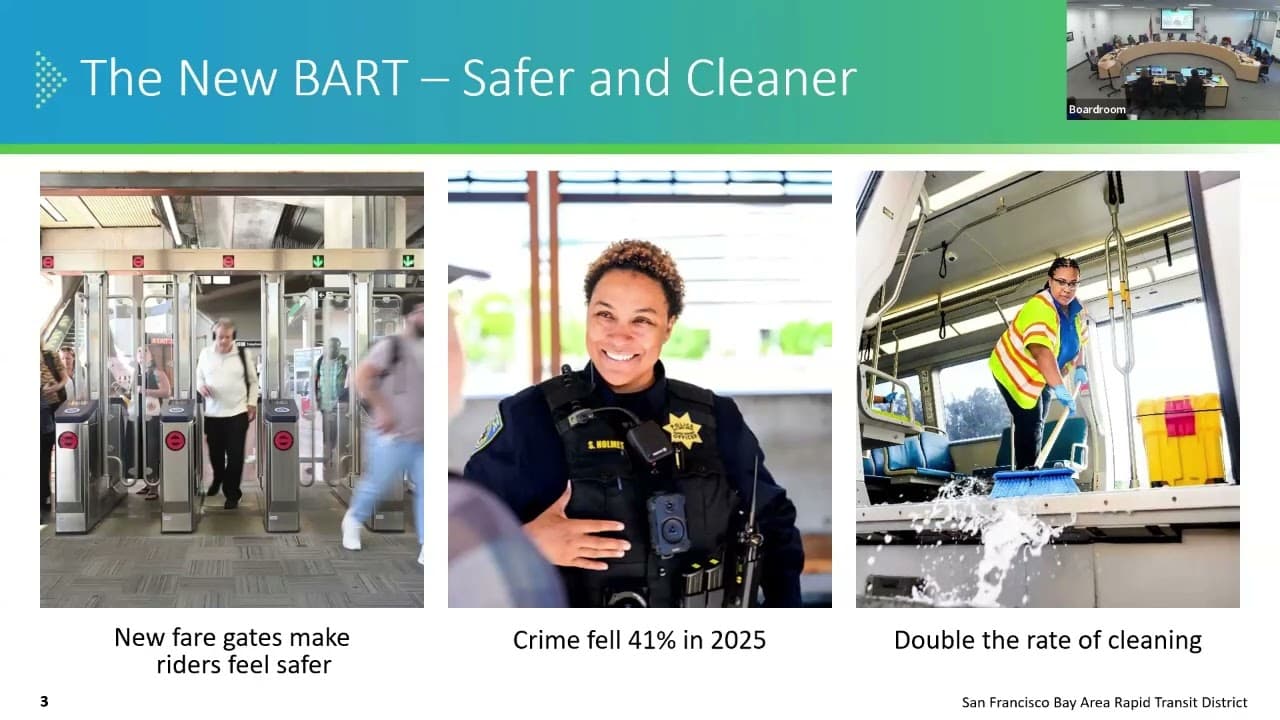
The pitch: Herhold paired the warning with good news. BART reports 89% customer satisfaction, more than 100,000 Bay Pass enrollees and new fare gates it estimates will bring in $10 million a year. She also cited local projects: El Cerrito Plaza transit-oriented development with 700-plus apartments, nearly 50% of them affordable, a Lafayette bike station, LED lighting in Concord, a Pittsburg/Bay Point elevator and bike channels in Walnut Creek.
The other side: Members were skeptical. "I think BART suffers from a PR problem, so to speak," said CAC Member Chris Sanders. CAC Member Edward Miller described "an ivory tower kind of problem" and urged the Metropolitan Transportation Commission to push toward a more stably funded regional system. CAC Member Michael Carr pressed BART on fare gate payback and labor costs, noting "folks are wearying of taxes a little bit." Herhold replied that "our awarded wage increases have been below the rate of inflation." She acknowledged that benefits cost several hundred million dollars and pointed members to bart.gov/budget for detail.
CAC Member Ravi Vedantham asked: "If it doesn't pass, is BART looking at other sources of funds, like public-private partnerships?" Herhold answered, "Public-private partnerships generally don't favor the public end of those discussions."
Decisions and stakeholder impacts: The item was informational, and the committee took no action. Riders in East County would feel cuts directly. Herhold said diesel service to Antioch is not part of BART's 100% electric traction power. Under the measure, the roughly $8 million a year BART now gives four small East Bay operators would grow. "Those $8 million worth of funds would be replaced with, I believe, $25 million of funds from the revenue measure," said Herhold.
The advocacy line: "We cannot use any public resources to advocate for a measure," Herhold said. Staff may explain consequences, and employees may volunteer on their own time. BART does no polling; Connect Bay Area handles it. CAC Member Joanna Pace urged members to visit Connect Bay Area's website.
What's next: Voters decide in November. The BART board would make any station closure decisions.
Measure J Keeps Commute and School Programs Running
Why it matters: These programs take cars off county roads at low cost, but administrators said demand exceeds funding.
The basics: Transportation demand management, or TDM, means programs that shift commuters out of solo car trips. "Our primary source is, of course, Measure J, which is our half-cent sales tax," said Danielle, CCTA Deputy Director for Planning Programs and Policy. The programs also draw on Measure J Programs 17 and 21, Transportation Fund for Clean Air money and OBAG 3 grants.
Where things stand: Kara DeYoung, AMG program administrator, said the countywide e-bike rebate, $150 or $300 for low-income residents, has issued more than 2,500 rebates. One member asked about raising the low-income amount. Pass to Class averages 3,900 students a year, and "96% of students reported riding the bus after receiving their pass," DeYoung said. Walk and Roll grew from seven schools in 2024-25 to 17 this year.
Chris Weeks, Southwest Area Transportation Committee staff, said subsidized vanpools cost "7 cents in a vanpool versus $3.91 a bus" per passenger mile. But the subsidy ends after year one: "It's kind of a hole in the program," Weeks said. He added that TRAFFIX school bus fares will rise about 5% a year, with waitlists at seven schools.
Corey Rowley, West Contra Costa Transportation Advisory Committee staff, described Tri-Transit $25 Clipper incentives, Take 10, Secure Your Cycle and Guaranteed Ride Home. He said Measure J Program 21B will provide about $890,000 in fiscal 2027 for low-income student passes: 95% to West Contra Costa Unified and 5% to John Swett Unified.
The other side: Whitney Simon, Lamorinda School Bus Program Manager, said a bus costs about $160,000 a year. She warned that "the program will collapse if we can't have a $3,000 bus pass for school." Miller said student service is "mispriced to the market badly." Pace reported that in West Contra Costa Unified, "many of the kids don't get their pass until halfway through the school year." CAC Member Tandra Ericson argued that infrastructure drives cycling: "The more you make it accessible, the more people bike."
Decisions and stakeholder impacts: The item was informational, with no vote. Families on school bus waitlists, low-income students and vanpool riders are the most exposed to funding limits.
New Leadership Takes Over July 1
The committee elected Vice Chair Dennis Esselsagoe as chair and CAC Member Sheena Patel as vice chair for fiscal 2026-27. The first nominations caused procedural confusion, which Miller resolved with a substitute motion naming both.
Vote: For: 14 (Bankert, Carr, Ericson, Esselsagoe, James, Lovejoy, Miller, Pace, Patel, Sanders, Shakerin, Stark, Vedantham, Wayne); Against: 0; Absent: 2 (Asch, Everage). Esselsagoe will run the July meeting.
- Consent calendar: The May 27 summary of actions and the attendance log were approved 14-0, with Asch and Everage absent.
- Summer survey confusion: Pace said a League of Women Voters board confused CCTA's summer listening survey with the transit measure. Staff offered an External Affairs contact.
- Survey outreach: Contractor Civic Edge staffed Richmond's Juneteenth event, and the East Bay Bike Coalition shared the survey link.
- Taking it home: Miller said, "I am going to be taking this to my own city council."
Looking ahead: Esselsagoe takes the gavel July 1. Summer survey results are due by September. The regional transit measure goes to voters in November.