
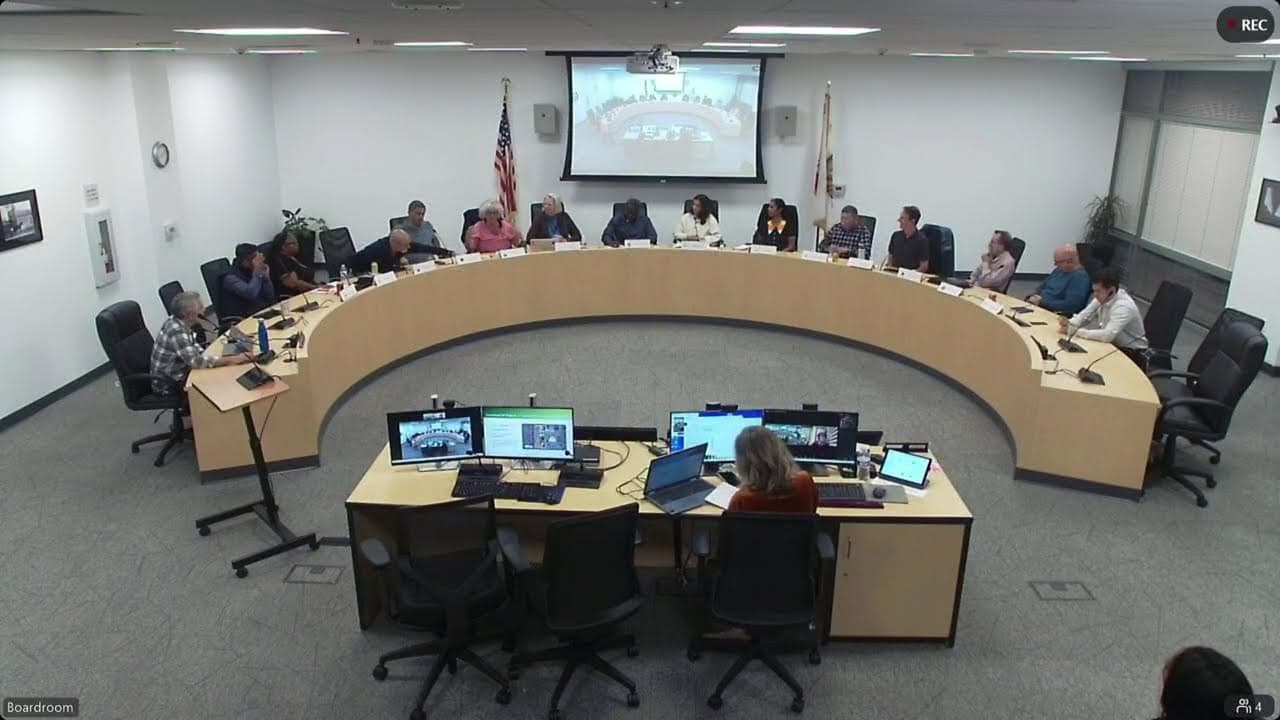
Caldecott Bore Closures Loom as Caltrans Warns of 30-Minute Delays
Citizens Advisory Committee (CAC) • Contra Costa Transportation AuthorityOctober 29, 2026
Locunity is an independent informational service and is not an official government page for this commission. All information is sourced from public footage and an analysis of official agendas with the aid of responsible, fact-checked AI. to report an error or omission.
Starting in August 2027, Caltrans plans to close the Caldecott Tunnel's three oldest bores one at a time, each for months. On Oct. 28, 2026, the agency told the Contra Costa Transportation Authority's Citizens Advisory Committee that commuters should expect queues and delays of up to about half an hour. The briefing was informational, with no vote, and drew sharp questions about transit funding, project sequencing and structural risk. The committee then voted 15-0 to approve Brentwood's Measure J growth management checklist, the first one filed for the 2024-2025 cycle.
- Bore 3 closes for up to 5 months starting August 2027, launching about three years of Caldecott work
- Delays of up to about 30 minutes projected when traffic switches between bores
- The 30% traffic-diversion goal is at risk if transit service is cut, Caltrans acknowledges
- Members press Caltrans to finish Interstate 680 work before closing bores
- Brentwood checklist approved 15-0 after questions on bike lanes, traffic and unspent funds
Caldecott's Long Squeeze Begins in 2027
The basics: Bores 1 and 2 opened in 1937 and Bore 3 in 1964, said Kenneth Puth, Caltrans District 4 Project Manager. Matt Kelly, CCTA Director of Planning, noted that Measure J funded the newer fourth bore. The project rehabilitates walls, ceilings, pavement, drainage, lighting and electrical systems. It also adds fire-life-safety equipment to meet National Fire Protection Association and State Fire Marshal requirements:
- Jet fans
- Deluge sprinklers
- Computerized SCADA controls
- Emergency communications
Why it matters: The bores carry State Route 24, about 200,000 vehicles a day, between Contra Costa and Alameda counties. Single-bore closures will strain that capacity for roughly a year.
Where things stand: About nine months of preparatory work will come first, mostly at the portals and at night. The closure sequence is:
- Bore 3: up to five months, starting August 2027
- Bore 2: more than three months, starting January 2028
- Bore 1: more than three months, starting in April
During closures, Bore 2 or Bore 3 will become the reversible bore. On weekdays, four lanes will run westbound from 10 p.m. to 11 a.m. and eastbound from noon to 9 p.m., with a traffic switch in between.
The work uses CMGC (construction manager/general contractor) delivery, which brings the builder in during design. Here, the builder is a Meyer Obayashi joint venture. Joe Rouse, Caltrans District 4 Chief, Office of Highway Operations, projected eastbound queues of a quarter to half a mile and delays of 14 to 30 minutes. "In the westbound direction, we're looking at maybe close to 3 miles of queue and about a half-hour delay," he said of weekends.
Puth said Caltrans is seeking "a diversion of traffic away from the construction up to 30%, and it's achievable." Rouse said the diversion goal did not assess where drivers would go. He also said Caltrans will use alternate state routes rather than local roads.
The other side: That 30% figure assumes drivers shift to other routes or to transit. "I think it's safe to say that we may not see that 30% diversion if the transit service gets cut," said a Caltrans representative, tying the outcome to an upcoming ballot measure.
A Caltrans project team member flagged an unresolved structural question. "It was assumed that the roadway pavement is supporting the tunnel wall," the team member said. Testing is under way, and the schedule assumes no restrictions. "It's a calculated risk that we're willing to take," the team member added.
Members also questioned timing and messaging:
- Michael Carr, Committee Member, noted the August start coincides with school opening. He urged Caltrans to "think about getting the 680 work done before you start closing the bore for months at a time." A Caltrans construction manager responded that the Alcosta-to-Lovano section should be mostly complete by year-end.
- Sheena Patel, Vice Chair, pushed for more candid congestion messaging: "Nobody wants to be trapped in the Caldecott Tunnel during a fire."
Decisions and stakeholder impacts: No vote was taken. The plan's success rests on commuters and employers changing habits and on transit agencies holding service. Joanna Pace, Committee Member, urged, "I encourage you to partner with AC Transit." Edward Carranza Jr., Committee Member, pressed Caltrans to use CMGC best practices to limit delays.
What's next: Caltrans said the schedule could shift slightly. It plans to give one month's notice before smaller closures and two to three months' notice before long bore closures, and it will launch a project website. CCTA and Caltrans said they will work with the Metropolitan Transportation Commission and transit agencies on contingency plans after the election.
Brentwood Clears Measure J Review, Faces Street Questions
Why it matters: Cities must file Measure J growth management checklists to stay in compliance. "This is the first checklist we've received for the reporting period covering years 2024 and 2025," said Kelly.
Where things stand: Anju Pillai, City of Brentwood Engineering Manager, reported the following:
- Housing element: certified by state housing regulators in April 2024
- Permits: 55 in 2024 and 123 in 2025, with accessory dwelling unit (ADU) permits exceeding the projected 14
- Completed capital projects: the Sand Creek Road extension (about $11.5M) and Lone Tree Way improvements (about $2.3M)
- Ongoing work: downtown alley work is active
Pillai deferred broader housing-capacity questions to city planners, adding, "pretty much I think Brentwood is built out to capacity." Dennis Esselsagoe, Committee Chair, asked "why is there such a large unspent balance." Pillai said the money would go to next year's capital projects.
The other side: A committee member said "pretty much overwhelmingly the pictures that you showed us showed no complete streets" and called the expanded Lone Tree Way dangerous for cyclists. Pillai said future phases and adjacent developments will add bike lanes and sidewalks on collectors and arterials. Pace noted the report showed $0 spent on transit capital operations and trails. She requested maps of transit lines, stops and bike lanes in the next report, urging investments to "make it safer for kids to walk to school."
Patel, a Brentwood resident near the Stonebrook site, asked about school-hour traffic at San Jose Avenue and Sand Creek Road. Pillai said the issue "is on the radar with the city at this point." She noted the intersection opened as an all-way stop, the city will analyze traffic after build-out, and residents can file requests through the GoGov portal. On speeding, Pillai outlined the city's approach:
- Enforcement first: police enforcement and speed trailers
- Speed-hump criteria: residential streets posted at 25 mph, up to 40 feet wide and carrying 500 to 2,000 vehicles a day
- Resident concurrence before installation
Decisions and stakeholder impacts: The checklist passed 15-0 (For: 15, Against: 0, Absent: 3). Ravi Vedantham moved and Jared Asch seconded.
- Voting yes: Asch, Bankert, Carr, Carranza, Ericson, Esselsagoe, James, McFarland, Miller, Pace, Patel, Shakerin, Stark, Vedantham and Wayne
- Absent: Everage, Lovejoy and Sanders
Brentwood stays in compliance. Members, however, signaled they will use these reviews to press cities on bike, pedestrian and transit access.
What's next: Kelly urged other cities to file their checklists. Members also floated traffic-calming technologies and sharing best practices across cities as future agenda topics.
Minor Items
- Consent calendar approved 8-0 (Abstain: Carranza, James, Miller; Absent: 7) after the clerk recounted an initially misjudged tally.
- New member welcomed: The committee seated Edward Carranza Jr. of San Ramon.
- Committee fully seated: "We have literally every chair filled for the first time," said Asch, Committee Member.
- Outreach credited: Pace thanked Lindy Johnson, CCTA External Affairs Director, for presenting to the League of Women Voters of West Contra Costa.
Looking Ahead
The committee's next regular meeting is proposed for Dec. 9.