Board of Directors - Jun 04, 2026 - Meeting

Board of Directors - Jun 04, 2026 - Meeting

Board of DirectorsCentral Contra Costa Sanitary DistrictJune 4, 2026

Sources:

Locunity is a independent informational service and is not an official government page for this commission.We use AI-assisted analysis and human editorial review to publish information.

Central San Adopts Annual Budget, Touts 1.9 Million Pounds of Hazardous Waste Collected

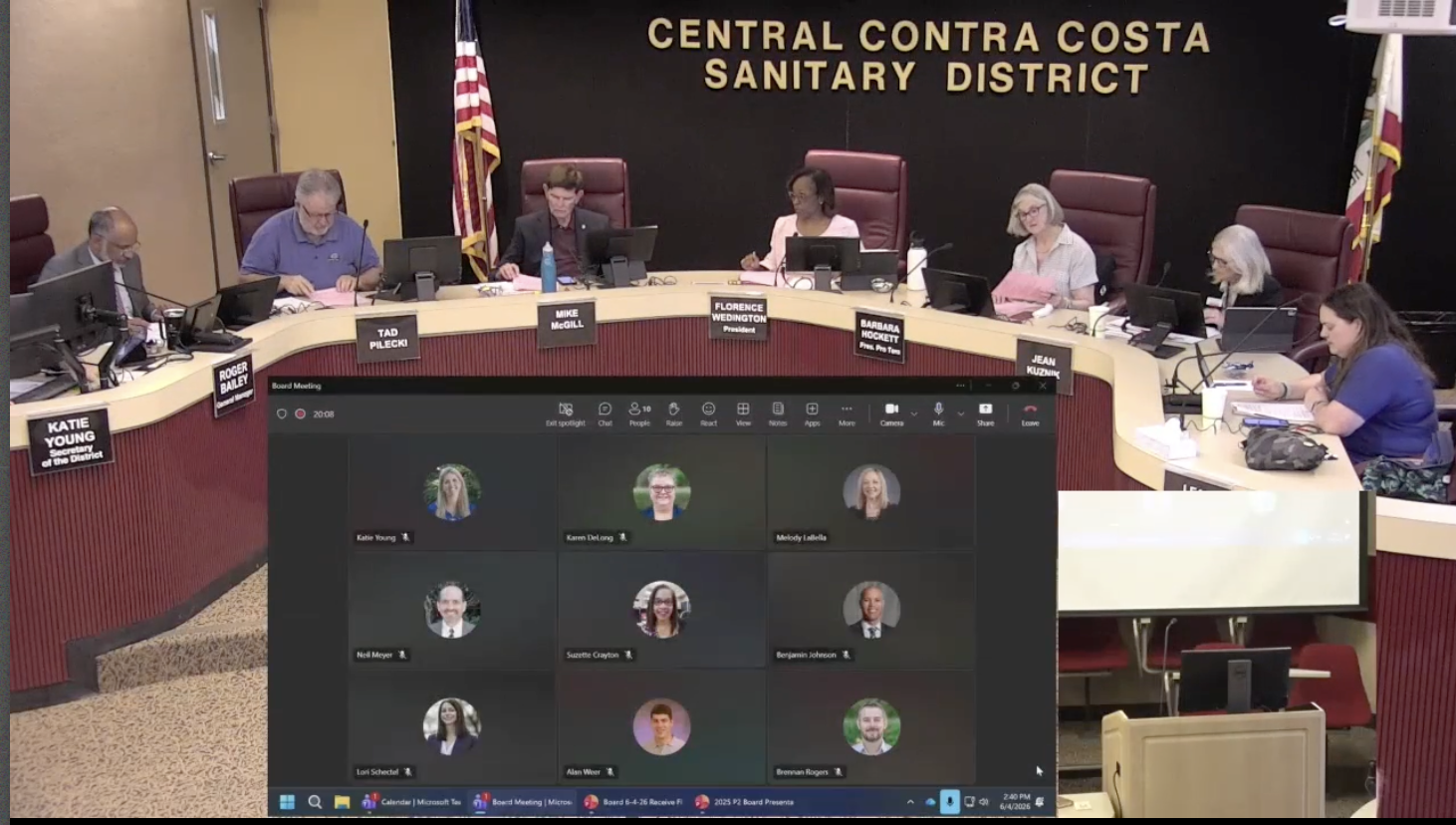
The Central Contra Costa Sanitary District board moved swiftly through its June 4 meeting, unanimously adopting the FY 2026-27 budget with no public opposition, then turned to a detailed pollution prevention report showing the district collected nearly 2 million pounds of hazardous waste last year. With a sold-out 80th anniversary celebration days away and food production rising at its recycled water farm, Central San is entering its new fiscal year on an ambitious footing.

  • FY 2026-27 budget adopted 5-0 after a public hearing drew zero testimony

  • 1.9 million pounds of hazardous waste collected in 2025 as district tracks PFAS and microplastics

  • AgLantis recycled water farm increases food production as SNAP cuts deepen community need

  • 80th anniversary open house on June 13 expects 1,000+ attendees; treatment plant tours sold out with 75 on the wait list

  • $1.24M contract with Apps Associates and four other consent items approved unanimously


Budget Passes Without a Word From the Public

The board adopted Central San's FY 2026-27 budget — covering operations and maintenance, capital improvements, self-insurance, and debt service — after a public hearing that opened and closed without a single commenter.

Why it matters: The annual budget is the district's most consequential financial action, directing every dollar spent on wastewater treatment, infrastructure, and environmental programs for the coming year. The absence of public opposition suggests broad acceptance of the spending plan heading into a fiscal year that also launches a new strategic plan.

Decisions: The board voted 5-0 to find the budget exempt from CEQA and adopt it in full. Board Member Jean Kuznik moved; Board Member Michael McGill seconded. No board members posed questions or offered comments before voting.

What's next: The budget takes effect July 1. A separate public hearing on sewer service charge collection — scheduled for July 23 — will determine how those charges appear on Contra Costa County property tax bills.


District Collected 1.9 Million Pounds of Hazardous Waste in 2025

Central San's annual pollution prevention report, required under the district's federal NPDES permit, revealed a busy year of hazardous waste collection, business inspections, and emerging legislative battles over PFAS and microplastics.

The basics: The district's household hazardous waste facility collected more than 1.9 million pounds of hazardous waste in 2025, including mercury, pesticides, and pharmaceuticals. Environmental compliance inspectors conducted more than 1,090 inspections at 914 businesses and administered 782 discharge permits. Under a partnership with the Contra Costa Clean Water Program, the district also completed 928 stormwater inspections at 833 businesses.

Why it matters: The report tracks pollutants of emerging concern — PFAS, microplastics, and industrial chemicals — that are increasingly the focus of state and federal regulation. It also shows the scale of Central San's role as the region's front line for keeping hazardous materials out of the wastewater system and waterways.

"I believe here at Central San that we kind of live and breathe pollution prevention. It's part of our mission," said Colleen Henry, pollution prevention staff.

Almost all of Central San's pharmaceutical collection sites transitioned in 2025 to the state MedProject program, which shifts collection costs from local ratepayers to pharmaceutical manufacturers.

Where things stand: On the legislative front, Colleen highlighted two state bills: AB 823, a microplastics bill targeting glitter and similar materials in personal care products, was vetoed by the governor. AB 1181, banning PFAS in firefighting gear, was signed into law.

Board Member Barbara Hockett asked about the microplastics legislation, sharing her own experience teaching community health nursing. "When I was teaching community health nursing and hand washing to preschool kids, my students would use sometimes glitter. And I didn't know it and I usually ask them not to for that reason," she said.

Board Member Kuznik asked about nonylphenol ethoxylates, or NPEs, industrial chemicals used in commercial laundry detergents. Colleen explained that NPEs "are used in the industrial laundry community. And so they could be part of a detergent, and they can be very detrimental to the environment."

What's next: In 2026, the district will continue monitoring PFAS and microplastics, supporting related state legislation, and conducting community outreach on pollution prevention.


AgLantis Farm Ramps Up Food Production as SNAP Cuts Bite

The board received the annual report on AgLantis, Central San's decade-old recycled water agriculture initiative that grows food for distribution to food-insecure residents.

Why it matters: The farm is producing more food than ever and expanding greenhouse infrastructure — but the need is growing too. Board Member Hockett drew a direct line between rising production goals and federal policy, noting that reductions in SNAP benefits are intensifying food insecurity across the service area.

"They're probably contributing more now that the need is so severe because of the reduction in SNAP benefits," said Board Member Hockett. "I'm hoping that their productivity is increased."

General Manager Tad Pilecki confirmed that the project has shown steady year-over-year improvement over its decade of operation, calling it a success. "I think the bigger picture is just the remarkable progress that they have made over the decade that this project has been in place," he said. Production goals for next year surpass last year's achievements, and the farm is building additional greenhouses to maximize output.


80th Anniversary Celebration Sells Out Tours, Expects 1,000+

Central San's 80th anniversary open house, planned for Saturday, June 13, from 10 a.m. to 2 p.m., is shaping up as the district's largest public engagement event in a decade.

Why it matters: Special districts rarely generate public excitement, but Central San's event — 14 months in the making — has already sold out all 300 treatment plant tour tickets, with 75 people on a wait list. The district has rented two county parking lots, arranged six shuttles, and partnered with Bike Concord to run a bike bus from Pleasant Hill BART.

"On June 13, we anticipate having customers from all over our service area here, probably 1,000 or more," said Emily, communication services and government relations staff. She noted that one third of the district's employees will participate and that the event will be plastic-free to the extent possible.

The event will feature big trucks, racing toilets and bathtubs, free food — including poop emoji ice cream — a one-ton toilet photo booth, and the sold-out treatment plant tours. Tour groups of up to 375 will cycle through on 30-minute tours departing every 15 minutes, using listening devices. Employee-featuring commercials are running on cable, streaming, and social media. Congressional offices, including Sen. Alex Padilla's, have acknowledged invitations.

Board Member Kuznik said he has been promoting the event at the San Ramon Planning Commission. He also noted that "even though I was not at the last meeting, I did watch the meeting on the live stream. So I was up to date and the presentation about the budget. So my voting was an informed vote."


New Strategic Plan Launches July 1

General Manager Tad Pilecki presented the FY 2026-28 strategic plan, the district's seventh two-year plan since it began continuous strategic planning in 2014.

"We have been at this for quite some time since 2014. So this will really represent about 14 years or seven strategic plans that Central San has been using this tool to chart the course for where we need to go over the intermediate term," GM Pilecki said.

The plan was developed through a process that began in fall 2025 with board dialogue on vision, mission, values, and goals, followed by staff development of detailed strategies and key performance indicators — a new term replacing the previous "key success measures" and "key metrics." The Administration Committee reviewed the material in February and March. The plan is embedded in the budget document adopted earlier in the meeting and launches July 1. Staff will produce a public-facing booklet and supplementary materials for employees and the website.


Minor Items

  • Consent calendar (items 2-6) approved 5-0: Resolution 2026-007 consolidating the Nov. 3, 2026 election; $1,241,984 contract with Apps Associates for professional services; revisions to Board Policy BP 018 on sick leave for temporary employees; sixth amendment to the agreement with the City of Concord; and scheduling a July 23 public hearing on FY 2026-27 sewer service charges.

  • New employees introduced: Israel Espinoza joins collection system operations from the City of Walnut Creek Streets Department. Rebecca Overacre is the new senior engineer for asset management, bringing 10 years at East Bay MUD and 10 years at Carollo Engineers — and previously consulted on Central San's asset management implementation plan in 2015.

  • Financial reports received without discussion: April 2026 expenditures, budget-to-actual through April, and the Q3 FY 2025-26 quarterly financial review.

  • Committee minutes received: Administration Committee (May 19) and Finance Committee (May 20).

  • Board Member McGill reported attending the East Bay Leadership Council Infrastructure Task Force meeting on Plan Bay Area 2050 and noted an upcoming Contra Costa Special Districts Association joint meeting planned for July 15.

  • No reportable action from the May 28 closed session.