
Split Central San Board Punts on Naming Facilities After People
Board of Directors • Central Contra Costa Sanitary DistrictOctober 1, 2026
Locunity is an independent informational service and is not an official government page for this commission. All information is sourced from public footage and an analysis of official agendas with the aid of responsible, fact-checked AI. to report an error or omission.
Central Contra Costa Sanitary District's board spent more time on one question than on anything else Oct. 1: should the district ever name a facility after a person? No vote was taken. Directors sent the policy back to staff, which will return with three competing versions, and the debate has already changed how every committee-reviewed policy reaches the full board.
Facility-naming fight deferred: Staff will return three versions of BP 025 to the full board
Claims down, costs up: Liability costs top $500,000, driven mostly by legal expenses
El Niño warning: District Counsel says landslide-related claims could "go up a lot"
Rate study ahead: A cost of service study will set future sewer service charges
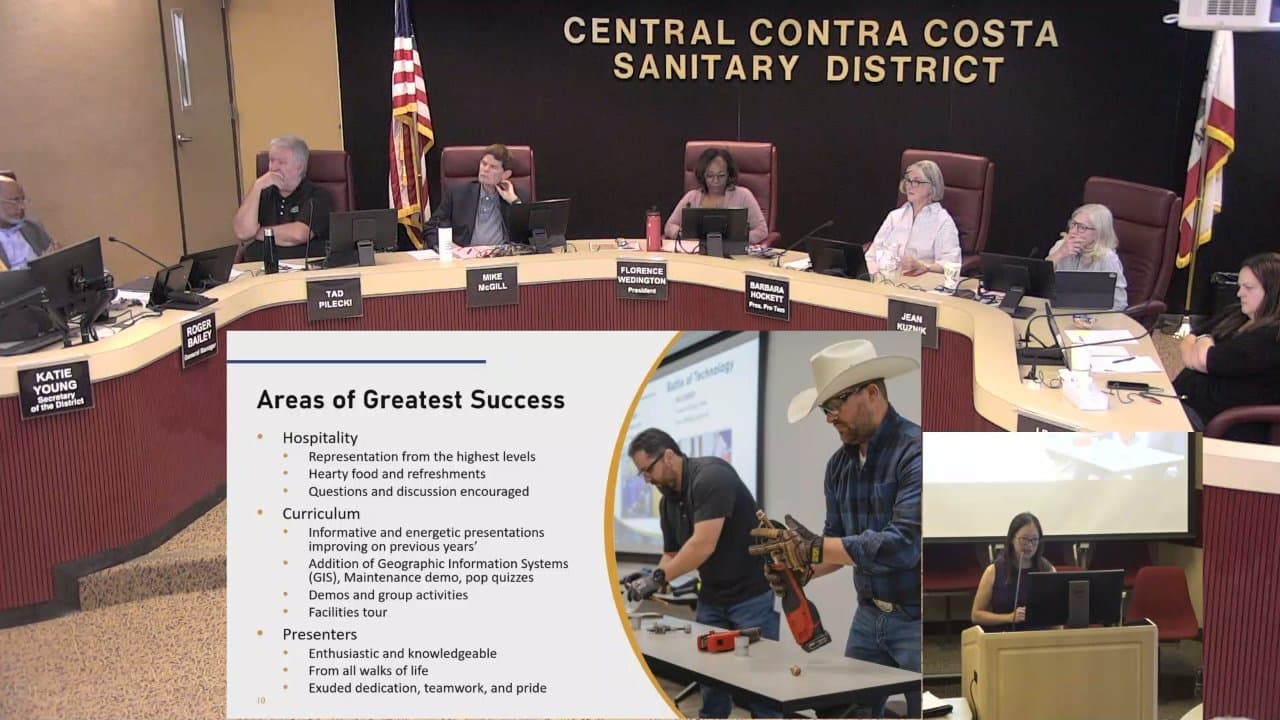
Citizens academy rebounds: 27 participants in a shorter three-class format; next session in 2027
Naming Rights: People or Only Organizations?
The basics: Board Policy BP 025 lets the district name facilities after individuals or organizations that meet listed criteria. It allows names to be removed, for example after a felony conviction, and requires a 4/5 board vote. The Administration Committee reviewed it in August and recommended no changes.
Why it matters: The outcome decides whether Central San can honor individual employees or directors with named facilities, or only outside organizations.
Where things stand: Director Barbara Hockett proposed striking "individuals" and most criteria. Under her proposal, only extraordinary contributions by foundations or organizations that directly support the district's mission would qualify. Her version keeps the one-facility-per-honoree rule and the 4/5 vote, and deletes criteria items 2–4, 6–8 and 10.
"My goal was to facilitate an objective way to recognize organizations and not individuals," said Hockett. She argued that naming people inevitably turns subjective and said she did not run for office to have her name on anything. "I wanted to have a process that was objective, not a popularity contest," she said.
The other side: Director Tad Pilecki said naming facilities after individuals is common nationwide and that special districts have few other ways to recognize staff and directors. He argued the existing safeguards, including the 4/5 vote, are adequate.
"So I, for one, would not want to take away this board's ability to recognize individuals that have gone above and beyond," said Pilecki. He offered a middle path: "If the concern is subjectivity, let's put some criteria in it." His examples were 20 years of service and executive roles with NACWA, CASA or CSDA, the national and state clean-water and special-district associations.
Board President Florence Wedington said Hockett's many verbal edits were too much to absorb on the spot. She raised a hypothetical in which a staffer stops an active shooter. "If we take all of the opportunities away in this policy to nominate somebody, then it could never happen unless we change the policy again," she said.
Director Jean Kuznik, a newer member, asked, "When was the last time a facility was named for someone?" The district laboratory was cited, and Kuznik noted it is the only named facility she has seen. Roger, the General Manager, said, "But there's no plan, at least that I'm aware of, to name the buildings."
Decisions and stakeholder impacts: A second was voiced after Hockett's proposal, but no vote occurred. Kuznik asked to see the proposals in writing. "I think the decision is to send it back to staff to do more revisions, and so we'll agendize it for a future meeting once we've been able to accomplish that," said Leah, District Counsel.
The stakes fall on long-serving employees and directors who could lose a path to recognition. Mission-aligned organizations would become the only eligible honorees under Hockett's version. Because no building is slated for naming, the choice is about principle rather than a pending honor.
Process shift: Committees only recommend, so staff will now bring every committee-reviewed board policy to the full board, typically on the consent calendar. Pilecki credited Hockett's item with prompting the change.
What's next: Staff will return to the full board, not the committee, with the current policy, Hockett's revisions and an enhanced-criteria version. No date was set.
Fewer Claims, Bigger Bills
Why it matters: Rising per-claim costs and active lawsuits draw on the district's self-insurance fund, the reserve the district uses to pay claims itself.
Where things stand: Risk Management staffer Shari reported that workers' compensation indemnity claims keep getting more expensive. Lower-back injuries account for 24% of injuries over five years, which disqualified the district from its insurance pool's safety award.
Liability claims topped $500,000. "That is predominantly due to legal expenses," said Shari. The district missed its average-cost-per-overflow target of about $25,000 for 2025-26 because of a sewer overflow in Rossmoor that affected three units.
Claim counts are down from the 2007 era in every category. Sanitary sewer overflow claims, for example, fell from 52 to 32. But costs per claim rose sharply. Staff cited about five active litigated cases.
The El Niño factor: In response to a question from Pilecki, staff said "other liability" mostly covers bodily injury and property damage. District Counsel noted that inverse condemnation claims, in which property owners seek compensation for damage tied to public facilities, fall in that category and typically follow erosion and slides. "If the El Niño year is what they are expecting, that number is going to go up a lot this year," said Leah.
The accounting: Claim costs are booked to the year the incident occurred, not the year it is resolved. At the general manager's suggestion, staff stopped netting $581,000 in self-insurance fund investment income out of the total cost of risk. That change makes the rising trend more visible.
What's next: Security updates were offered for closed session. Staff is also redesigning the district's enterprise risk scoring.
Strategic Plan Previews Rate-Setting Year
Why it matters: This year's objectives include a cost of service study that will set sewer charges, which directly affect customer bills.
Where things stand: Staff presenter Christina reported the district met all seven strategic goals in fiscal year 2025-26. Highlights included:
100% discharge permit compliance, extending a 27-year platinum award streak
217 million gallons of recycled water
$30M in State Revolving Fund loan reimbursements
8.8 miles of sewers replaced
Live streaming of board meetings launched
The district also ended its 17-year pharmaceutical take-back program. That program collected 171,000 pounds of medications, and its 13 sites moved to MedProject.
On the current year, Christina said, "We'll complete a cost of service study and establish sewer service charge rates for the next year and beyond." Other objectives include phase 1 of electric vehicle charging and a membrane aerated biofilm reactor (MABR) demonstration. Staff also plans an assessment of the district's permitting software and aims to substantially complete a consolidation study with Mt. View.
What's next: Pilecki urged readers to look at the performance metrics in the full report, which he called "the real story."
Citizens Academy Bounces Back
Where things stand: The ninth Central San Academy, the district's citizen-education program launched in 2016, drew 44 applicants and 27 participants. That was a rebound from last year's dip. Staff shortened the course to three Tuesday classes, with optional bike, facilities and plant tours. Walnut Creek supplied the most participants, with 10. The program now has 252 alumni, and staff advised the City of Orinda on starting its own academy.
The other side: Pilecki pushed to move a future session to the Lamorinda area. "In fact, we've hit Martinez so many times, we only had 2 people this year," he said.
What's next: The next session is set for 2027, the program's 10th anniversary.
A 19-Year Engineer Signs Off
Civil engineer and land surveyor Stephanie Myers used the meeting's only public comment to announce she will retire in November after more than 19 years. She credited the district's Leadership Academy, its mentorship program and employee groups such as Women Engineers in Water. "Long before work-life balance became a common vocabulary, Central San had already supported it, and that mattered to me," she said.
Senior Engineer Tomasio Zepeda introduced her successor, Graham Goodwin. Goodwin is a Cal Poly civil engineering graduate with 10 years of land development experience, including work at Meta.
Minor Items
Consent calendar passed (For: 5, Kuznik, Hockett, McGill, Pilecki, Wedington; Against: 0; Absent: 0), with no items pulled and no discussion.
SDI Presence, LLC contract for permitting software support rose from $194,010 to $279,630, about 44%.
New BP 054 sets procedures for disruptions to remote meeting access, as required by Senate Bill 707.
Mt. View consolidation: The general manager said he answered a letter from Mt. View on consolidation questions.
Closed session: The board recessed to discuss litigation over District Inspection No. 1786632 and the general manager's performance evaluation; outcomes were not reported.
Looking ahead: Employee service awards are scheduled for Oct. 7, and the board meets next on Oct. 15 at 2:30 p.m.