Board of Directors - May 28, 2026 - Special Meeting
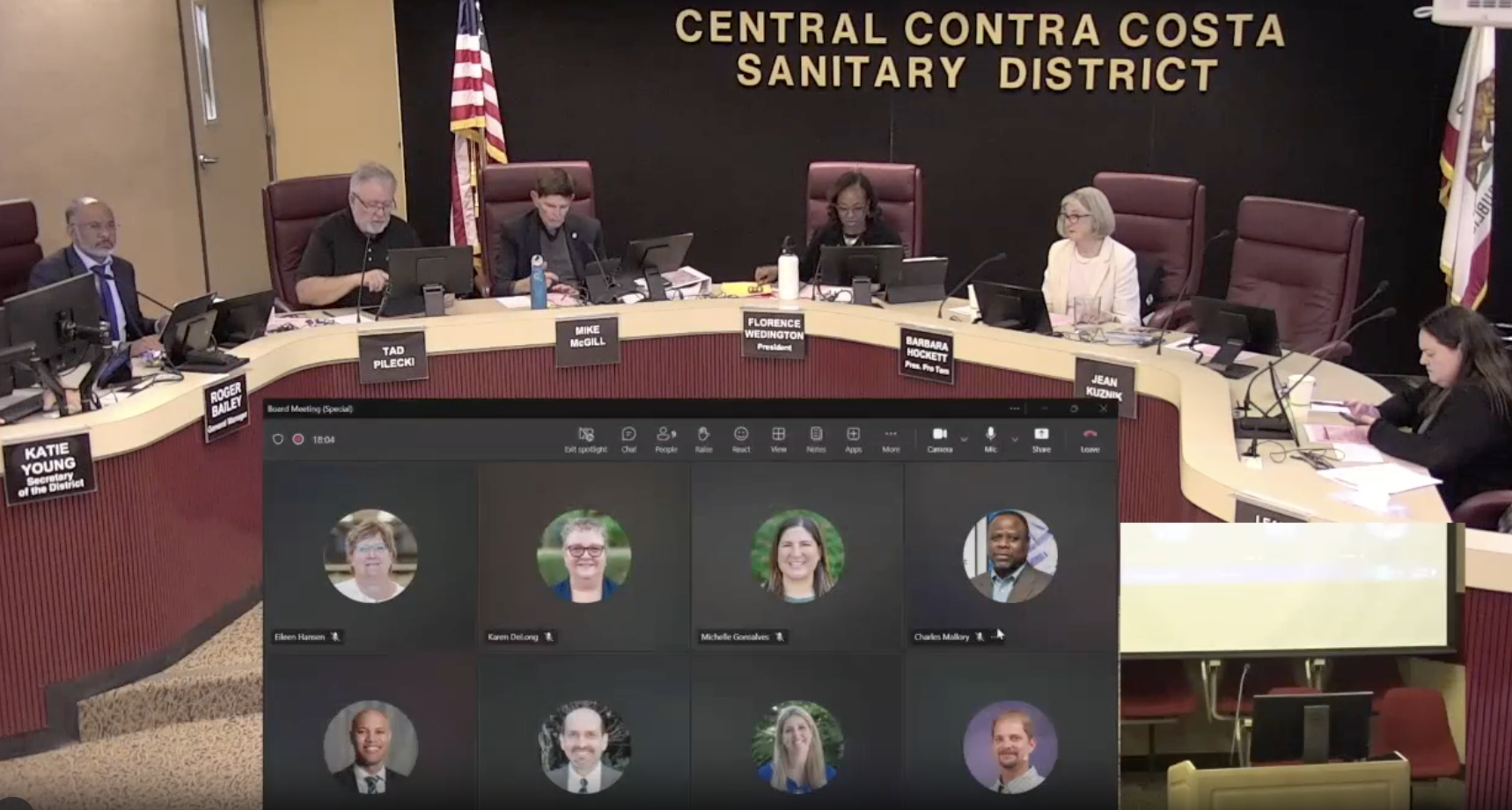
Board of Directors • Central Contra Costa Sanitary DistrictMay 28, 2026
Locunity is a independent informational service and is not an official government page for this commission.We use AI-assisted analysis and human editorial review to publish information.
Central San Previews $271M Budget With $155M Capital Push and 4% Rate Hike
The Central Contra Costa Sanitary District board received its most comprehensive fiscal blueprint of the year Wednesday — a $271 million spending plan for FY 2026-27 that pairs a 4% sewer rate increase with one of the largest capital programs in the district's history, anchored by $155 million for treatment plant upgrades, collection system rehabilitation, and regulatory compliance.
$271M budget heads to adoption June 4 with a 4% sewer rate hike adding roughly $30/year for single-family customers and $25 for multifamily
$155M capital program climbs 7.8%, targeting solids handling, UV disinfection, pump stations, and 8+ miles of sewer rehabilitation
10-year infrastructure outlook tops $1.4 billion as the district pursues nutrient removal, PFAS readiness, and a potential Mountain View Sanitary District consolidation
District lands ~$50M in state revolving fund financing at sub-1% interest for UV disinfection — roughly half the project's construction cost
Concord City Council approves Navy financial deal that could unlock demand for Central San's recycled water program
A $271 Million Plan for Aging Pipes and Tightening Rules
The basics: Central San treats 34 million gallons of wastewater daily through more than 1,500 miles of pipe for a service area spanning much of central Contra Costa County. The FY 2026-27 budget breaks into four funds: operations and maintenance ($106.1 million), capital improvements ($155 million), self-insurance ($2.83 million), and debt service ($9.3 million). Formal adoption is scheduled for the June 4 board meeting.
Why it matters: The 4% sewer service charge increase — year two of a schedule the board adopted last year — hits every customer class. For a single-family household, that translates to about $30 more per year; for multifamily units, roughly $25. Revenue grows slightly above 4% because the district is also adding new residential equivalent units as development continues.
Where things stand: Deputy General Manager Phil Lieber framed the rate increases as a product of regulatory pressure, not runaway spending. "We have a lot of evolving regulatory requirements and the main thing of course is the nutrients order, but it's not limited to that. We have an EV mandate. We have a lot of other work that supports nutrients, updating the aeration basins, trying to get ahead of the PFAS issues that are evolving," he said. He added: "We are looking for a 4% rate increase across the board to affect all the customer classes, including single family, multifamily, and all the commercial classes as well."
Revenue is diversified across sewer service charges — the largest source — plus state revolving fund loan proceeds (~$50 million at 0.9% interest), City of Concord reimbursements covering roughly one-third of treatment costs, property taxes, and investment income. Labor accounts for two-thirds of operating spending, with a 2.5% cost-of-living adjustment mirroring Bay Area CPI.
General Manager Roger Bailey opened the presentation by stressing the scale of investment the board has authorized. "This board, over the last 10 years, has invested over $770 million into our infrastructure. In the last 10 years you have delivered over $730 million worth of improvements to keep it operating in compliance with state and federal regulatory requirements," he said.
What's next: The board will take a formal adoption vote at its next meeting on June 4.
$155M Capital Program Targets Treatment Plant, Sewers, and Regulatory Unknowns
Why it matters: The capital improvement program — up 7.8% over last year — is the single largest budget component and the engine of the district's decade-long infrastructure overhaul. Treatment plant projects dominate spending, but collection system work remains substantial at $32 million. The 10-year CIP outlook now totals approximately $1.4 billion, an 8% increase over the prior year's plan.
Where things stand: Capital Projects Division Manager Edgar Lopez walked the board through the pipeline: solids handling Phase 1A, filter plant and clear well improvements, wet weather basin safety upgrades, emergency notification and security construction, and recycled water Phase 2 design. UV disinfection replacement has been designed but construction timing is being coordinated with the district's nutrient removal plan.
On the state revolving fund placement, Lopez was direct: "We've made the list for SRF funding. There was a mention of it early, about 50 million. That's roughly half the construction cost. That's a really big deal."
The district is targeting 8-plus miles of sewer rehabilitation this year after completing only 4 miles last year, with a long-term annual target of 7 to 7.5 miles. Lopez also introduced Enterprise Performance Management, a new Oracle module for project-level budgeting that replaces the district's 10-year-old program budgeting approach. The goal: hit a 95% budget spend rate, up from 90%, and reduce carry-forward dollars. "We're really setting the bar high and trying to make sure we're spending everything that we're asking for and doing the improvements in a timely manner and staying within budget," he said.
The other side: The 10-year outlook carries significant unknowns — the nutrient roadmap, an electrical facility plan, a water exchange project, a regional solids facility, Concord reuse projects, and a Caltrans interceptor relocation. Lopez noted the increases are being driven less by the treatment plant itself and more by security, IT, and other focus areas: "Most of that isn't where you think. You think, is it in the treatment plant? No, that's been pretty stable budget wise. It's in other areas."
Board Director Michael McGill praised construction quality in the Lamorinda communities: "Speaking for Lafayette, Moraga and Orinda, the constituents there couldn't be more pleased with the communication and the construction quality. I'm not hearing any noise, and if I do hear something, it's a compliment on how well you guys are doing."
General Counsel Leah highlighted an extraordinary track record behind all that spending: "I really cannot emphasize what a tremendous track record that is to have invested that much money over that period of time with no substantial construction litigation through some periods of pretty significant economic pain." Staff noted that figure exceeds $730 million across the program with no major legal claims or serious safety incidents. The district also maintains a $5 million program contingency for unexpected needs.
O&M Holds at $106M as PG&E Relief Offsets Inflation
The $106.1 million operating budget rises 3.4% — a $3.5 million increase driven almost entirely by labor costs. Salaries climb 3.3% ($1.6 million) and benefits rise 5.2% (~$1 million), fueled by an 8% jump in medical premiums partly offset by shifting more staff time to capital projects through increased capitalized administrative overhead.
Supplies and materials are effectively flat, thanks to an external tailwind. As finance staff member Kevin explained, "There was a flattening of the costs for PG&E for energy such as electricity and gas, and that was largely attributable to the end of PG&E cost recovery programs from the significant wildfires." That savings absorbs inflationary increases in chemicals, hauling, and general supplies.
Staffing rises from 303 to 304 with the addition of one electrical technician for plant maintenance. Three new limited-duration positions — part of a "general manager special positions" framework — bring the district's total limited-duration slots to 10, providing flexibility for succession planning without permanently exceeding the 304 FTE cap. A 4% vacancy factor is maintained across the budget.
Strong Pension and Reserve Position Underpins Spending Plans
Why it matters: Central San's ability to sustain a $155 million annual capital program without crisis-level borrowing rests on its financial reserves and pension health — both of which staff presented as among the strongest in the sector.
Where things stand: The pension plan is 96% funded and OPEB (retiree health benefits) is 94% funded, both well above typical public agency levels though still short of the board's 100% policy target. Total supplemental trust contributions to date: approximately $106 million across both plans. The 2021 certificates of participation issuance used to pay off pension unfunded liability is reviewed annually and continues to produce net savings.
No discretionary trust contributions are planned for FY 2026-27 given the healthy funded positions, though the board recently authorized $1.6 million to the pension pre-funding trust from FY 2025-26 favorable variances — a practice that could recur next fall. Reserves across all funds are projected to meet or exceed board minimums. The sewer construction fund carries $89.3 million above its minimum target, intentionally high to support elevated CIP spending, with a drawdown to roughly $2 million above target projected by FY 2029-30.
Staff also presented AWWA benchmarking data showing the district performing at or near median on most metrics — customer accounts per employee, total O&M cost per account, and staffing levels. Service affordability sits at 0.45% of customer income, placing Central San in the top quartile nationally. Some metrics on wastewater throughput per employee run unfavorable, which staff attributed to California's water conservation culture reducing volumes.
General Manager Bailey tied the data back to accountability: "When we tell our customers that we are doing the best we can, we must be able to back it up. We make a conscious effort to benchmark to figure out how well we're doing so that if that trend is not a good trend, we're going to try to correct it over time."
Director McGill noted that external validators agree: "For a number of years now you've presented to the Taxpayers Association and they look at spending public money with a jaundiced view, and they've always come away from the meetings very impressed with the work that you and your team does."
Deputy General Manager Lieber credited institutional discipline: "The board's commitment to having good strong financial policies over the years really makes all of this easier. Puts us in a strong footing. We don't have crises to deal with."
Concord Navy Base Deal Could Fuel Recycled Water Demand
Board President Florence Wedington flagged a development outside the district's walls that could shape its future: the Concord City Council has approved the financial agreement with the Navy for development of the former Naval Weapons Station.
"I saw that the Concord City Council approved the financial agreement with the Navy for the development of the Naval Weapons Station. So hopefully this is good news for our recycled water program," President Wedington said. Central San has been developing recycled water capabilities for years; a major new urban development on the former base would represent a significant potential customer for that program. Recycled water Phase 2 design is already included in the current CIP.
Minor Items
Consent calendar approved 4-0 (For: Wedington, McGill, Pilecki, Hockett; Absent: Kuznik), including prior meeting minutes with minor spelling corrections.
Charles Hill Road Contractual Assessment Agreement: Public hearing opened and closed with no public comments; Resolutions 2026-05, 2026-06 and Ordinance 347 adopted 4-0 (For: Wedington, McGill, Pilecki, Hockett; Absent: Kuznik), formalizing infrastructure cost recovery for the Charles Hill Road service area.
April 2026 financial reports received without discussion.
Mountain View Sanitary District consolidation is nearing the end of evaluation with favorable preliminary indications, per Deputy General Manager Lieber.
Director McGill attended CCWD's 90th anniversary, a Northern California Sanitary Agency JPA meeting, Cocoa Tax executive and general meetings, an East Bay Leadership Council water task force session, and an Orinda Chamber board meeting.
Board entered closed session on two items: significant litigation exposure involving one potential case and labor negotiations with Local 1, MSCG, and the Management group.
Director Pilecki requested that SRF debt proceeds be separated from other debt funding in future budget presentations, noting they are fundamentally different instruments. Staff agreed.