Board of Directors - Apr 16, 2026 - Meeting

Board of Directors - Apr 16, 2026 - Meeting

Board of DirectorsCentral Contra Costa Sanitary DistrictApril 16, 2026

Sources:

Locunity is a independent informational service and is not an official government page for this commission.We use AI-assisted analysis and human editorial review to publish information.

Board Confirms $784 Sewer Rate as Staff Warns of Rising Capital Costs

The Central Contra Costa Sanitary District (Central San) Board of Directors met April 16 and unanimously confirmed a 4% sewer service charge increase to $784 per single-family residence — but the real news was what comes next. Staff disclosed that capital spending pressures now exceed projections by $25 million for next year alone and $140 million over the next decade, signaling sustained rate increases and an accelerated bond offering.

  • Board confirms 4% sewer rate hike to $784 per home; staff warns future increases will likely hit 5% annually

  • Two fee ordinances adopted unanimously after public hearings draw zero comments from 300 notified stakeholders

  • District opposes AB 1997 housing permit bill containing "alarming language" that could let cities override utility authority

  • Board backs new PFAS fertilizer regulation and below-market water reuse loan legislation

  • $13M authorized for nutrient management demonstration that could reduce a $500M compliance cost estimate

  • Miramonte High School senior presents award-winning solar wastewater technology with 95%+ ammonia recovery


Rate Hike Goes Through, but the Real Story Is What's Coming

The Board voted 5-0 to let the previously adopted 4% sewer service charge increase take effect July 1, 2026, bringing the annual rate for single-family residences to $784. The vote was a procedural confirmation — the two-year rate schedule was adopted last year under a Prop 218 process requiring a two-thirds supermajority — but this year's public hearing surfaced significantly more financial pressure than the Board anticipated when it set the trajectory.

Why it matters: The sewer service charge funds more than half of the District's roughly $239 million annual budget. Staff revealed that four capital projects — wet weather basins, electrical infrastructure, secondary clarifier channels, and odor control — have added $25 million in spending pressure above the current financial plan for next year. On top of that, a $500 million placeholder for long-term nutrient management compliance looms over 10-year projections.

Where things stand: Staff presented data showing operations and maintenance spending is tracking at $106.1 million against a $106.4 million plan. But capital is a different story. The rate stabilization fund was drawn down from $12 million to $6 million last year, and total capital improvement plan pressure over 10 years now sits roughly $140 million above prior projections. An external bond offering previously scheduled for 2030-31 is now expected in 2028-29.

"We are seeing a little bit more pressure there. The plan as of last year had some 4½ to 5% increases. Now it's looking like we would need roughly 5% increases over the next several years and also have an accelerated need for a bond offering," said Phil Leiber, Deputy General Manager (Finance and Administration).

General Manager Roger Bailey cautioned the Board against the temptation to defer rate increases to ease near-term pain.

"There's a tendency to kick rates down, basically defer the decision to do rates, but when you do that, you're basically causing stress on the system which requires a bigger rate increase in the future," he said. "Gradually, I think our recommendation would be to do the gradual rate increases versus doing a big surge spike at the end."

The other side: Board Member Tad Pilecki pressed staff on the $500 million nutrient compliance assumption baked into the financial model, noting it could come down substantially if the District's membrane aerated biofilm reactor (MABR) demonstration project delivers strong results. Staff confirmed that MABR data expected this fall could provide significant cost relief. Board Member Michael McGill defended the two-year rate approach as the product of extensive prior study, not a rubber stamp.

"We had gone through extensive studies, tremendous review, consideration of different options which got us to this two-year recommendation," he said.

Decisions: The Board passed the motion 5-0 (For: Wedington, Kuznik, McGill, Pilecki, Hockett; Against: 0; Absent: 0). District Counsel Leah clarified that only a majority vote was required since the original adoption already secured the two-thirds supermajority mandated by Prop 218.

What's next: The $784 rate takes effect July 1, 2026. Residents should expect future annual increases closer to 5%. MABR test results expected in the fall could reshape the District's long-term capital outlook and potentially moderate the trajectory.


District Draws Line on Housing Permit Bills, Backs PFAS and Water Reuse

The Board voted 5-0 to shift positions on three pieces of legislation after a detailed staff briefing covering nine state bills and two federal bills. The most consequential move: opposing AB 1997, a permit-processing bill that would create county development coordinators with sweeping authority over utility sign-offs.

Why it matters: Special district independence is at stake. Multiple housing permit-streamlining bills making their way through Sacramento would allow cities and counties to override decisions by independent utilities — a significant erosion of governance authority for agencies like Central San.

Where things stand: Legislative staff member Emily Barnett flagged AB 1997 as the most alarming bill on the tracker.

"The most concerning language requires this development corporation coordinator for counties to mediate all project issues. And then there's a provision that when one utility signs off, then all the utilities have somehow signed off, which is just hard to explain that idea," she said.

A separate CSDA/CASA-opposed housing bill has authors refusing all amendments, prompting a full-court coalition response.

On the support side, the Board moved from "watch" to "support" on a water reuse bill now carrying printed language and CASA backing, attracted by its below-market interest rate loan provisions. The Board also added a support position on AB 1603, an Environmental Working Group–sponsored bill regulating PFAS in fertilizer, despite the governor's history of vetoing PFAS legislation.

Barnett also noted that AB 2462, which would require refunds on recalled household hazardous waste products, cleared its policy committee and moved to Appropriations — but she warned that any bill with a fiscal impact faces long odds due to the state's deficit.

District Counsel Leah Castella offered a broader reassurance, noting that even problematic bills would face legal challenges.

Decisions: The Board voted 5-0 to change positions on three items: water reuse from watch to support, AB 1997 from watch to oppose, and AB 1603 PFAS to support (For: Wedington, Kuznik, McGill, Pilecki, Hockett; Against: 0; Absent: 0). On the federal front, staff reported the Wipes Act (S. 1092) passed the Senate on unanimous consent and is expected to clear the House by mid-July.


Two Fee Ordinances Adopted After Silent Public Hearings

The Board held back-to-back public hearings and unanimously adopted Ordinance No. 345 (capacity fees) and Ordinance No. 346 (environmental and development-related fees). Letters were sent to approximately 300 stakeholders for each fee schedule. Not a single comment was received for either.

The basics: Capacity fees are one-time charges to new development as a buy-in to existing infrastructure. Ordinance 345 raises the capacity fee 6.8% to $10,034 per residential unit equivalent. Ordinance 346 covers 89 permit counter fees — 39 increase, 5 decrease, and 45 remain unchanged. The annual CADS interest rate rises from 5.61% to 5.82%.

Why it matters: These fees directly affect developers and contractors connecting new projects to the District's system. The capacity fee increase reflects updated infrastructure asset valuations, and staff noted a rates consultant will review the methodology in an upcoming cost-of-service study.

Board Member Michael McGill asked why no public feedback was received despite the outreach. Board Member Tad Pilecki responded that the lack of discussion reflected thorough prior work, not indifference.

"Board, in conjunction with staff at various committee meetings and workshops and other things, have reviewed a lot of background information. And that's why the public doesn't see a lot of discussion, because we've already gone through it, a lot of detail," he said. "I just wanted to make sure that it's not that we're just rubber stamping this. We've done our homework."

Decisions: Both ordinances required a two-thirds supermajority (four affirmative votes). Ordinance 345 passed 5-0; Ordinance 346 passed 5-0 (For: Wedington, Kuznik, McGill, Pilecki, Hockett; Against: 0; Absent: 0).


High School Senior's Solar Tech Could Tackle District's Costliest Problem

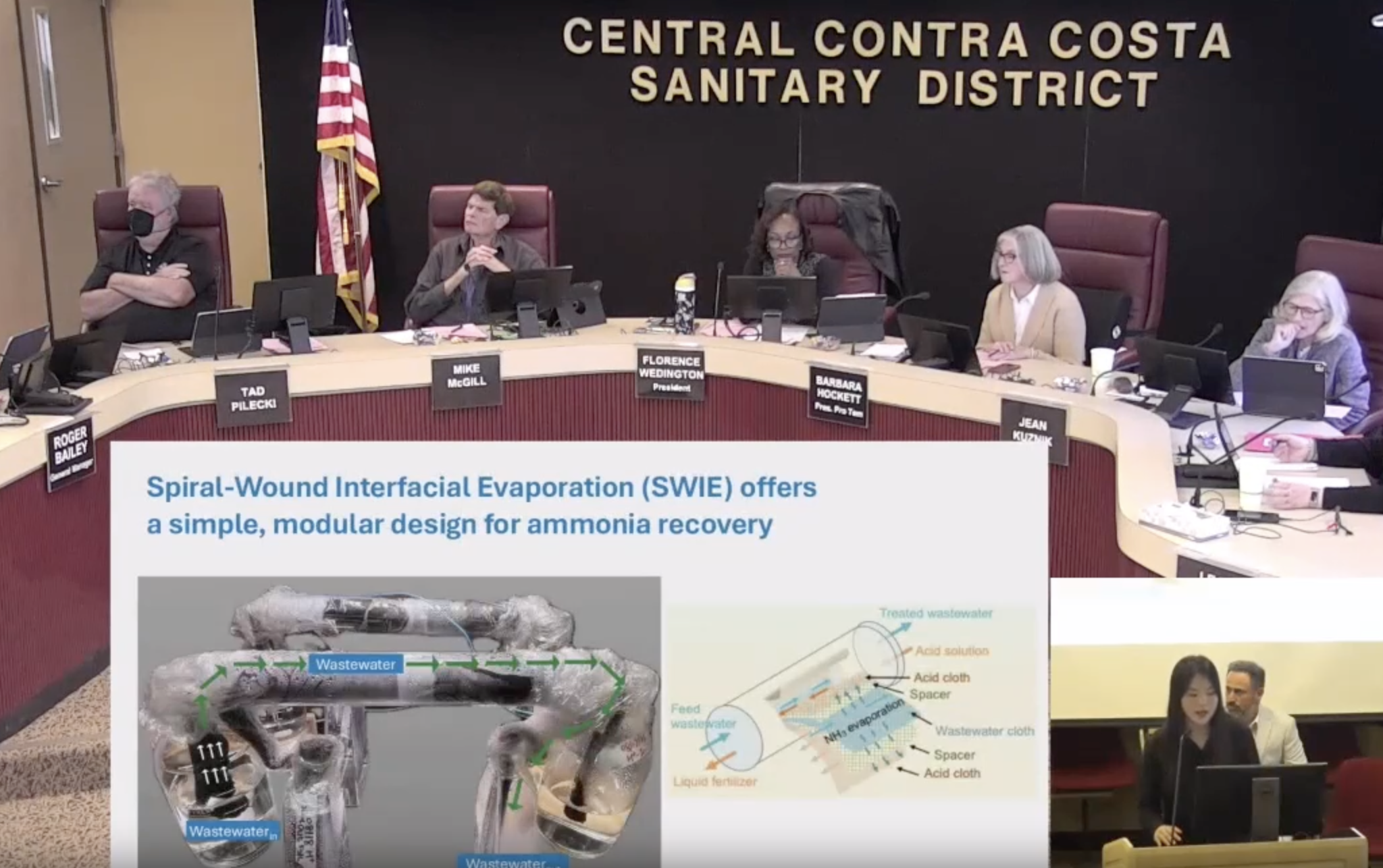
Mifay Liu, a 12th grader at Miramonte High School in Orinda and winner of the Contra Costa County Science and Engineering Fair's water research award, returned for a second year to present an updated solar-powered prototype that recovers ammonia from wastewater and converts it into fertilizer — with no external energy, no pumping, and no chemical waste.

Why it matters: The District faces an estimated $500 million nutrient management compliance cost. While Liu's technology is still at the prototype stage, its scalability and low cost caught the Board's attention. Her spiral wound interfacial solar evaporation device uses two porous cloths separated by a plastic spacer, relying on capillary force and solar heat to drive ammonia evaporation. Over 40-day testing periods, both removal and recovery efficiencies exceeded 95% across synthetic urine, human urine, chicken manure, and digester centrate. The crystallized ammonium sulfate output can be applied directly as fertilizer.

"The main benefits of this technology: number one, it's very scalable. The materials used to create this prototype are very affordable and accessible. Second, this prototype doesn't need any water pumping for it to work. It relies solely on the natural capillary force of the porous material. And lastly, there's no chemical waste because the acid used in this process can be reused," said Liu.

Board members responded with enthusiasm. Board Member Jean Kuznik suggested Liu save her data for a future dissertation. Staff offered to help with patent development and encouraged her to apply for a co-op position with the District. Liu, who is collaborating with UC Berkeley researchers and has published a paper on the technology, said she hopes to begin implementing it at farms and wastewater treatment agencies.


Minor Items

  • $13M MABR authorization approved on consent: The Board authorized a $5.5 million change order with C. Overaa & Co. and a $7.5 million supplemental capital budget to complete the membrane aerated biofilm reactor demonstration system (District Project 100078). Results expected this fall could reshape the District's $500 million nutrient compliance cost estimate. Passed 5-0.

  • Annual safety report received: The District recorded 8 occupational injuries in 2025, up from 4 the previous year but near the 8-year average. The recordable rate of 2.9 per 100 workers remains well below the 4.8 industry average for governmental wastewater agencies. Plant operations accounted for 279 of 282 total lost workdays, driven by two overexertion injuries. A Cal/OSHA citation from the 2024 arc flash incident remains under appeal. Staff announced plans for a facility-wide public address system covering the plant and outside facilities.

  • Quarterly parking lot items list received without discussion.

  • Upcoming schedule: Finance Committee meets April 22; Bring Your Child to Work Day is April 23; May committee and board dates were announced.