
Sanitary Board Rewrites Ethics Rules, Takes Investigations Out of Its Own Hands
Board of Directors • Central Contra Costa Sanitary DistrictNovember 19, 2026
Locunity is an independent informational service and is not an official government page for this commission. All information is sourced from public footage and an analysis of official agendas with the aid of responsible, fact-checked AI. to report an error or omission.
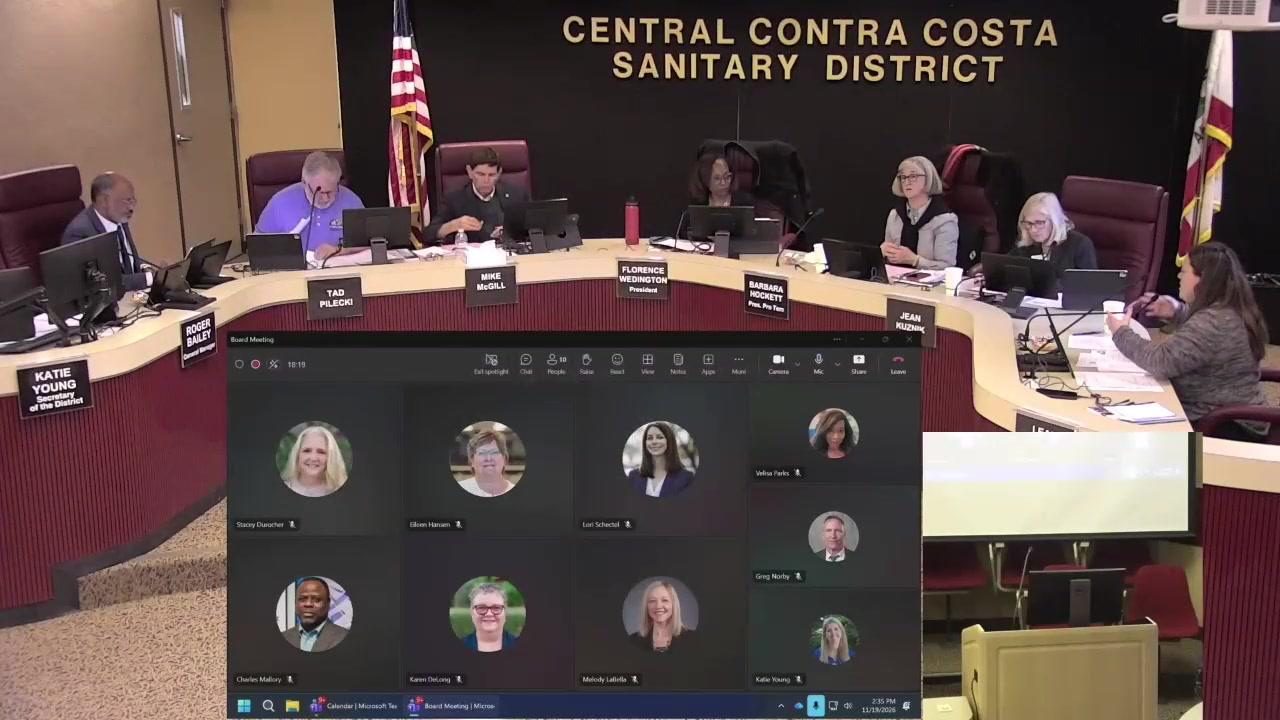
The Central Contra Costa Sanitary District Board of Directors spent most of its Nov. 19, 2026, meeting rewriting the rules that govern its own conduct. In a 5-0 vote, directors approved an overhauled ethics policy that moves misconduct investigations out of the board's hands. They also tightened the rules for naming district facilities and picked Barbara Hockett and Jean Kuznik to lead the board in 2027. Taken together, the actions reshape how the board polices itself, honors people and organizes its leadership heading into the new year.
- Ethics policy rewrite approved 5-0, routing complaints to board leadership instead of the full board
- Directors can seek union support, under language added at the dais
- Facility naming survives with stricter vetting, after the board rejected an organizations-only option
- Hockett named 2027 board president, Kuznik president pro tem, each by a 4-0-1 vote
Ethics Overhaul Targets a Brown Act Problem
Why it matters: District counsel said the old process for investigating directors created potential Brown Act problems. The Brown Act is California's open meeting law. The rewrite changes who hears complaints against board members and when the district pays for an outside investigator.
Where things stand: Counsel said a periodic review of Board Policy 023 found two weaknesses: the investigation process and thin guidance on what counts as appropriate conduct.
"That was the Brown Act issue that I really had some concerns about," said District Counsel.
The revised policy adds:
- A definitions section and expanded training with a required signed acknowledgment
- Detailed conduct guidelines on expenses, budgeting, respect and not interrupting
- A requirement that staff performance concerns go through the general manager
- A board self-evaluation section, plus lists of prohibited and permitted conduct
- An enforcement section sending complaints to the president or president pro tem, with no investigation conducted by the board itself
The union question: Director Tad Pilecki said the ban on soliciting political support from staff needed work.
"I think maybe we need a little clarification for when we deal with the unions, because that is staff," said Pilecki.
Counsel agreed to add a sentence to Section 3C stating that directors are "entitled to solicit public support from independent political organizations or interest groups like unions."
The other side: Pilecki also argued that the policy sets too high a bar for bringing in an independent investigator. Under the policy, an outside investigator is used only when a matter involves significant public funds or public attention.
"I think we're limiting it too much because what if the accusation results in significant discipline or repercussions to one of the board members?" said Pilecki.
Counsel defended the narrow trigger on cost grounds, noting that "hiring an outside investigator is a significant expense." Counsel added that the board itself can decide when an issue will generate significant public attention. The investigator threshold was not changed.
Decisions and stakeholder impacts: The board approved the policy with the Section 3C modification. For: 5 (Hockett, Kuznik, McGill, Pilecki, Wedington), Against: 0, Absent: 0.
- District staff gain a clearer buffer, since performance issues must flow through the general manager.
- Unions keep a defined, permitted channel for political engagement with directors.
- Board leadership takes on new responsibility as the first stop for complaints. Starting Jan. 1, 2027, that role falls to Hockett and Kuznik.
Naming Rights Stay, but With Homework
Why it matters: The board settled a policy dispute over whether district facilities can carry an individual's name. Directors kept that option but added a verification step.
Where things stand: Counsel presented three options for Board Policy BP 025:
- Keep the current policy.
- Allow naming only after organizations, the version requested by Director Barbara Hockett.
- Adopt a modified policy informed by other agencies' rules.
Counsel said the third option is "modified to strengthen the criteria for naming facilities after either individuals or organizations."
One director asked who would handle verification and legal review. Counsel said staff, including legal, would handle it, and that it would not be a huge job: "The idea is to just verify the factual predicates that justify suggesting that something be named after someone."
The other side: Another director asked whether former employees should face a waiting period before a facility could be named for them. Colleagues called that too granular. Counsel noted the policy keeps a one-year wait after a person's death. One director said they did not want their own name placed on any district facility.
Decisions and stakeholder impacts: The board adopted option 3. For: 5 (Hockett, Kuznik, McGill, Pilecki, Wedington), Against: 0, Absent: 0. Hockett voted for the stricter-criteria version rather than the organizations-only approach she had requested. Individuals and organizations both remain eligible, but any nomination now has to clear documented criteria and staff review.
Hockett and Kuznik to Lead in 2027
Where things stand: The board appointed Hockett of Division 4 as board president, and Kuznik of Division 5 as president pro tem. Both serve one-year terms beginning Jan. 1, 2027.
Decisions and stakeholder impacts: Each vote was For: 4, Against: 0, Abstain: 1, with each nominee abstaining on their own appointment. Board President Florence Wedington presided over the meeting.
What's next: The oath of office and photos are set for the Dec. 3 board meeting.
Minor Items
- Consent calendar approved 5-0: The board adopted the Nov. 5 minutes and revisions to BP 024 (occupational health and safety), BP 041 (pension funding), BP 042 (OPEB, or other post-employment benefits, funding) and BP 043 (buffer property management), all without discussion. No public comments were offered on items 1 through 9.
- Storm flows tested the plant: The general manager reported a peak flow of about 90 million gallons per day (MGD), compared with a 34 MGD average, all treated without problems. Staff get nervous around 100 MGD, and about 110 MGD has long been seen as the limit before diverting flow to retention ponds. "We divert raw sewage into those ponds and then we bleed them back into the treatment plant over some period of time," said the General Manager.
- Regional concerns raised: In board reports, Pilecki flagged "significant healthcare cost issues, especially for all the folks that are losing healthcare in the county," along with FEMA emergency response. Director Michael McGill reported attending the mayor's conference in Clayton.
- October investment report received: The monthly portfolio report drew no questions.
- Closed session on litigation: The board recessed to discuss one potential case of significant exposure to litigation and the existing lawsuit Hagen vs. CCCSD (C23-02285). No outcome was reported in open session.
Looking Ahead
District offices close Nov. 26–27 for the holiday. The Dec. 1 Administration Committee meeting is canceled. The Engineering and Operations Committee meets Dec. 2 at 9 a.m., and the full board meets Dec. 3.