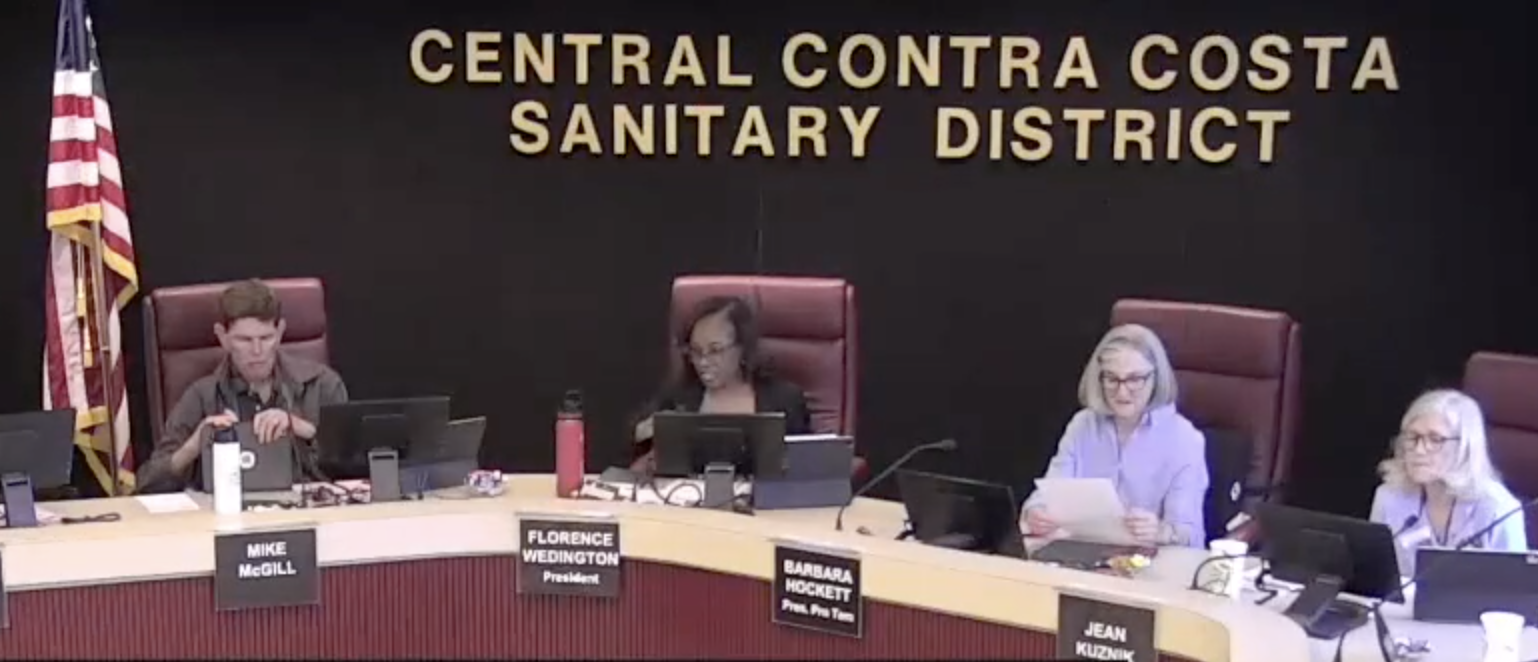
Board of Directors - Mar 19, 2026 - Meeting
Board of Directors • Central Contra Costa Sanitary DistrictMarch 19, 2026
Locunity is a independent informational service and is not an official government page for this commission.We use AI-assisted analysis and human editorial review to publish information.
Board Tackles Developer Permitting Bills, Wastewater Diversion in Wide-Ranging Session
Central San's board drew a line against Sacramento housing legislation that would fine agencies thousands per unit for slow plan reviews, authorized a partnership that could send millions of gallons of wastewater to San Ramon Valley for recycled water, and rolled out one of the first AI governance policies among California special districts. The March 19 meeting covered an unusually broad policy slate — from energy savings to cybersecurity to a 50-year water deal — reflecting a district navigating regulatory pressure on multiple fronts.
Board strengthens opposition to developer-backed bill imposing $10,000-per-unit penalties on agencies for plan review delays, with legislative staff warning of a coordinated "shotgun approach" flooding Sacramento with 12–20 permitting bills
Wastewater diversion framework approved to study sending up to 2.7 million gallons per day to San Ramon Valley for recycled irrigation water, potentially reshaping regional water reuse for decades
District saves over $1 million in electricity costs through cogeneration upgrades and new solar array
New AI governance policy establishes staff accountability for AI-generated work and data protection standards; legal counsel flags Public Records Act exposure for AI prompts
$2.2 million in federal funding secured for UV disinfection and aeration basin projects
Developer Bills Draw Fire as Board Strengthens Opposition
The longest and most contentious discussion of the meeting centered on a wave of state legislation that Central San's legislative staff described as a coordinated assault on local permitting authority — bills that would compress plan review timelines, cap the number of reviews, and impose steep financial penalties on agencies that fall behind.
The basics: The Housing Accountability Act and related bills would allow courts to fine local agencies a minimum of $10,000 per housing unit for missing compressed review deadlines. A "bad faith" multiplier could push penalties to five times that amount. Plaintiffs' attorneys would be awarded fees, creating a financial incentive to sue.
Why it matters: For a sanitary district like Central San, plan reviews ensure sewer connections, capacity, and environmental compliance. Penalties would ultimately be borne by ratepayers — not the agencies' general funds — while the compressed timelines could force staff to approve plans without adequate health and safety review.
Where things stand: Staff presented nine pieces of legislation for board positions. Emily Barnett, legislative staff, described the developer coalition's strategy as deliberate volume. "There is a tactic where you throw out a dozen to 20 bills, and if you're a committee staffer, you go, 'Wow, this must be a really big issue.' I guess we should let two to four go through," she said. She added that CASA — the California Association of Sanitation Agencies — made the unusual decision to run no offensive legislation this year, dedicating all staff bandwidth to defense.
"Courts may impose fines on local agencies that violate the Housing Accountability Act — that is the legislation we're talking about in a number of these bills," Barnett explained. "In a minimum amount of $10,000 per housing unit, with funds deposited into local housing trust funds."
Many of the bills are "spot bills" — placeholder legislation with minimal language — making formal opposition premature on some. But Board Member Tad Pilecki pushed for a more aggressive posture. "Anytime you start putting in a penalty, I don't see that as a watch," he said, successfully moving the board to elevate AB 1621 from a "watch" position to "oppose unless amended," matching the district's stance on a related bill.
The other side: Legal Counsel Leah Castella offered the sharpest framing of the stakes. "This is not what it is about. It is about reducing local discretion. It is really part of an ongoing effort to reduce the ability of local government at all levels to exercise discretion to protect health and safety," she said.
Board Member Michael McGill brought a community perspective, noting resistance to high-density development in parts of the district. "People are living in Lamorinda because they like the type of community they live in. They like the single-family home, they like the front yards, backyards," he said. "There is not a willingness I would characterize to take that away in the interest of affordability." He advocated for a public relations campaign explaining the public health purpose of plan reviews.
Decisions: The board adopted staff legislative recommendations with the AB 1621 amendment (For: 4 — Kuznik, McGill, Pilecki, Weddington; Against: 1 — Hockett). Vice President Barbara Hockett did not state a reason for her dissent.
On the federal side, Barnett announced Central San received approximately $2.2 million in community project funding — $1,092,000 for UV disinfection sponsored by Congressman DeSaulnier and roughly $1.1 million for an aeration basin project.
What's next: Staff will continue monitoring spot bills as language is added, with CASA coordinating statewide opposition strategy through the legislative session.
Wastewater Deal Could Reshape San Ramon Valley Water Supply for 50 Years
The board authorized a memorandum of agreement with DURWA, DSRSD, and East Bay MUD to study the feasibility of a long-term seasonal wastewater diversion — a framework that could redirect up to 2.7 million gallons per day from Central San's collection system to San Ramon Valley for recycled irrigation water.
The basics: DURWA — the Dublin San Ramon Services District/East Bay MUD Recycled Water Authority — is running short on recycled water supply. A temporary diversion pilot, initiated after a 2017 request, was activated only once during its term due to moderate weather. That agreement expired in 2025, and this MOA launches technical studies toward a potential 50-year long-term agreement.
Why it matters: The MOA is a one-year agreement with two possible one-year extensions, covering studies on full-flow diversion impacts, metering requirements, and pump station integrity — all funded by the DURWA partners, not Central San ratepayers. Melody LaBella, engineering/planning staff, explained the opening: "The two refineries near us, one has significantly changed their operation. The demand between the two went from 20 million gallons a day to 13 million gallons a day. So it frees us up to consider what I hope we're able to do, which is all of the above."
Board Member Pilecki raised practical concerns about what happens to pump stations sitting idle during summer diversions. "Now that we're talking about taking everything from that pump station, I want to make sure that studies really take a hard look at how are we going to maintain the integrity of pump station when it's not running during summer months," he said. He also flagged potential downstream odor issues in the collection system and recommended future deliberations be routed to the E&O or REAP committee, given President Florence Weddington's work-related conflict of interest.
Decisions: The motion passed 4-0 (Kuznik, Hockett, McGill, Pilecki; Weddington recused). Vice President Hockett presided over the item.
What's next: Technical studies will proceed under the one-year MOA, with findings expected to inform whether a 50-year agreement is viable.
Cogeneration Investments Drive $1 Million in Energy Savings
Clint, energy staff, reported that electricity costs fell by more than $1 million year-over-year in 2025, driven primarily by a jump in cogeneration output from 19 million kWh in 2024 to 22 million kWh following engine overhauls. Monthly energy costs ranged from $494,000 to $653,000.
The Blum Road solar array, in its first full year, generated 3,066 MWh. The district stayed below the 25,000 metric ton CO₂-equivalent threshold that would trigger costly cap-and-trade obligations. Natural gas supply shifted to Pacific Summit Energy after Shell exited the commercial market. A new general manager monthly dashboard is in beta for tracking energy and operational performance metrics.
AI Policy Puts Central San Ahead of the Curve
Charles Mallory, IT staff, presented a new AI administrative procedure built on three pillars: staff accountability for AI-generated outputs, data protection reinforcing existing prohibitions on submitting personally identifiable information, and incident response protocols.
The policy covers generative AI, predictive analytics, cybersecurity AI already deployed for server communication anomaly detection, computer vision for inspections, geospatial AI, and digital twins. Charles emphasized the policy is meant to guide responsible use, not restrict it. The procedure was developed with input from MESAC — a multi-city technology conglomerate based in Fresno — along with legal counsel, HR, and communications staff.
Board Member Pilecki asked about extending training to board members. "Is there any training plan for the board members?" he asked, prompting Charles to commit to developing a training package.
Legal Counsel raised a fast-emerging issue. "One of the things that people are really starting to see — people meaning public agencies across the state — are Public Records Act requests for AI and specifically for AI prompts and other things that are generated by AI," she said, recommending the district develop a specific retention and destruction policy. General Manager Roger Bailey noted the policy is designed to be evergreen and continuously revised.
Audit Plan Zeros In on Safety and Environmental Risk
Central San's internal auditor presented the 2026 audit plan, which targets the district's two highest-ranked enterprise risks: safety governance and environmental compliance. The safety audit will assess committee structure, staff capacity, and the timely completion of safety requests. The environmental audit will examine whether structures and processes meet regulatory expectations.
The finding dashboard showed only two open findings as of year-end 2025, with 100% of high-risk findings closed. Board Member McGill praised the organization, noting his experience at national conferences. "I am so impressed with the job we are doing as an organization, but particularly the job our staff is doing," he said, adding he saw nothing at conferences that Central San wasn't already doing.
Minor Items
Consent calendar (items 2–8) approved unanimously, 5-0.
Kevin Bowen, a Chemist 2 at Central San, received the CWA SF Bay Section Lab Person of the Year Award, presented by Billy Wong, CWA SF Bay Section president. Bowen will compete at the state level.
80th anniversary open house announced for Saturday, June 13, 10 a.m. to 2 p.m. at the treatment plant. The free event will feature behind-the-scenes tours, interactive games, food, and educational exhibits. Roughly 90–100 employees will participate, and neighboring agencies including DSRSD, East Bay MUD, and Contra Costa Water District have expressed interest. CASA asked the district to promote it statewide.
Vice President Hockett reported enthusiastically on a tour of the Albert Robles recycled water center, advocating for a similar educational facility in the district.
The board received the February 2026 investment portfolio before recessing to closed session on labor negotiations.