Board of Directors - Apr 02, 2026 - Meeting

Board of Directors - Apr 02, 2026 - Meeting

Board of DirectorsCentral Contra Costa Sanitary DistrictApril 2, 2026

Sources:

Locunity is a independent informational service and is not an official government page for this commission.We use AI-assisted analysis and human editorial review to publish information.

Board Freezes Its Own Pay, Receives Elite Compliance Reports at Central San

The Central Contra Costa Sanitary District Board of Directors declined to give itself a raise, received two reports showcasing nationally recognized operational performance, and quietly approved a $1.5M contract to prepare for tightening federal rules on "forever chemicals" — all in a brisk April 2 meeting that underscored the district's emphasis on institutional culture ahead of upcoming labor negotiations.

  • Board unanimously freezes its per-meeting stipend at $230, declining an available 5% increase, with members citing solidarity with employees ahead of contract talks

  • Sewer spill count rose to 24 but volume plunged 60% after staff discovered 752 misclassified inspection reports and shifted maintenance tactics

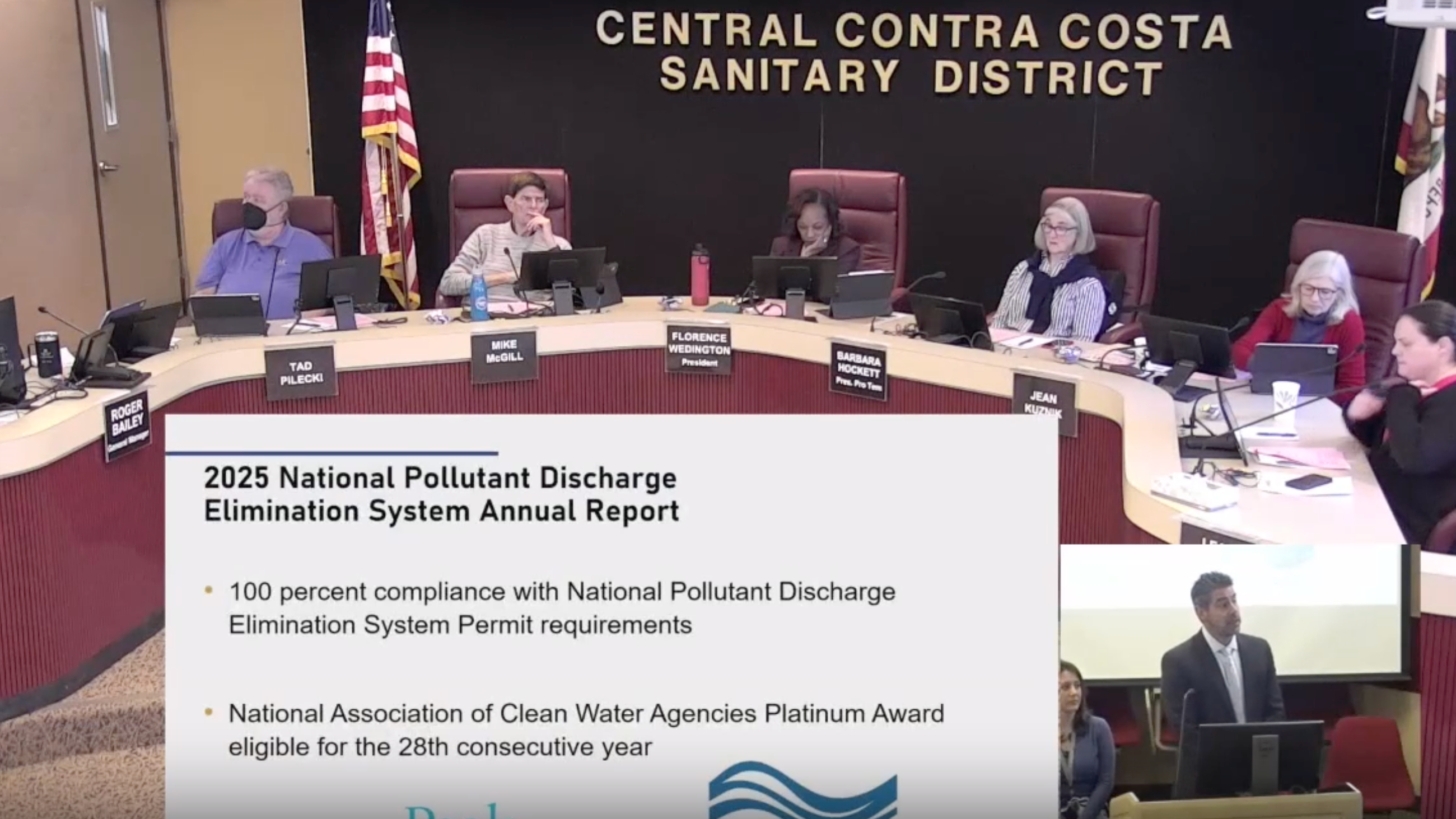
  • District notches 28th consecutive year of perfect NPDES compliance, processing 13.4 billion gallons with zero permit violations

  • $1.5M PFAS regulatory planning contract with Brown and Caldwell approved on consent, advancing the district's response to emerging federal contamination standards

  • Board Member McGill honored by the Contra Costa Special Districts Association for civic contributions


Spill Count Up, Spill Volume Down: Inside the Data Detective Work

The basics: Central San's collection system spans roughly 1,540 miles of sewer pipe and reported 24 sanitary sewer spills in 2025 — up from a record low the prior year but representing just 1.56 spills per 100 miles. Staff cleaned 750 to 800 miles of pipe, TV-inspected 136 miles, completed 51 spot repairs, 103 structure adjustments, and handled nearly 30,000 underground-service-alert requests.

Why it matters: Under the Clean Water Act, any member of the public can file a third-party lawsuit over a single spill. General Manager Roger Bailey framed the stakes bluntly:

"The way the Clean Water Act is written is anyone could sue us for a spill. And so there is high risk in what they do on our behalf."

Where things stand: While the spill count ticked upward, the total volume discharged fell approximately 60% because the additional overflows were smaller. Three were Category 1 spills — meaning wastewater reached waters of the state — while eight were Category 4, under 50 gallons and contained. Roots caused 71% of all spills, grease 8%, and other blockages such as concrete, asphalt, and non-flushable wipes accounted for 21%. Most spills clustered in Lafayette, Orinda, and Walnut Creek — areas served by pre-1960 clay pipe — with Division 2 accounting for 14 of 24 incidents.

The most striking finding was an internal data audit: staff discovered 752 closed-circuit television inspection reports that mentioned roots in their written descriptions but showed no root findings in the actual report data.

"We grabbed all those and we've re-reviewed and re-TV'd those, and a percentage of those have been changed over to get cut with the cutter blades to cut the roots out," said Paul, a collection system operations staff member.

The discovery shifted affected lines from hydro-flush maintenance to mechanical root-cutting — a more aggressive protocol aimed at preventing future blockages.

Board Member Tad Pilecki praised the team's investigative instincts:

"This is what I think distinguishes us from an average or even a good organization. I consider them the best in the state."

Board Member Barbara Hockett acknowledged the public's role in the problem, noting that residents plant trees near sewer lines and "the trees find that fabulous nutritious water source and then they become your challenge."

Board President Florence Wedington closed the discussion by noting that the team's peers statewide had already recognized the unit as Collections System of the Year.


28 Years, Zero Violations: NPDES Compliance Streak Continues

Why it matters: The district's treatment plant processed 13.4 billion gallons of wastewater in 2025 — an average effluent flow of 34.6 million gallons per day — with 100% compliance across every National Pollutant Discharge Elimination System permit requirement. That makes Central San eligible for a 28th consecutive NACWA Platinum award, one of the most elite benchmarks in the clean water industry.

Where things stand: Plant Operations Division Manager Alan Weer and staff member Blake presented the annual report, emphasizing that maintaining compliance is a year-round effort spanning planning, monitoring, sampling, and cross-department coordination — not a single end-of-year report. The annual filing is submitted to the CWICS portal by Feb. 1.

Board Member Tad Pilecki put the streak in dramatic terms:

"Put it in another way, 10,200-plus days in compliance, or another way, maybe even more dramatic, 245,000 hours."

He noted that a single missed test could break the record. Board Member Barbara Hockett credited the lab and all contributing departments, while General Manager Roger Bailey described the Platinum award as "one of the most coveted awards that NACWA actually gives out."

President Florence Wedington highlighted individual talent, noting that lab staff member Kevin recently received a laboratory person of the year award from industry peers — further evidence of the district's operational culture.


Board Declines Raise, Signals Solidarity Before Contract Talks

The basics: State law allows special district boards to increase their per-meeting stipend by up to 5% annually after a public hearing. Central San's current rate is $230 per meeting, with a cap of six meetings per month. A 5% increase would have raised the stipend to $241.50.

Why it matters: The Board's unanimous decision to forgo the raise comes ahead of upcoming contract negotiations with district employees — and multiple members framed the vote explicitly as a message to staff.

Where things stand: Secretary Katie Young provided historical context: the stipend was $100 in 1987, rose to $221 in 2007, was cut to $185 in 2012, increased to $200 in 2022, and reached $230 in 2025. No public comments were received during the hearing.

Board Member Tad Pilecki said the current rate is appropriate:

"We just gave ourselves a $30 bump last year, and I feel that we're good. We're right in the middle of the pack."

Board Member Michael McGill agreed, adding that the position should remain accessible without becoming a source of personal enrichment:

"We're not getting rich off of this, but at the same time, we want enough incentive to have people want to run for the position."

Board Member Jean Kuznik offered the sharpest rationale, tying the decision directly to labor relations:

"Instead of us first, we're taking care of boots on the ground and all of our staff as we're looking at contract negotiations rather than voting ourselves another raise."

Board Member Barbara Hockett affirmed that message, saying the Board values its employees.

Decisions: Pilecki moved to leave compensation at the status quo; Board Member McGill seconded. The motion passed 5-0 (For: Kuznik, Hockett, McGill, Pilecki, Wedington; Against: 0; Absent: 0).


Minor Items

  • $1.5M PFAS consulting contract with Brown and Caldwell for regulatory planning services (District Project 100090) approved on the consent calendar, advancing the district's preparation for emerging federal "forever chemicals" standards.

  • Item 4 tabled: Revisions to BP 013 (Standing Committee Protocols, Guidelines and Charters) were pulled from the consent calendar after General Manager Bailey flagged errors; the item was sent back to the administration committee for correction.

  • May 7 public hearing set on district vacancies and recruitment and retention efforts.

  • Deferred compensation report, expenditure listing, and budget-to-actual overview received without discussion.

  • Board Member McGill was individually recognized by the Contra Costa Special Districts Association at its March 26 annual dinner for his civic contributions. President Wedington also announced the district's 80th anniversary celebration at the event.

  • Board Member McGill praised engineering coordination between Central San and Lafayette, noting staff-level collaboration has eliminated the need for high-level liaison meetings.

  • Board recessed to closed session for one potential litigation case under Government Code Section 54956.9(d)(2).

  • Upcoming: Special board meeting scheduled for April 21; committee meetings forthcoming per secretary's announcements.

Board Freezes Its Own Pay, Receives Elite Compliance Reports at Central San | Board of Directors | Locunity