
Police Chief Defends Flock Cameras as Residents Demand Oversight
City Council • Cathedral CitySeptember 16, 2026
Locunity is an independent informational service and is not an official government page for this commission. All information is sourced from public footage and an analysis of official agendas with the aid of responsible, fact-checked AI. to report an error or omission.
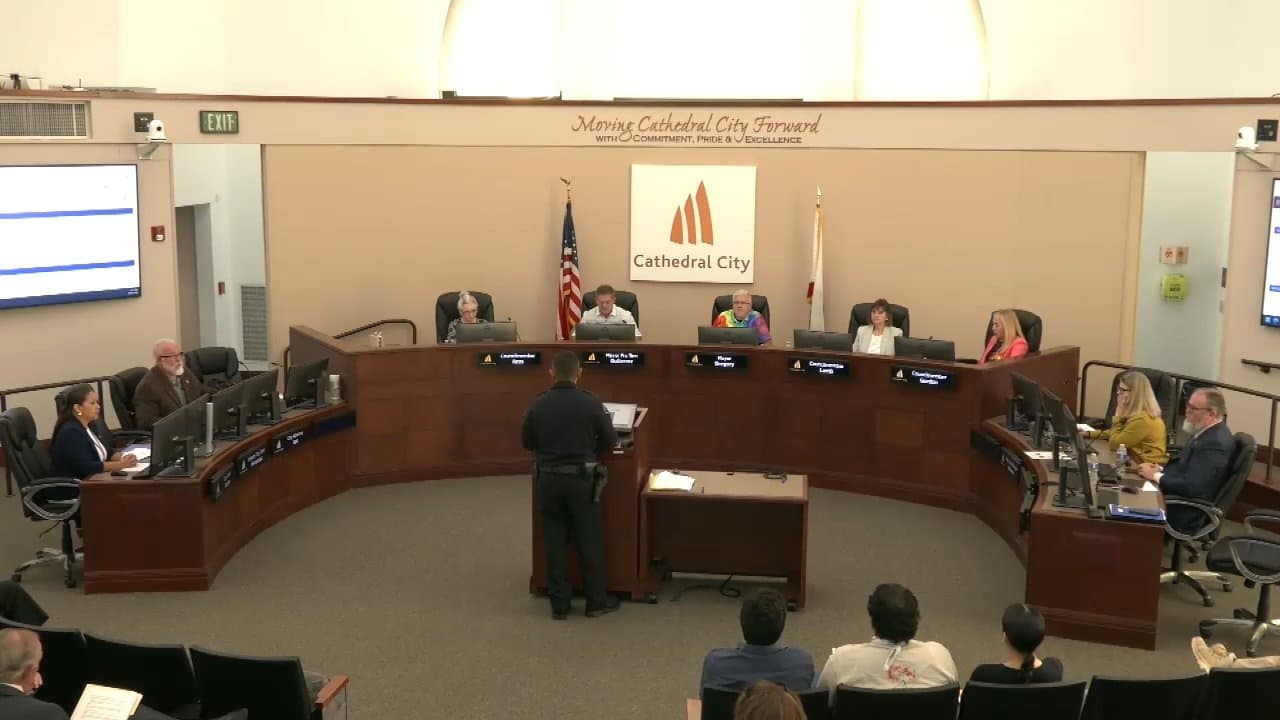
Cathedral City's license plate reader network faced nearly two hours of direct public scrutiny on Sept. 16, 2026. Police Chief Rick Sanchez defended the 34-camera Flock system as a lead-generating tool with tight guardrails, and residents pressed for a citizen oversight commission or an outright ban. The item was receive-and-file, so nothing changed. Later that evening, the City Council voted 5-0 to rename LGBT+ Days as Cathedral City Pride amid a heated fight over whether scrutiny of the event's funding is accountability or targeting.
- Flock ALPR program defended: 34 cameras, 30-day retention, no federal data sharing
- Residents seek citizen oversight commission or a ban; no council action taken
- LGBT+ Days becomes Cathedral City Pride, approved 5-0, with dates moved to March 12–14, 2027
- Audit-request dispute splits speakers over accountability versus targeting of one event
- About $1.1M in street contracts approved; four safety grant applications due Nov. 2
Flock Cameras Get a Two-Hour Public Grilling
The basics: Automated license plate recognition (ALPR) cameras log a passing vehicle's plate, make, model, color, time and location. The Cathedral City Police Department has used Flock since 2021, after earlier using Vigilant roof-mounted cameras.
Why it matters: The council is weighing how much surveillance to keep, and possibly expand, while residents worry outside agencies could use the data for immigration enforcement.
Where things stand: "The system identifies vehicles, not people," said Police Chief Rick Sanchez. He said the system has no facial recognition, audio, cellphone or GPS tracking, and issues no tickets. He also said alerts are leads, not probable cause.
The department's safeguards include:
- Flock Academy certification for users
- Individual logins tied to a documented case reason
- Supervisor review and monthly audits by a Professional Standards sergeant
- A public transparency portal
- Discipline for misuse, up to termination and prosecution
Sanchez reported no abuse in the department. He credited the system with helping in the Dream Homes homicide, a fatal hit-and-run, the case of a 13-year-old's murder and the case of a Los Angeles-area synagogue shooting suspect.
Cathedral City runs one of the valley's smallest networks. By comparison, Palm Springs has 224 cameras, Palm Desert 183, Rancho Mirage 173 and Indio 102. Sanchez called 1,000 cameras excessive but added, "I wouldn't mind 20 more."
On data sharing, Sanchez cited the California Values Act (SB 54) and said data goes only to approved California agencies that share back. It does not go to federal agencies or fusion centers. Asked by Mayor Pro Tem Ernesto Gutierrez about ICE access, Sanchez said, "We never have, nor will we ever." He said El Cajon police, then under investigation by the state attorney general, were cut off the day a resident flagged them.
Mayor Raymond Gregory, a former contract police chief, said, "I think Cathedral City probably has some unsolved homicide cases that if we had this technology at the time, it would have made a difference." Citing mistrust of the federal administration, he urged police to challenge heavy-use agencies: "I would encourage that we do so and not be shy about asking."
The other side: Councilmember Christina Gordon said the city's policy tracks an ACLU model "very, very close with the exception of retention." The ACLU model suggests 48 hours, while the city keeps data for 30 days. Sanchez said many victims "don't realize you're a victim of a crime immediately."
A Flock representative said machine learning only reads plates and classifies vehicles. She recalled a misread rate of roughly 9 in 1,000, and said officers verify every match. Public commenter Andrew Negus cited reports of 30% to 96% misread rates. He also asked, "Why is Cathedral City not considering banning this technology today?"
Other public commenters raised several concerns:
- Yasmin Espinoza noted the city is 60% Hispanic and said ICE activity adds fear.
- Gary Paulson proposed an independent community body empowered to end the program.
- Dave O'Brien said, "I'm asking this council to create that commission."
What's next: No council member requested a follow-up agenda item. Flock said automatic logout for idle users arrives in upgrades by year-end.
Pride Rebrand Passes Amid Funding-Scrutiny Fight
Why it matters: The vote locks in the branding and calendar for an event that drew more than 12,000 people in 2026. The city's capped contribution rises from $85,000 to $90,000 for 2027.
Where things stand: The council approved three changes:
- Renaming LGBT+ Days as Cathedral City Pride, effective 2027
- Moving the 2027 event to March 12–14 to avoid a RuPaul World Tour stop at Agua Caliente on the original Saturday
- Authorizing the city manager to amend the Montage Agency LLC agreement
The 2026 event drew "an estimated combined attendance over the weekend of over 12,000 people, the largest ever in Cathedral City history," said Michael Westman, managing director of Montage Agency LLC. He said "Pride" is searched 100,000 to 1 million times, compared with about 1,000 for "LGBT Days."
Ryan Hunt, director of communications and engagement, said the city's contribution is a cap and that total costs exceed $125,000 with sponsorships. By comparison, he said the Balloon Festival costs roughly $200,000 and Taste of Jalisco about $110,000. Gordon asked staff to quantify earned media and local business impact.
The other side: The vote followed a public fight over a resident's requests for Pride financials. Public commenter Sunshine Herrera apologized to anyone made afraid but said, "I will not apologize for asking questions about public money and transparency." She also filed a public records request about Montage's communications with the city. Public commenter Julian Reese backed her: "These are not anti-gay questions. These are accountability questions."
Others saw it differently. Charlie McClendon, a former city manager, said "singling out this event smacks of the kind of bigotry that flies in the face of everything Cathedral City stands for." Public commenter Alan Carvalho praised Montage but questioned the absence of local-hire clauses and of residents on the organizing committee.
Gutierrez said he has never voted against LGBT events. Gregory pushed back on the earlier request to audit a single event, saying it "has had modest city investment… and has had a great investment from the producer." Written comments included a request to censure Gutierrez.
Decisions and stakeholder impacts: Gordon moved and Councilmember Rita Lamb seconded. The motion passed by roll call (For: 5, Against: 0, Absent: 0) after the electronic voting screen froze. Voting yes were Gordon, Lamb, Councilmember Nancy Ross, Gutierrez and Gregory. Gutierrez called it "a wonderful decision." Supporters included the Desert Business Association, a Human Rights Campaign board member and former Mayor John Aguilar.
Street Work Advances on Unanimous Votes
Why it matters: The council approved about $1.1M in construction contracts and set up the city's next bid for state safety money.
Where things stand: The council approved three contracts, each carried with all ayes announced (For: 5, Against: 0, Absent: 0):
- Traffic signal: Elecnor Belco Electric won $367,614 ($441,136.80 with a 20% contingency) for a signal and scramble crossing at Cathedral Canyon Drive and Canyon Shores Drive, near CV Link. The city received seven bids, and costs are shared 75/25 with CVAG (Coachella Valley Association of Governments) on a $600,000 program budget. Lamb moved, and Gutierrez seconded. Two written comments raised concerns.
- Slurry seal: Petrochem Materials Innovation won $589,571 ($678,006.65 with contingency) for slurry seal in Dream Homes, Assessment District 88-2 and the Cove Lane/Grove Street area. The work is funded mainly by Measure W and uses Los Angeles County piggyback pricing.
- Safety grants: Albert A. Webb Associates received a $64,901 task order to prepare up to four applications for the state's Highway Safety Improvement Program (HSIP), Cycle 13. Lamb moved, and Gordon seconded.
City Engineer Armando Baldassarre explained the slurry seal approach: "We try to maintain the streets that are in good condition before doing rehabilitation or reconstructions that are more costly for the city." He said the city won almost $9M in HSIP grants over the past six cycles.
The capital improvement update outlined $8M in planned roadway work: $6.8M in reconstruction and $1.2M in maintenance. Projects include Vista Chino rehabilitation, East Palm Canyon widening and the Ramon Road Bridge widening, which Palm Springs leads, with bids due at the end of September.
What's next: HSIP applications are due Nov. 2. If awarded, the city would owe a local match of about $200,000 per year.
Minor Items
- Consent calendar passed with all ayes, including a $50,000 state traffic enforcement grant and Tyler Rinehart's Architectural Review Committee appointment.
- Closed session covered eight litigation matters; Gutierrez recused on two, and the council gave direction on one.
- Hispanic Heritage Month proclaimed for Sept. 15–Oct. 15, 2026, after a folklorico performance.
- Measure A: Gregory said the November measure removes the transportation tax's 2039 expiration: "It is not a tax increase."
- Septic-to-sewer: Lamb said resident participation affects scoring for a District 1 grant.
Looking Ahead
The council adjourned to Oct. 14. Conflict-of-interest code amendments must return for adoption before Dec. 31, 2026.