
Campbell Trustees Pause Westmont-to-Prospect Shift, Lean Toward Ending Free Zones
Board of Trustees • Campbell Union High School DistrictOctober 16, 2026
Locunity is an independent informational service and is not an official government page for this commission. All information is sourced from public footage and an analysis of official agendas with the aid of responsible, fact-checked AI. to report an error or omission.
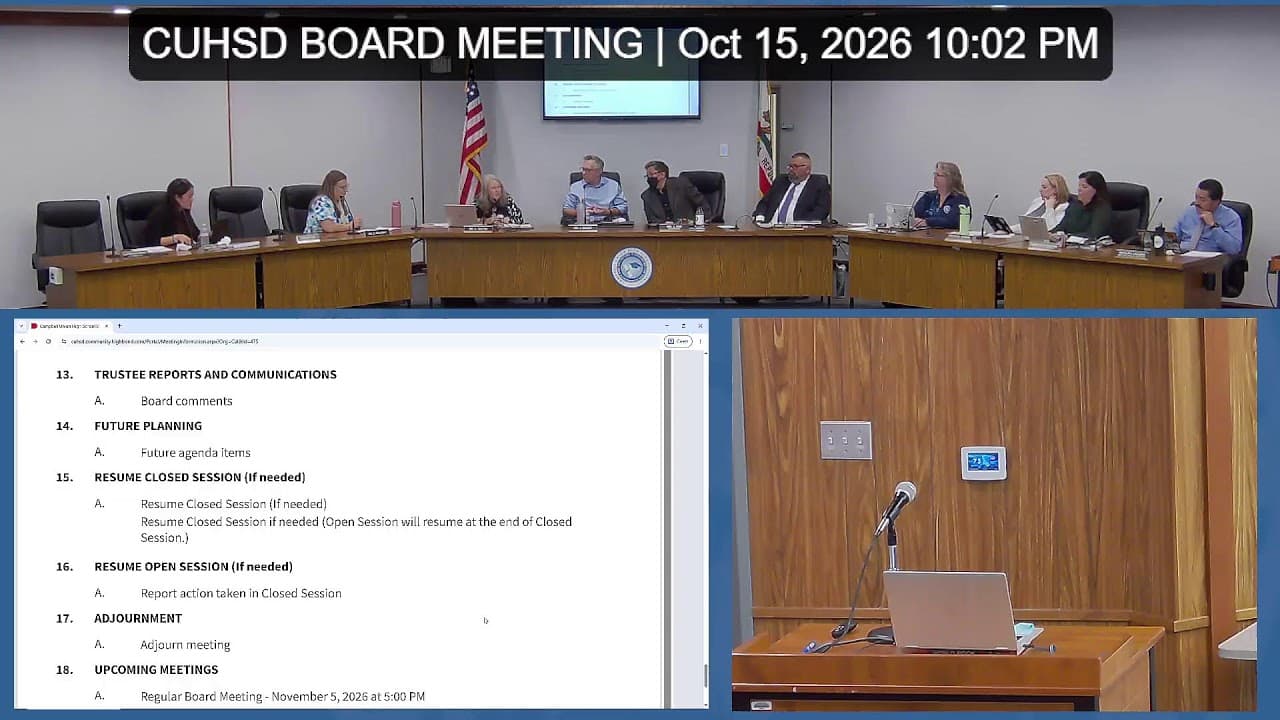
A staff proposal to redraw high school attendance lines dominated the Campbell Union High School District Board of Trustees meeting on Oct. 15, 2026. Families, a neighborhood association and the teachers union pushed back on moving about 200 Loma Verde-Cadillac students from Westmont to Prospect. Trustees took no vote. Instead, they asked staff for transfer data and a possible study session, while approving exam-fee relief, a split-vote special education placement and an $8.8M construction savings plan at Prospect.
- No vote on attendance boundaries. Trustees leaned toward folding the Leigh and Branham free zones into regular attendance areas but paused the Westmont-to-Prospect idea.
- Out-of-state special education placement approved 3-2 after two trustees objected to retroactive approval.
- Option 1 exam-fee subsidy passes 5-0, extending AP/IB relief to disadvantaged students at every school.
- Single-phase Prospect build advances 5-0, which staff project will save about $8.8M.
Boundary Ideas Draw Pushback and No Vote
The basics: Staff floated two ideas. The first would fold the Leigh and Branham "free zone," now called priority consideration, into those schools' attendance areas, a net shift of about 18 students to Branham. The second would move the Loma Verde-Cadillac neighborhood, about 200 students, from Westmont to Prospect.
Why it matters: Boundaries decide which campus a family's teenager attends. Staff acknowledged no community engagement had occurred before the item reached the board.
Where things stand: Director of Student Services Courtney Shembry made a transportation case for the Prospect move. A transit trip to Prospect can take as little as 24 minutes, while the trip to Westmont can take up to an hour with two transfers. She recommended phasing in any change.
"I'm not suggesting that we move anybody right now or anybody all at one time," said Courtney Shembry, Director of Student Services.
Superintendent Robert Bravo apologized that the item had surprised staff. "This is not about trying to make a decision tonight," said Bravo.
The other side: The Campbell High School Teachers Association (CHSTA) spoke before the item came up. Reading a statement for union President Barbara West, the union's secretary said members felt blindsided. The union saw a possible transportation benefit but wanted the district to slow down and gather input from stakeholders.
"We request that you delay a vote on this item tonight," said Mary McClellan, Secretary, Campbell High School Teachers Association.
Four members of the public spoke on the item:
- Maria Inez Ortega, President of the Cadillac-Winston Everett Association, urged the board not to separate students and to ensure transportation to Westmont. She cited safety concerns and gang conflicts.
- Lupe Maya Ortega, a former Westmont student, said incoming ninth graders should keep their choice of school. She warned that new boundaries could separate friends and siblings.
- Juan Maya, a Westmont graduate who rode VTA, said moving ninth graders to Prospect did not seem right.
- Gertrudis Martinez, a Loma Verde parent, asked through translation how the change would affect transportation for her child, who enters high school next year.
Decisions and stakeholder impacts: No motion was made. Trustees broadly supported ending the free zones, with exceptions such as keeping siblings together. "I am in favor of the free zones going away," said Linda Goytia, Trustee.
The Westmont shift split the board:
- Trustee Elisabeth Halliday and Goytia opposed or were skeptical of the move.
- Trustee Aine O'Donovan backed it as a phased, long-term change.
- Trustee Jason Baker wanted to wait until after the vote on a regional transit measure, then hold a later hearing. "I think we will know a lot more in a few weeks," said Baker.
Board President James Kim widened the lens to rebalancing enrollment across the district, including Del Mar's size and program offerings. "I think discussing attendance boundaries is deeply personal," said Kim.
What's next: Staff will send transfer-request data and criteria in a Friday letter and poll trustees on scheduling a study session. Any change would likely need decisions before February enrollment.
Split Vote on Retroactive Special Ed Placement
The basics: Some students with disabilities are placed in non-public or out-of-state schools when their Individualized Education Program (IEP) team decides local options can't meet their needs.
Where things stand: On item 12.A, Halliday asked why placements made Sept. 8 and Sept. 22 reached the board late. Staff said the paperwork arrived after placement and that the services were urgent. The board ratified the non-public school agreements on a motion by Halliday, seconded by Goytia (For: 5, Against: 0, Absent: 0).
Item 12.B was harder. The agenda listed it as a contract with Copper Hills Youth Center, and the board discussed it as a non-residential placement in Utah. Staff confirmed the IEP team made the decision and that the board was being asked to approve it retroactively. Halliday noted the parents had arranged transportation and raised concerns about the delay.
The other side: "I would prefer, especially on these out-of-state placements, to receive notice before or earlier," said Halliday.
Decisions and stakeholder impacts: Item 12.B passed on a motion by Baker, seconded by Kim (For: 3, Against: 2, Absent: 0).
- Voting yes: O'Donovan, Baker and Kim.
- Voting no: Halliday and Goytia, who both cited the retroactive approval.
The student's services continue. The dissent puts pressure on staff to tighten how quickly the board learns about placements.
What's next: Halliday asked to bring back board policies 6159.2 and 3541.2 for review at a future meeting.
Exam-Fee Relief Spreads Across All Campuses
Why it matters: COVID-recovery funds had covered International Baccalaureate (IB) exam fees at Del Mar. When that money ran out, the package approved at the prior meeting returned the cost to families. Trustees then asked staff for more subsidy options.
Where things stand: Staff offered several scenarios, including fully subsidizing all IB and AP exams. The only funding source identified was the district's fund balance. Staff estimated that covering every exam would cost about half a million dollars. They said students eligible under Option 1 are already identified as socioeconomically disadvantaged.
"I like option 1 because I feel it's fair and equitable," said O'Donovan, who cited a $23,400 cost. Baker, Halliday and Goytia also backed Option 1, citing fairness and equity across schools. Halliday pointed to strain on the budget.
The other side: Goytia raised a competing safety need: football helmets. Staff estimated an upgrade would cost about $350,000.
Decisions and stakeholder impacts: The board approved Option 1 on a motion by Halliday, seconded by Baker (For: 5, Against: 0, Absent: 0). Low-income students at every school now get the same exam-fee relief. Del Mar IB families who don't qualify lose the pandemic-era full subsidy.
Prospect Build Goes Single-Phase
Where things stand: Executive Director of Facilities Gabe Altamirano said Amendment #15 with Finney Architects adds 15 portables for interim housing at Prospect High School. With the portables in place, the new administration and classroom building can be built in one phase. That approach eases state approval and shortens construction to about 2.5 years.
"Financially, we are looking to save approximately $8.8 million in a single-phase construction," said Altamirano.
The other side: Kim praised the facilities team but demanded input from the people who will use the building, pointing to poorly attended meetings. "I do not want to have buildings built and then afterwards the people tell us that they're unusable," said Kim.
Decisions and stakeholder impacts: The board approved three related items:
- Amendment #15: Approved on a motion by Halliday, seconded by Goytia (For: 5, Against: 0, Absent: 0).
- PG&E agreements: Covering new electric service at Prospect, a new panel at Westmont and an electrical upgrade at Leigh. Approved together on a motion by Halliday, seconded by Baker (For: 5, Against: 0, Absent: 0).
- Construction West agreement: Ratifies a maintenance agreement for exterior lighting controls, which staff described as phase one of emergency work on lighting that had become unsafe. Approved on a motion by Baker, seconded by Halliday (For: 5, Against: 0, Absent: 0).
What's next: Lighting plans for the remaining sites will return to the board.
Minor Items
- Consent calendar: Passed 5-0, minus item 10.K. That item, ratifying contracts up to $30,000, passed 5-0 after staff said a failed boardroom sound system had to be replaced.
- Staffing update: Director of Human Resources Diane Mackenzie reported:
- Most sites lost teacher allocations because of enrollment; Branham fell from 67.6 to 66.4 full-time positions.
- Staff supported 25 transfers and welcomed 14 new certificated administrators.
- A new staff equity ambassador program is starting. Its theme, said teacher Karen McClintock, is that "authenticity matters."
- Boynton High School: Principal Liz Tovar said "our graduation rate increased by 7%," to about 90%, though state test (CAASPP) and English proficiency (ELPAC) goals went unmet.
- El Niño warning: Assistant Superintendent Hudson relayed a risk-management briefing on "potentially the most impactful El Niño on record." Flood-preparation task forces may follow.
- Sutter Health investment: Goytia reported that Sutter Health gave $500,000 in year one to Silicon Valley Career Technical Education (SVCTE) and committed $250,000 for year two. The money supports about 250 students across five career pathways.
Looking Ahead
CHSTA said its bargaining cycle begins next week. Halliday relayed student reports of longer Westmont lunch lines under the phone-pouch program, and staff will analyze lunch participation districtwide.