
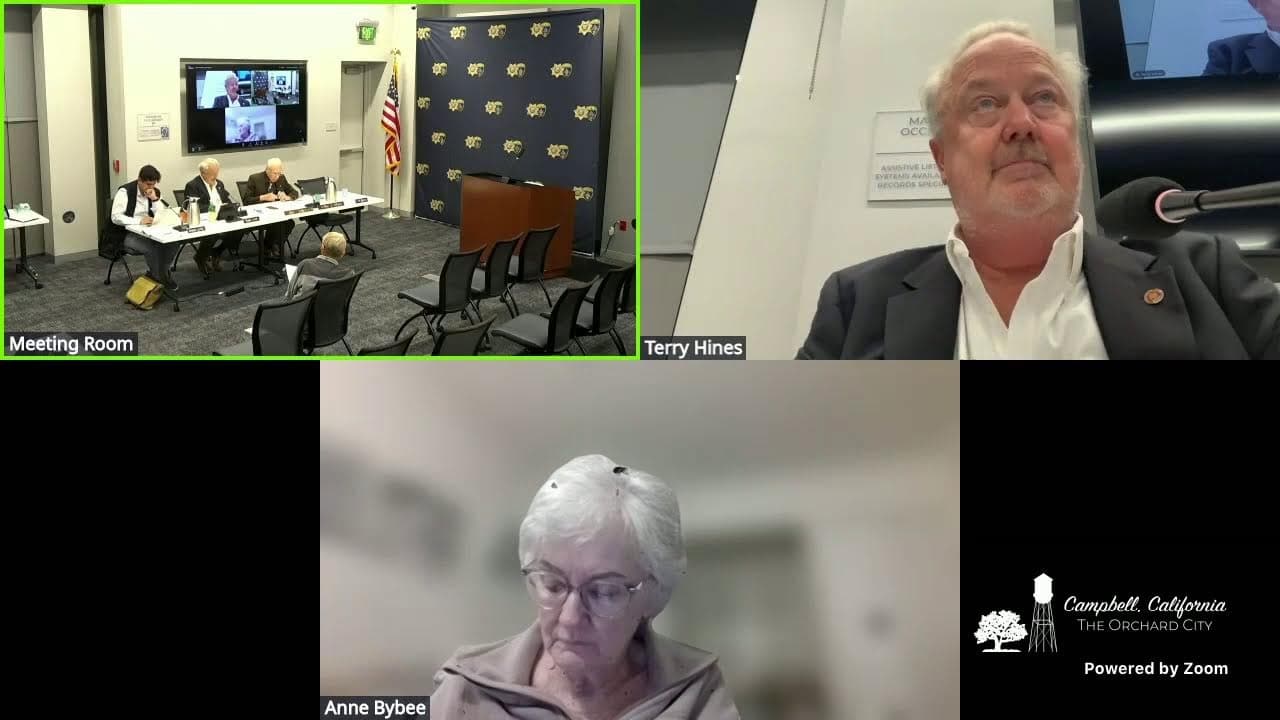
Campbell Approves 290 Homes at Tech Park as State Law Limits Council
City Council • CampbellNovember 3, 2026
Locunity is an independent informational service and is not an official government page for this commission. All information is sourced from public footage and an analysis of official agendas with the aid of responsible, fact-checked AI. to report an error or omission.
Campbell's 17-acre Campbell Technology Park will become a 290-home neighborhood after the City Council voted 3-1 Monday, Nov. 2, 2026, to certify the project's environmental review and advance its approvals. State housing law left the council little room to say no, so the debate centered on what it could not fix: traffic queues, sidewalk gaps and a row of redwoods.
- 290-home Tech Park project approved 3-1, with Mayor Daniel E. Furtado voting no
- 58 homes reserved for lower-income households for 45 years
- Builder's remedy and a five-hearing cap gave the council narrow grounds to deny the project
- Traffic substitute motion dies without a second; queuing and restriping fixes go to future city work
- 116 trees, including redwoods, slated for removal with no amendment to save them
- White Oaks Manor residents push back on townhomes replacing single-family homes
- $175,000 police recruitment contract renewed 4-0 amid questions about results
Tech Park Turns From R&D Campus to Homes
The basics: Bay West Development will demolish Campbell Technology Park and build 290 homes on about 17 acres: 27 detached single-family homes, 149 three-story townhome condominiums and 114 four-story townhome-style condominiums. Twenty percent of the units, 58 homes, are restricted to lower-income households for 45 years.
Why it matters: This is what staff called a builder's remedy project. Under that state provision, cities without a certified housing element lose much of their power to block housing that conflicts with local zoning.
Where things stand: The preliminary application was filed April 18, 2023. That was the same day the council considered its new general plan and housing element, so the city lacked a certified housing element when the application arrived. Under AB 1893, the project is deemed consistent with local plans. It is reviewed under 2023 standards, not the city's newer objective design standards.
"The city cannot deny or reduce the density of a project simply because it is not consistent with the general plan or zoning," said Senior Planner Daniel Falma.
The procedural walls were high. Staff said the Housing Crisis Act caps a project at five hearings, and Monday's was the fifth, so a continuance would have counted as a sixth. The Housing Accountability Act allows denial only for specific adverse health or safety impacts that cannot be mitigated. AB 1633 treats an unjustified failure to certify an environmental impact report, or EIR, as a disapproval.
"The state has a very high bar for allowing for disapproval of housing in this situation," said Sean Marciniak, legal counsel for the applicant, Hanson Bridget.
The pitch: The applicant framed 290 units as restraint. City zoning and state density bonus law could allow 620 to 1,240 units, and staff noted that three of the four parcels were already zoned residential for more than 600 units. The Planning Commission recommended approval 7-0 on Oct. 13.
"We strongly feel that our proposal before you tonight, the 290 units, is much more preferred by the general community," said Jason Laub, applicant representative, Bay West Development.
Neighbors' red line: Pat Tinto, representative of the Paseo de Palomas Board of Directors, said the neighboring park backs the 290-unit plan over the higher-density alternatives. He also said the park will not open its only entry to general traffic. Staff said the existing easement through Paseo de Palomas to Union Avenue is emergency-only, and that the fire department reviewed the project. Chris Coggins, a Paseo de Palomas resident, agreed, citing seniors who use walkers and the park's 10 mph limit.
Disclosures: Councilmember Sergio Lopez disclosed that the emergency access easement "does abut the rental property that I rent on a month-to-month lease." He did not recuse himself. Councilmember Terry Hines said he had met with stakeholders, including the applicant.
Decisions and stakeholder impacts: Lopez moved to certify the EIR, introduce the planned development ordinance with a tree removal permit, and approve the vesting tentative subdivision map. Bybee seconded. Lopez said the project was "not for more housing. It's actually for less housing" than the general plan anticipated. The vote was For: 3 (Lopez, Hines, Bybee), Against: 1 (Furtado), Absent: 1 (Councilmember Elliot Scozzola). Furtado did not state his reasons for voting no. The council then waived further reading of the ordinance 4-0.
Traffic, Trees Left to Future City Action
Why it matters: The council could only require mitigation tied to objective standards. Queuing and some sidewalk gaps have no such standards, so those fixes now depend on future city work, some of it unfunded.
Where things stand: Staff said the project adds a net 1,368 daily trips after subtracting the 889 trips generated by the former R&D campus. Intersections keep acceptable service levels. Queuing at Kirtner-White Oaks-Camden would rise from 30 to 32 vehicles.
Required mitigation includes a mid-block crossing, a crosswalk at McGlincy and ADA upgrades. A city restriping project at Camden and White Oaks is separate from the project and unfunded.
The applicant also agreed to record an easement for a possible Highway 17 pedestrian and bike overcrossing. A grant application for a feasibility study was unsuccessful. Staff said the applicant "has agreed to record an easement across the site that would allow for public access should such a bridge ever be built in the future."
The other side: Steve Saunders, a resident, said the traffic analysis omitted intersections such as McGlincy and Kirtner. He also faulted the lack of stop signs at Technology Park Parkway and McGlincy, and called the queuing methodology opaque.
Hines pressed the issue from the dais. "I call on the applicant to specifically address this issue for pedestrian, bike, and vehicle safety and traffic congestion," said Councilmember Hines. His substitute motion to address traffic mitigation in the EIR died for lack of a second.
The redwoods: The ordinance approves removal of 116 trees. Tinto and resident Terry Kurz asked that trees along the shared fence line stay. "I'm also concerned about the redwood trees," said Mayor Furtado. Vice Mayor Anne Bybee also asked why the redwoods must go.
Staff said trees are removed when they obstruct stormwater facilities or roadways, and that the tree ordinance requires replanting or an in-lieu fee. Staff could not explain the reasons for specific trees. Lopez said he hoped the redwoods could be replanted. No amendment was made.
Decisions and stakeholder impacts: Bybee voted yes despite her concerns. "I'm going to support the project," said Vice Mayor Bybee. The Planning Commission had recommended creating objective traffic standards and prioritizing the restriping project. Lopez supported adding both to city work plans.
What's next: Staff said traffic patterns can be monitored after the project is built. The Planning Commission also requested three-hour parking on Campbell Technology Parkway.
White Oaks Manor Draws Line on Infill
Why it matters: A cluster of residents from one neighborhood used public comment on non-agenda items to signal a coming fight over redevelopment in single-family areas.
Where things stand: Alyssa Lynch said neighbors support new homes in the right places. She objected to a proposal to replace three single-family homes with 14 townhomes and asked for transparent, objective rules. Emily Remisch, a Holmes Avenue resident, described a close-knit neighborhood where accessory dwelling units, or ADUs, already house renters.
Teresa Wadholm referenced an Oct. 27 Planning Commission meeting where developers opposed a demolition ordinance. She said some investors want to flip homes, and that townhomes belong in higher-density areas.
Kayvon Turhani opposed proposals for four or more houses on a lot. He said such homes would cost $1.5 million to $2 million each, and urged one or two single-story ADUs plus density along commercial corridors. Furtado suggested he forward his comments to state legislators. Tom Fisher asked whether the city can halt redevelopment once its housing element targets are met.
What's next: Watch the pending demolition ordinance as it moves from the Planning Commission.
Police Recruitment Contract Renewed, With Skepticism
Why it matters: The $175,000 program has sharply increased applications, but it has produced relatively few officers who completed probation.
Where things stand: Captain Ian White of the Campbell Police Department said the FY26-27 budget allocated $175,000 for recruitment. The All-Star Talent contract continues work that began in 2023. Applications rose from just above 57 in 2022 to 355 last year.
Since then, the department has run 67 background investigations: 28 passed, 17 completed field training and 11 completed probation. "So in total, we've had 11 police officer positions filled during that period of time," said Captain White.
Of 42 total hires, "32 of them are currently employed. So it's about a 76% success rate," he said. White estimated a cost of roughly $75,000 per officer, a figure finance staff had not verified.
The other side: "It appears to me that the focus is more about quantity than quality," said Vice Mayor Bybee. She still backed the item because it was already budgeted. Lopez supported it, citing competition from cities such as Palo Alto and its new public safety building.
Decisions and stakeholder impacts: The council approved the one-year contract and waived bidding requirements. Lopez made the motion. The vote was For: 4 (Lopez, Hines, Bybee, Furtado), Against: 0, Absent: 1 (Scozzola).
Minor Items
- Remote attendance: The council voted 4-0 to let Bybee participate remotely due to a contagious illness.
- Consent calendar: Items 7.1 to 7.6 passed 4-0, with no items pulled.
- Pedestrian safety: Resident Joseph Ravitch proposed fundraising for traffic enforcement; he was referred to staff.
- Committee reports: Councilmembers reported on regional water, clean energy and city attorney recruitment.
- Civic calendar: Applications are open for board and commission vacancies through the City Clerk's Office.
Looking ahead: Polls are open 7 a.m. to 8 p.m. on Election Day, Nov. 3. Mail ballots must be postmarked by Nov. 3 and received by Nov. 10, and Furtado recommended getting a manual postmark at a post office counter. The Veterans Day ceremony is Nov. 11 at 9 a.m. at Orchard City Green, followed by the Saluting Our Veterans Gala on Nov. 14 ($100 tickets).