
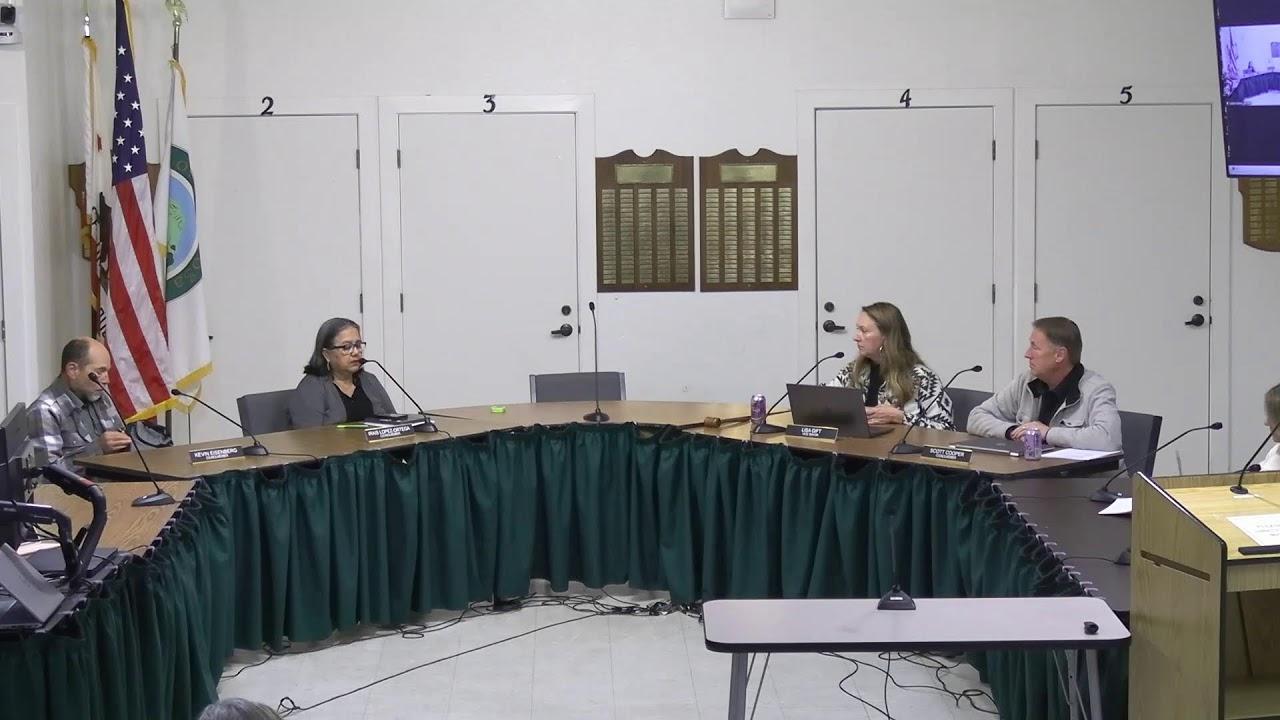
Calistoga Council Leans Toward Financial Analysis Before Fairgrounds Master Plan
City Council • CalistogaNovember 18, 2026
Locunity is an independent informational service and is not an official government page for this commission. All information is sourced from public footage and an analysis of official agendas with the aid of responsible, fact-checked AI. to report an error or omission.
Calistoga's City Council spent nearly an hour Nov. 17 on the future of the roughly 70-acre fairgrounds. Members signaled that the city should study the money before it commits $300,000 to $600,000 to a master plan. Councilmembers also questioned the police department's license plate cameras, split 3-1 over Planning Commission appointments, and funded livestreamed advisory committee meetings.
- Fairgrounds planning: Council favors financial analysis first and funds livestreamed advisory meetings, 5-0
- License plate readers: Police chief defends six Flock cameras; a councilmember floats writing safeguards into local law
- Water and sewer: Two state-mandated projects are done, and state may lift cease-and-desist order Dec. 9
- Appointments: Mayor's slate confirmed 3-1-1 after the vice mayor pushes for an experienced commissioner
- Grants: $20,000 food bank aid is separated from $30,000 in enrichment grants
Fairgrounds: Volunteers Ask for Help, Council Says Count First
Why it matters: How the city sequences fairgrounds planning decides whether it spends $300,000 to $600,000 on a master plan up front. It also determines who shapes a major public asset: volunteers, consultants or staff.
Where things stand: Fairgrounds Advisory Committee Chair Karen Jensen reported on six subcommittees, covering site analysis, site development, budget and infrastructure, capital campaign and outreach, the golf course and the RV park. She said it is unclear whether the committee should guide planning or do it.
"As a group of five people who are volunteers, it's a huge task to try to plan that entire fairgrounds," said Jensen. "I feel that more analysis is probably needed in the financial department."
Councilmember Kevin Eisenberg said the survey priorities fit the purchase agreement's historical uses. Those priorities are the racetrack, golf course, open space, community celebration space, emergency services and an RV park. "Once we decide on the elements, then the city is going to have to do a financial analysis, and that means paying a consultant," he said.
"I hesitated to embrace the $300,000 to $600,000 master plan immediately," said Councilmember Scott Cooper, who prefers to start with financial analysis. Vice Mayor Lisa Gift, who presided, argued for professional resources: "We cannot ask volunteers to do everything."
Mayor Donald Williams praised David Gates' concept plan and urged the committee to bring recommendations forward. He said "this revitalization is being led and facilitated by Calistogans for Calistogans."
The other side: Public commenters split. "I would urge the decision-makers to be at this time considering a low-intensity alternative," said Tim Riley, a public commenter who also asked for financial analysis of every alternative and a public participation subcommittee.
Cindy Yant of the Calistoga Fairgrounds Foundation called council direction vague and urged incremental steps over a 30-year plan. "You can't do everything," she said. Carrie Abrams disagreed that participation is lacking and urged council to back staff. Bobby Enderland suggested a council liaison to the committee, as in Benicia.
Earlier, during general public comment, Sally Houck called the Gates concept costly and duplicative and pushed golf course proposals developed at private cost. "We have a museum. We don't need another duplicate museum," she said. Georgie Costello also backed restoring the golf course.
Decisions and stakeholder impacts: Council took no formal vote on direction. It did vote to fund moving committee meetings to the community center with livestreaming, while keeping the option to hold large meetings elsewhere. Gift cited roughly $2,000 for 12 meetings. Eisenberg noted the committee itself had voted 3-0 to request the move. (For: 5, Williams, Gift, Eisenberg, Cooper, Lopez-Ortega; Against: 0; Absent: 0)
Staff said about 53 responses have come in through the online comment form for the plan.
What's next: The committee is expected to recommend fairgrounds elements, with a consultant-led financial analysis to follow.
Police Chief Defends License Plate Cameras
The basics: Automated license plate readers (ALPRs) are cameras that photograph and log vehicle plates. Calistoga contracts with Flock for its system.
Where things stand: Police Chief McCaffrey said the department runs six cameras and keeps data for 30 days. The cameras scanned 117,000 vehicles in the past 30 days, and officers ran 15 searches. The department audits use quarterly and shares data only with California agencies. "No federal agencies, no task force," he said.
He cited a Lake County homicide suspect case and a St. Helena hit-and-run as examples of the cameras' value. "The contract is $17,500 a year, and the total value of the contract, or cost of the contract, was $85,000," he said. The contract expires in November 2028.
"I'm a firm supporter of ALPR technology," said Councilmember Cooper.
Eisenberg asked: "Could the appropriate policies that you have that protect the privacy of our individual residents, could they be incorporated into municipal law?" He added, "There is no suspicion of it being improperly used by our Calistoga Police Department." McCaffrey preferred a statewide framework backed by police chiefs, sheriffs and PORAC. He said a local ordinance would "kind of be like having an ordinance for DUI to go along with a state law for DUI."
Councilmember Irais Lopez-Ortega asked whether data would go to ICE. "We already have state law in place that would prohibit that, so the answer is no, as well as department policy," McCaffrey said. Vice Mayor Gift asked about audits and cost, noting "hundreds of communities are reportedly reconsidering or have canceled these ALPR programs."
The other side: "What violates the Fourth Amendment is the gathering and using of that data," said public commenter Dan Herndon. He cited pending court cases and unanswered records requests. "The Flock cameras can identify people in the cars," he said.
What's next: Council took no action. Local codification was floated but not pursued.
Water Projects Done; State Order Could Lift Dec. 9
Where things stand: Public Works Director Derek Raynor reported that the Con Creek waterline and Riverside Pond projects are complete. "Those were two mandated projects that the city was required by the state of California to complete," he said. Con Creek was about 70% FEMA grant-funded (about $2.2M).
Other progress includes:
- Wastewater plant upgrades are saving 10% to 15% on energy.
- Digital meter registers are nearly all replaced, with monthly billing expected early next year.
- The Kimball filters are running again after about eight years.
The 10-year capital outlook is about $150M.
Why it matters: Recycled water ties the utility to the fairgrounds. Raynor said that without the fairgrounds, the city would need 8 to 10 acres of storage for 40 million gallons. The golf course takes roughly 25% of effluent, with a range of 20% to 60%. Recycled water's high boron content limits residential use, and treating it to drinking-water standards would be very expensive.
Rates stay high because of scale: about 1,600 water customers and 1,300 sewer customers fund the systems. "We have 1,600 customers to pay that $5 million every year," Raynor said. Riley asked whether the investments would slow rate increases. Abrams said the recycled water use shows the golf course is more than recreation.
What's next: Raynor said "the State Water Board will hopefully on December 9th rescind our cease and desist order."
Mayor's Appointments Survive Vice Mayor's Challenge
Where things stand: Gift pulled the item to back Michael Vaughn, who served three years on the Planning Commission. "I really want to express my support for Michael Vaughn for the Planning Commission," she said.
"I believe that the authority to make the nominations resides with the mayor's office," said Mayor Williams. He said Vaughn had not responded to his invitation.
Eisenberg said he interviewed the three standout candidates and was impressed with the mayor's two nominees. "So I would go along with the mayor's recommendations," said Cooper. Lopez-Ortega voiced support for Vaughn.
Decisions and stakeholder impacts: The vote shows the limits of council influence over mayoral nominations. (For: 3, Williams, Eisenberg, Cooper; Against: 1, Gift; Abstain: 1, Lopez-Ortega)
Grants Resolution Splits Out Food Bank Money
Where things stand: Gift asked that the resolution separate $30,000 in enrichment grants from the $20,000 Calistoga CARES allocation, which comes from council's Aug. 25 discretionary fund.
Eisenberg objected to grant money paying for firefighters' defibrillators. "It seems like the enrichment grants should be about community organizations not about paying for something that really should be a basic city need," he said. Deputy City Manager Rachel Stepp said staff had found city funds for the $8,000 expense.
Decisions and stakeholder impacts: The freed $8,000 returns for a later decision. The amendment and the amended resolution each passed 5-0.
- Missing middle housing: Council approved an Opticon consultant contract, 5-0, with no general fund cost; Cooper said he "originally kind of winced about spending a quarter million dollars."
- Foodware rules: Ordinance amending Chapters 8.16 and 8.17 introduced 5-0; a mandatory 25-cent bag-charge sign was dropped after legal review citing SB 270.
- Water waste: AB 1572 ordinance introduced 5-0; it bans potable irrigation of nonfunctional turf on commercial, industrial and municipal property by Jan. 1, 2027. A landscape ordinance reference update also passed 5-0.
- Pool season: Residents asked for a March-through-Thanksgiving pilot; staff anticipated considering it in the 2027-28 budget, or sooner if council wishes.
Looking ahead: A Calistoga Speedway license agreement with top-scoring proposers Brad and Rachel Sweet comes to council Dec. 8, along with review of fairgrounds water and sewer design proposals. A new Caltrans requirement for $10M in liability insurance threatens the lighted tractor parade. A flash flood watch covers the Pickett Fire burn area. Council also informally agreed to hear a presentation on Gift's request for competitive bidding rules.