
Caltrans Faces $1.45M in Past-Due Airspace Rent as Audit Fixes Roll Out
Commission • California Transportation CommissionOctober 19, 2026
Locunity is an independent informational service and is not an official government page for this commission. All information is sourced from public footage and an analysis of official agendas with the aid of responsible, fact-checked AI. to report an error or omission.
Caltrans told the California Transportation Commission that 23 state-owned airspace sites owe $1.45 million in past-due rent and that 100 tenants are still holdovers. The report came as the agency works through a corrective action plan tied to an audit. On Day 2 of its Oct. 19, 2026, meeting in Hanford, the Commission also approved a long slate of funding, including $162.2M for the SMART rail extension to Healdsburg and a $2.74B annual federal allocation.
- Airspace lease audit update: 488 sites, 100 holdovers, $1.45M past due and 33 fire-safety inspection failures
- Direct negotiation approved for eight airspace leases, covering tower cranes, a tieback and landlocked parcels
- $162.2M for the SMART Healdsburg Extension after strong ridership and youth-fare results
- Beaumont's $50.4M grade separation pulled from the 2024 TCEP; the city plans to reapply in 2026
- $5.447M supplemental for Tulare County's SR 99/Page Avenue interchange after a canal cost error
- $2.74B federal allocation and more than $300M in transit, highway and freight funds approved without opposition
Airspace Leases: Audit Fixes Still in Progress
The basics: Caltrans leases "airspace," meaning state highway right-of-way, for parking, wireless towers and other commercial uses. A holdover is a tenant that stays on after its lease expires. Under Resolution G2514, Caltrans must report to the Commission on the program every quarter.
Why it matters: The program puts private businesses on public land. The audit findings cover unpaid rent, expired leases and fire-safety failures on state property.
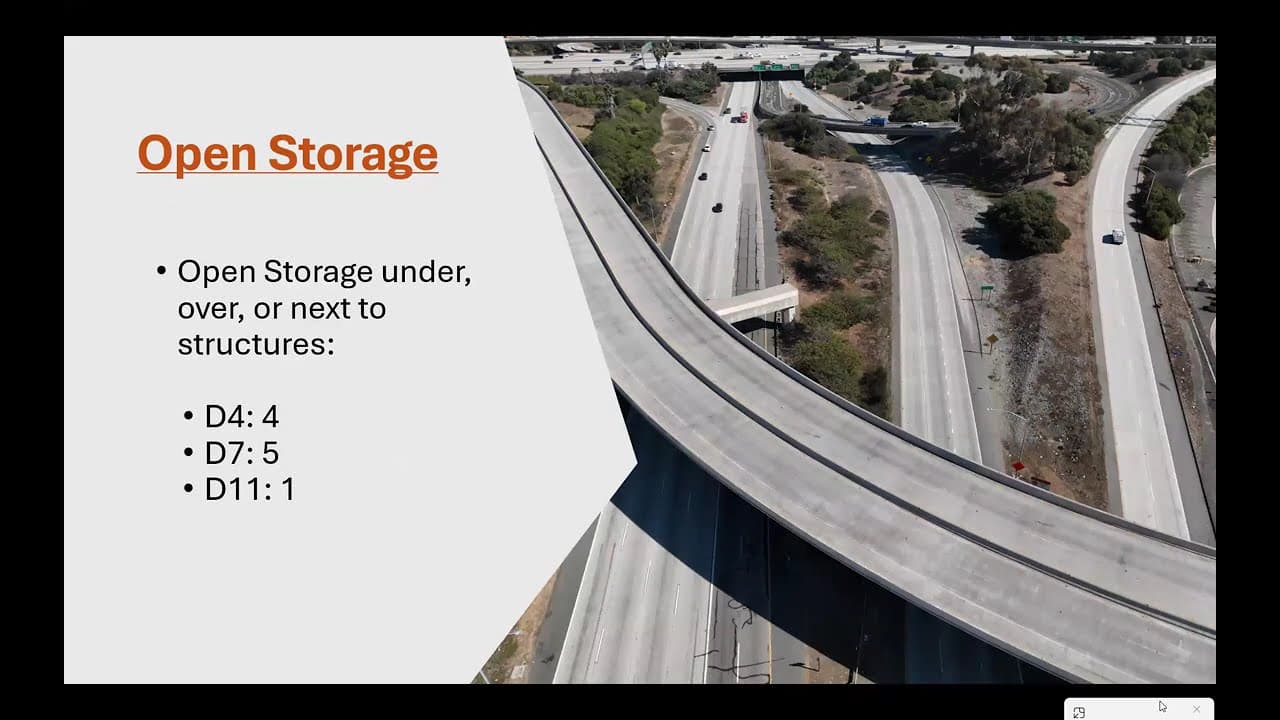
Where things stand: The fourth-quarter report for FY 2025-26 showed 488 managed sites, down from 506. That total includes 167 wireless sites and 162 parking sites. Open-storage sites fell from 21 to 10 because the Federal Highway Administration no longer allows that use on interstates. Holdovers dropped from 151 to 100. Still, 23 sites carry $1.45M in past-due rent, 79 sites have compliance issues and 33 failed State Fire Marshal inspections.
Tiara Maureen, Deputy Division Chief, Division of Right-of-Way and Land Surveys, Caltrans, walked through a 180-day corrective action plan prepared for the Independent Office of Audits and Investigations. Caltrans has completed three steps:
- A contract for delivery
- Expiration tracking
- An approval memo for direct negotiation
The remaining steps are on a staged calendar:
- An Airspace Academy in November 2026
- Record audits by Dec. 31, 2026
- Tenant billing adjustments by Feb. 1, 2027
- An escalation clause policy by March 2027
- Repayment plans by May 31, 2027
The other side: Commissioner Lee Ann Eager asked how much revenue the program brings in each year and what share is delinquent. The presenter did not have those figures on hand. A staff member explained that lease revenue "generally speaking, is not money that stays with the department." Instead, it pays debt service on transportation bonds. Staff later corrected the legal citation to "Section 183.1 of the Streets and Highways Code."
Commission Chair Clarissa Reyes Falcon asked how Caltrans designed the plan. "We contacted a couple of other states, specifically like Washington and Oregon and Nevada," said Maureen.
Decisions and stakeholder impacts: This was an information item, so no vote was taken. In a related action (Tab 79), the Commission authorized Caltrans to negotiate eight leases directly instead of bidding them out. Six are temporary construction encroachments: five tower cranes and one tieback lease under a highway. The others are landlocked parcels that can only be reached through adjacent private property.
"The Streets and Highways Code requires these leases to be competitively bid unless the commission finds by unanimous vote that direct negotiation is in the best interest of the state," said Commission staff. Commissioner Zahirah Mann made the motion and Commissioner Darnell Grisby seconded it. The Chair announced it passed with no opposition or abstentions. Builders and adjacent landowners benefit most from the approval. Item 80 was withdrawn.
What's next: Caltrans owes the Commission its revenue and delinquency figures. Final terms for the eight leases will come back to the Commission for approval.
SMART Rolls Toward Healdsburg With $162M
Why it matters: The extension aims to ease congestion on US 101 and connect North Bay residents to housing, tourism and job centers.
Where things stand: The Commission approved a $162.207M allocation drawn from three programs: Solutions for Congested Corridors, the Local Partnership Program and the Transit and Intercity Rail Capital Program. Earlier in the day, it approved an $800,000 supplement for design work on the Windsor-to-Healdsburg segment (Tab 88). Mann moved that item and Eager seconded.
Joanne Parker of SMART reported the system's current footprint and ridership:
- 14 stations
- 48 miles of rail and 39 miles of pathway
- 1.45 million riders last year
- 25% of riders are youth using the free youth fare
Parker said SMART is delivering the extension through progressive design-build, a method that brings the contractor in early to shape the design before the final price is set. SMART expected to award a contract that Wednesday.
Decisions and stakeholder impacts: Grisby moved approval and Eager seconded. The motion passed by voice vote. Grisby, Eager, Mann and the Chair all praised the project, especially its youth ridership. "You all are doing everything right," said Commissioner Grisby.
Sonoma County gained more at the same meeting. A separate $1.117M Local Partnership allocation (Tab 92) funds a bike and pedestrian crossing of US 101 in Windsor.
Beaumont Steps Back, OCTA Splits Coastal Work
Why it matters: Withdrawing Beaumont's project from the 2024 Trade Corridor Enhancement Program (TCEP) raises capacity for the 2026 cycle to about $1.34B.
Where things stand: The City of Beaumont and Caltrans withdrew the $50.4M Pennsylvania Avenue Grade Separation. Utility, right-of-way and third-party agreement risks threatened the project's delivery deadline.
Mayor Jessica Voigt of Beaumont called the project a top priority for emergency access and goods movement. She said the city supports reapplying in the 2026 cycle and thanked the Commission, the Riverside County Transportation Commission and Caltrans.
The same amendment changed the Orange County Transportation Authority's $80M Coastal Rail Infrastructure Resiliency Project on the LOSSAN rail corridor. OCTA split the unallocated Area 4 and sand nourishment component into two pieces to speed delivery ahead of El Niño storms. Total funding stays at $80M.
The other side: A commissioner asked a broader oversight question. "I was wondering if this is on the state's risk list that we talked about," the commissioner said, referring to statewide utility and railroad negotiation risks. Staff replied, "I do not know the answer to that, but I can look into it and get back to you, Commissioner."
Decisions and stakeholder impacts: Commissioner Paulette Brown-Hinds moved approval and Mann seconded. The Chair called the vote a second time after the question, and the item passed by voice vote. Freight applicants competing in 2026 gain room in the funding pool, while Beaumont goes back into the queue.
What's next: Staff will report back on the risk-list question. Beaumont plans to reapply in the 2026 TCEP cycle.
Tulare Interchange Gets $5.4M After Canal Miscalculation
Why it matters: The SR 99/Page Avenue project aims to reduce truck backups into nearby neighborhoods and add bike and pedestrian access near the International Agri-Center.
Where things stand: The project already had $99.639M programmed across the 2022 and 2024 TCEP cycles. Two problems drove up costs. An administrative error understated the cost of relocating a Tulare Irrigation District canal, and additional canal modifications were needed for Southern California Edison lines.
Caltrans and the Tulare County Association of Governments requested $5.447M from Cycle 5 capacity. Local sources are contributing $8.172M.
Decisions and stakeholder impacts: Eager and Grisby both toured the site. They cited truck queues, neighborhood requests for bike lanes and equity.
"This is an extremely important project in that area," said Commissioner Eager. "This is definitely an environmental justice community that needed support," said Commissioner Grisby.
Eager moved approval and Grisby seconded. The motion passed by voice vote.
The Big-Dollar Slate Passed With Little Debate
Why it matters: These allocations fund local safety, freight, transit and bike projects across the state.
Where things stand: The largest item of the day was the $2,739,885,000 federal allocation for FY 2026-27. Caltrans Local Assistance administers those funds consistent with the 2026 Budget Act. The Commission also approved:
- State Highway Operation and Protection Program (SHOP): $110.092M for nine construction projects and $47.035M for 35 preconstruction phases
- State Transportation Improvement Program (STIP): eight allocations totaling $5.293M
- Freight and zero-emission trucks: about $26.6M across three TCEP projects in Ventura, Long Beach–East Los Angeles and the South Bay
- Active Transportation Program: allocations including a pedestrian-bicycle bridge over SR 99; two projects were pulled from the list
Decisions and stakeholder impacts: The Commission also approved a $106.625M Transit and Intercity Rail Capital Program allocation for 11 bus, ferry and rail projects, including high-speed rail integration. Mann recused herself from that vote over a potential financial conflict.
All allocation items passed by voice vote. Closing out the multi-day hearing, the Chair cited funding "totaling at $3.4 billion, equating to a total of 37,501 jobs."
- SHOP cost increases: About $11M for six projects (Tabs 82–87). Staff said it was "the lowest amount requested for these types of items since June of 2021."
- 2026 SHOP amended: 22 projects added and 16 revised, including four lapsed Los Angeles County projects and a Caldecott tunnel control project.
- Emergency repairs: Caltrans reported about $801M for 191 emergency projects in FY 2025-26, down from $857M the prior year, with about $248M in federal relief.
- Madera County extension: A 12-month post-fact extension for the Lavena project was approved after Caltrans failed to forward the request in time. "I really appreciate the honesty and the teams working together," said Commissioner Eager.
- LA Metro deadline extended: The award deadline for a $20M traction power project on the C and K lines moves to April 30, 2027.
Looking ahead: Kelly Brinkman, representing United Caltrans Tenants of the 710 Corridor and a Pasadena tenant for 20 years, urged the Commission to press Caltrans on home sales under AB 2329. She asked for a public status report, an implementation timeline and written guidance on eligibility and procedures. She also asked for fair purchase opportunities for all tenants, including those in multifamily buildings, and for valuations based on the 2019 appraisal adjusted for current condition. The Commission took no action on the request.