
Forestry Board Re-Adopts Zone Zero Rules Over Homeowner Cost Objections
California Board of Forestry and Fire Protection • CaliforniaNovember 5, 2026
Locunity is an independent informational service and is not an official government page for this commission. All information is sourced from public footage and an analysis of official agendas with the aid of responsible, fact-checked AI. to report an error or omission.
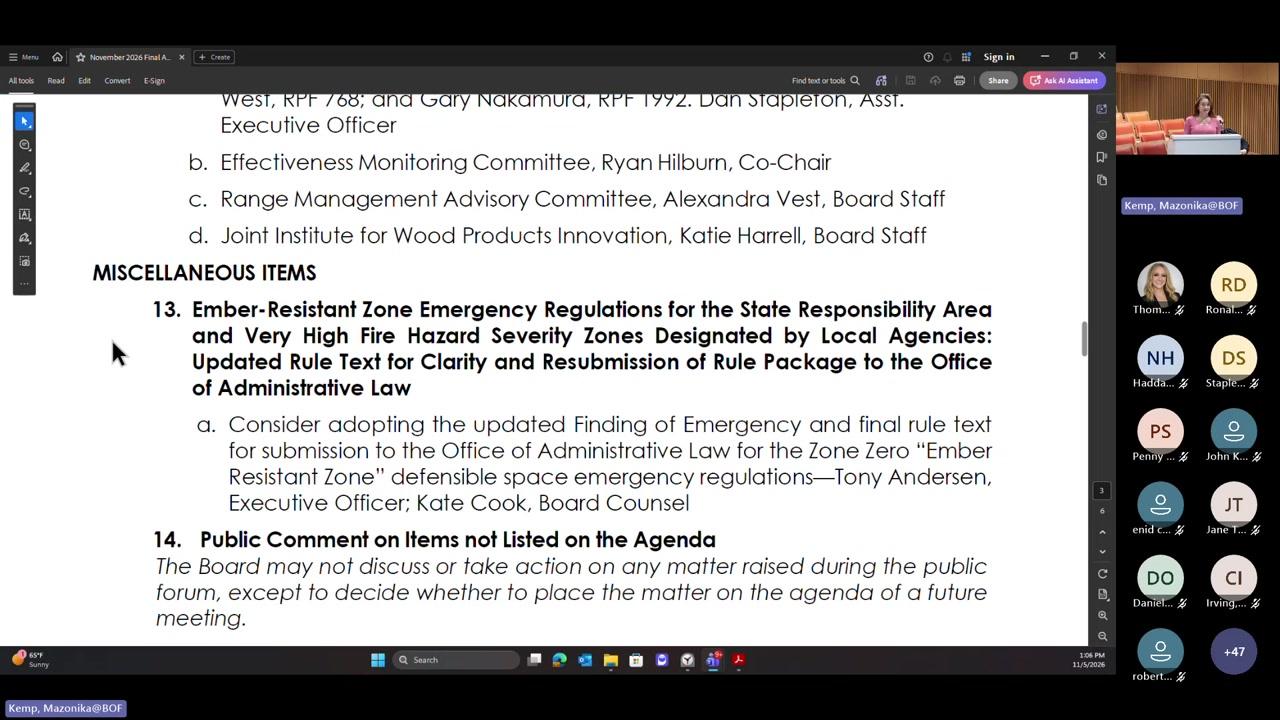
California's Board of Forestry and Fire Protection on Nov. 5, 2026, re-adopted its Zone Zero ember-resistant rules after nearly an hour of testimony, much of it from homeowners in Brentwood, Los Angeles and Berkeley who said the costs are understated and the science is thin. The board also advanced a Professional Forester exam fee increase, heard a stark forest health assessment, and debated how to run itself as new state laws pile on work.
- Zone Zero emergency rules re-adopted and headed back to the Office of Administrative Law after homeowner opposition
- Exam fee for Registered Professional Foresters rises to $450 from $200, approved 5-0 as members pledge to revisit it
- 2.5 million acres of forest in the "zone of imminent mortality," according to a new CAL FIRE assessment
- California Forest Improvement Program has no funding source, the first time in over 12 years
- "Board Forward" plan could mean fewer meetings and new committees; no decision yet
Zone Zero Returns, With Fixes and Familiar Fights
The basics: Zone Zero is a 5-foot ember-resistant zone around structures. It applies in State Responsibility Areas and local very high fire hazard severity zones. Requirements phase in, starting with immediate removal of dead branches and debris, followed by 3-year and 5-year requirements.
Why it matters: The rules reach homeowners, homeowners associations and public buildings in the state's highest-risk areas. Opponents said they could face compliance bills in the tens of thousands of dollars.
Where things stand: Board counsel Kate Cook said the board withdrew its Aug. 19, 2026, package from the Office of Administrative Law (OAL) after comments showed it needed clarity edits. The edits define combustible material and vegetation, clarify how spacing is measured and how trees are treated, set a standard for local alternatives, and move firewood removal to the 3-year phase.
"There were not any major changes to board direction," said Cook.
Cook also confirmed the rules apply to public buildings in local very high hazard zones. In response to a Plumas County commenter, she offered to add language making clear the rules are not meant to override fire code provisions on heating fuel storage.
The other side: Opposition centered on cost, science and process.
- Nathan Haddad, counsel with Paul Hastings for the Brentwood Homeowners Association, opposed adoption on science, clarity, local control and cost grounds.
- Enid Camps said compliance costs run tens of thousands of dollars and urged regular rulemaking or a cost cap instead of emergency rules.
- Dave Lefkwith, president of the Mandeville Canyon Association, disputed the board's finding that the rules impose no local mandate and challenged its cost analysis.
- Emily Loughran, a Brentwood resident, and Diana Nicole, president of the Sunshine Hills Resident Association, said there is no demonstrated community consensus.
- Jane Turjong, a Berkeley homeowner, backed an ember zone in principle. She questioned the cost figures and cited about 20% compliance with Berkeley's own local rule.
Others asked for narrower fixes. Greg Herner of the Synthetic Turf Council asked for consistent wording so noncombustible materials are not banned. John Larcher, chair of the Del Sur Fire Safe Council, said the guidance document no longer matches the rule text and urged coordination with insurers.
Support came from Steve Hawks, senior director for wildfire at the Insurance Institute for Business and Home Safety, and David Fowler, a Sonoma County resident in a very high hazard zone.
Decisions and stakeholder impacts: Board Member Williams set the frame for the vote. "This is essentially a technical review of technical changes to a document," said Williams.
The motion approved an updated finding of emergency, adopted the rules, and authorized staff to submit them to OAL. It passed on a roll call with four ayes recorded, from Board Chair Terrence O'Brien and Board Members Goldsworthy, Hilburn and Williams. Board Member Del Bar's response could not be confirmed. Four members were absent: Lopez, King, Blake and Pardee.
The vote leaves insurers' safety advocates with the rules they wanted. Affluent hillside neighborhoods, which organized much of the opposition, have so far failed to slow the package.
What's next: Staff will open a 5-day comment period and resubmit to OAL. The board authorized further nonsubstantive and clarity changes.
Forester Exam Fee More Than Doubles
Why it matters: Aspiring Registered Professional Foresters (RPFs) will pay $450 to apply for the licensing exam, up from $200. That is the first increase since 1994, and it still falls short of the roughly $460 to $480 the exam costs to run.
Where things stand: Tyler Hullquist, the board's regulations program supervisor, presented the Title 14 changes. Besides the fee, they add pathways to qualifying experience, define supervision, and drop a proposal involving arboriculture.
Assistant Executive Officer Dan Stapleton said the fee had to rise because it has been frozen for decades. Members agreed but did not like the number.
"$450 on the back of a professional forester in a down market is really a lot of money," said Board Member Goldsworthy.
"$450 is a lot of money for the chance to fail the test," said Board Member Hilburn.
Board Member Williams suggested "tying to CPI in the future so that sticker shock is more predictable." Members also floated other funding sources and spreading costs across other fees. Counsel said any changes could be worked out later.
Decisions and stakeholder impacts: The board authorized a 15-day public notice of the changes. For: 5 (O'Brien, Del Bar, Goldsworthy, Hilburn, Williams), Against: 0, Absent: 4. Early-career foresters bear the cost for now. Members said they want to revisit the fee, which could lower it later.
Board Forward: Rethinking How the Board Works
Why it matters: Executive Officer Tony Andersen proposed changes that could alter how often the board meets and how the public engages. The changes come as new laws and a new administration add to the 2027 workload.
"2027 will be a rebuilding year," said Andersen.
Where things stand: The menu includes annual priority-setting, a committee refresh, a standing agenda item for board member communications, and board member leads for initiatives. It also proposes setting meeting schedules by criteria, adding field tours and strengthening federal coordination.
Members raised concerns about public access and about the limits the Bagley-Keene Act places on committees of three. Bagley-Keene is California's open-meeting law for state bodies. Members also said the Effectiveness Monitoring Committee needs clearer direction. O'Brien backed field travel, engagement with the Forest Service and two-member leads.
"It's really important for the board to get out in the field," said O'Brien.
The other side: Paul Mason of the Pacific Forest Trust warned against overreach. He said assigning lead roles does not add capacity and urged workshops modeled on the Air Resources Board.
Longtime commenter Richard Gienger of Forest Forever said the process is hard for the public to follow. "The Board of Forestry has resisted every positive change," said Gienger.
What's next: No vote was taken. Feedback will go into a December memo.
Grim Forest Data, and a Program Without Money
Where things stand: CAL FIRE previewed its Forest and Range Assessment Report, which covers 13 chapters and 52 indicators. The first four chapters are posted, and a second set is due within weeks. Findings include rising high-severity fire and fewer sawmills and biomass plants. A public dashboard is planned for December.
"There's also quite a bit of area, 2.5 million acres, that are in the zone of imminent mortality," said Jamie Lydersen, lead for the report.
"Those were some scary slides," said O'Brien. He said the data should be used to push leaders, including the incoming administration, for urgency and more forest infrastructure.
Why it matters: Earlier, Chief Huff, CAL FIRE deputy director for natural resource management programs, said the California Forest Improvement Program has no funding source for landowner assistance. That is the first time in over 12 years, as greenhouse gas reduction funds shrink.
"CFIP is probably the first recognizable casualty," said Huff.
Decisions and stakeholder impacts: Board members offered to help advocate for the program. Gienger urged using AB 1492 revenues to keep it alive. Small private forest landowners lose a key source of help with forest work while the program lacks funding.
New Laws, Heavier Load
Board Member Goldsworthy, who chairs the Joint Forest Practice and Management Committee, outlined new board duties under four laws:
- SB 1370: a certified regulatory program for vegetation management, with emergency regulations due by July 2028
- AB 706: biomass waste disposal
- AB 2075: emergency rulemaking on fire tools and clearance
- AB 442: higher acreage limits for plans
"This is a waste disposal program. This is not a new market for cutting trees," Goldsworthy said of AB 706.
The board's call for regulatory review drew 16 individual submissions plus agency and industry comments.
"We aren't going to get a total handle on forest health and resilience unless we have additional infrastructure," said O'Brien. He warned of hard priority choices in December and January.
Minor Items
- Research grants approved: The consent calendar funded three Effectiveness Monitoring Committee projects: EMC-2026-003, -004 and -010. They study spotted owl trade-offs, coastal redwood post-fire effects and Sierra Nevada riparian zones. For: 5, Against: 0, Absent: 4.
- Licensing chief retiring: Assistant Executive Officer Dan Stapleton will retire in December. Staff also reported that RPF counts have held nearly steady since 2019 while range manager registrations fell.
- CAL FIRE leadership: Director Joe Tyler was absent and is to deliver his final report in December before retiring.
- Water for firefighting: Board Member Del Bar asked agencies to make off-stream water storage for firefighting easier. "It would be really nice if agencies could work together," said Del Bar.
- Loggers' transition: Eric Carlson announced his retirement after 20 years as executive director of Associated California Loggers. New Executive Director Sam Dorsey will address the board in December.
Looking Ahead
December brings the Board Forward memo, Director Tyler's final report, CAL FIRE's assessment dashboard and the start of priority-setting. Board staff are also preparing a transition report for the incoming administration.