
Calaveras Eyes On-Farm Cannabis Manufacturing, Seeks Waiver for Gann Fire Cleanup
Board of Supervisors • Calaveras CountyNovember 24, 2026
Locunity is an independent informational service and is not an official government page for this commission. All information is sourced from public footage and an analysis of official agendas with the aid of responsible, fact-checked AI. to report an error or omission.
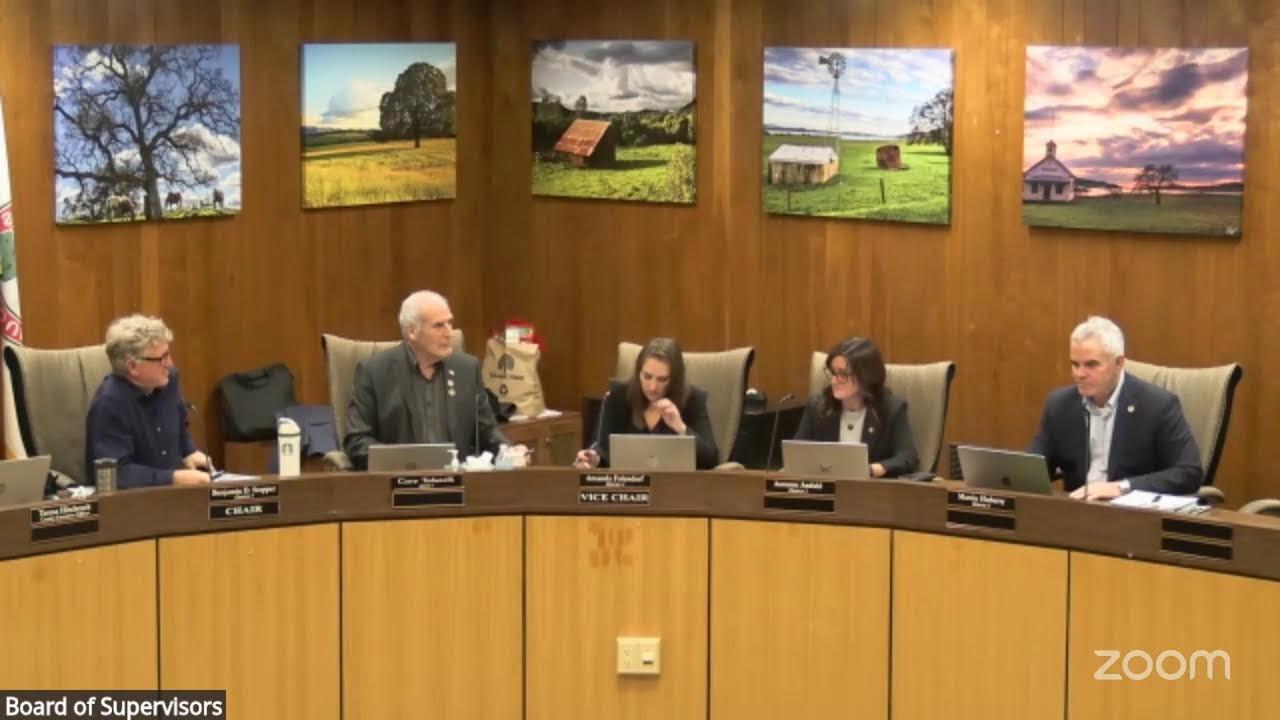
Calaveras County supervisors spent the longest stretch of their Nov. 24, 2026, meeting on how far to open the door for local cannabis farms. They settled on a narrow path: staff will spend six months studying non-volatile manufacturing and direct sales. The board also voted 5-0 to join a roughly $2.4M Gann Fire debris cleanup only if the state waives the county's 25% match, while a contested Appaloosa Road safety reimbursement ended without an announced result.
- Cannabis direction: staff to return in about six months on non-volatile Type 6 manufacturing and retail
- Gann Fire cleanup: board votes 5-0 to seek a waiver of the 25% local match before fronting about $2.4M
- Appaloosa Road: safety reimbursement capped at $76,450; Supervisor Andahl votes no, result not announced
- Cannabis farmers press for on-site processing and direct-to-consumer sales to stabilize their farms
Cannabis: A Narrow Opening for Existing Farms
The basics: Chapter 17.18 is the county code section governing cannabis. A Type 6 license is California's permit for cannabis manufacturing that uses non-volatile processes.
Why it matters: Cultivators say on-site manufacturing and direct-to-consumer sales could stabilize struggling farms. Any ordinance change still faces environmental review under the California Environmental Quality Act (CEQA), county staff capacity limits and litigation risk.
Where things stand: Chief Building Official Doug Oliver worked through a menu of expansion options. He called cannatourism, commercial licenses in commercial and industrial zones, volatile manufacturing and shared-use facilities unreasonable. He said cultivation changes and limited manufacturing were feasible.
"If there's anything that can be done, it's in including limited manufacturing types into our current cultivation scheme," said Oliver.
The revenue upside is modest. Oliver estimated limited manufacturing would bring roughly $250,000 in added tax revenue at best through a 5% excise tax.
Capping the canopy: Oliver said removing the "right to apply" requirement could save applicants about $75,000 per acre. However, the change could push cultivation canopy beyond what the county's environmental impact report (EIR) covers. Supervisor Benjamin Stopper, who chaired the meeting, opposed that idea. "You just added 100 permits to an EIR that tops out at almost 200 acres," he said.
Growers make their case: Three farm operators spoke. Mark Bolger of Rimrock Farms backed non-volatile Type 6 manufacturing and direct-to-consumer sales, saying the industry in other counties is faltering. Tina Alexander of Whiskey Slide Farms said her farm pays out-of-county processors for infused pre-rolls. She asked that unused pre-sunset acreage go to farmers in good standing. Jennifer Smith of Nye Squirrel Farms supported Type 6 licensing and direct sales paired with agritourism, arguing cannabis is agriculture.
The timing fight: Supervisor Amanda Folendorf, District 4, pushed to include retail and speed up the timeline. "I would like to see it back sooner than later," she said. Staff and the county's advisors said six months was the minimum. They cited CEQA requirements, the need for planning expertise and the arrival of a new planning director.
Decisions and stakeholder impacts: The board took no vote but gave direction. Supervisors prefer excluding ethanol and other flammable or hazardous processes, and they said carbon dioxide extraction could be managed through permits. Supervisor Autumn Andahl, District 2, framed the goal as helping current operators "prop up the industry we do have rather than trying to draw to it." Existing cultivators in good standing stand to gain the most. Canopy expansion and changes to the right to apply stay off the table.
What's next: Staff will return in about six months with an informational item on non-volatile Type 6 processes and offsite or direct retail options.
Gann Fire Cleanup Hinges on a State Waiver
Why it matters: The county would front about $2.4M to clear burned private parcels. Reimbursement is uncertain and could take years, while the county's capital account and disaster reserves are limited.
The basics: In a private property debris removal (PPDR) program, the county leads cleanup of burned private parcels and then seeks state and federal reimbursement. APNs are assessor's parcel numbers.
Where things stand: Captain Tim Sturm of the Sheriff's Office/OES and Assistant CEO Denise Huebner recounted the fire. The Gann Fire burned 10,339 acres from Aug. 3–12, 2026, affecting 23 APNs, and the state issued emergency declarations. That makes the county eligible for California Disaster Assistance Act (CDAA) funding and eligible to lead a PPDR program.
Response costs of about $234,600 are 75% covered by a federal Fire Management Assistance Grant (FMAG). After CDAA funding, the county's remaining share is about $14,688.
The cleanup itself is a different scale. Staff estimated about $2.4M, or roughly $100,000 per parcel. For comparison, staff pointed to Bishop at $3.6M for 19 parcels and Tuolumne County at $4.5M for 60 parcels. The county would pay up front, with up to 75% reimbursed, possibly anywhere from six months to four years later.
Huebner warned that "reimbursement is not guaranteed and is often delayed." She noted the program would consume 28% of the capital account's available funds. She added, "I do not believe the county has ever done a county-led program."
Staff offered three options. Option A was to participate outright, Option B was to participate only if the state waives the 25% local match, and Option C was to decline. Staff called Option A infeasible given the county's fiscal condition.
The other side: A Circle 20 resident urged supervisors to look beyond the figures and remove destroyed structures, saying residents are at a standstill.
Decisions and stakeholder impacts: Supervisors weighed a disaster/Gann reserve of roughly $1.2M, an outstanding Butte Fire bill and possible winter flooding. "I would love to see us look for a waiver because we're a small county," said Folendorf.
Vice Chair Martin Huberty, District 3, moved Option B, and the motion passed (For: 5, Against: 0, Absent: 0). The county protects its reserves for now. Fire-affected property owners, however, remain in limbo.
What's next: Staff will report back as updates arrive. No timeline was set for a waiver decision.
Appaloosa Road Fix Splits the Board
Why it matters: The fix responds to a hazard residents tie to a county-run project. Paying for it would tap a strained general fund and could set a precedent for other community services districts (CSDs).
Where things stand: The item returned from Oct. 13 with updated quotes that include prevailing wage, presented by Public Works Director Micah Martin. Residents said the county's Wagon Train project moved the road next to the mailboxes. As a result, drivers stop in the travel lane with poor visibility.
Gina Gonzalez, a public commenter, called the design poor and dangerous, saying her car door was nearly struck. Nick Meyer, Board Chair of the Appaloosa Road CSD, warned of the hazard and a possible lawsuit against the district. Tim Murphy, a CSD board member, said the district struggles to maintain the road.
Supervisors Folendorf, Gary Tofanelli and Huberty said the county bore responsibility. "It's our job to make sure when we do something that it's safe for the people that use it," said Supervisor Gary Tofanelli, District 1. "I do think from a public safety standpoint, I could stand behind this," said Huberty.
The other side: Andahl acknowledged the safety concern but said needs elsewhere in the county outweigh the budget. "I will be voting no on the general fund funding it today," she said. Stopper weighed the safety issue against the fact that the CSD is not a county responsibility.
Decisions and stakeholder impacts: Huberty moved and Folendorf seconded an amended motion. It would reimburse public-safety work only, excluding a sign, not to exceed $76,450. The item required a four-fifths vote. Andahl voted no, but the chair announced no result or tally.
What's next: Residents and CSD leaders should confirm the outcome in the official minutes.
Minor Items
- Opioid settlement: In closed session, the board voted 5-0 to authorize a national opioid litigation settlement (Albertsons Companies, Inc.); terms were not disclosed.
- Public safety labor deal: A one-year MOU with the Public Safety Employees Association was moved and seconded, but no result was announced. It would cover health premium increases of $170, $341 and $443 monthly by tier and raise bilingual pay to $100. It would also double the deferred compensation match to $100.
- 2027 appointments: The board voted 5-0 on regional delegates, shifting ESJPA seats to Public Works staff and adding Andahl as an RCRC alternate.
- Proclamation and consent: The board voted 5-0 to proclaim November Sikh Awareness and Appreciation Month and to approve a consent agenda that included a Toys for Tots donation. Lena Gonzalez of Toys for Tots said need has almost tripled.
- Ethics allegations: Christopher Budner, publisher of calaveraswatchdog.com, alleged the county lacks independent ethics oversight and said he would file Fair Political Practices Commission (FPPC) complaints. The board did not respond, and his claims are unproven.
Looking Ahead
County staff urged residents to prepare sandbags ahead of a wet El Niño winter. The board also adjourned to closed session with one final item still to be reported.