
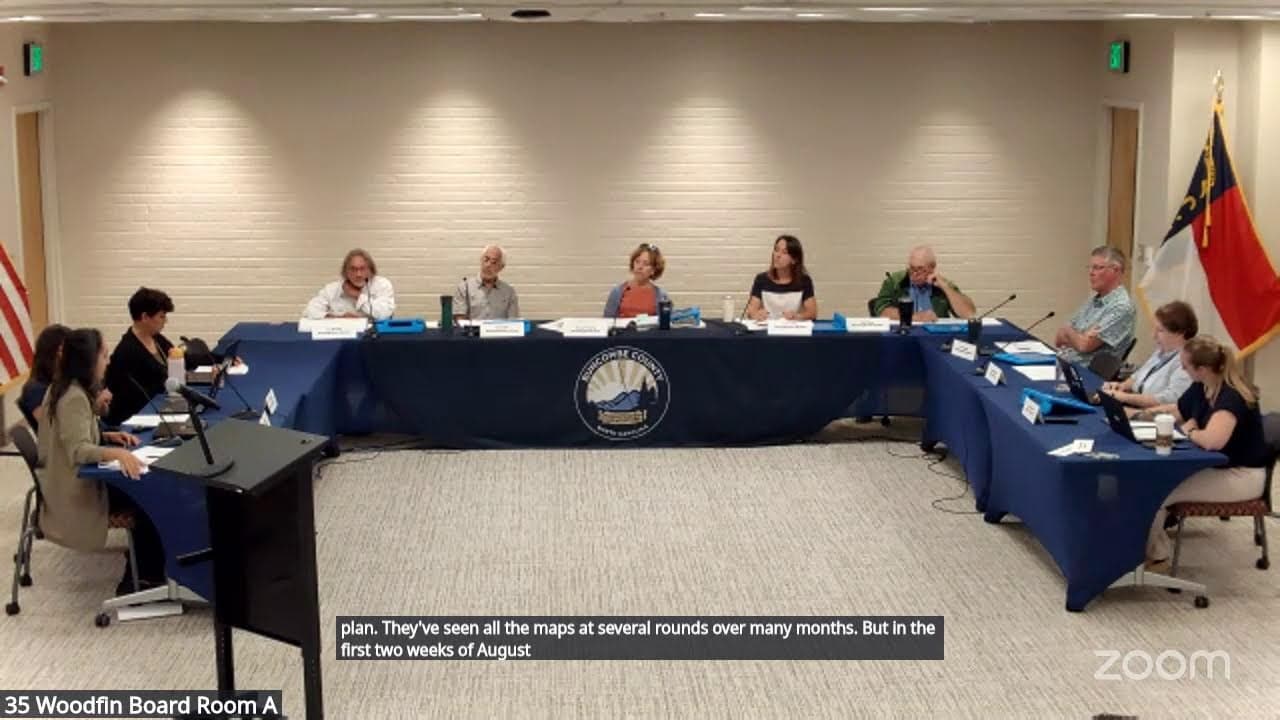
Swannanoa Recovery Plan Heads Toward November Hearings as KOA Downzoning Advances
Planning Board • Buncombe CountyJuly 20, 2026
Locunity is an independent informational service and is not an official government page for this commission. All information is sourced from public footage and an analysis of official agendas with the aid of responsible, fact-checked AI. to report an error or omission.
Buncombe County's Planning Board spent the bulk of its July 20, 2026, meeting on a draft Swannanoa Small Area Plan that became a flood-resilience blueprint after Hurricane Helene. The plan's biggest money lever is entry into FEMA's Community Rating System (CRS), which could cut flood insurance costs, but staff say it is the one action that needs new staff. Members also sent county commissioners a recommendation to rezone two KOA parcels near US 70 from commercial to residential.
- Swannanoa plan review: Members praised the post-Helene draft. Community exhibits are set for early August, with hearings tentatively set for Nov. 16–17.
- Flood insurance savings hinge on CRS entry. Staff call it a top priority but say it is the only five-year action requiring additional staff.
- Board members flagged gaps on impervious surfaces, tree canopy, river-corridor development and interim water monitoring.
- KOA rezoning of 6.77 acres recommended by voice vote. One member recused, and the request now heads to the Board of Commissioners.
Swannanoa Plan Pivots to Recovery, Heads to Hearings
1 big thing: The draft Swannanoa Small Area Plan now covers land use for about 40,000 acres. It grew into something bigger than planners first expected.
"This plan definitely had more of a resilience focus than what we thought when we were going into it, and a lot of recovery discussions," said a county planner.
Why it matters: The plan will guide where and how Swannanoa rebuilds after Helene. Board members are also watching it as a possible model for other communities. The artifact cites Enka as an example.
Where things stand: Staff circulated the draft the prior week. They asked for typo fixes, glossary terms and general feedback. No vote was taken.
Board Chair Nancy Waldrop, who took part in the process, credited residents. "The community was just really great with what they did, and the people there were so concerned and so involved," Waldrop said.
Board Member Ken Kahn compared the effort to a post-disaster community plan he saw in Lyons, Colorado, in 2010. "The only question now is if this serves as a template for future small area plans," Kahn said. Staff answered that each community will have unique needs.
Kahn also pressed on whether outreach reached a "large representative swath." Staff said "we have reached our technical targets of how many people we would ideally want to have to feel like it was representative." They added that they checked geographic spread across rural corners and worked with local nonprofits.
Board Member Carl Kuhn asked staff to update the future land use map on pages 16–17. He wants land that Warren Wilson recently placed in a conservation easement shown as conservation/working land. Kahn asked how close the county is to its open space goal. Staff said they would have to check.
Can staff deliver? Board Member Liza Schillo asked, "Do you feel appropriately resourced?" Staff pointed to hourglass-marked actions, compiled on page 55. These are items staff believe they can start and finish within five years using known money and staff. Many are text amendments that can be handled in-house. Other actions depend on grants or new hires. Kahn called the list "your stake in the ground," and staff agreed.
What's next: The draft goes back to technical agencies for final review. Community exhibits will run in Swannanoa during the first two weeks of August. Staff called them "our last big push to get any big feedback before it goes to public hearing." A Planning Board hearing is tentatively set for Nov. 16, with commissioners taking it up the next day.
Flood Rules, Insurance Costs Dominate Debate
Why it matters: For Swannanoa property owners, the most tangible payoff may be cheaper flood insurance. That savings depends on a program the county is not yet staffed to join.
The CRS math: Kahn asked whether CRS status would "affect insurance rates for the people affected by it?" Staff said yes. "One of the major goals of getting into that program is that it does reduce the community-wide cost for flood insurance," the planner said.
Joining CRS is action B in the five-year plan. Action F, a river corridor standard, and action H, updated flood standards in the zoning ordinance, would earn CRS points. The catch: "That's the only one, as far as I know, that really will require additional staff," the planner said. That means CRS entry could slip if resources fall short.
Where things stand: Schillo raised concerns about denser neighborhood centers. "I didn't see any impervious surface limits or tree canopy requirements," she said, calling it a red flag for flood management. Staff said tree canopy rules would be a countywide matter. They added that impervious limits are being studied for countywide text amendments, and offered to explore referencing them in the plan's land use descriptions.
Kuhn asked whether such rules could apply to Swannanoa alone. Staff said it depends: "an overlay district is a tool where we could impose additional requirements over just a specific area." That approach has been discussed for the River Corridor, though staff said they want to keep the ordinance simple.
The other side: On river-corridor land zoned for low-density residential, Schillo said, "Just my first thought was predatory developers." Staff said low density means single-family homes, maybe duplexes at most. Any building in the 100-year floodplain still needs a flood permit, including elevation above base flood. Staff said floodplain maps could change within a couple of years. They described the approach as keeping high-intensity development out of the most dangerous areas without stripping owners of the right to build on lots already platted.
Septic gap: Schillo noted that sewer extension, action 113 on page 27, is labeled long-term. She asked about interim water quality monitoring. Staff said the action comes from the Helene Recovery Plan and is managed by another department. It is long-term because of feasibility, funding and construction timelines. "We have a lot of failing septic systems throughout Buncombe County, but it's also an issue in Swannanoa," the planner said. The plan includes no monitoring provision. Staff said that would belong in a countywide plan, possibly the comprehensive plan.
Decisions and stakeholder impacts: Swannanoa homeowners and renters stand to gain the most from CRS savings and tighter flood standards. Owners of platted riverside lots keep development rights, subject to flood permits. Residents on failing septic systems face a long wait with no interim monitoring in this plan.
KOA Rezoning Clears Board, Heads to Commissioners
The basics: Kampgrounds of America Inc. asked to rezone two parcels totaling 6.77 acres from CS Commercial to R-3 Residential. The parcels are 517 Lazy Bear Blvd. and an unaddressed lot off US Hwy 70. Current uses include camps, cottages, an RV park and a commercial vacancy.
Why it matters: The change bars most commercial uses, including retail, restaurants, nightclubs, hotels, warehousing and manufacturing. Manufactured homes, manufactured home parks, travel trailers and travel trailer parks would be allowed.
Where things stand: Staff presenter Haley Matvis said density would stay at 12 units per acre. Maximum height would drop, and setbacks would shift. Staff recommended approval, citing alignment with the Comprehensive Plan's future land use map, sewer and water access, and the transportation corridor.
The one plan inconsistency is flooding. "Yes, it is partially in the regulated flood hazard area," Matvis said. A flood permit would still be required. "I don't know that it would make any major difference for how development would occur," she said. Another planner framed the request as "lower density, lower intensity uses with a downzoning," permissible because the owner applied for it.
The other side: No residents spoke. A KOA representative said, "I know of no pushback or any negative feedback." He described the change as "just kind of bringing it in line with what's already there," including storage.
Decisions and stakeholder impacts: Kuhn moved approval with a finding that the rezoning is consistent with the 2043 Comprehensive Plan's growth, equity and conservation goals. The motion passed on a voice vote with no opposition heard. Individual tallies weren't recorded. A board member who arrived late recused: "We do business with the campground, so I will recuse myself from voting on this." KOA gains zoning that matches its campground operations. Nearby businesses lose the prospect of new commercial neighbors on the site. Staff analysis is in the agenda packet.
What's next: The recommendation goes to the Buncombe County Board of Commissioners.
Minor Items
- Agenda approved by voice vote; moved by Tim Collins, seconded by Kahn.
- June 15, 2026, minutes approved by voice vote; moved by Kahn, seconded by Collins.
- General public comment was skipped, then opened after the KOA vote; no one spoke.
- Roll call was taken out of order after a member prompted it.
Looking Ahead
Swannanoa residents get their last big chance to shape the plan at community exhibits in the first two weeks of August. Hearings are tentatively set for Nov. 16 before the Planning Board and the next day before the Board of Commissioners.