
Building Commission Backs Tougher Oversight of Repeat Code Violators
Building Inspection Commission • San FranciscoNovember 18, 2026
Locunity is an independent informational service and is not an official government page for this commission. All information is sourced from public footage and an analysis of official agendas with the aid of responsible, fact-checked AI. to report an error or omission.
San Francisco's Building Inspection Commission voted 5-0 on Nov. 18, 2026, to support an ordinance that would widen the city's list of repeat code violators to cover planning violations and quadruple the window for counting offenses. The same meeting showed how hard enforcement can be in practice: a Valley Street homeowner pressed for action after months of a neighboring building touching his home, and the Department of Building Inspection (DBI) set a two-week deadline for the contractor.
- Commission votes 5-0 to back File No. 261105, expanding and renaming the repeat-violator program
- Look-back window for three violations would grow from 18 to 48 months; only seven people have been listed in five years
- DBI sets a two-week deadline on Valley Street shoring documents, or a notice of violation follows
- Public commenter questions whether the $133.9M 30 Otis Street permit has expired
Repeat-Violator List Gets Wider Reach
The basics: The Expanded Compliance Control Program (ECC) was created in 2021. It flags contractors and owners who rack up violations and subjects their future work to extra scrutiny. File No. 261105, from Supervisor Danny Sauter, would rename it the Compliance Oversight Program and pull the Planning Department fully into it.
Why it matters: Supporters argue the list has barely been used. If the ordinance is enacted, more repeat violators of planning and building rules could face added review before they pull permits again.
Where things stand: Michelle Andrews, legislative aide to Supervisor Danny Sauter, said the ordinance grew out of neighborhood reports of bad actors who defrauded the city.
"Today marks 5 years since the first individual was added to the ECC list. And since then, only 6 other individuals have been added to it," said Andrews.
Tate Hanna, presenting for staff, explained the program's current rules:
- A person is listed after three violations in 18 months, or after an egregious violation that is also a health and safety threat.
- A listing lasts five years.
- Listed parties face senior plan reviewers, pre-permit site inspections and notifications to licensing bodies.
A 2025 ordinance from Supervisor Melgar added a limited set of planning violations to the program.
What would change: The new ordinance would:
- Cover any serious planning code violation.
- Bring the planning director into listing decisions.
- Coordinate final inspections with Planning.
- Extend the window for counting three violations from 18 months to 48 months.
- Loosen the egregious-violation test to "and/or a threat to safety." Under that wording, a violation would no longer need to threaten both health and safety to qualify.
The other side: No opposition surfaced. The Code Advisory Committee recommended approval unanimously on Nov. 10, 2026, and neither department proposed amendments. No members of the public commented.
One commissioner asked whether Planning runs its own compliance program. Staff said it does not; the program is a joint effort that relies on DBI's list. The commissioner then endorsed the measure.
"I'm in support of this legislation. I think it's so obvious and good," said the commissioner.
Decisions and stakeholder impacts: Commissioner Bianca Neumann moved the item, and Commission President Alysabeth Alexander-Tut seconded. The vote was For: 5 (Alexander-Tut, Jang, Lee, Maclise, Neumann), Against: 0, Absent: 1 (Calamuci, excused).
The biggest change for contractors and owners is the 48-month window. Under that rule, scattered violations over four years could add up to a listing. Neighbors who report bad actors gain a broader tool. For Planning, the ordinance formalizes a role in decisions that until now sat mostly with DBI.
What's next: The commission's recommendation goes to the Board of Supervisors, which will act on the ordinance.
Valley Street Neighbor Gets a Deadline, Not an Inspection
Why it matters: A homeowner says a new building has been in contact with his century-old home since July. DBI's answer shows where the department draws the line on its own responsibility for safety between neighboring properties.
Where things stand: During general public comment, Jeremy Beal, a public commenter who lives at 246 Valley Street, said the two buildings are rubbing together. He said his complaint remains open, no lath inspection has been recorded and no written safety determination exists. He asked that DBI do a structural inspection and record the wall's location before approving the lath inspection. He also said staff have not responded to him.
During commissioners' questions, one commissioner pressed DBI directly.
"Has the department looked into the structural integrity and the safety of their property?" the commissioner asked.
Deputy Director Matthew Greene, who oversees Inspection Services at DBI, answered that "we don't normally do structural integrity inspections of properties." He said owners should hire their own engineer.
Greene also said:
- There is a claim against the city.
- A survey suggests Beal's building is out of plumb and crosses the property line.
- DBI is still waiting on shoring and excavation documents for the adjacent site.
"If we don't get it within 2 weeks, we'll issue a notice of violation," said Greene.
The other side: Beal asked President Alexander-Tut, or any commissioner, to place 248 Valley Street on a future agenda as its own item with a staff report. If that is not possible, he asked to be told why. The commission took no action on the request.
Decisions and stakeholder impacts: No vote was taken. Beal now has a concrete enforcement date, but the safety assessment he wants remains the job of a private engineer. The case highlights a gap residents may face citywide: DBI enforces permit documents but generally does not judge the structural risk to a neighboring home.
What's next: DBI said it will issue a notice of violation if the shoring and excavation documents are not filed within two weeks of the meeting.
30 Otis Permit Questions Go Unanswered
Where things stand: Jerry Drattler, a public commenter, used slides to argue that the $133.9M building permit for 30 Otis Street may have expired. His claims:
- No inspections were recorded between February 2022 and January 2026.
- A listed permit expiration date of May 8, 2031, is questionable.
- Sixteen of the project's 22 temporary certificate of occupancy (TCO) extensions were issued retroactively. A TCO lets people occupy a building before final sign-off.
- The 22nd extension expires the day after the meeting.
Why it matters: If substantiated, the claims would raise questions about how DBI enforces permit expiration and occupancy rules on a major project. These are one speaker's allegations, and no commissioner or staff member responded during the meeting.
What's next: Drattler asked the commission to seek advice from the deputy city attorney. No action was taken.
Minor Items
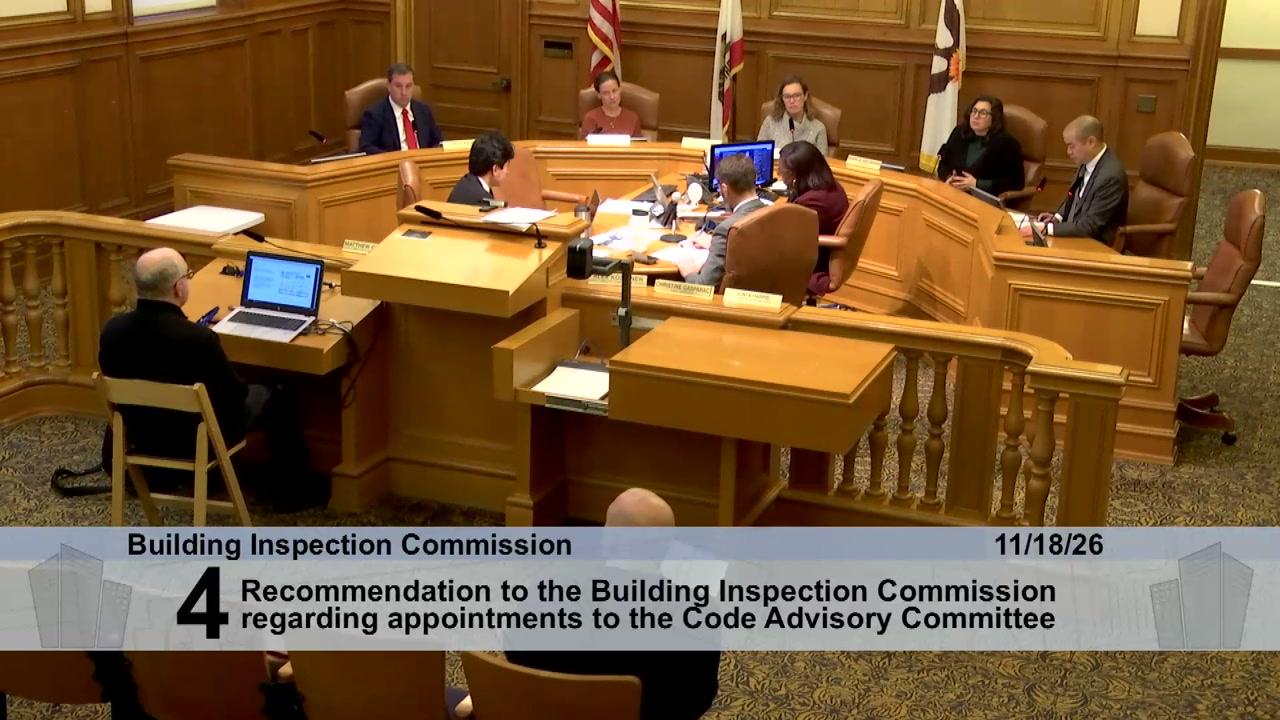
- Code Advisory Committee: The commission voted 5-0 (Calamuci excused) to recommend Glenn Rogers for the licensed residential projects contractor seat, with a term through Aug. 10, 2028. Rogers was sworn in at the meeting. "He has a lot of experience in the residential space and I think will bring a good view to the Code Advisory Committee," said Commissioner Lindsey Maclise, who made the nomination.
- Permit speed: Megan Walsh, Operations and Performance Analytics Manager for the Planning Department, reported that more than 4,600 building applications had been filed in OpenGov as of Nov. 13. Of those, 85% have been issued, with a median of three business days. Over-the-counter permits slipped to a four-day median, partly because some permits remain in the old system.
- Permit module pause: Solar permits will move to OpenGov in the coming months. "We are expecting to have a pause on launching new permit modules for the first half or so in 2027," said Interim Director David Kane.
- DBI finances: About a third of the way through the fiscal year, revenue is ahead of budget and spending is behind. October slowed after a record September. "We're still projecting an overall revenue surplus this year, but something to keep an eye on," said Deputy Director of Administration Alex Costanin.
- Ceiling-height ordinance: Staff flagged that a ceiling-height ordinance takes effect Dec. 3, 2026.
Looking Ahead
President Alexander-Tut reordered the agenda to accommodate an expected mayoral press conference announcing a merged Planning and Building Department, with Kane named as building official. The press conference was apparently canceled, and Kane stayed for the meeting. He promised more details on the merger at future meetings. "We should expect to see some invitations for joint commission hearings in the early part of the next year with the Planning Commission," said Alexander-Tut. The commission's next regular meeting is Dec. 16, 2026.