
Planning-DBI Merger Targets July 2027 as Tenant Advocates Press for Safeguards
Building Inspection Commission • San FranciscoOctober 21, 2026
Locunity is an independent informational service and is not an official government page for this commission. All information is sourced from public footage and an analysis of official agendas with the aid of responsible, fact-checked AI. to report an error or omission.
San Francisco's Planning Department and Department of Building Inspection are on track to become one agency by July 1, 2027. At the Building Inspection Commission's Oct. 21, 2026, meeting, leaders said the merged agency would be fee-funded with no planned job losses. Tenant groups and commissioners are focused on one question: whether housing inspection, the city's main habitability enforcement tool for roughly 400,000 tenants, survives the reorganization intact.
- Planning and DBI target July 1, 2027, merger, with legislation and a budget returning this winter and spring
- Commissioners press on general fund exposure and the building official's independence
- Housing inspectors logged 6,768 cases last year and are asking for a full-time outreach coordinator
- Tenant groups from the Tenderloin, Chinatown and citywide call for more inspectors
- 248 Valley Street neighbors demand a written DBI report on buildings they say still touch
Merger Timeline Set; Protections Still Being Written
Why it matters: DBI is self-funded through fees. Commissioners and tenant advocates fear a merger could expose its housing inspection work to general fund pressure and weaken the building official's authority.
Where things stand: Planning Director Sarah Dennis Phillips and Interim Director David Kane described four guiding principles and a phased rollout:
- Technology and Permit Center staff merged in early 2026.
- Administration, finance and policy followed in summer 2026.
- The final phase depends on November ballot measures.
Phillips framed the effort as consolidation rather than repair. "There is not a broken thing that we are trying to correct here," said Phillips.
She also addressed staffing directly. "We have not released any personnel," said Phillips.
Alex Koskinen, Deputy Director of Administration at DBI, said both departments are projected to run surpluses of about $10 million each and no cross-subsidization is planned. "The goal right now is for both departments to be fully fee-funded," said Koskinen.
The other side: Commissioners pushed on funding and independence.
- "My concern is in the merger that DBI could come under the general fund," said Commissioner McLeese.
- Commission President Alexander Toot asked about safeguards for code enforcers: "What is the structural protection they have to do their jobs without political influence?"
Kane answered that the building official would remain a senior role. "There is some autonomy there to enforce safety requirements and follow the building code," said Kane. Phillips added that pending legislation is about naming: "Our thinking is that it's simply naming legislation, not changing the spirit or content of code provisions."
On housing inspection funding, Phillips pointed to dedicated sources. "We have revenue sources, including taxes on rental buildings, that support those," said Phillips.
Public commenters laid out what they want protected:
- Lisa of Chinatown Community Development Center urged keeping core housing inspection, community partnerships, financial separation and public visibility. "It does not merge on basically the backs of the tenants that we serve," she said.
- Joseph Schmook of the Race and Equity in All Planning Coalition warned that programs like the Code Enforcement Outreach Program could be lost. He noted that action 2.1.3 of the city's Housing Element, its state-required housing plan, explicitly names that program.
- Georgia Schuttish, a public commenter, praised the Commission's letter supporting keeping the Building Inspection Commission and Planning Commission separate. She asked officials to reconcile how the two departments define demolition and to retain the permit tracking system.
Decisions and stakeholder impacts: This was an informational item, and no vote was taken. Tenants, community-based organizations and fee-paying permit customers all have a stake in how fees, oversight and housing enforcement are structured. Toot signaled the Commission may lean in on staffing: "We also want to be advocates for additional positions and right-sizing different things."
What's next: Merger legislation and a new budget are expected this winter and spring and will return to the Commission.
Housing Inspectors Ask for Help as Caseloads Concentrate
Why it matters: Housing Inspection Services enforces habitability standards for roughly 400,000 tenants. Four districts account for 40% of cited items. "San Francisco has one of the highest percentage of tenants in the nation," said a Housing Inspection Services presenter.
Where things stand: The division reported 6,768 cases last year and an 88% abatement rate, meaning the share of violations corrected. The presenter walked through the complaint-to-penalty process, including:
- Section 204 litigation carrying penalties of $1,000 per day.
- A settlement of roughly $9 million.
- Redrawn inspection districts in the Tenderloin.
The presenter's main ask was staff. "It would help to have a dedicated position for full-time program coordinator for code enforcement outreach and DSROs," said the presenter.
Kane said DBI is weighing the request. "We are looking at the fee model that we have and looking at the budget to see if we can expand capacity," said Kane. Asked about criminal referrals, the presenter said efforts with the district attorney have had limited success: "We haven't really gotten much success going that route."
The other side: Community groups backed the program but said it needs more resources.
- Pratibha Tekke, who oversees the Tenderloin Housing Clinic's code enforcement program, described outreach and SRO collaboration work and asked for more inspectors. "So we are the glue in between," she said.
- Sandy Jiang of Chinatown Community Development Center said SRO residents underreport problems. "But Chinatown made only 310 calls last year, below the citywide average, while inspectors found 3,816 items, well above average," said Jiang. She urged tighter coordination among DBI, the Department of Public Health and the Fire Department.
- Maria Samuli, Executive Director of the Housing Rights Committee of San Francisco, called for a fully staffed inspector program. She cited accountability problems at Alice Griffith. "Across the city, we are seeing an increase in fires," said Samuli.
Decisions and stakeholder impacts: No vote was taken. SRO tenants in the Tenderloin, South of Market and Chinatown, along with the nonprofits that connect them to inspectors, have the most riding on staffing decisions. The same nonprofits are lobbying to protect the program in the merger.
What's next: DBI will evaluate added inspection capacity as part of its budget process.
Valley Street Neighbors Escalate Complaints Against DBI
Why it matters: Residents allege DBI inspectors closed complaints early and that the department reviewed complaints about its own conduct internally. Their case tests how DBI handles complaints about itself.
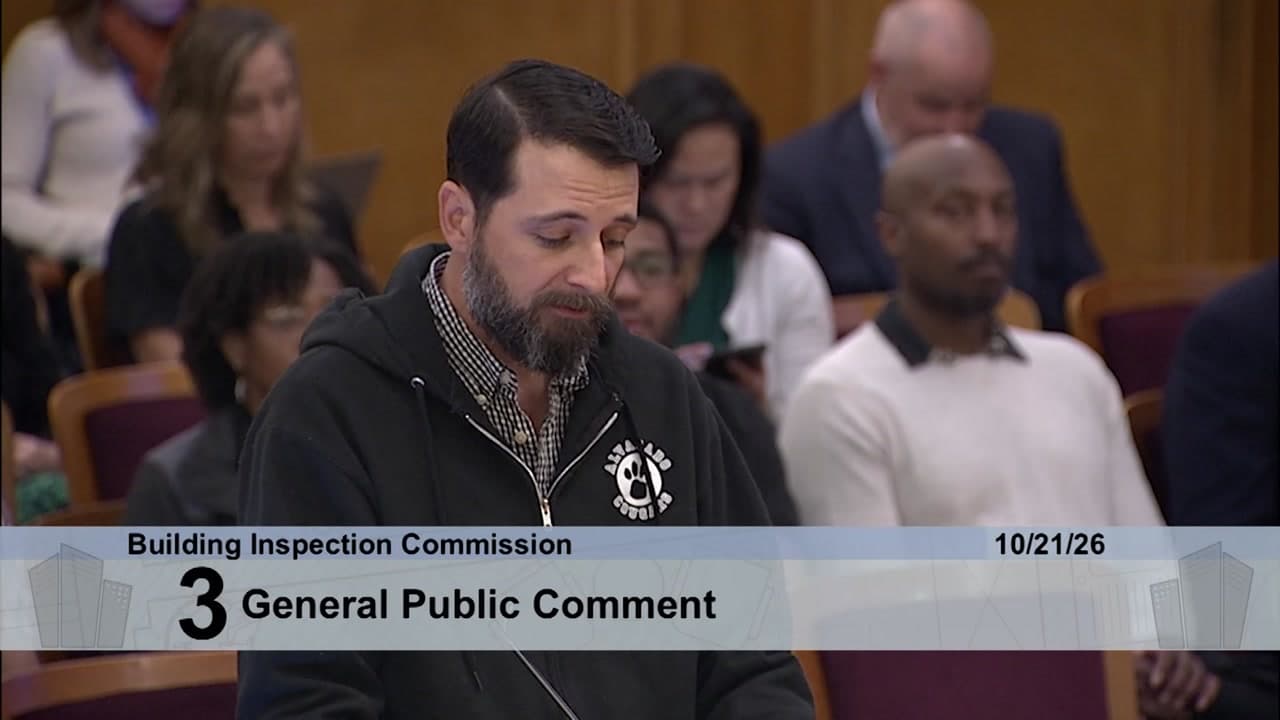
Where things stand: Jeremy Beal, a 246 Valley Street resident, first raised the issue during general public comment. "Who reviews complaints about the Department of Building Inspection's own handling of a case?" said Beal. He returned under commissioners' questions to ask the Commission to:
- Agendize 248 Valley Street as a standalone item.
- Require a written staff report.
- Measure the contact between the buildings.
- Review the closed complaints.
Kimberly Beal, also of 246 Valley Street, described digging against her home, new cracks and ongoing contact between the buildings. "No one from DBI has ever told us in writing whether our home is safe for our family," she said.
David Chow, owner of 244-246 Valley Street, said he received no notice before excavation. "I have not given any written consent to this contact or to any work on my building," said Chow.
Another public commenter, a Noe Valley resident, said the project's entitlement sold for more than $2.5 million. The commenter framed the dispute as an equity issue for the tenants next door. Schuttish argued that projects approved as "tantamount to demolition" under the planning code should be reviewed by DBI as demolitions.
The other side: Deputy Director Matthew Green said a whistleblower complaint was closed by the Comptroller's Office. He said a third senior inspector is now assigned and another inspection is scheduled. He limited further comment because of pending litigation. "There is also an active claim against the city that we are cooperating with the city attorney on at the moment," said Green.
Decisions and stakeholder impacts: The Commission took no action. The president asked the Commission secretary to give Jeremy Beal contact information for outside complaint bodies. The neighbors' requested written report remains pending.
What's next: DBI has another inspection scheduled. No agenda item on 248 Valley Street has been set.
Minor Items
- DBI finances: DBI collected $93M against $74M budgeted. Koskinen said "there is very likely to be fee decreases for next fiscal year."
- Winter prep: DBI forecasts 30% more rain and over 25 king tides. Water and flood complaint deadlines drop from 30 to 15 days.
- PermitSF: Median over-the-counter permit issuance rose to five days from one. Median in-house permits took 143 days over the past 12 months.
- Legislation: The ceiling-height ordinance awaits a full Board of Supervisors hearing, Planning's Tate Hanna said.
- Leadership vacancies: The Commission took no action on the vice president election or subcommittee seats. It approved the Aug. 19, 2026, minutes by voice vote.
Looking Ahead
The Commission's next regular meeting is Nov. 18. Planning staff expect to bring an expansion of the compliance control program, which would add planning code violations and lengthen the current window of "3 violations in 18 months." DBI also expects to release EGO-6, an information sheet on secondary egress tied to single-stair reform, "in the next few weeks," Kane said. Solar permits are slated to move into PermitSF near year-end.