
Budget & Finance Committee - Jul 08, 2026 - Regular Meeting
Budget & Finance Committee • San FranciscoJuly 8, 2026
Locunity is a independent informational service and is not an official government page for this commission.We use AI-assisted analysis and human editorial review to publish information.
Cal Academy Faces First-Ever Audit as Workers Decry Layoffs and Executive Pay
The San Francisco Board of Supervisors' Budget & Finance Committee unanimously advanced all 13 items on its July 8 agenda, but the marquee action was a pointed directive: audit the California Academy of Sciences for the first time in the institution's 170-year history. Laid-off workers, union representatives, and supervisors painted a picture of opaque finances, top-heavy management, and executive bonuses exceeding $100,000 at an organization that operates on city land, receives general fund support, and sits atop a $200 million endowment — all while cutting more than 50 jobs.
Beyond Golden Gate Park, the committee moved forward on a 10% jump in city health insurance costs that will push the annual bill past $1.1 billion, a $40 million public-private redesign of Embarcadero Plaza, $270 million in school bonds, and final funding for a nearly $80 million Mission Bay ferry terminal that will host the nation's first electrified ferry system.
- Cal Academy ordered to submit to first-ever performance audit after layoffs of 50+ workers; city places half the institution's budget on reserve
- City health benefits costs climb 10% to $1.1 billion, driven by GLP-1 drugs, gene therapies, and hospital consolidation
- $40 million Embarcadero Plaza and Sue Bierman Park renovation advances with $20 million in private fundraising
- $270 million in SFUSD bonds approved as the district taps its second tranche of Prop A 2024
- Mission Bay Ferry Landing secures final $8.5 million from UCSF and the transportation authority as construction nears
- Wastewater drug monitoring program launched to detect emerging synthetic threats beyond fentanyl
Workers, Supervisors Demand Answers From Cal Academy
The California Academy of Sciences — a jewel of Golden Gate Park and one of San Francisco's most prominent cultural institutions — will undergo its first-ever performance and management audit after the Budget & Finance Committee unanimously advanced a motion by Supervisor Myrna Melgar directing the Budget and Legislative Analyst and the Controller's Office to conduct the review.
Why it matters: The Academy operates on city-owned land and receives general fund support, but it has never been subject to a city audit. The committee placed the second half of the Academy's current-year budget — and the entire second year — on reserve pending results. The BLA estimated the audit would take six to nine months, assuming cooperation.
Where things stand: The audit was triggered by this spring's layoff of more than 50 workers, questions about executive compensation, and concerns about the institution's financial trajectory. Supervisor Melgar framed the moment bluntly: "The recent layoffs of the workers at the Cal Academy is alarming, and we are hearing some of the executive decisions that could have exacerbated the financial health of this institution."
She also flagged a pattern of repeated refinancing. "This institution has refinanced repeatedly, which, if you know from personal finance coaching, is something that you shouldn't do while you're not paying down debt," said Supervisor Melgar.
Chair Connie Chan zeroed in on the Academy's balance sheet, specifically a $200 million endowment that includes $50 million in unrestricted funds. "I am also interested to understand the $200 million endowment that Academy of Sciences has — that is inclusive of $50 million that is unrestricted — and how is that managed by the board and the administration," she said.
Six public commenters — all supporting the audit — delivered emotional testimony that gave the financial questions a human face.
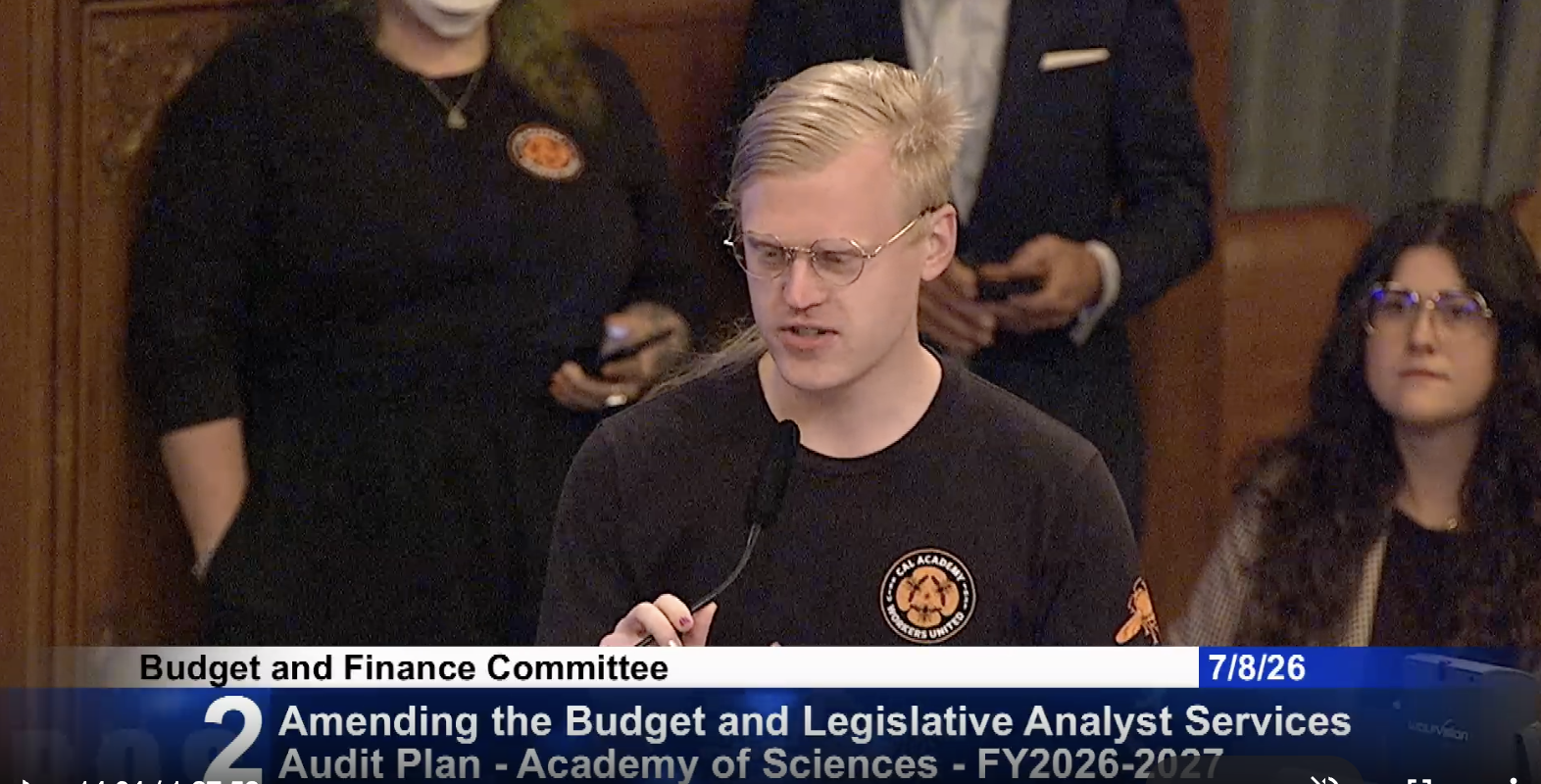
Teddy Voelman, chapter board president of Cal Academy Workers United (SEIU Local 1021), told the committee that the union was denied financial information during layoff bargaining. He described a management structure he called "top heavy" and "opaque," citing the Education Division as an example: "The Education Division is going from having two directors to three directors. And so this is just one personal example I have seen of a top-heavy management style that is very opaque." Three part-time science education presenters — costing roughly $60,000 to $80,000 total — were laid off while that third director was added.
Michael H. Santos, a volunteer diver at the Academy for more than a decade, drew the sharpest contrast between leadership pay and the institution's bottom line. "Executives are receiving bonuses in excess of $100,000 a year while steering an organization that loses millions of dollars in that same year. There's something wrong," he said.
T.R. Malcolm, a recently laid-off creative team project manager, testified that dozens of creative staff — storytellers, graphic designers, photographers, exhibit designers — had been cut, with their work contracted out in what he described as a violation of the union contract. He said the layoffs represent 377 years of institutional knowledge lost.
Elizabeth Travels Light, a field representative for SEIU Local 1021, drew parallels to the closures of the SF Art Institute and California College of the Arts, citing risky debt, wage gaps, and an absence of leadership accountability.
Kate Muir Welch, an Exploratorium employee and 60-year San Francisco resident, said the Academy layoffs had rippled through the broader museum community, noting that the elimination of the professional development group in the Academy's education division had affected colleagues at other institutions.
Emily Abraham, the Academy's director of government affairs, welcomed the audit and pledged full cooperation, but emphasized that the release of reserve funds at the end of the year is critical for operations, building infrastructure, and the animals in the aquarium.
The motion also directs the Controller's Office to review the Academy's assets, debts, and investments, and to establish best practices for governance of cultural institutions operating on city land — a provision that could set a precedent for other organizations in similar arrangements.
Decisions: Passed 3-0 (For: Supervisors Chan, Dorsey, Sauter; Against: none; Absent: none).
What's next: The BLA audit is expected to take six to nine months. The second half of the Academy's budget remains on reserve pending findings.
City Health Costs Hit $1.1 Billion
The committee approved a 10.11% increase in city employee health premiums for calendar year 2027, pushing the city's total share from roughly $1 billion to approximately $1.1 billion — an increase of about $100 million in a single year.
Why it matters: The increase lands during an already constrained budget cycle. The city manages health benefits for more than 139,000 members through the Health Service System, and the $100 million annual jump narrows room for other spending priorities.
Where things stand: Vice Chair Matt Dorsey, who serves as the Board of Supervisors' representative on the Health Service Board, presented the item alongside HSS Executive Director Ray Guillen and Chief Financial and Affordability Officer Theresa Tan.
Supervisor Dorsey set the national context: "At a time when headline inflation, or CPI, is running around 4%, employers are seeing increases to health benefit costs that range from about 6.5% to double-digit increases." A 10-county California survey showed a 9.3% average increase; the national average is 9.5%.
Key cost drivers include surging utilization of GLP-1 weight-loss medications, gene and cell therapy expenses, high-cost claims, provider consolidation reducing competition, and post-pandemic healthcare labor shortages. Executive Director Guillen detailed how each premium dollar is allocated: "82.5% of every premium dollar will pay for medical services to our members like hospital stays, doctor's visits, and lab tests. 15.3% covers the cost of prescription drugs." Administration accounts for 2.1%, with taxes and fees under 0.5%.
The other side: The Budget and Legislative Analyst flagged a notable decision by the Health Service Board: it chose not to switch from Delta Dental to MetLife, despite MetLife's bid offering an estimated $11.6 million in annual savings. The board determined that MetLife's smaller provider network would cause too much disruption for members.
No major plan design changes are proposed except the discontinuation of the Kaiser plan covering approximately 200 retirees in Washington, Oregon, and Hawaii — alternative plans remain available — and new restrictions on weight-loss medications.
Chair Chan discussed the importance of aligning HSS rate-increase timing with the budget process to avoid fiscal surprises and requested continued monitoring of discussions between Blue Shield and the Protect Our Benefits advocacy group. HSS confirmed the next meeting between those parties was scheduled for the following Monday.
Decisions: Passed 3-0 (For: Supervisors Chan, Dorsey, Sauter; Against: none; Absent: none).
$40 Million Embarcadero Plaza Redesign Moves Forward
The committee authorized the Recreation and Park Department to accept up to $20 million from the San Francisco Downtown Development Corporation for the renovation of Embarcadero Plaza and Sue Bierman Park — the culmination of a roughly $40 million public-private partnership aimed at transforming a relic of the demolished Embarcadero Freeway into a new civic centerpiece.
Why it matters: The project would finally address the urban divide left by the freeway demolition, creating improved connectivity between downtown and the waterfront for thousands of nearby residents.
Where things stand: Supervisor Danny Sauter introduced the resolution. Lisa Branston, Rec & Park's director of partnerships, presented the funding structure: BXP has contributed a $2.55 million in-kind design grant, the Downtown SF Partnership has raised $2 million, and the DDC has committed to fundraising the remaining $20 million. The city's share totals approximately $18 million from various public sources, including nearly $14 million from the Vibrant SF 2024 bond, with additional contributions from OEWD.
The concept plan was approved by the Rec & Park Commission the prior month following three community meetings and thousands of surveys. The redesigned space will include fitness areas, a dog park, and improved connectivity between downtown and the waterfront. Supervisor Sauter emphasized the benefit to nearby residents, particularly the Gateway Tenants Association.
TJ Wenzel, managing director of capital initiatives for the DDC, testified in support, describing the project as one of the most important initiatives to strengthen San Francisco's "global front door."
Decisions: Passed 3-0 (For: Supervisors Chan, Dorsey, Sauter; Against: none; Absent: none).
Mission Bay Ferry Landing Locks In Final Funding
Three related items secured the last major funding pieces for the nearly $80 million Mission Bay Ferry Landing, which will host the nation's first electrified ferry system in partnership with SF Bay Ferry.
Why it matters: The terminal will serve San Francisco's fastest-growing neighborhood — home to Chase Center, Mission Rock, UCSF's campus, and the Dogpatch and Pier 70 developments — without adding cars to already strained roadways.
Where things stand: The committee approved two accept-and-expend resolutions — a $4 million grant from UCSF and $4.5 million from the SFCTA (Proposition L sales tax funds) — and a retroactive contract extension with COWI-OLMM Joint Venture for design services through June 30, 2028, necessitated by delays in Regional Measure 3 implementation. Item 6 was amended on the floor to add retroactive language.
Vice Chair Dorsey championed the package: "Importantly, these actions do not require new general fund dollars. As I understand it, we're leveraging outside funding to deliver a major piece of public infrastructure."
Ami Alden of UCSF testified that roughly half of UCSF's employees live in the East Bay and noted that arriving ferry riders will be able to connect to UCSF's existing free all-electric shuttle system serving locations across San Francisco, including SF General Hospital, the VA, the Parnassus campus, and Civic Center BART.
The project also leverages EPA grants enabling ferry electrification, Bay Bridge toll revenue from Regional Measure 3, port harbor funds, and initial general fund support.
Decisions: All three items passed 3-0 (For: Supervisors Chan, Dorsey, Sauter; Against: none; Absent: none).
Wastewater Monitoring Targets Emerging Synthetic Drugs
The committee approved an $87,000 in-kind gift from Biobot Analytics for wastewater analysis services that will allow the Department of Public Health, in partnership with the Public Utilities Commission, to detect novel synthetic drugs circulating in San Francisco's drug supply at the population level — before they show up in emergency rooms.
Vice Chair Dorsey championed the item and underscored the urgency: "In the synthetic drug era, fentanyl was only the beginning. It is also nitazines, which is the new synthetic opioids. Xylazine — the trank — metatomidine, the new trank, cycloprophene."
Dr. Jeffrey Hamm, DPH's medical officer for science and policy, explained that the program will complement clinical surveillance data by monitoring wastewater for emerging substances. The retroactive authorization was needed because DPH received notice of the gift only 22 days before the project period began.
Decisions: Passed 3-0 (For: Supervisors Chan, Dorsey, Sauter; Against: none; Absent: none).
Minor Items
-
Grant approval threshold raised from $100,000 to $1 million. An ordinance raising the minimum grant amount requiring Board of Supervisors approval to the greater of $1 million or the federal single audit threshold, effective Oct. 1, 2026. The measure also narrows when grant increases trigger Board review and exempts gifts of legal services from the $10,000 gift acceptance threshold. Continued from June 6 and June 17. Passed 3-0.
-
$270 million in SFUSD bonds advance. The committee approved the issuance of up to $270 million in Series B general obligation bonds from the $790 million Prop A 2024 authorization. Series A of $160 million was issued in April 2025. The bonds carry a not-to-exceed true interest cost of 6% with a maximum 25-year repayment term. The district is also considering refunding older bonds (2006 Series F, 2011 Series B-C, 2016 Series A) for taxpayer savings. Pricing expected August-September 2026. Passed 3-0.
-
SFO approves nap rooms and speakeasy lounge. A 12-year lease with Hotel Zoe LLC for a "Travelers Retreat" in Harvey Milk Terminal 1 and Terminal 3, featuring private nap rooms with sleep and shower services ("Wait and Rest") and a speakeasy-inspired lounge with Japanese-Peruvian cuisine ("Lost Gate"). Minimum annual guarantee of $350,000; 15% of rent (~$630,000 over 12 years) flows to the general fund. Passed 3-0.
-
SFO terminates underperforming Sweet Maple lease. SSP America's Sweet Maple restaurant in Terminal 2 consistently underperformed on sales per square foot. The freed space will accommodate a retail marketplace relocation and a future passenger lounge. Passed 3-0.
-
DA secures $275,000 restitution grant. A three-year grant from the California Victim Compensation Board funds a restitution specialist who pursues restitution owed to the state board and works alongside victim advocates and assistant district attorneys. Passed 3-0.
-
DA launches Project Restore. A $200,000 gift from the Chris Larson Fund (facilitated by Silicon Valley Community Foundation, through Five Keys) creates safe, healing-centered respite housing for women and their children in the aftermath of violent crime — addressing a gap identified over nine years of victim services work. Passed 3-0.