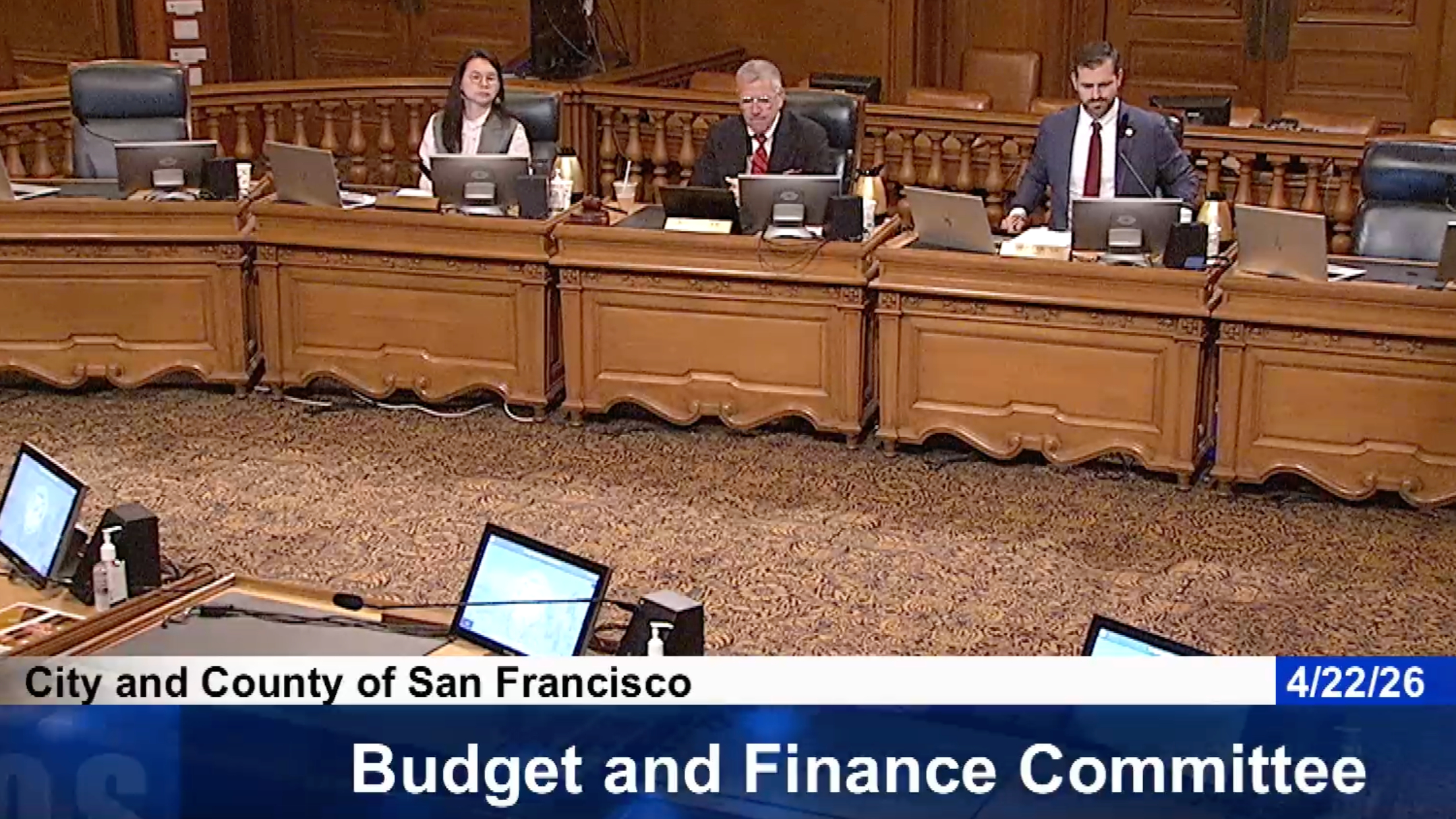
Budget & Finance Committee - Apr 22, 2026 - Regular Meeting

Budget & Finance Committee - Apr 22, 2026 - Regular Meeting

Budget & Finance CommitteeSan FranciscoApril 22, 2026

Sources:

Locunity is a independent informational service and is not an official government page for this commission.We use AI-assisted analysis and human editorial review to publish information.

SF Advances Four-Year Police and Fire Contracts With 14% Raises, $43M in Federal Grants

San Francisco's Budget and Finance Committee unanimously cleared a sweeping package of public safety and housing measures Wednesday, headlined by four-year labor agreements with the city's police and fire unions that lock in 14% wage increases and new recruitment incentives during a period of chronic understaffing. The committee also forwarded nearly $37.5 million in federal housing and homelessness grants and approved a $6.25 million DOJ hiring grant already under legal challenge.

  • Four-year police and fire contracts advance with 14% raises, $25K lateral signing bonuses, and the first field training officer pay increase in 20 years

  • $37.5M in federal HUD grants for affordable housing, homelessness services, and HIV/AIDS support move to the full board

  • Committee approves $6.25M DOJ grant to hire 50 new officers — City Attorney David Chiu fighting unlawful conditions attached by the federal government

  • $537K in police overtime reserve released, highlighting fiscal strain of understaffing

  • Chinatown Public Health Center lease amendment adds $500K for state-mandated fire safety upgrades


Stability and Certainty: Police and Fire Lock In Four-Year Deals

The committee's main event was three ordinances implementing successor labor agreements with the San Francisco Police Officers Association and the San Francisco Firefighters Union Local 798 (Units 1 and 2), covering July 2026 through June 2030. All three passed and head to the full Board of Supervisors.

The basics: Each agreement provides 3% annual wage increases plus a 2% bump on the final day of the contract — 14% total over four years. The contracts were negotiated at Mayor Daniel Lurie's direction during what officials described as a challenging budget cycle.

Why it matters: San Francisco has struggled for years to recruit and retain police officers, with staffing levels well below what the voter-approved methodology requires. These contracts represent the city's most significant compensation response to date, pairing across-the-board raises with targeted incentives designed to stem mid-career attrition and attract experienced officers from other agencies.

Where things stand: Executive Director Carol Isen, Department of Human Resources, framed the agreements in fiscal terms:

"If I had to pick a couple of words to characterize what these agreements are really about, they provide both stability and certainty for the city over the next four years."

For police, the POA contract includes retention payments at years 8 and 10, a $25,000 signing bonus for lateral officers funded by a one-time grant, five floating holidays for laterals, and enhanced field training officer compensation — which had not been updated in two decades. Employee Relations Director Ardis Graham explained that these provisions specifically target mid-career officer retention and lateral recruitment.

For fire, the Local 798 agreements create incentives for a San Francisco-specific training program at the city's new firefighter training facility, preparing for earthquake and wildfire scenarios. Graham described the rationale:

"Part of the plan to use that firefighter training facility is to help prepare our department to prepare for the next big earthquake or heaven forbid we have a situation like Los Angeles with the huge fires. And so we have some very San Francisco specific dynamics."

The agreements also fund a behavioral health wellness program at $20,000 annually, a behavioral health unit, and tuition reimbursement.

Isen highlighted San Francisco's pension advantage as a recruitment tool, noting that officers who work under the city's SPRS system end up substantially better off than those under the Public Agency (PERS) and Public Employees' Pension Reform Act (PEPRA) arrangements used by most competing agencies.

The other side: No one opposed the contracts, but supervisors used the hearing to press for more. Supervisor Danny Sauter called for higher bilingual recruitment bonuses in future agreements:

"Something I'd like to see us go further in either in this, in the future or in a future agreement which is more work, specifically higher bonuses around bilingual recruitment and certification."

Vice Chair Matt Dorsey used the discussion to vent frustration over understaffing:

"It is exasperating that so many of the responses that I have to constituent concerns about things that are playing out with street conditions in their neighborhood have to include some explanation that we don't have enough police officers for that."

While the city is now hiring more officers than it loses, Dorsey noted the voter-approved staffing methodology shows the need grew by more than 200 officers.

Dorsey also praised the behavioral health provisions:

"I really appreciate that investing in behavioral health units work. I think that's really important for jobs that are just — I don't think people who aren't in these kinds of positions fully understand the level of stress that we put people under who do this."

San Francisco Police Officers Association (POA) President Louis Wong called it the best contract in his 30-year career, reporting 19 lateral officers from the South Bay waiting to join and the highest academy graduation class since 2017 — 41 officers. He said the union intentionally chose a four-year term instead of the traditional three to help the city through its budget crisis, and reported overwhelming ratification above 95%.

Officer Ashley Slomowitz, a member of the POA Board of Directors, stressed that the FTO pay increase was overdue, citing burnout among training officers:

"FTO burnout is real. Our officers here do probably more work. The calls that we see in a regular week of patrol is probably on par with what smaller agencies maybe see in a couple of months."

SFPD Chief Derrick Lew spoke in support, citing 14,000 drug-related arrests during the fentanyl crisis as evidence that officers deserve recognition. He pointed to lateral officer interest as a barometer of the department's attractiveness.

Decisions: All three MOUs passed 3-0 and were forwarded to the full board with a positive recommendation.

What's next: The full Board of Supervisors will take up the ordinances. The contracts, if adopted, take effect July 1, 2026 and run through June 30, 2030.


$37.5M in Federal Housing Grants Head to Full Board

The committee forwarded four U.S. Department of Housing and Urban Development (HUD) entitlement grant resolutions for FY2026-2027 totaling approximately $37.5 million: Community Development Block Grant ($21.5 million), HOME Investment Partnership ($6.6 million), Emergency Solutions Grants ($1.7 million), and Housing Opportunities for Persons with AIDS ($7.7 million). All four passed 3-0.

Why it matters: These formula-based federal funds underpin San Francisco's safety-net infrastructure for housing, homelessness, and HIV/AIDS services — and reduce pressure on a strained general fund during a difficult budget year.

Where things stand: Julia Sabori, Deputy Director of Community Development with the Mayor's Office of Housing and Community Development, detailed the programs' reach:

"Last year these funds served over 13,000 residents through job training, eviction prevention and housing counseling, supported nearly 1,500 people experiencing homelessness and assisted over 1,000 residents living with HIV/AIDS."

Community Development Block Grant dollars supported tenant counseling, eviction prevention, and job training, along with affordable housing preservation at Normandy Apartments and 249 Pennsylvania. HOME funds went to the Sunnydale Hope SF site and 772 Pacific in Chinatown for 359 units of affordable housing. Emergency Solutions Grants served over 1,400 individuals through emergency shelter and nearly 3,000 households through homelessness prevention. Housing Opportunities for Persons with AIDS provided rental subsidies and residential care for more than 1,000 residents living with HIV/AIDS. The funds are administered jointly by MOCD, the Office of Economic and Workforce Development, and the Department of Homelessness and Supportive Housing.

Sabori noted the amounts are formula-based estimates that typically vary by less than 5%.

The other side: Vice Chair Matt Dorsey asked about eviction defense funding within the Community Development Block Grant allocation. Helen Hale, Mayor's Office of Housing and Community Development, explained that the grant provides a small portion, with other city funds filling the gap. Dorsey expressed concern about ensuring adequate eviction prevention resources in the upcoming budget.

Decisions: All four resolutions forwarded to the full board 3-0.


$6.25M Federal Grant to Hire 50 Officers — With Legal Strings Attached

The committee approved an ordinance retroactively authorizing SFPD to accept and spend a $6.25 million grant from the Department of Justice's COPS Hiring Program, awarded in October 2025. The item passed 3-0 and heads to the full board.

Why it matters: The grant — the maximum DOJ award in a single cycle and the department's second such award in five years — funds 50 new full-time police officer positions. But it commits the city to an estimated $18 million in matching funds over three years and comes with federal conditions that San Francisco is challenging in court.

Where things stand: The grant covers up to 75% of entry-level salary and benefits, capped at $125,000 per officer over three years, with a 12-month retention requirement after funding ends. As of April, 27 of the 50 positions are filled, with the remainder expected through upcoming academy classes.

Carl Nicita, Assistant to the Director and Commission Affairs Manager, disclosed that the City Attorney's office obtained a preliminary injunction in January blocking unlawful conditions the federal government attached to the grant and is now seeking a permanent injunction.

The Budget and Legislative Analyst confirmed the city's projected $18 million in matching funds to cover full wages and benefits during the grant period and recommended approval.

Decisions: Ordinance forwarded to the full board 3-0.


Overtime Release Spotlights Police Staffing Strain

The committee released $537,583 in general fund overtime that had been placed on reserve in June 2025, voting 3-0. The funds cover SFPD's minimum staffing requirements for the remaining pay periods of the fiscal year.

Why it matters: The release consumes over half of SFPD's projected salary surplus of just under $1 million, illustrating how overtime dependency from chronic understaffing compounds the department's budget pressure.

Where things stand: Carl Nicita, Assistant to the Director and Commission Affairs Manager, explained that the board recently approved a $28.5 million increase in SFPD overtime appropriation by de-appropriating salary savings. The BLA confirmed the surplus figures and recommended approval.

Vice Chair Matt Dorsey used the item to underscore a broader point:

"It was revelatory to me when I had asked about how much money would it cost us to fully staff the police department and to find out that the cost savings from overtime would almost make it a wash."

Decisions: Hearing heard and filed; reserve funds released 3-0. This item does not require full board action.


Chinatown Health Center Lease Gets $500K Boost

The committee approved an amendment to a lease between the Department of Public Health and Chinese Hospital Association for the fourth floor of 845 Jackson Street, where the Chinatown Public Health Center is temporarily relocating during approximately four years of renovations to its permanent facility.

Why it matters: State-required fire alarm system installations — needed for a change-of-use permit from hospital to clinic — drove the construction reimbursement cap from $300,000 to $800,000 and delayed the move by about seven months. No rent increase is involved; the additional $500,000 comes from DPH's general fund, and the improvements will permanently benefit Chinese Hospital.

Supervisor Danny Sauter, whose district includes Chinatown, championed the item:

"This is going to allow that during the time that the Public Health Center is closed that we still have those services available to the neighborhood in partnership with Chinese Hospital."

The BLA flagged an inaccuracy in the resolution's long title — a phrase stating no change to the total lease amount — and Sauter moved the amendment, which passed 3-0.

Vice Chair Matt Dorsey called Chinese Hospital a special institution. The resolution was approved as amended 3-0 and forwarded to the full board.


Minor Items

  • Chair Connie Chan excused from the meeting by a 3-0 vote; Vice Chair Dorsey presided.

  • All seven votes during the session were unanimous 3-0, with Supervisors Sauter, Chen, and Dorsey present.