
Budget & Finance Committee - Jul 22, 2026 - Regular Meeting

Budget & Finance Committee - Jul 22, 2026 - Regular Meeting

Budget & Finance CommitteeSan FranciscoJuly 22, 2026

Sources:

Locunity is a independent informational service and is not an official government page for this commission.We use AI-assisted analysis and human editorial review to publish information.

Chinatown Senior Housing Advances as Committee Weighs Nitrous Oxide Ban, Federal Funding Risks

The San Francisco Board of Supervisors' Budget & Finance Committee moved unanimously through more than a dozen items on July 22, headlined by a $100M-plus affordable housing project in Chinatown that required the city to forgive $1.2M in unpaid restaurant rent — and a contested nitrous oxide retail ban that drew sharp pushback over its $600K annual enforcement price tag. The committee also authorized the city to compete for $56M in federal homelessness funds under dramatically tougher rules.

  • 175-unit Chinatown senior housing project advances with $2.2M city property acquisition and $1.2M rent forgiveness for New Asia Restaurant; five community groups testify in support
  • Nitrous oxide retail ban amended and continued to September after the Public Defender's Office and community members challenge $600K enforcement cost and absence of local data
  • San Francisco faces tougher federal competition for $56M in annual homelessness funds as HUD slashes protected funding tier from 95% to 60%
  • Youth navigation center at 888 Post Street expands with $1M in private philanthropy for a wellness center serving transitional-age youth
  • Be The Jury program accepts $250K grant but warns juror stipend must drop from $100 to $75 without new public funding
  • Emergency dredging at Marina Yacht Harbor completed for $1.8M — $700K under estimate — after the city fired its original contractor

Chinatown Housing Deal Unlocks $100M in Financing — With Strings Attached

The committee advanced two companion resolutions clearing the way for a 175-unit affordable senior housing project at 758-772 Pacific Avenue in the heart of Chinatown, approving the city's $2.2M acquisition of 758 Pacific, a $13.7M pre-development loan, and $1.2M in rent forgiveness for the New Asia Restaurant tenant.

Why it matters: The city's relatively modest investment is designed to unlock more than $100M in state and federal financing — a $32M state Multifamily Housing Program award expected in September and a $75M tax credit award anticipated in August — with construction targeted for March 2027 and occupancy by 2029.

Where things stand: Robert Baca, MOHCD Director of Housing, walked the committee through the financing stack and timeline, but the Budget and Legislative Analyst flagged significant oversight concerns. Nick Menard, Budget and Legislative Analyst, told the committee that "the tenant hadn't paid rent in five years and MOHCD had not appeared to take action in that intervening time period," recommending a January 2027 report on all MOHCD commercial tenants not in compliance with their lease terms.

Supervisor Cheyenne Chen pressed MOHCD on the oversight failure, asking staff to "elaborate, lessons learned from this case, what can we do in the future to improve the process of holding our subleases to the same standards of a sub grantee?"

Baca acknowledged the problem but defended the agency's pandemic-era posture: "The priority during the pandemic was survival. And we just wanted to support them. The one tool that all landlords have is the threat of eviction. And we just never felt that that was the appropriate step for us to take."

Supervisor Danny Sauter sought to balance the scrutiny, noting "this is a situation where we have to do our best to balance the scrutiny and importance of these recommendations with weighing the community benefit that this project would bring."

The community voice was emphatic. Five speakers testified in support, representing the Chinatown Media and Arts Collaborative, Chinese Culture Center and Foundation, Chinatown Community Development Center, Rose Pak Asian American Club, and San Francisco Housing Authority Commissioner Sharon Lai (via a letter read by Dixon Lee). Multiple speakers described New Asia as an irreplaceable cultural gathering space in a neighborhood they characterized as the poorest in San Francisco. Jeremy Lee, president of the Rose Pak Asian American Club, urged the committee to view the resolution as an investment in Chinatown's economic vitality.

Decisions: Both resolutions were amended — incorporating CEQA/AB 2011 language and a notice-to-clerk requirement — and forwarded to the full board, 3-0. MOHCD agreed to two of three BLA recommendations but opposed competitive procurement for the future commercial tenant, citing its existing commercial underwriting guidelines.

What's next: MOHCD will report back to the Board by Jan. 15, 2027, on commercial tenants not in compliance. The state tax credit decision is expected in August, and the $32M Multifamily Housing Program award is anticipated in September.


Nitrous Oxide Ban: $600K Question

Supervisor Danny Sauter's ordinance to ban the retail sale of nitrous oxide — commonly known as laughing gas or whippets — generated the meeting's most contested debate before being amended and continued to Sept. 2.

The basics: The ordinance would prohibit retail nitrous oxide sales in San Francisco, joining dozens of California jurisdictions. Sauter introduced substantive amendments adding display-based trigger language at the hearing.

Why it matters: The BLA estimated enforcement would cost roughly $600K per year, requiring 1.4 new environmental health inspector positions plus police overtime — for a problem the city has not yet quantified locally.

Where things stand: Sauter framed the ban as urgent, citing medical evidence: "Nitrous oxide does pose real health risks. Research has shown that repeated use can lead to serious and potentially life threatening health complications, including nerve damage, psychosis and heart attack. One U.S. study identified that nitrous oxide deaths increased 600% from 2010 to 2023." He said impending state and federal bans make San Francisco action inevitable: "I have a strong feeling that this ban is going to happen one way or another and we need to be ready from an operations and administrative perspective to apply it."

The other side: Nick Menard, Budget and Legislative Analyst, warned that "the city lacks systematic data about the scope of the problem, and in part it's because there's no existing enforcement of nitrous oxide regulations," recommending two data reports before and after enforcement begins. Supervisor Cheyenne Chen questioned whether the legislation amounted to an unfunded mandate, asking: "Does legislation appear to be an unfunded mandate and requires funding of positions that aren't necessary and mounted in the budget that we just passed?"

Three public commenters opposed the spending. Carolyn Goosen of the Public Defender's Office urged the board to remove criminal penalties, delay funding until data shows a genuine local problem, and instead pursue civil enforcement and public education. Jack Pereira argued policy should be data-driven rather than anecdotal. Aaliyah Romero said the $600K should be redirected to existing DPH programs like Maternal Child and Adolescent Health, which recently lost administrative positions to budget cuts.

Vice Chair Matt Dorsey supported the ban, cautioning that "being a jurisdiction that has more permissive policies than neighboring jurisdictions can sometimes create a magnet effect that we know and have documented in other drug policy areas."

Decisions: Amended and continued to Sept. 2 by a 3-0 vote to allow the substantive amendments to sit.

What's next: The committee will take the item up again at its Sept. 2 meeting. The BLA's recommended data reports would precede and follow any enforcement rollout.


$56M in Federal Homelessness Funds at Greater Risk

The committee authorized HSH to apply for the 2026 HUD Continuum of Care competition — San Francisco's primary dedicated federal homelessness funding stream — under rules that have become significantly more competitive.

Why it matters: Dylan Schneider, HSH Interim Deputy Director, told the committee that "the relatively protected Tier 1 is now limited to 60% of renewal demand compared to roughly 90 to 95% in recent years." San Francisco received $56.1M in the 2024 competition; the 2026 rules put existing permanent supportive housing programs at greater risk as HUD shifts priorities toward transitional housing, recovery-focused models, and employment programs.

HSH's strategy prioritizes large site-based permanent supportive housing projects for Tier 1 protection, ranks renewals through a local scoring process for Tier 2, and advances new projects aligned with HUD's evolving priorities. The application deadline is Aug. 26, with awards expected this winter.

Decisions: Forwarded to the full board, 3-0.


Youth Navigation Center Gets Room to Breathe

The committee approved a $1-per-year lease expansion at 888 Post Street in Lower Polk, allowing the Third Street Youth Center to build out a wellness center on the 2nd and 3rd floors of the city-owned building that houses the existing 24-hour TAY navigation center.

Why it matters: Michelle Roberts, Director of Residential Behavioral Health at Third Street Youth Center, described the challenge: 75 youth share a single dorm room, with no private space for counseling, wellness activities, or quiet time. The expansion — funded by more than $1M in private philanthropy including the Crankstart Foundation — will create therapy offices, a wellness room, barber and salon area, computer lab, and calming rooms without adding beds.

Vice Chair Matt Dorsey asked about LGBTQ representation among the transitional-age youth population. Schneider confirmed higher rates tracked through point-in-time counts and SOGI reports. Dorsey observed that "especially in the current political environment we're seeing more and more transgender and gender non conforming people who are really coming to San Francisco because this is a place of refuge, a place of sanctuary."

Supervisor Danny Sauter, whose District 3 includes the site, praised the project: "This is a dense neighborhood without much open space, and I think this extra room will do a lot of good. I appreciate the work to work with private philanthropy, particularly the Crankstart Foundation, to support the build out."

Decisions: Forwarded to the full board, 3-0.


Be The Jury: Success Story Faces a Funding Cliff

The Treasurer's Office accepted a $250K grant from the Jain-Trivedi Fund to sustain the Be The Jury program, which raises daily juror stipends for eligible low-income San Franciscans — but warned the money comes with a catch.

Why it matters: Amanda Fried of the Office of the Treasurer and Tax Collector presented data showing the program has made SF juries more representative: "84% of participants said they could not have served without the stipend. And 11% of all San Francisco jurors served through this program. Median participant household income was about $38,000, far below the citywide median." Participants were also more racially diverse than the city's registered voters.

The grant will fund one more year of operations — but requires reducing the stipend from $100 to $75 per day. The program has unanimous support from the District Attorney, Public Defender, Superior Court, and Bar Association.

Vice Chair Matt Dorsey praised the results: "This is a program that works. It's really hard to argue with success, and I think hopefully next year's budget we'll have some conversations about how to make sure that this kind of success is funded."

Decisions: Forwarded to the full board, 3-0.


Marina Yacht Harbor: Emergency Fix After Contractor Failure

The committee approved the Recreation and Park Department's emergency declaration for dredging at the Marina Yacht Harbor after the original contractor, Marin Ship LLC, failed to perform due to inadequate equipment. Replacement contractor Dutra completed the work by June 30 for $1.8M — $700K under the $2.5M estimate.

Why it matters: Funding came from a $1M open space fund loan and $800K from the marina fund, with repayment over seven years. The contractor failure delayed several routine marina capital maintenance projects.

Supervisor Cheyenne Chen asked about procurement improvements. Antonio Guerra, Rec and Park Chief Financial Officer, outlined four strategies: screening for prior contract failures, best-value contracting, long-term contracts, and coordination with the Port of San Francisco. Guerra clarified that the delayed capital projects involve routine maintenance — paving, generators, gates — funded by slip-holder fees, not the PG&E-funded East Harbor remediation.

Decisions: Forwarded to the full board, 3-0.


Minor Items

  • Transfer tax foreclosure exemption ordinance forwarded to the full board for placement on the November 2026 ballot. The initiative would eliminate the exemption for most commercial and larger residential properties. (3-0)
  • $200K state grant accepted for striping, yield markings, and signage at Sunset Dunes park to reduce pedestrian-cyclist conflicts. Completion expected before year-end. (3-0)
  • $1.1M in budget reserves released for the Sheriff's Office: $25K holdover rent at 70 Oak Grove, $93K for Axon body-worn camera software licensing expansion to all deputies ($1.45M spent so far), and $1M in salary and fringe costs driven by hiring 118 new deputies — 43 more than the original goal. (3-0)
  • Two Resource Design Interiors contract amendments for city office furniture approved, bringing combined not-to-exceed totals to $10.6M and $17.75M. (3-0)
  • $250K state grant accepted for DPH sexual and reproductive health services through the Maternal Child Adolescent Health program. (3-0)
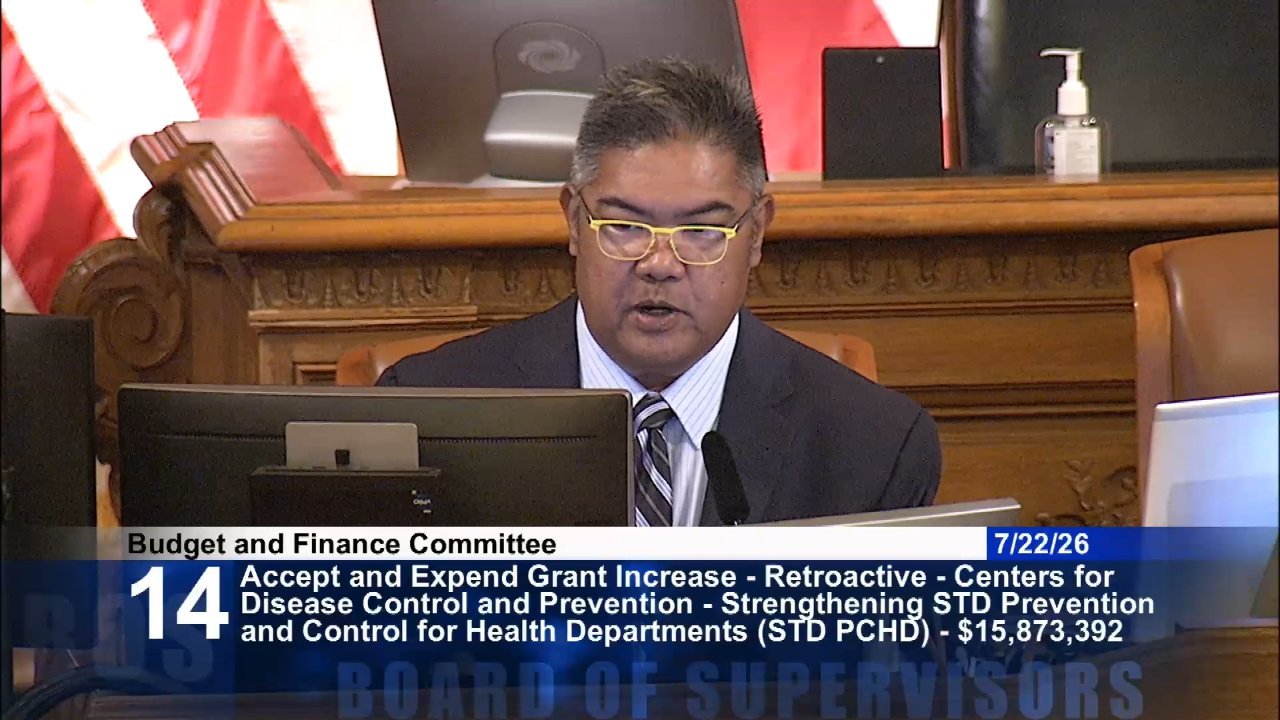
  • $1.1M CDC grant increase accepted for STD prevention, disease investigation, and outbreak response. (3-0)
  • Three Epic Systems gifts totaling $165K accepted by DPH for electronic health record improvements. (2-0; Chen absent)
  • Two labor union settlements approved in closed session: $201K with IFPTE Local 21 and $181K with SEIU Local 1021, both forwarded to the full board.
Chinatown Senior Housing Advances as Committee Weighs Nitrous Oxide Ban, Federal Funding Risks | Budget & Finance Committee | Locunity