Budget & Finance Committee - Apr 29, 2026 - Regular Meeting
Budget & Finance Committee • San FranciscoApril 29, 2026
Locunity is a independent informational service and is not an official government page for this commission.We use AI-assisted analysis and human editorial review to publish information.
Budget Committee Advances $1.15 Billion in Home Care Contracts as Fiscal Warning Signs Mount
San Francisco's Budget and Finance Committee moved more than $1.15 billion in contracts for in-home care workers through committee Wednesday, underscoring the city's growing obligations to its aging population — even as the Public Defender's emergency funding request signaled deeper budget trouble ahead.
$991 million, five-year contract locks in health and dental benefits for 30,000 in-home care workers serving the city's rapidly growing senior population
$158 million Homebridge contract advances despite only 54% of authorized care hours being used — committee told client refusal, not provider failure, is the primary driver
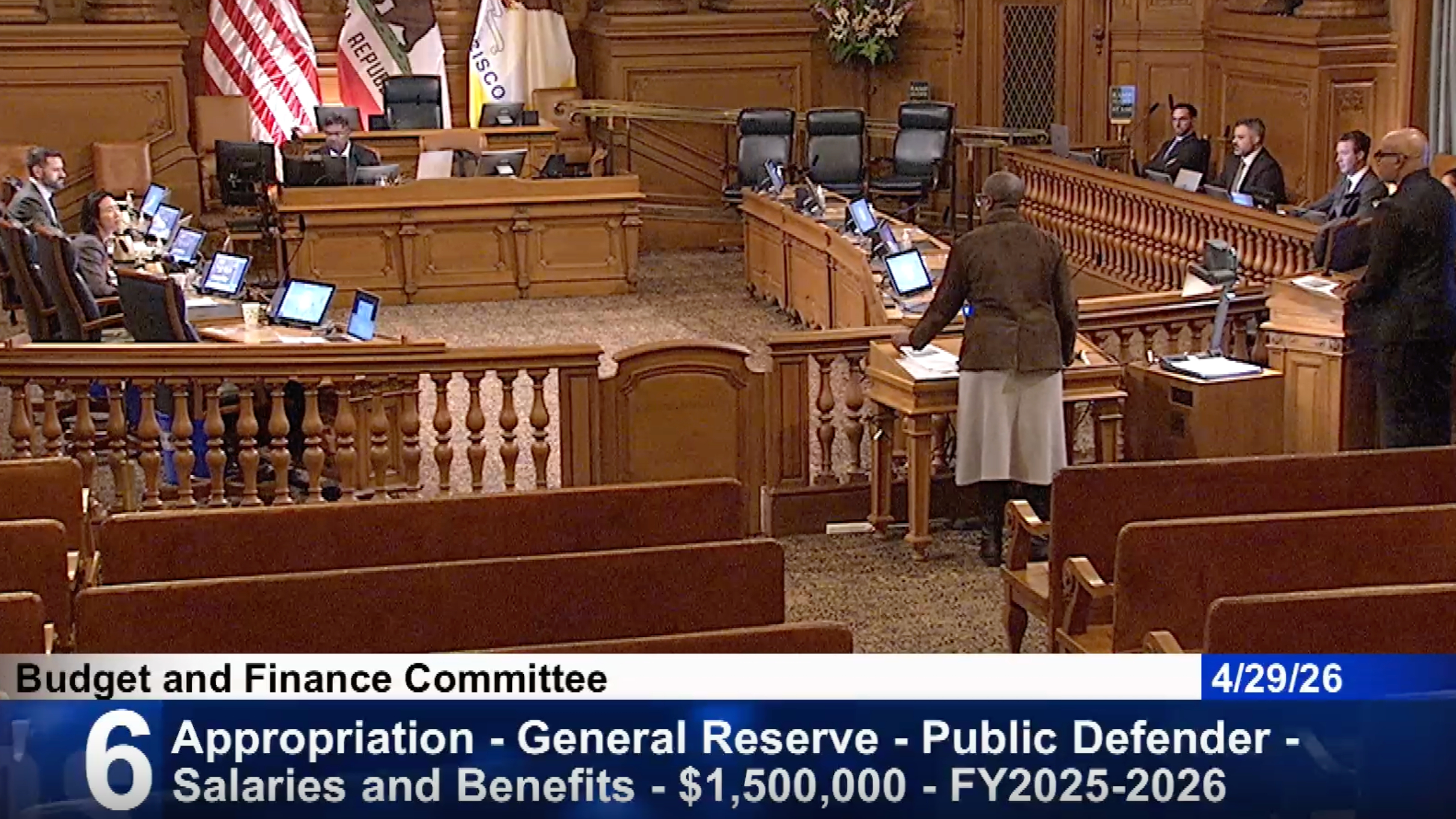
Public Defender wins $1.5 million emergency appropriation after reporting felony caseloads up 56% and misdemeanors up 78%
Chair Chan warns mid-year supplementals are a "not a good sign" and flags potential federal cuts from HR1
$5 million state grant for a historic Castro LGBTQ venue delayed one week after OEWD admits it hasn't finalized grant details; chair rebukes department for bringing an unready item
Half the Hours, All of the Need: Homebridge Contract Exposes Home Care Paradox
Why it matters: Homebridge is the only contracted caregiving agency of its kind in California — serving roughly 1,100 of San Francisco's most vulnerable In-Home Supportive Services (IHSS) recipients who cannot hire, supervise, or manage their own caregivers. Many live in permanent supportive housing, lack family support, or have long histories of homelessness.
Where things stand: The committee advanced a resolution increasing Homebridge's contract by $118.8 million to a total of $158.4 million through June 2029 — roughly $36 million a year, with $10.8 million from the General Fund.
But the bulk of the discussion centered on a stubborn problem: Homebridge is serving only about 54% of the care hours its clients are authorized to receive. IHSS Program Director Shannon Morgan walked the committee through three client profiles to explain why.
"Etta is an 81-year-old woman living in the Bayview District. She's been receiving Homebridge services for 14 years. She's currently authorized 143 hours. However, on a six-month average, Homebridge has only been able to serve 26% of Etta's total authorized hours," said Morgan.
Etta refuses substitute caregivers when her regular provider is unavailable.
The pattern repeats across the caseload: clients lock out providers, decline personal care, or refuse substitutes — all within their rights but rendering the 65% utilization target essentially unattainable. Morgan announced the target will be removed from future agreements.
The other side: Supervisor Danny Sauter pressed on the economics.
"We're essentially not using half of them and paying for half of them. I'd love more focus on creative approaches to increase that number," he said.
Morgan clarified that Homebridge only bills for hours actually served — the city isn't paying for unused time. But Sauter's question pointed to a deeper issue: authorized hours represent assessed need that is going unmet, even when a provider is available.
Budget and Legislative Analyst Nick Menard recommended approval and noted that HSA projects a slight increase in IHSS caseloads driven by demographics — growth he said will outpace any enrollment losses from the federal "one big beautiful bill."
Decisions: Passed 2-0 (For: Chan, Sauter; Absent: Dorsey, excused). Referred to the full Board with recommendation.
Nearly $1 Billion Contract Funds Care Workers as Senior Population Surges
Why it matters: With San Francisco's population aged 60 and older projected to reach one-third of all residents by 2030, the independent provider mode of IHSS — where clients directly hire and supervise their own caregivers — is the backbone of the city's home-based care system, serving approximately 30,000 active recipients.
Where things stand: The committee approved a new five-year contract between the Human Services Agency and the SF IHSS Public Authority valued at $991.3 million, running July 2026 through June 2031. This covers the 96% of IHSS recipients who can self-direct their care — hiring, interviewing, and managing their own providers.
"The older adult population in San Francisco is expanding. We expect that the older adult population, 60 plus, to be one-third of the city's population by 2030," said Shannon Morgan, IHSS Program Director.
Budget and Legislative Analyst Nick Menard told the committee that 96% of contract spending goes directly to health and dental benefits for IHSS workers, with 32 staff positions funded at the Public Authority. The contract is 20% General Fund-funded, part of a $200 million state-imposed spending requirement.
The Public Authority met or exceeded almost all performance objectives, though three mentorship-related measures lacked data due to COVID restrictions and Laguna Honda Hospital's loss of accreditation. Morgan noted the mentorship program at Laguna Honda has since been revived to help residents transition from institutional placement back into the community.
Decisions: Passed 2-0 (For: Chan, Sauter; Absent: Dorsey, excused). Referred to the full Board with recommendation.
"Every Vacancy Is a Constitutional Obligation": Public Defender Gets $1.5M Lifeline
Why it matters: Unlike large city departments that can absorb budget pressure by strategically leaving positions vacant, the Public Defender's Office has a constitutional mandate under the Sixth Amendment to provide counsel to every qualifying defendant. Every empty desk is a right going unmet.
Where things stand: SF Public Defender Manohar Raju told the committee the office serves 20,000 people annually, representing 84% of all indigent defendants in San Francisco. Every client is low income.
"There's a 56% increase in active felonies and a 78% increase in active misdemeanors. This isn't a staffing problem, it's a funding problem, and it has real consequences for the people we serve and their families," Raju said.
The office presented a $1.5 million supplemental appropriation from the General Reserve, sponsored by the Mayor's Office, to cover a structural shortfall in salaries and fringe benefits for the current fiscal year. Raju explained that positions are typically filled within two to three months of receiving approval — the office simply cannot use the city's attrition-based savings model because it lacks the staffing depth to absorb vacancies.
Chair Connie Chan approved the request but used the moment to deliver a broader fiscal warning.
"Not just the Public Defender, but any departments that come to this body in a mid-year supplemental is not a good sign, and it means that there's actually more fiscal issues that we actually have to deal with in June," said Chan.
She urged the Raju to work with the Mayor on the June budget proposal and flagged the potential impact of federal cuts from HR1.
Decisions: Passed 2-0 (For: Chan, Sauter; Absent: Dorsey, excused). Referred to the full Board with recommendation. The ordinance requires two-thirds approval of all Board members.
What's next: The supplemental heads to the full Board, where it will need at least eight votes. The broader fiscal reckoning Chan alluded to arrives with the Mayor's June budget proposal.
"Get Your Ducks in a Row": Chair Rebukes OEWD Over Unready Castro Grant
Why it matters: A $5 million state grant from the California Natural Resources Agency, authorized through SB 105, would fund the preservation and revitalization of a historic LGBTQ venue in the Castro — but the department brought the item to committee before resolving basic questions about how the money will flow.
Where things stand: Ben Van Houten from the Office of Economic and Workforce Development requested a one-week continuance, saying the department was still finalizing details with CNRA and the City Attorney. No specific venue has been identified; OEWD plans to issue a competitive RFP.
Chair Connie Chan did not mince words.
"I'm not trying to give you a hard time, but generally speaking, once you actually put it on the calendar, my expectation is that you really have it ready, that it's ready to go. You don't need a continuance and definitely not with like a state agency," said Chan.
She requested to be kept in the loop and asked to be added as a co-sponsor.
Decisions: Item continued to the May 6 meeting. Vote 2-0 (For: Chan, Sauter; Absent: Dorsey, excused).
Minor Items
$408,000 NIH grant for adolescent HIV research: The committee approved a retroactive grant increase of $172,000 from the National Institutes of Health through Florida State University for BridgeHiv, a division within the Department of Public Health, supporting the Adolescent Medicine Trials Network Scientific Leadership Center. Total grant value: $408,000 through January 2027. Passed 2-0.
$50,000 ADA restroom design grant for Charity Cultural Services Center: A state grant from CNRA will fund architectural and engineering design for an ADA-compliant restroom at CCSC, a District 3 nonprofit on Commercial Street with more than 40 years of community service. The grant covers design only, not construction. Both Supervisor Sauter and Chair Chan signed on as co-sponsors. Passed 2-0.
Vice Chair Matt Dorsey was excused from the meeting by a 2-0 vote at the opening of the session.