Budget & Finance Committee - Sep 02, 2026 - Regular Meeting
Budget & Finance Committee • San FranciscoSeptember 2, 2026
Locunity is a independent informational service and is not an official government page for this commission.We use AI-assisted analysis and human editorial review to publish information.
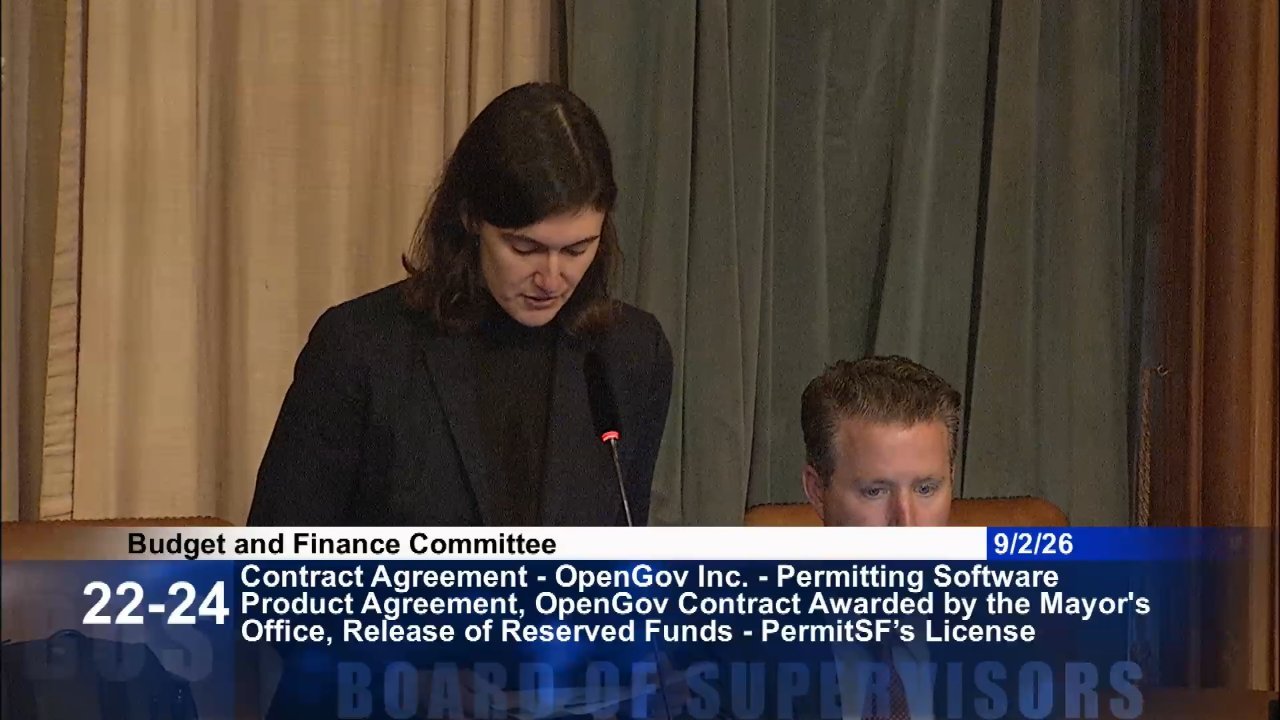
OpenGov Permit Contract Heads to Full Board Without Backing After Procurement Probe
The San Francisco Board of Supervisors' Budget and Finance Committee spent nearly five hours Wednesday interrogating how the city chose its new permitting software — and ultimately sent the $33 million contract to the full board without a recommendation, a rare signal of unresolved concern. The marathon session also moved more than $480 million in bond and certificate financing for affordable housing, park improvements, fire stations, and behavioral health facilities, and deployed the first-ever rental subsidies from the voter-approved Affordable Housing Opportunity Fund.
- $33M OpenGov permitting contract advances to full board without recommendation after BLA finds procurement bypassed competitive bidding best practices
- $423M in general obligation bonds greenlit for 1,100+ affordable housing units, fire station replacements, a behavioral health step-down facility, and park projects — with earthquake safety bonds trimmed by $77M after a pipeline setback
- First-ever Prop G rental subsidies awarded: $18.5M flows to five projects serving 145 extremely low-income units across the city
- $43M in certificates of participation approved to bridge pandemic-era cost overruns on five major parks
- Nitrous oxide retail ban delayed after health inspector union demands meet-and-confer on enforcement; workers and a survivor testify to deadly risks
OpenGov's $33M Permit Deal: Legal, but Was It the Best Deal?
The committee's most contentious item — a five-year, $33 million extension of the OpenGov contract powering the city's new Permit SF system — consumed the bulk of the meeting and exposed deep fault lines over how San Francisco procures technology.
Why it matters: Permit SF now handles all 500-plus permit types across 12 city departments. The contract will govern how residents, developers, and businesses interact with city permitting for at least the next five years — and possibly longer.
Where things stand: The Budget and Legislative Analyst found the original procurement did not violate city law but fell short of best practices. OpenGov was selected through a Section 21.30 sole-source technology waiver — a provision unchanged since 1999 — rather than competitive bidding. "The OpenGov selection process did not violate city requirements. However, it did not conform to best practices or typical city practice in procurement because it was not competitively procured," said Fred Brousseau, Budget and Legislative Analyst. Among the BLA's findings: no standardized scoring rubric was given to vendors, staff-vendor communications were not prohibited during the evaluation, costs were not fairly compared across finalists, and only 10% of the 70 participating city staff submitted written feedback — which actually favored competitor Clarity.
Supervisor Fielder, who requested the procurement hearing, questioned whether the city got the best deal. "I am not questioning whether San Francisco should have an integrated and best-in-class permitting system," she said. "I am, however, questioning whether we got the best deal for this contract and for the people of San Francisco."
The other side: Permit SF Director Elizabeth Waddy acknowledged procedural shortcomings but defended the selection, arguing OpenGov had a proven track record of on-budget delivery. "Every implementation was on budget. There was not one OpenGov example procurement process that we checked references on that ran over budget or had change orders that cost more money," she said. She contrasted that with Clarity, which she said had a history of cost overruns and reliance on third-party implementation partners. Asked about the lack of a standardized scoring rubric, Waddy conceded the point: "It's absolutely one of those things that is lessons learned for all of us and that if we were to do this again, would be one of the things we provided at the outset."
Supervisor Sherrill offered the sharpest defense of the contract, arguing the city's traditional procurement process had produced expensive failures. "Our current processes got us software like JUSTIS, which was over two decades delayed and tens if not hundreds of millions of dollars over budget," she said. "You simply cannot say that the city is great at procuring software."
Vice Chair Connie Chan took the opposite position, stating flatly: "If the BLA's complete recommendations are not accepted, I cannot vote in good faith for this contract." The BLA had recommended capping the extension at one additional year rather than five.
Public commenters raised additional concerns. Jerry Gradler argued the project lacked organizational structure and an implementation partner, and that foundational planning documents remained incomplete. Jessica Newti, representing Local 21, said permits that were previously issued the same day now take seven to 10 days, and argued the city was effectively funding OpenGov's ongoing product development.
Decisions: Chair Matt Dorsey negotiated a compromise: the addition of an annual termination-for-convenience clause, which he argued gave the board a stronger off-ramp than the BLA's one-year cap. "Counterintuitively, one of the major advantages I see for Permit SF is that it's actually starting with controversy and intensive scrutiny right out of the gate," he said, drawing a contrast with the failed JUSTIS project. The contract was forwarded to the full board without recommendation (For: 3, Against: 0, Absent: 0 — Dorsey, Chan, Sauter). The procurement hearing was continued to the call of the chair for ongoing oversight. Reserve funds of $13.2 million were released contingent on full board passage of the contract.
What's next: The full board must now decide whether to approve the five-year extension, with the annual termination clause as the key safeguard. Expect a vigorous floor debate.
Nearly Half a Billion in Bonds and Certificates for Housing, Safety, and Parks
1,100+ Affordable Units Get the Green Light
Three separate bond issuances totaling approximately $200 million will fund a wave of affordable housing construction and preservation across the city.
Why it matters: Four senior housing projects totaling more than 550 units in Districts 3, 5, 6, and 8 received tax credit approvals the day before the hearing, meaning all will begin construction by February. "The good news is we just yesterday got approval for all of these projects for bonds and tax credits, meaning they're all going to start construction in February or by February," said Lydia Ely, MOCD director of housing.
The 2016 PASS bonds ($47 million, final issuance) fund rehabilitation and acquisition projects, including the Derek Silva community on Market Street and a 2059 Mission Street conversion by MEDA. The 2019 bonds ($107.5 million, final issuance) primarily support the four senior projects, with a small portion funding middle-income down payment assistance for approximately 15 homeowners at $425,000 each. The 2024 bonds ($47 million, second issuance) fund a family project at Treasure Island and 187 units at 1939 Market Street. The PASS bonds carry a unique 40-year amortizing structure because borrowers pay real mortgage debt service, with repayments reducing taxpayer costs over time.
Earthquake Safety Bonds Trimmed After Pipeline Failure
The fourth issuance of 2020 Earthquake Safety and Emergency Response bonds was reduced from $215 million to $138 million after the SFPUC's emergency firefighting water system pipeline hit unexpected setbacks. Josh Andreessen, SFPUC senior project manager, explained that the designed pipe technology failed pressure and deflection testing — a plastic locking ring ejected during testing — and a separate CEQA appeal delayed the project four to five months.
The remaining $138 million funds three Department of Public Works projects: a new Fire Department Division of Training facility in Bayview Hunters Point (already under construction), replacement of Fire Station 7 in the Mission (where seismic evaluation found replacement more practical than retrofit), and seismic fortification of Taraval Police Station in the Sunset.
Health and Recovery Bond Funds Behavioral Health and Parks
The fourth issuance of 2020 Health and Recovery bonds ($83.5 million) funds final Rec Park capital projects — Crocker Amazon, Jackson Playground, Lake Merced, India Basin, and Community Opportunity Fund projects — along with a Treasure Island Residential Step-Down Facility providing transitional housing for clients exiting substance abuse programs. DPH COO Sabrina Robinson noted that a recently awarded state Behavioral Health Infrastructure Program grant of $14.2 million could offset $12.1 million of the $42.1 million bond request for DPH projects. The BLA flagged ongoing operating costs: $8.6 million per year for the Treasure Island facility and $350,000 per year for India Basin park.
$43M in COPs Bridge Pandemic Cost Gaps for Five Parks
Certificates of participation totaling $43 million, secured by the Open Space Fund rather than the general fund, will fill a $26 million gap on five park projects — Jackson Playground, India Basin, Crocker Amazon, Embarcadero Plaza, and McLaren Park — that experienced significant cost escalation during the pandemic combined with reduced impact fee revenues. The BLA found the annual debt service of $3 million represents about 4% of projected Open Space Fund revenues and is affordable given the fund's $29 million balance. A minor amendment removed a clause referencing the city's general fund commercial paper program.
Chair Dorsey thanked San Francisco voters for their confidence: "Whenever we talk about our general obligation bonds or any bonds, we owe a debt of gratitude to San Francisco voters for their confidence in us."
Decisions: All bond and certificate items passed 3-0 (Dorsey, Chan, Sauter), with amendments reducing ESER bonds from $215 million to $138 million.
First Prop G Dollars Flow to 145 Extremely Low-Income Units
The committee approved the first-ever grants from the Affordable Housing Opportunity Fund, the building-based rental subsidy program created by voters through Proposition G in November 2024. Five projects will share $18.5 million across 145 units.
The basics: AHOF provides ongoing rental subsidies directly to affordable housing buildings, closing the gap between what extremely low-income tenants (earning 15–35% of area median income) can pay and what it costs to operate the buildings.
Why it matters: "This is the first time that we are bringing for approval a group of grant agreements under the Affordable Housing Opportunity Fund," said Mara Blitzer, MOCD director of preservation. The five projects are: 160 Freelon (15 units, Related California/SFHDC, already under construction), 3300 Mission (23 units, Bernal Heights Neighborhood Center), Ambassador Hotel (31 SRO units, TNDC), SOMA Studios (27 units, TNDC), and South Park scattered sites (49 units, Mission Housing Development Corporation).
Where things stand: Nonprofit operators described the subsidies as solving a structural financial problem. Todd Laverge, TNDC strategic projects director, testified that very low-income tenants simply cannot cover operating costs without the subsidy. Sarah Davey Dillon, Mission Housing senior asset manager, described the challenge of running three century-old SRO buildings where over 40% of units were previously unsubsidized, calling AHOF "integral to financial stabilization."
Decisions: Approved 3-0 (Dorsey, Chan, Sauter), with a minor amendment correcting a grantee name. Three additional projects will be brought forward as they approach construction.
Nitrous Oxide Ban Stalls on Labor Dispute
Supervisor Danny Sauter's proposed ban on retail sales of nitrous oxide — introduced amid a 600% increase in related deaths and a 500% surge in emergency room visits over the past decade — was continued to the call of the chair after TWU Local 258, which represents health inspectors, demanded a meet-and-confer before enforcement provisions are finalized.
Where things stand: The ordinance would ban retail sales while exempting medical, dental, research, manufacturing, and food uses. But Pete Wilson, TWU Local 258 president, argued that enforcement should fall to police, not health inspectors who lack training for potentially dangerous criminal encounters.
Waste workers and a survivor made the case for urgency. Jamario Jackson, government relations manager for Ecology, testified the company pays approximately $20 per cylinder to properly dispose of discarded nitrous oxide canisters in the waste stream. Robert Sandoval, Teamsters Local 350 principal officer, described pressurized canisters violently exploding inside garbage truck hoppers and igniting fires. A public commenter named Julia offered wrenching personal testimony, describing six years of addiction, hundreds of thousands of dollars spent, multiple hospitalizations including paralysis and third-degree burns, and nine inpatient rehabilitation programs.
What's next: The union meet-and-confer must occur before the ordinance can return. Two state bills addressing nitrous oxide are also pending the governor's signature, which could shape the local enforcement framework.
Minor Items
- SFO Airport contracts: Two amendments totaling $34 million — $17 million for Faith Group PMCM2JV commissioning services and $17 million for Atkins Realis airfield improvement management — approved 3-0. Both are funded entirely by airport revenue bonds.
- DPH PrEP grant: The city accepted a $149,000 NIH grant via Heluna Health to evaluate a PrEP adherence blueprint. Chair Dorsey probed the stability of federal funding; DPH's Hyman Scott acknowledged recent grant cancellations that were later reinstated and noted ongoing shifts in the NIH process, including potential political review of scientific grants.
- DPH community health assessment: $204,000 grant from the San Francisco Health Plan approved for community health assessment work.
- Perinatal behavioral health: $2.3 million, three-year grant from the SFGH Foundation approved for the Solid Start program, supporting a multidisciplinary team providing mental health consultation, patient navigation, and Homeless Prenatal Program services at Zuckerberg SF General.