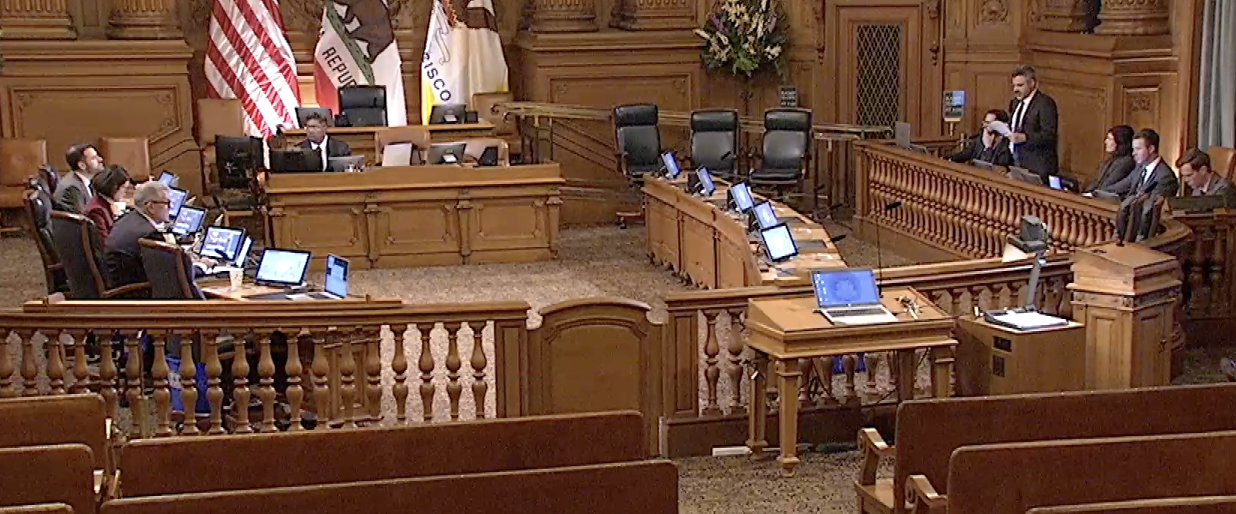
Budget & Finance Committee - Apr 15, 2026 - Regular Meeting
Budget & Finance Committee • San FranciscoApril 15, 2026
Locunity is a independent informational service and is not an official government page for this commission.We use AI-assisted analysis and human editorial review to publish information.
SFPUC Green Stormwater Program Extended Through 2031 After $30M in Citywide Grants
The San Francisco Board of Supervisors' Budget & Finance Committee moved unanimously through a packed April 15 agenda, advancing six items to the full board — headlined by a five-year extension of the city's signature green infrastructure program and a reassurance from the Elections director that the June vote faces no federal interference.
SFPUC's Green Infrastructure Grant program extended five years through July 2031 after delivering 29 projects — including 11 public schools — managing 18 million gallons of stormwater annually
Elections director tells committee he expects no federal interference in June 2026 election, detailing live-streaming of all ballot handling and in-person observation protocols
$11.6M Hetch Hetchy grid compliance contract approved despite budget analyst warning it may be undersized by roughly $1 million due to inflation
SF agrees to backstop Caltrain's $15.7M pension liability, a low-risk regional pact enabling the railroad's governance independence from SamTrans
City's Gann spending limit set at $14.6 billion with $9 billion in headroom, partly thanks to Prop M's four-year business tax exemption
Green Infrastructure: $30M Invested, 1 Billion Gallons to Go
The committee extended the SFPUC's authority to issue 20-year green infrastructure grant agreements through July 2031, giving the Wastewater Enterprise another five years to fund rain gardens, green roofs, permeable pavement, and other projects that capture stormwater before it overwhelms the city's combined sewer system.
Why it matters: San Francisco's combined sewer system sends both sewage and stormwater through the same pipes. During heavy rains, overflow can discharge into the Bay. The Green Infrastructure Grant Program is the city's primary tool for intercepting stormwater on-site — at schools, parks, housing developments, and private properties — before it enters the system.
Where things stand: Since 2019, the program has awarded roughly $30 million across 29 projects, with nine completed and nine more under construction. "To date, we have awarded about $30 million in grants to 29 projects including 11 public schools, five public parks, nine private schools, one housing development and one artist cooperative," said Willis Logsdon, SFPUC Wastewater Enterprise planner. Completed projects will manage about 18 million gallons of stormwater annually — putting the city roughly one-third of the way toward its goal of managing 1 billion gallons by 2050.
The program requires a minimum half-acre drainage management area, caps individual grants at $2.5 million, and uses a cost-per-acre metric recently bumped from $1.035 million to $1.12 million to reflect construction inflation. The SFPUC Commission has authorized the General Manager to adjust the cost-per-acre cap annually using the city's infrastructure construction cost inflation estimate.
The other side: Supervisor Danny Sauter asked about getting green infrastructure into denser neighborhoods — specifically Districts 2 and 3 — that lack the large impervious surfaces the program's half-acre minimum tends to favor. Logsdon pointed to the Urban Watershed Stewardship Grant program for smaller-scale projects and said the SFPUC could consider lowering the minimum acreage threshold.
Decisions: Chair Connie Chan praised the program's impact at Lafayette and Alamo elementary schools, then moved to accept clerical amendments introduced by Jeremy Spitz of the City Attorney's Office. The ordinance passed 3-0 (For: Chan, Dorsey, Sauter; Against: none; Absent: none) and heads to the full board.
Elections Director: No Federal Threats to June Vote
The committee retroactively authorized $416,431.10 from the California Secretary of State to reimburse costs for voting system and election management system replacement — routine grant administration that turned into a broader conversation about election security in the Trump era.
The basics: The funds represent San Francisco's allotment from a statewide appropriation. The city already meets its $138,810.37 local match through existing lease payments on equipment, meaning no new general fund dollars are required.
Why it matters: With a June 2026 election approaching amid national debates over ballot integrity, the committee pressed John Arntz, Director of the Department of Elections, on whether federal agencies posed any threat to local election administration.
Where things stand: "In my experience the federal government has not interfered with elections processes in San Francisco during my time as director. And we do work with the FBI before every election and the DOJ," Arntz said. He detailed the department's surveillance and transparency regime: live-streaming of all ballot-handling processes, internal camera monitoring of servers and voting centers, and an open-door policy for in-person observers. "We actually allow people to come and visit the department and actually be next to our personnel as we process the ballots. They can see what we're doing. Nothing's being hidden," he said, describing San Francisco's protocols as far more robust than other California counties.
Vice Chair Matt Dorsey praised the department's posture, noting the Trump administration's accusations of ballot fraud. "I think it is important that you're being proactive in addressing those kinds of things with transparency in the way that you're doing it," Dorsey said.
Decisions: The resolution passed 3-0 (For: Chan, Dorsey, Sauter; Against: none; Absent: none) and was referred to the full board.
Budget Analyst Flags Inflation Risk in $11.6M Grid Compliance Contract
The SFPUC's Hetch Hetchy Water and Power division won approval for a five-year, $11.6 million professional services agreement with Archer Energy Solutions for North American Electric Reliability Corporation compliance and audit support — but not without a warning that the contract may come up short.
The basics: NERC sets mandatory reliability standards for operators of the bulk electrical system. Hetch Hetchy manages four powerhouses, high-voltage transmission lines, substations, and switchyards interconnected with PG&E, Turlock Irrigation District, and Modesto Irrigation District. The Archer contract covers 56 reliability standards affecting more than 1,800 devices and funds approximately $2.3 million per year with no built-in inflation escalation.
Why it matters: "We're in a high inflationary environment. We're at 3%. It's going to go higher given the energy crisis and other inflationary federal policy, and this contract budget essentially doesn't assume any inflation," said Nick Menard of the Budget and Legislative Analyst's Office. He noted $750,000 remains on an existing contract running through March 2027 that could serve as a buffer.
The other side: Adam Ozerkowitz, SFPUC Hetch Hetchy Water and Power division manager, acknowledged the potential shortfall — roughly $1 million over the five-year term — but said recent internal hires could reduce dependence on outside consultants. "We were able to bring some staff on board, subject matter experts, that should alleviate some of that spending and potentially lower the use rate of the contract capacity," Ozerkowitz said.
Decisions: The resolution passed 3-0 (For: Chan, Dorsey, Sauter; Against: none; Absent: none) and was referred to the full board.
SF Joins Regional Pact to Backstop Caltrain Pension
The committee approved an agreement making San Francisco, VTA, and SamTrans jointly responsible for Caltrain's CalPERS pension obligations if the railroad were ever dissolved or CalPERS terminated its contract — a backstop CalPERS requires before it will grant Caltrain its own separate pension contract.
Why it matters: Getting its own CalPERS contract is a key step in Caltrain's governance transition from SamTrans as managing agency to an independent executive structure established by a 2022 four-party memorandum of understanding. VTA and SamTrans boards have already approved the agreement; SFMTA also recommended approval.
Where things stand: Caltrain's assets of $4.2 billion vastly exceed its estimated $15.7 million unfunded pension liability, making the trigger scenario extremely unlikely. "It is extremely unlikely that this clause would ever be triggered. Caltrain's assets are valued at approximately $4.2 billion and the estimate of pension liability for rail employees has been estimated at approximately $16 million," said Jesse Koehler, strategy director at the San Francisco County Transportation Authority.
Still, Menard cautioned the committee that the risk is not zero. Caltrain ridership remains 38% below pre-COVID levels and net income is negative $200 million. "I don't think it's completely without risk that Caltrain does go under," he said, while noting that a pending regional sales tax measure would cover all Caltrain expenses for 14 years if voters approve it, further reducing exposure. The apportionment of responsibility among the three agencies is deferred to a future agreement.
Chair Chan expressed support. "It's better that we're all in this together," she said, framing the backstop as a shared regional obligation.
Decisions: The resolution passed 3-0 (For: Chan, Dorsey, Sauter; Against: none; Absent: none) and was referred to the full board.
Minor Items
FY2025-2026 Gann Limits (Files 260205 & 260207): The committee set the city's annual state-mandated appropriations limit at $14.6 billion against $5.5 billion in net tax proceeds — $9 billion of headroom. Prop M's 2024 exemption of all business taxes for four years added $1.6 billion to the cushion. Special tax district limits were adjusted by a combined 6.02% factor. Both resolutions passed 3-0.
Upcoming hearings: Chair Chan announced the committee has asked the Budget and Legislative Analyst's Office for deeper analysis of city debt policies and management fee waivers, with hearings expected later in April and early May as the budget process ramps up.