
Committee Backs $14.2M Treasure Island Recovery Campus, Hardware Tax Fix
Budget & Finance Committee • San FranciscoOctober 7, 2026
Locunity is an independent informational service and is not an official government page for this commission. All information is sourced from public footage and an analysis of official agendas with the aid of responsible, fact-checked AI. to report an error or omission.
San Francisco's Budget & Finance Committee on Oct. 7, 2026, advanced a $14.2 million state grant toward an $80.5 million treatment and recovery campus on Treasure Island. The campus would add up to 300 beds and cost the city about $1 million a year to run. The committee also unanimously forwarded all 12 items to the full Board, including a Prop M tax credit for neighborhood hardware stores, faster vote counting and a rare early tax auction of a Richmond District home tied to alleged fraud.
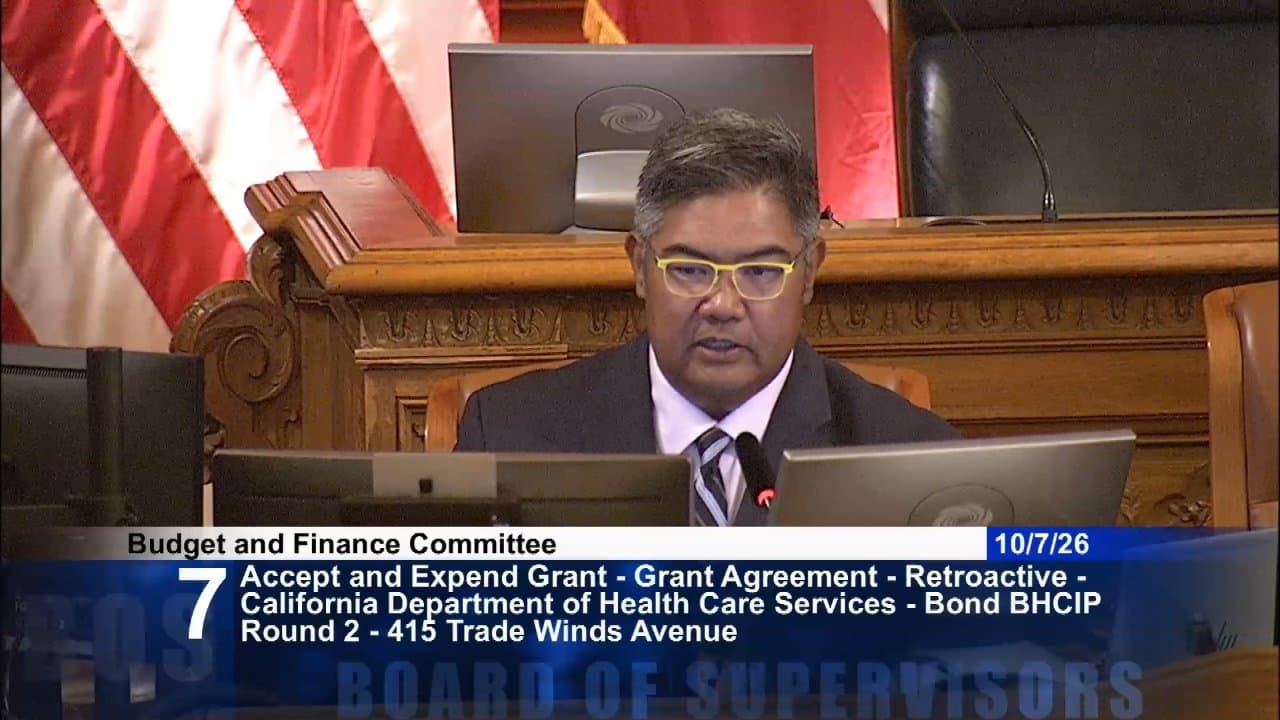
$14.2M state grant advances 300-bed Treasure Island recovery campus on a 3-0 vote
Hardware stores win Prop M tax relief after owners say their gross receipts taxes doubled
$658,000 in state money aims to finish the vote count during election week
Tax Collector cleared to auction 250 32nd Ave., which owes about $329,000 and carries alleged fraudulent deeds
SFO shuttle contract grows about $26M, trimmed by the Budget and Legislative Analyst to $98.1M, to expand airport worker commuter routes
Treasure Island Recovery Campus Moves Forward
The basics: The Behavioral Health Continuum Infrastructure Program (BHCIP) is a state program run by the California Department of Health Care Services (DHCS). It funds construction of treatment facilities and is administered here by Advocates for Human Potential.
Why it matters: The project at 415 Tradewinds Ave. would add 44 residential substance use treatment beds and up to 256 transitional "step-down" recovery beds. Construction would run from November 2026 through June 2028.
Where things stand: The Board authorized the Department of Public Health (DPH) to apply in October 2025. DPH received a conditional award March 11, 2026, and the agreement in August 2026. Partners include the Treasure Island Development Authority (TIDA), the Mayor's Office of Housing and Community Development, Mercy Housing and HealthRight 360. A 10% match comes from the 2020 Health and Recovery Bond.
Of the $80.5M total cost, the Budget and Legislative Analyst's Office attributed $13.5M to this grant and about $10M to another state grant. City funds cover most of the rest.
"DPH estimates that the beds will cost about $4.9 million a year. About 80% of that would be reimbursed by Medi-Cal, leaving about $1 million a year that would have to be locally funded," said Nick Menard, analyst, Budget and Legislative Analyst's Office.
Strings attached: The state's nonstandard terms include a 30-year recorded declaration of restrictions on the property. DHCS could also seek a court-appointed receiver if the city defaults, and the city must indemnify DHCS and Advocates for Human Potential.
Federal risk: Matt Dorsey, Supervisor, District 6, and committee chair, asked whether HR 1's Medicaid changes threaten reimbursement. Dr. Kelly Hom, Substance Use Disorder System of Care Director, DPH, said HR 1 mainly affects people maintaining their eligibility, not the rates DHCS sets. She said those rates have risen 2% to 3% a year.
The site is in Dorsey's district, and he framed the project around his central policy goal.
"I've said many times that recovery should be the organizing principle of our response to the drug crisis, and that requires treatment on demand," said Supervisor Dorsey.
Decisions and stakeholder impacts: The committee forwarded the grant (For: 3 — Chan, Dorsey, Sauter; Against: 0; Absent: 0). People in recovery and nonprofit operators gain capacity. Taxpayers take on an ongoing local operating share and a 30-year state restriction.
Island context: The committee also forwarded Amendment No. 51 to TIDA's master lease with the U.S. Navy, 3-0. The amendment extends the no-rent lease on about 120 acres through Nov. 30, 2027. Sheila Javan, Executive Director, TIDA, said the Navy again declined a multi-year term. She said the final land transfer is not expected before 2035.
Prop M Fix Targets Neighborhood Hardware Stores
Why it matters: Voters approved Prop M in 2024 to restructure business taxes and help small businesses. Neighborhood hardware stores, however, saw their gross receipts tax bills climb.
Where things stand: Board President Rafael Mandelman's ordinance creates a credit for tax years 2026 through 2035, retroactive to Jan. 1, 2026. Retailers qualify if more than 50% of their gross receipts come from qualifying hardware products and their combined gross receipts total less than $50M.
"These neighborhood hardware stores have seen significant increases to their gross receipts tax burden since the passage of Prop M in 2024, and this measure will provide some much-needed relief," said Grace Wang, Legislative Aide to Board President Mandelman.
Wang cited competition from chains and online retailers, retail theft and tariffs. She also pointed to the closure of Pappenhausen Hardware in West Portal in December 2024 after 88 years. Ted Egan, Chief Economist, Controller's Office, said the measure would not have an economic impact requiring a report.
The owners speak: Two store owners testified in support.
"I emailed and talked to the supervisor's office and the legislators repeatedly telling them that when I did the math, that it would mean my gross receipts tax doubled. My gross receipts tax doubled," said Terry Aston Bennett, co-owner, Cliff's Variety.
Jamie Gentner, co-owner, Center Hardware, a Dogpatch store founded in 1880, called the store an infrastructure business and described Prop M's impact as unintentional. "Your building engineers, your emergency teams, they all have our phone number," Gentner said.
Decisions and stakeholder impacts: Dorsey noted state limits on local tax options and pointed to Vice Chair Connie Chan's resolution seeking more flexibility. He asked to co-sponsor the ordinance.
"Sometimes when you go to the one sort of grand bargain like Prop M was, there's going to be unintended consequences and things that need to be fixed," said Supervisor Dorsey.
The committee forwarded the ordinance (For: 3 — Chan, Dorsey, Sauter; Against: 0; Absent: 0).
State Cash Aims to Finish Vote Count Faster
Why it matters: Under California's vote-by-mail system, more than half of ballots arrive on Election Day. San Francisco typically finishes counting the week after the election.
Where things stand: The state allocated $34M to counties, including $658,000 for San Francisco. John Arntz, Director, Department of Elections, laid out the spending plan:
About $350,000 for a vote-by-mail sorting machine, envelope openers, roster scanning workstations and extra scanners, which the department will keep for future elections
About $200,000 for several hundred temporary workers running 24 hours a day for three days after Election Day, plus overtime
About $100,000 for outreach overtime
The Budget and Legislative Analyst said the new resources, plus other changes the department is making, should let it conclude the count during election week. The analyst flagged about $35,000 a year in new General Fund costs, which the department can absorb within its $23M budget.
Dorsey asked whether the state money was enough. Arntz said it is, but structural limits remain.
"The final results cannot be certified for three weeks after Election Day, no matter how fast we can process ballots after Election Day," Arntz said.
Decisions and stakeholder impacts: The committee forwarded the appropriation (For: 2 — Chan, Dorsey; Against: 0; Absent: 1 — Sauter, excused). The full Board must approve $308,000 of the appropriation by a two-thirds vote.
Rare Tax Auction Targets Home with Alleged Fraudulent Deeds
The basics: State law allows a county to auction tax-defaulted property after five years and requires a sale after nine. San Francisco usually waits until close to year nine.
Where things stand: The property at 250 32nd Ave. has been tax-defaulted since July 2021, and the city gained the power to sell it in July 2026. David Augustine, Tax Collector, said about $329,000 is owed and the minimum bid will be $500,000. Alleged fraudulent deeds have been recorded against the property, and a sale would yield a legitimate deed. Paying the full balance stops the auction, which is expected before the end of 2026.
The other side: Dorsey raised due-process and constitutional takings concerns. Augustine said an outside vendor researches parties of interest. His office will notify roughly the past four owners of record and all lienholders in a four-month process. Excess sale proceeds would be held for the legitimate owner for one year after the sale.
"Just for my own education, how often does something like this happen?" asked Danny Sauter, Supervisor, District 3.
"I've never seen this set of facts before with the alleged fraudulent deeds and the high value owed," answered Augustine, who said he has worked in the office for 22 years.
Decisions and stakeholder impacts: Dorsey amended the resolution to identify the address as Block 1391, Lot 014. The committee forwarded it as amended (For: 3 — Chan, Dorsey, Sauter; Against: 0; Absent: 0).
SFO Shuttle Deal Grows for Airport Commuters
Where things stand: Modification No. 3 with SFO Hotel Shuttle Inc. raises the contract's not-to-exceed amount by about $26M. The term stays January 2023 through December 2027. Since 2023, the contractor has run commuter routes for airport workers to Hayward, Castro Valley, El Cerrito, Vallejo, Oakland and San Francisco.
Deanna Volokh, Manager of Government Affairs, SFO, said airfield busing begins in March 2027 and more Vallejo trips start in fiscal year 2027-28. Budget and Legislative Analyst Christina Malamut attributed the increase mainly to commuter route expansion and to higher-than-budgeted labor and operating costs. The contract includes a fixed management fee of about $77,000 a month. The airport accepted the analyst's cut of about $465,000, bringing the cap to $98,110,172.
The other side: "However, improvement is needed in areas such as incident reporting and customer complaint responses," said Volokh. She said a new tool implemented in September 2026 addresses those gaps.
Decisions and stakeholder impacts: "So we want to support the ability of people to work at SFO," said Supervisor Dorsey. The committee forwarded the amended contract (For: 2 — Chan, Dorsey; Against: 0; Absent: 1 — Sauter, excused).
Minor Items
DA youth trip: A $525,000 Crankstart grant funds three more years (May 2026 to April 2029) of the free "Sojourn to the Past" civil rights trip for youth from high-crime districts; approved 2-0.
Domestic violence supervision: A $300,000 Cal OES grant funded through the Violence Against Women Act partially funds one Adult Probation officer, with a $25,000 annual city match; staff cited federal Office on Violence Against Women cuts; approved 2-0.
Pier 96 lease: Cresco's equipment yard grows to about 44,750 square feet for up to $4.3M over 10 years, with 6.5% of revenue going to the Southern Waterfront Beautification Fund; approved 2-0.
HIV research: A $72,466 NIH grant increase supports a DPH-led mobile-health HIV and STI prevention trial; Dorsey will co-sponsor; approved 2-0.
Black Infant Health Program: DPH leases at 1290 Fillmore St. (about $105,000 a year) and 1533 Eddy St. ($39,600 a year), both at or below market, were approved 3-0.
Looking Ahead
All items are expected on the full Board of Supervisors agenda Oct. 20, where the elections appropriation needs a two-thirds vote.