Budget & Finance Committee - Mar 25, 2026 - Regular Meeting
Budget & Finance Committee • San FranciscoMarch 25, 2026
Locunity is a independent informational service and is not an official government page for this commission.We use AI-assisted analysis and human editorial review to publish information.
Emergency Grocery Cards, Troubled Tech and $142M for Housing
The San Francisco Board of Supervisors' Budget & Finance Committee swept through eight resolutions on March 25, all unanimously, but the most striking moment came when the panel turned from grilling a tech vendor over a five-year-delayed property tax system to hearing how city staff stood up an $18 million emergency food program in six days. Together, the items commit the city to tens of millions in health, housing and technology spending — with pointed questions about accountability running through every one.
$18M emergency grocery card program formalized after reaching 65,000 households when federal SNAP funding lapsed
Five-year-delayed property tax system gets its final $6.7M extension — committee warns the contract cannot come back
$142M in combined financing cleared for 158 affordable units at Balboa Reservoir, with construction targeted for May 2026
$31.7M in health access contracts extended through 2030 for HIV/STI services in LGBTQ+, Black and Latino communities, with harm reduction being restructured toward recovery
SFO extends $30M guest services contract one year to support Terminal 3 modernization
When Federal Aid Vanished, the City Built a Safety Net in Six Days
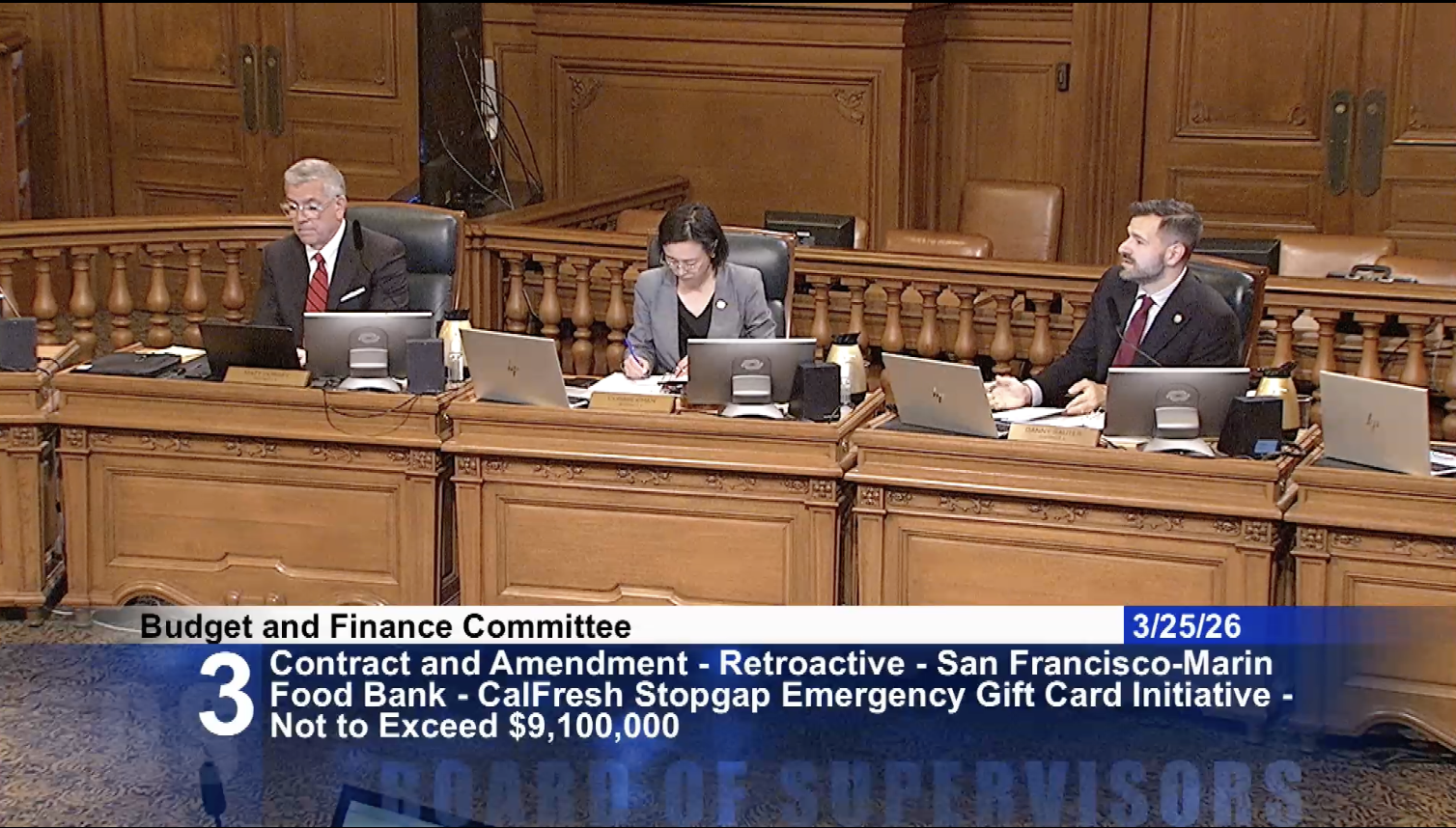
The basics: When the USDA failed to release emergency SNAP funds in October 2025, the Human Services Agency designed a CalFresh Stopgap Emergency Gift Card Initiative in three days. The $18 million program was split evenly between a challenge grant from the Crankstart Foundation and the city's state and federal revenue risk reserve. The SF-Marin Food Bank served as fiscal intermediary because the foundation could not fund a for-profit vendor directly. The committee retroactively authorized HSA's $9.1 million contract.
Why it matters: One in seven San Franciscans relies on CalFresh — 112,000 recipients, including 48,000 seniors and 18,000 children. The program offers a replicable template as federal safety-net cuts continue.
Where things stand: HSA had six days from funding approval to build recipient lists for 82,000 households, translate materials into five languages, train hundreds of frontline workers, establish a call center and deploy daily strike teams using activation data to target underserved populations.
"About 80% of the eligible households redeemed their cards. And that's a remarkable number given the vulnerability of the population we serve," said HSA Deputy Director Susie Smith. By the end of the activation period, 65,000 recipients claimed cards representing $14.4 million in benefits, with 92% — $13.2 million — spent as of March 22.
Chair Connie Chan framed the stakes in personal terms: "I have drilled in my head now that is 112,000 recipients of SNAP in San Francisco. And out of which I think 48,000 are seniors, 18,000 are children." Chan also noted the program benefited small grocery businesses, particularly in Chinatown during a citywide blackout period, since the gift cards kept customers shopping while EBT systems were uncertain.
Supervisor Danny Sauter drew a sharp contrast with the previous agenda item — the Sapient technology debacle: "I think it's a good reminder of what we can do when there's urgent needs. And I think it's just quite a contrast to our last item where we had a private for-profit company that is doing a four-year delay and here we are as government doing this in a matter of days."
HSA has already recovered $1.8 million from unactivated cards, with up to $500,000 more expected from unspent balances, to be split with Crankstart. The team won a SPUR Good Government Award, and lessons learned are being documented in a Stanford Social Innovation Review article. Public commenter Griffin Lee praised the interagency collaboration, calling it "what it means to really show up and step up in a really crucial time."
Decisions: Approved 3-0 (Chan, Dorsey, Sauter) and referred to the full board.
The Final Chapter for the Assessor's Troubled $34M Tax System
The basics: The committee approved a $6.7 million maintenance extension for the Assessor-Recorder's SMART property assessment system, built by Sapient Corporation (now Publicis Sapient), pushing the contract to a not-to-exceed total of roughly $33.9 million through June 2032. The system manages approximately $4 billion in annual property tax assessments.
Why it matters: SMART went live in September 2025 — roughly five years behind the original timeline. Implementation costs ran $16.6 million over budget, but the Assessor-Recorder's office negotiated aggressively: the vendor absorbed $15.3 million (92%) while the city covered just $1.3 million (8%).
Where things stand: Deputy Assessor Simone Jacques explained the turning point. In August 2023, the office discovered a significant design failure in the system. That discovery gave the city leverage at the negotiating table.
"The vendor provided their negotiating proposal, which was to split the cost half and half. And that was their $16 million proposal," Jacques said. "Instead of splitting the cost with the vendor half and half, we took about 8% of that responsibility. They took the remaining 92."
Supervisor Sauter pressed on whether the office still has confidence in Sapient: "How do you still have confidence in this consultant and along the journey, did you start an effort to look at alternative providers?" Jacques acknowledged the vendor market for property assessment systems is extremely limited and said the office's priority is ending the dependency entirely: "Our priority is really trying to find staff and upskill our own staff so that we can maintain the system. We know our process, and as long as we have the technical capability in-house, I believe we can do that without relying heavily on a vendor."
Chair Chan demanded that a detailed vendor cost breakdown be added to the legislative file before the full board hearing on April 7. Her warning was direct: "I do not hope to see this contract before us again. And because I think if we were to, I think it will be a very different conversation."
Decisions: Approved 3-0 and referred to the full board, with the vendor cost breakdown condition.
$31.7M in Health Access Contracts Move Forward Amid Recovery-First Pivot
The basics: The committee advanced contract extensions through June 2030 for three community-based organizations operating DPH Health Access Points: the San Francisco AIDS Foundation ($23.8 million NTE, amended down), Rafiki Coalition for Health and Wellness ($20 million NTE) and Instituto Familiar de la Raza ($17 million NTE). HAPs provide approximately 13 standards of care including integrated HIV/HCV/STI testing, primary care, mental health, overdose prevention and linkages to housing and employment.
Why it matters: The three contracts target San Francisco's most underserved communities. SFAF serves MSM communities in the Castro and SoMa. Rafiki serves Black San Franciscans in Bayview-Hunters Point. IFR serves the Latino community from the Mission District. Together they anchor a 17-CBO coordinated health network.
Where things stand: DPH's Nicole Trainor detailed the restructuring underway to align with Mayor Lurie's recovery-first directive. Three previous service buckets — harm reduction, overdose prevention, and syringe access and disposal — are being consolidated: "What we restructured, are in the process of restructuring, those three are really combined and it's really about overdose health and recovery with an emphasis on recovery."
Vice Chair Matt Dorsey, who authored the Recovery First ordinance, pushed for assurances that the contracts would comply: "Will it comport with Mayor Lurie's directive to make sure that we're doing it in a way that includes proactive outreach on drug treatment and access to programs consistent with the Recovery First ordinance that I authored?" But he also cautioned against a false binary: "Sometimes in the public debate there can be sort of a either harm reduction or treatment. And that's not the way the continuum works. Harm reduction is something that really needs to be an essential part of this. But if we're all rowing in the same direction to support and incentivize long-term recovery, that's really what the aim is."
The other side: The Budget and Legislative Analyst flagged that Rafiki had been rated below standards due to unmet service targets and invoicing issues. DPH reported the organization has since hired senior finance staff and is on track. SFAF's budget was reduced $400,000 annually as DPH cuts capacity-building support citywide.
Public commenter Griffin Lee, representing Connected SF, offered sharper criticism: "There's no talk about outcomes nor accountability. If you go through the second draft amendment in each one of these files, harm reduction is all over it. 40 times in one document as part of required services and training." Lee cited more than 600 annual overdose deaths and called for an audit before the contracts are renewed.
Decisions: Item 4 was amended to lower the NTE amount per DPH's request. Items 4 (as amended), 5 and 6 were approved 3-0 and referred to the full board.
158 Affordable Units at Balboa Reservoir Clear Final Budget Hurdle
The basics: The committee approved a $29.3 million MOCD gap loan, a 75-year ground lease and up to $112.7 million in tax-exempt and taxable housing revenue bonds for Balboa Reservoir Building A, to be developed by Bridge Housing. The 158-unit project — studios through three-bedrooms for households at 40–80% AMI, plus a manager's unit — targets construction start in May 2026 and completion by March 2028.
Why it matters: The project expands affordable housing on San Francisco's west side near City College, an area that has historically received far less affordable development than the eastern neighborhoods. But the price tag is significant: the city's total affordable housing contribution of roughly $87 million exceeds the development agreement obligation by $36 million, largely because the market-rate phase of Balboa Reservoir remains paused.
Where things stand: Financing layers include state housing tax credits awarded in fall 2025, a $33 million Affordable Housing and Sustainable Communities loan from the state, a $12.7 million AHSC transportation grant for bikeways, sidewalks and BART improvements, and private equity. The Budget and Legislative Analyst noted the total development cost per unit exceeds typical city projects due to infrastructure costs.
MOCD's Andrew Strong described the significance: "Balboa Reservoir Building A is an excellent opportunity to improve geographic equity by expanding affordable housing in San Francisco's west side neighborhoods." Chair Chan confirmed the AHSC loan functions similarly to city gap loans, coming out of the project's financial waterfall on repayment.
Supervisor Sauter welcomed sixth-grade students visiting from Notre Dame and described the project's importance. Chair Chan relayed that absent Supervisor Myrna Melgar wanted to express her support for the project in her district.
Decisions: Item 7 was amended to correct the developer name from Balboa Lee Avenue LP to Balboa Gateway LP. Items 7 (as amended) and 8 were approved 3-0 and referred to the full board.
What's next: The full board will take up the Balboa Reservoir financing items alongside the other referred resolutions.
Minor Items
SFO guest services contract extended one year through June 2027 with a $10.4 million increase (NTE $30.4 million) for Hallmark Aviation Services, which provides airport information desk staffing through LBE subcontractor Polaris and multilingual wayfinding support during Terminal 3 West modernization. SFO reported assisting 2.7 million guests in 2025. A 22.6% contingency budget reflects potential staffing needs from the new Airport Integrated Operations Center. Approved 3-0.