Budget & Finance Committee - Sep 16, 2026 - Regular Meeting
Budget & Finance Committee • San FranciscoSeptember 16, 2026
Locunity is a independent informational service and is not an official government page for this commission.We use AI-assisted analysis and human editorial review to publish information.
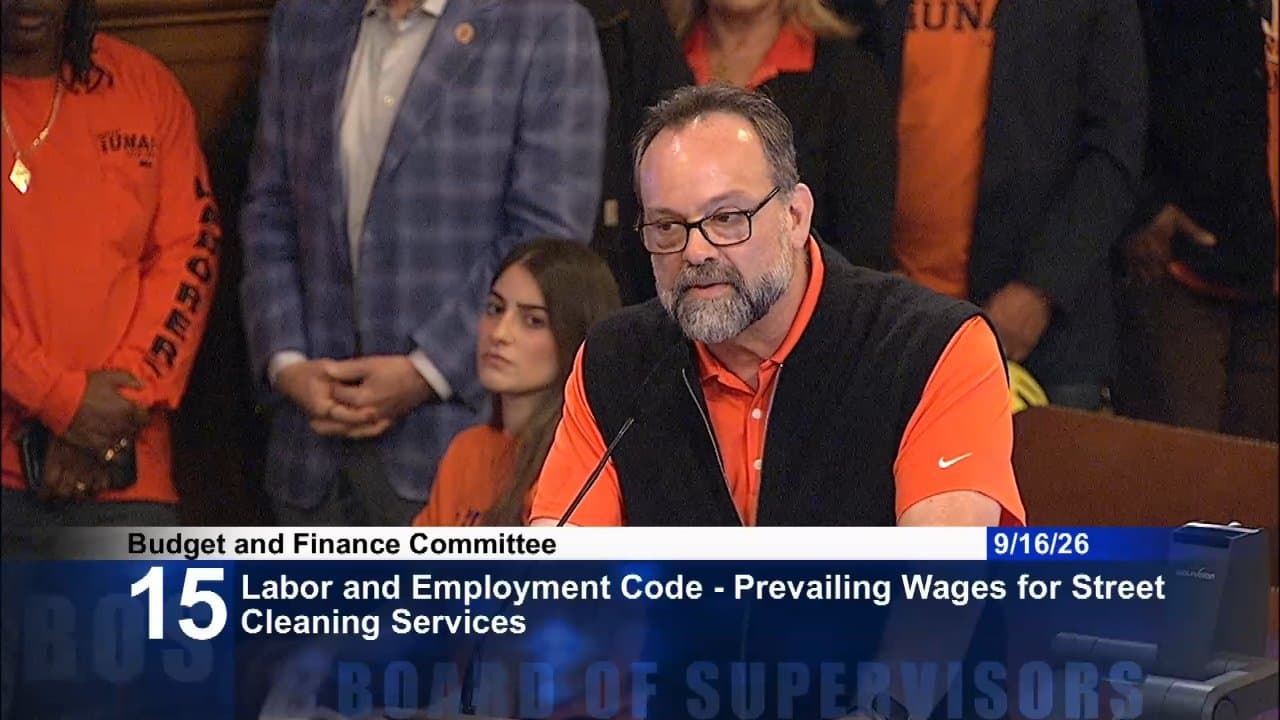
Clean Streets Prevailing Wage Ordinance Advances After Months of Labor Negotiations
San Francisco's Budget and Finance Committee unanimously advanced a landmark prevailing wage ordinance for street cleaning work, the centerpiece of a packed agenda that also committed $28.75 million to prevent hundreds of formerly homeless families from losing their housing and accepted $11.2 million in state funds for a new behavioral health center.
- Prevailing wage ordinance for city-funded street cleaning clears committee after months of negotiation between labor, nonprofits, and community benefit districts
- $28.75 million in local funds approved to bridge expiring federal housing vouchers for 390+ formerly homeless households
- $11.2 million state grant accepted for a one-stop behavioral health center at 1660 Mission Street, opening late 2028
- $1 million state earmark approved for Sunset Boulevard recycled water project to save 40 million gallons of drinking water annually
- Committee advances retroactive grants for two LGBTQI+ nonprofits serving trans immigrants and survivors of violence
Fair Pay for Clean Streets
The basics: The Clean Streets and Fair Pay Act would require prevailing wages — the locally established rate for public works — on any city-funded contract or grant for street cleaning, including power washing, steam cleaning, and bulk waste removal.
Why it matters: The ordinance responds to revelations that for-profit contractors billing the city as much as $200 per hour were paying their workers minimum wage, effectively using taxpayer money to undercut collectively bargained city employee wages. If codified, it creates a permanent floor preventing future privatization of city cleaning work at substandard pay.
Where things stand: Supervisor Myrna Melgar, who authored the legislation, described months of negotiations with Laborers Local 261, the Mayor's office, nonprofits, and the City Administrator's office to reach a workable compromise. "This ordinance mandates that when street cleaning is done with San Francisco taxpayer money, the workers will get prevailing wage. It's pretty simple and pretty straightforward," she said.
Key amendments negotiated into the final version include: redefining workforce development programs to require a path to employment with a 51% job placement rate and a three-year participant limit; exempting community benefit districts for activities funded exclusively by their private assessment dollars; exempting contracts below the delegated authority threshold; and giving workforce program nonprofits three-year contracts with stronger departmental support.
Budget and Legislative Analyst Christina Malamot noted the ordinance would apply only to future contracts and estimated potential cost increases of $8.9 million annually if workforce grants fail to meet the new performance criteria.
Chair Matt Dorsey, who spent 14 years at the City Attorney's office, asked pointed questions about how the ordinance's public right-of-way definition would interact with CBD responsibilities — particularly when districts receive both assessment revenue and city general fund dollars. Supervisor Melgar clarified that the prevailing wage requirement applies only to the city-funded portion: "If it is above and beyond what the assessment is that we collect through the parcel assessment for the CBD," the prevailing wage kicks in.
Vice Chair Connie Chan co-sponsored the legislation. "San Francisco should continue to invest our public dollar in supporting labor standards," she said. "This prevailing wage legislation demonstrates our commitment to making sure that our street cleaning workers are paid fair wages and benefits that allow you all to live in San Francisco."
Board President Rafael Mandelman, who spoke before departing, praised the negotiation process: "It feels like the plane is landing and that we are either at or very close to a measure that will both address the reasonable concerns of Local 261."
The other side: Chris Shulman of the Lower Polk CBD and the Benefit District Alliance acknowledged Supervisor Melgar's transparency and the assessment exemption but flagged concerns about unknowns around future prevailing wage rate determinations and the operational challenge of potentially splitting prevailing-wage and non-prevailing-wage activities within the same district.
Public comment was overwhelmingly supportive, with more than 15 speakers from labor, business, and community organizations. David Del Torre, business manager of Laborers Local 261, said his 5,000-plus members are highly trained to handle biohazards and paraphernalia on city streets, unlike some nonprofit workers who lack that training. Joshua Arce, executive director of the California Alliance for Jobs, representing 70,000 union members and 2,000 employers, said the ordinance stops further privatization. Teresa Foglio Ramirez, a business agent for Local 261 with 29 years at Public Works, said colleagues were disheartened to hear supervisors say they didn't trust Public Works — and that the answer is not to bring in unskilled labor at half the wages with no pension or health care. James Bryant, acting president of the San Francisco A. Philip Randolph Institute, argued the city should not create a two-tier system where workers performing similar public work receive dramatically different wages. Kim Tavaloni of the San Francisco Labor Council connected the issue to homelessness, noting the city spends $1.2 billion on homeless services and that raising wages helps prevent workers from falling into homelessness themselves.
Decisions: Amendments adopted 3-0 (For: Chan, Sauter, Dorsey). Ordinance forwarded as amended to the full Board of Supervisors with a positive recommendation, 3-0.
What's next: The ordinance goes to the full Board of Supervisors for final passage.
$28.75M to Prevent a Return to Homelessness
Why it matters: The federal emergency housing voucher program, created during COVID, is ending because HUD has not allocated new resources. Without local bridge funding, hundreds of formerly homeless households — disproportionately African American families concentrated in Districts 10 and 6 — could lose their rental subsidies.
Where things stand: Deputy Director Emily Cohen of the Department of Homelessness and Supportive Housing explained that the city included $27 million in last year's budget as an emergency fund. "In this month we transitioned 90 households to new federal vouchers. We anticipate 300 more by the end of the year," she said. Remaining transitions would follow in the subsequent year. Households will not have to move; the voucher simply changes on the back end.
"We do not obviously want anyone to fall back into homelessness because the federal government has decided not to fund this program anymore," Cohen said.
Budget and Legislative Analyst Nick Menard noted that the transition plan depends on pending federal housing appropriations. Funding comes entirely from the homelessness gross receipts tax (Prop C). Supervisor Danny Sauter thanked HSH for the work.
Decisions: Forwarded to the full board with a positive recommendation, 3-0 (For: Chan, Sauter, Dorsey).
A New Hub for Behavioral Health at 1660 Mission
Why it matters: An $11.2 million state BHCIP Round 5 grant will fund construction at 1660 Mission Street, transforming a building vacant for five years into the Health Recovery and Connection Center — a one-stop facility integrating substance use treatment, mental health services, and primary care.
Where things stand: Dr. Christy Soren, medical director of the Substance Use Services Division at DPH, explained the center will co-locate behavioral health access, walk-in medication access for substance use and mental health, a behavioral health pharmacy, a sobering center, and City Clinic. "It'll include walk-in access to medications for substance use and for mental health. It'll have a behavioral health services pharmacy and a sobering center," she said.
The city purchased the building in October 2025. Total project cost has grown to $106 million — $20 million more than originally estimated due to voluntary seismic work and a staircase addition. The BLA noted the 10% local match ($1.12 million) is more than covered by $33 million in homelessness gross receipts tax and $20 million in general obligation bonds. The grant requires a 30-year deed restriction. Supervisor Sauter asked about the sobering center model — 16 beds, still being designed, and distinct from the existing Reset center — and whether vacated spaces at 1380 Howard would generate savings.
Decisions: Forwarded to the full board, 3-0 (For: Chan, Sauter, Dorsey). Opening targeted for late 2028.
Sunset Boulevard Goes Recycled
Why it matters: A $1 million state legislative earmark secured by Senator Scott Wiener will help Public Works transition 60 acres of green space along a two-mile Sunset Boulevard stretch from potable to recycled water, saving roughly 40 million gallons of drinking water annually.
Ian Schneider, government affairs manager at Public Works, explained that drought-era restrictions had slashed irrigation from 120 million gallons annually to just 16 million, degrading the green belt. "By transitioning our irrigation source to the highly treated recycled water directly from the Oceanside Sewage Treatment Plant, this project will save approximately 40 million gallons of drinking water every single year," he said. The project will tap into a 16-inch recycled water transmission line at four intersections, remove five existing potable connections, and install booster pumps. Total project cost: $10.5 million, with no general fund match required. The project includes a partnership with the Northern California Laborers Training Center.
Decisions: Forwarded to the full board, 3-0 (For: Chan, Sauter, Dorsey).
Grants for Trans Immigrant and Anti-Violence Nonprofits
Why it matters: Two retroactive grants from the Agency for Human Rights — a $150,000 increase bringing funding to $450,000 for Parivar Bay Area and a $100,000 increase to $300,000 for Community United Against Violence — reimburse services delivered during a period of heightened federal hostility toward LGBTQ communities.
Anjali Remi, president and co-founder of Parivar Bay Area, gave emotional testimony: "We are the only trans Kinner Hijra-led Global South trans organization in the entire United States of America and we have proudly existed in San Francisco for eight years." She described more than 600 events, 28,300 participant engagements, and 212 graduates of its leadership program — and said the loss of city funding forced the closure of the organization's cultural center in April 2026.
Board President Rafael Mandelman spoke in support, describing both organizations as providing critical services. Chair Dorsey emphasized that for politically charged priorities like the trans community and the immigrant community, the city is often the only funder. "There's really not another option if San Francisco isn't going to be there," he said.
Samuel Thomas, CFO of the Agency for Human Rights, read extensive fiscal sponsorship amendments into the record for Item 1, reflecting the transfer from Center for Immigration to Transcan Work, Inc.
Decisions: Item 1 (Parivar) was amended and continued to Sept. 23 to finalize language; Item 2 (CUAV) forwarded to the full board, 3-0 (For: Chan, Sauter, Dorsey).
Minor Items
-
$75 million in PUC environmental services contracts — Five firms (Environmental Science Associates, Acom Technical Services, Panorama Environmental, GEI Consultants, Stantec) each received seven-year, $15 million contracts for CEQA/NEPA compliance supporting the PUC's $12.5 billion capital plan. Each firm committed to 20% local business enterprise sub-consultant participation. Approved 3-0.
-
Jail Health Services lease renewed at 32% discount — DPH secured a rent reduction from $58.53 to $40 per square foot per year at 650 Fifth Street for administrative space housing 23 Jail Health staff. New term runs through July 2031. Chair Dorsey commended the real estate department for getting good value for taxpayers. Approved 3-0.
-
City Attorney authorized to accept $200,000 grant from the San Francisco Foundation for affirmative litigation covering consumer protection, worker protection, housing enforcement, and defense of federal funding. Approved 3-0.
-
FY 2026-27 property tax rate set at $1.18 per $100 of assessed valuation, virtually unchanged from the prior year. The median homeowner will pay approximately $174 more due to assessed value growth under Prop 13, not rate increases. Approved 3-0 with a non-substantive amendment.
-
Women's Options Center security grant ($475,000) from Cal OES continued to Sept. 30 due to a scheduling issue. Approved 3-0 to continue.