
Committee Pauses $22M Mission Street Housing Loan Over MEDA Oversight
Budget & Finance Committee • San FranciscoOctober 21, 2026
Locunity is an independent informational service and is not an official government page for this commission. All information is sourced from public footage and an analysis of official agendas with the aid of responsible, fact-checked AI. to report an error or omission.
San Francisco's Budget & Finance Committee moved three economic development and safety packages to the full Board of Supervisors on Oct. 21, 2026. It stopped short on the meeting's biggest item: more than $22 million in permanent financing for the Mission Economic Development Agency's 39-unit building at 2059-2065 Mission Street. A newly disclosed Tier 3 monitoring designation from the Controller's Office led the two supervisors present to vote 2-0 to delay the loan for more answers.
- $22.2M Mission Street affordable housing loan continued after the Controller flagged MEDA for Tier 3 review
- Produce market lease overhaul advances, clearing a path to financing a 67,000-square-foot warehouse
- Ten SFO concession leases extended two years, protecting about $3.4M a year in minimum rent
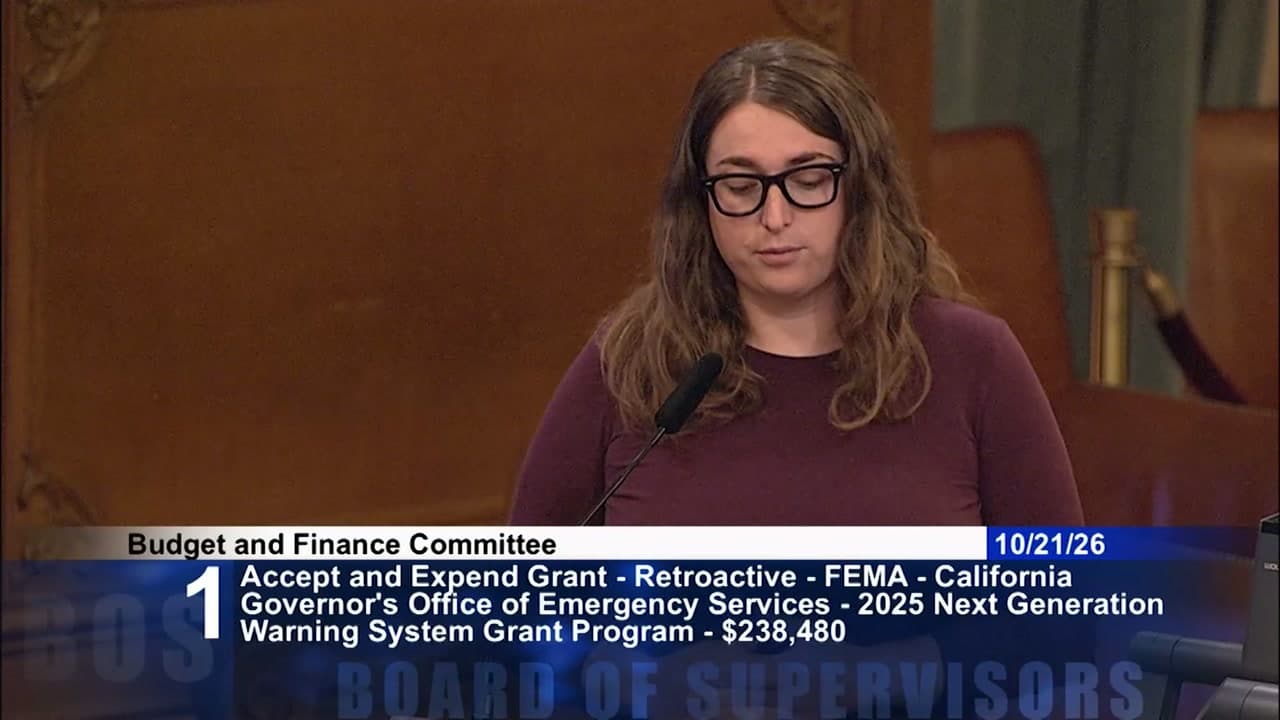
- $238,480 federal grant would put emergency alerts on Muni digital signs
A Tier 3 Flag Stalls Mission Street Financing
Why it matters: The delay leaves 39 units of preserved affordable housing in financial limbo. The project's bridge loan comes due Dec. 1, 2026, and it puts one of the Mission's best-known nonprofit developers under public scrutiny.
The basics: MEDA bought the 39-unit building, which has 35 residential and four commercial units, in September 2024. It financed the purchase with a roughly $20M bridge loan from the Housing Accelerator Fund (HAF). Rehabilitation began in October 2025. Remaining work covers approval of accessory dwelling units (ADUs) and legalization of existing units.
Where things stand: The resolution would let the Mayor's Office of Housing and Community Development (MOHCD) buy the HAF loan for up to $20,258,781 and assume its obligations. MOHCD would then provide up to $22,157,500 in permanent financing: a Small Sites Program loan of about $18M and a PASS loan of up to $4.1M.
MOHCD said buying the loan avoids indefinite third-party interest. "Purchasing the HAF loan will allow the project to complete its small remaining scope on the ADUs and the unit legalization in the most time and cost-efficient manner with the least risk to the city," said Aaliyah Gage, Preservation Program Manager, MOHCD.
The Budget and Legislative Analyst's office said about $400,000 of work remains. Given the Controller's recent monitoring findings, it treated approval as a policy decision for the committee rather than giving a recommendation.
The Controller weighs in: MOHCD opened by acknowledging a Chronicle article and the Controller's Tier 3 designation for MEDA. Greg Wagner, Controller, said Tier 3 signals severe issues. It triggers corrective action plans and technical assistance, not a funding freeze. "The designation of corrective action is not intended to be a block on funding," Wagner said.
Wagner said MEDA responded proactively by bringing in outside contractors, auditing and changing its financial controls. The organization has a week or two to respond to the designation, and he expected significantly more information within a couple of months.
Chair Dorsey presses: Matt Dorsey, Supervisor, District 6 and committee chair, asked about safeguards, Tier 3 status, leverage over the developer fee and contingency plans. "We are a committee that owes it to the taxpayers we serve to make sure that we're spending their money wisely and prudently," Dorsey said.
MOHCD staff described several protections:
- Closing conditions on the loan
- Quarterly reporting on key performance indicators
- A developer fee of about $390,000 at risk if leasing milestones are missed
Staff also said the loan carries an interest reserve of about 30 days and that the Small Sites Program is nearly fully subscribed.
The other side of the ledger: Dorsey also raised a delayed $1.3M city payment that MEDA's executive director had cited. Wagner called payment timeliness a recurring citywide conversation with varied causes. He said he lacked specifics on that payment. Daniel Cruz, Project Manager, MEDA, thanked MOHCD and the city. He stressed the value of preservation work for displaced and at-risk tenants and acknowledged that matters beyond this project still need to be revisited.
Decisions and stakeholder impacts: Danny Sauter, Supervisor, District 3, asked for more information, including directly from MEDA. "I think we could do well to have a few more weeks," Sauter said. Wagner offered a quick briefing. Dorsey moved to continue the item to the call of the chair and said he expected one to three weeks. The motion passed (For: 2, Dorsey and Sauter; Against: 0; Absent: 1, Vice Chair Connie Chan).
The pause shifts timing risk onto the project, its tenants and MOHCD. The roughly 30-day interest reserve gives some cushion past the Dec. 1 maturity.
What's next: The item returns at the chair's call. Watch for the Controller's briefing and MEDA's response to the Tier 3 designation.
Produce Market Lease Rewrite Aims to Unlock Construction
Why it matters: The restated lease lets the San Francisco Wholesale Produce Market close financing for a 67,000-square-foot building at 1900 Kirkwood. The project would anchor a city-owned food hub in Bayview-Hunters Point.
The basics: The market at 2095 Gerald Avenue operates under a 60-year city lease that took effect in 2013. The lease was amended in 2022 to create a separate parcel lease structure so the market could use private financing.
Where things stand: John Lau, Senior Project Manager, Mayor's Office of Economic and Workforce Development, said the amendments make three main changes:
- Replace the rigid schedule of performance with a development plan concept already in the lease
- Streamline the city's review and approval process
- Fine-tune separate parcel terms as the market nears closing on a major financing
Lau also distributed an added exhibit. It lets the city allocate funds already dedicated through a Prologis development agreement.
The deal includes a deliberate subsidy, and the market must save its net proceeds for the project. "The city has made a policy determination to accept essentially below market rate rent in this case because the market is a public good," Lau said.
Who showed up: Michael Janus, General Manager, SF Market, called it the only nonprofit wholesale produce market of its scale in the country. He said it has more than 500 overnight team members and runs San Francisco's largest food recovery program. Patrick Mills, Co-CEO, Buy Right, said his company sources from more than 300 regional farms, many tied to market merchants. Tim Bacon, a member of the SF Market board of directors, said the financing structure and long-term flexibility are important and expected groundbreaking within months.
Decisions and stakeholder impacts: Both supervisors praised the market and asked to co-sponsor. Sauter moved the item, and it passed (For: 2; Against: 0; Absent: 1). Market merchants, regional farms and food recovery partners benefit. The city continues to trade below-market rent for a public-good return.
What's next: The lease goes to the full Board.
SFO Tenants Get Two More Years to Recoup Costs
Why it matters: The extensions give ten airport concessionaires more time to recover cost overruns. They also protect about $3.4M a year in minimum guaranteed rent.
Where things stand: Original lease terms assumed buildout costs of $1,300 per square foot for food and beverage tenants and $900 for retail. Costs rose sharply between 2015 and 2019. The Airport Commission extended 30 similar leases in 2019, and the board approved them the following year. Staff reviewed the remaining 26 leases and found ten eligible: six food and beverage and four retail. Each gets two extra years with no other changes. The Budget and Legislative Analyst confirmed that tenants spent about 30% more than assumed.
Daniel Sang, Government and Policy Assistant, SFO External Affairs Unit, presented the item. Sauter asked why some restaurants saw fewer passengers. Airport staff blamed construction and said they expect traffic to recover. "I feel like this is something where the city is modeling good behavior," Dorsey said.
Decisions and stakeholder impacts: At the analyst's recommendation, with the airport's agreement, the committee amended item 5 (file 260937). The change limits that extension to the post-security departures retail location in Harvey Milk Terminal 1, not the pre-security baggage claim site. The amendment and the forwarding of all ten items each passed (For: 2; Against: 0; Absent: 1).
Emergency Alerts Headed to Muni Signs
Why it matters: Wireless emergency alerts do not currently appear on SFMTA digital signs. The grant would extend alerts to people who miss them on their phones.
Where things stand: The resolution retroactively authorizes the Department of Emergency Management (DEM) to accept $238,480 from FEMA through Cal OES. The grant covers Aug. 1, 2026, through June 30, 2028, and requires no general fund match. The money splits two ways:
- $226,560 goes to SFMTA by work order for software, multilingual and accessible templates, testing, training and an exercise
- $11,920 covers DEM's grant management
Cal OES notified the city on Aug. 21, which explains the retroactive timing. It is a reimbursement grant, and no funds have arrived yet.
Jackie Thornhill, Communications Manager, DEM, said launch timing is still being finalized, with hopes for operation earlier next year. "I think it's a creative approach," Sauter said. Dorsey asked how confident the city is that federal and state money will flow. DEM said it is as confident as it can be and is proceeding with city attorney guidance.
Decisions and stakeholder impacts: The committee forwarded the item with a positive recommendation (For: 2; Against: 0; Absent: 1).
What's next: Cal OES conditioned any disbursement on board approval by Nov. 1.
Minor Items
- Committee excused Vice Chair Connie Chan, Supervisor, District 1, leaving two voting members for every vote.
Looking Ahead
The Mission Street loan returns at the chair's call, which Dorsey expected within one to three weeks. The full Board must approve the emergency alert grant by Nov. 1 to meet the Cal OES condition.