
Home Kitchen Permits Advance as Committee Adds Landlord Notice, Delivery Limits
Budget & Finance Committee • San FranciscoNovember 4, 2026
Locunity is an independent informational service and is not an official government page for this commission. All information is sourced from public footage and an analysis of official agendas with the aid of responsible, fact-checked AI. to report an error or omission.
San Francisco moved a step closer to letting residents legally sell meals cooked in their own kitchens. On Nov. 4, 2026, the Budget & Finance Committee voted 3-0 to send an amended home-kitchen ordinance to the full Board of Supervisors after nearly an hour of testimony from street vendors and advocates. The committee also advanced $1.7 million for immigration legal defense and pressed two shelter operators on fiscal oversight.
- Home kitchen permits forwarded 3-0 with landlord-notice, delivery and meal-cap amendments
- About $1.7 million for immigration legal defense advances amid an 81% rise in Bay Area arrests
- Larkin Street and Bayview shelter grants advance despite invoice and audit concerns flagged by analysts
- Bayview Navigation Center extension reaches $25.7 million as its operator works through an audit backlog
Home Kitchens Move Closer to Legal Status
The committee unanimously recommended an ordinance from Supervisor Jackie Fielder that creates a permit process and annual license fee for Microenterprise Home Kitchen Operations, or MEHKOs. It was the longest item of the day and drew the largest turnout.
The basics: MEHKOs let residents cook and sell meals from home under a state program. Fielder said about 1,300 permits are active in 20 California jurisdictions, with startup costs under $1,000. Operators are capped at 30 meals per day, 90 per week and $100,000 in gross annual sales. The ordinance would also let a home kitchen serve as the commissary for a compact mobile food operation (CMFO), such as a street cart.
Why it matters: The permit offers home cooks and street vendors a legal, low-cost path into business. Supporters say it could replace commissary-kitchen costs that Scott Feeney of the Democratic Socialists of America San Francisco chapter said can reach $40,000.
Where things stand: Fielder argued the model has a clean track record elsewhere. “Approximately 97% of permitted MEHKOs have never received a formal complaint involving food safety, traffic, parking, noise, or other neighborhood concerns,” said Supervisor Jackie Fielder.
The cost picture is less settled. The Budget and Legislative Analyst estimated first-year costs of $462,275 to $564,551 and net ongoing costs of $33,492 to $66,983. The Department of Public Health (DPH) said it would need two new positions, at roughly $809,166 in the current fiscal year. “They indicated that they don't have capacity with existing staff to take on this additional workload,” said Fred Brousseau of the Budget and Legislative Analyst's Office, describing DPH's position.
A coalition shows up: Leaders of the Food Vendors Council spoke in Spanish through an interpreter. They asked the committee to approve the program so they can cook safely, pay rent and support their children. Jessica Rubio, Policy Director at the Mission Economic Development Agency, said her organization has supported 250 entrepreneurs this year. Kari Rodriguez of Nuestra Causa asked for a process offered in community languages and shaped with vendors. Representatives of SF New Deal, Renaissance Entrepreneurship Center and Indivisible SF also spoke in support.
The other side: The San Francisco Apartment Association did not oppose the bill but wanted tenants to get landlord permission, modeled on the city's Airbnb rules. “So notifying somebody that you're doing something is quite different than getting permission,” said Janine New of the San Francisco Apartment Association. She also suggested limiting carts to RH-1 single-family districts. Supervisor Danny Sauter, District 3, said the amendments respond to dense housing and the relationships among tenants, landlords and neighbors.
Decisions and stakeholder impacts: Fielder's amendments require tenants to notify landlords or homeowners associations, not obtain their permission. They limit delivery to employees or household members, which bars third-party apps. They also require direct, same-day sales and cut CMFO permits from two to one per person. Home kitchens that support a cart get higher caps: 80 meals per day, 200 per week and $200,000 in sales. Vice Chair Connie Chan, Supervisor, District 1, moved the amendments. “This is a city that is becoming too expensive, and too many family members are struggling to stay in San Francisco, a city that we all call home,” said Chan.
Vote: For: 3 (Chan, Sauter, Dorsey), Against: 0, Absent: 0. Vendors gain a legal pathway, and landlords gain notice but not veto power. DPH's staffing request remains open.
What's next: The ordinance goes to the full Board. Watch whether DPH's two-position request survives budget talks.
Immigration Legal Defense Gets $1.7 Million Push
The committee voted 3-0 to forward an ordinance appropriating about $1.7 million from the general reserve for immigration legal defense and community rapid response.
Why it matters: Legal providers say federal enforcement is outpacing their capacity. “Immigration arrests across major Bay Area cities rose 81% between July 2025 and July 2026,” said Supervisor Jackie Fielder, who noted that every supervisor has signed on as a co-sponsor. That includes committee chair Supervisor Matt Dorsey, District 6.
Where things stand: Testimony was uniformly supportive, and no one spoke in opposition.
- Shira Levine, Deputy Legal Director at the Immigration Institute of the Bay Area, said fast habeas petitions are the most effective response. A habeas petition asks a court to review whether a person's detention is lawful. Levine said courts found arrests illegal more than 90% of the time.
- Annette Wong of Chinese for Affirmative Action said funding must be steady because removal defense, habeas and asylum cases take years.
- John Phillips, an immigration attorney with La Raza Community Resource Center, described a client arrested after a green card interview. He said shifting federal rules are adding to caseloads.
- Amy Aguilera of Poder described rising demand for Know Your Rights workshops, family emergency plans and multilingual outreach.
- Ty Santos of the San Francisco Rapid Response Network said the money sustains dispatch partners, outreach and accompaniment.
- Speakers from the ACLU's San Francisco chapter framed the funding as protecting due process for everyone, regardless of immigration status.
Decisions and stakeholder impacts: Vote: For: 3 (Chan, Sauter, Dorsey), Against: 0, Absent: 0. The money would sustain legal and outreach networks the city already supports, rather than build new ones. Immigrant families and nonprofit legal providers benefit most.
What's next: Because the money comes from the general reserve, the ordinance needs a two-thirds vote of the full Board.
Shelter Grants Advance Under Audit Scrutiny
Two homelessness grants cleared the committee 3-0. In both cases, the Budget and Legislative Analyst's findings drove the questioning.
Larkin Street: The Department of Homelessness and Supportive Housing (HSH) asked to extend Larkin Street Youth Services' grant for a 36-bed young-adult shelter through June 30, 2029, with a $14.9 million cap. Analysts found Larkin largely met its performance goals. However, they flagged invoices lacking supporting documentation on a separate workforce grant from the Office of Economic and Workforce Development (OEWD). Analysts called approval a policy matter rather than issuing a recommendation.
“I would say, however, that when the BLA calls it a policy matter for the board instead of a recommendation, we do take that seriously,” said Dorsey.
Dorsey asked about cash disbursements to clients and the monitoring timeline. Emily Cohen, Deputy Director of HSH, said the Department of Public Health led the joint monitoring and that Larkin has adopted new invoice checks. She added that HSH reviews every invoice and agreed to report back to the committee. Sherilyn Adams, CEO of Larkin Street Youth Services, said the finding involved OEWD client-level items, not fiscal invoicing, and has been fixed.
The grant comes as HSH reprocures its shelter system. “The intent is to set a 90-day length of stay initial placement for all guests, extendable based on continued engagement in their case management,” said Cohen. The committee also amended the resolution to correct the request-for-proposals number to 127.
Bayview: The second grant extends the 203-bed Bayview Navigation Center by two years, bringing the total to $25.7 million. The center costs about $6 million per year, funded entirely by Proposition C. HSH said it served more than 800 adults at 98% average occupancy.
Analysts raised several concerns. Three of four outcome objectives lacked tracked data, and the operator's last completed audit covered fiscal year 2021-22. “Bayview Hunters Point has been in Tier 3 for several years now,” said Nick Menard of the Budget and Legislative Analyst's Office. Tier 3 is the city's fiscal-monitoring status for contractors with financial problems. Menard noted that the operator's internal, unaudited data suggest improvement.
Darrell Smith, the new CEO of the Bayview Hunters Point Foundation, said the fiscal year 2022-23 audit is expected within weeks. He said all audits should be current by the end of this fiscal year. Analysts recommended approval.
Decisions and stakeholder impacts: Larkin vote, as amended: For: 3 (Chan, Sauter, Dorsey), Against: 0, Absent: 0. Bayview vote: For: 3 (Chan, Sauter, Dorsey), Against: 0, Absent: 0. Both shelters stay open for youth and adults who rely on them. Both operators now face public commitments on paperwork and audits.
Minor Items
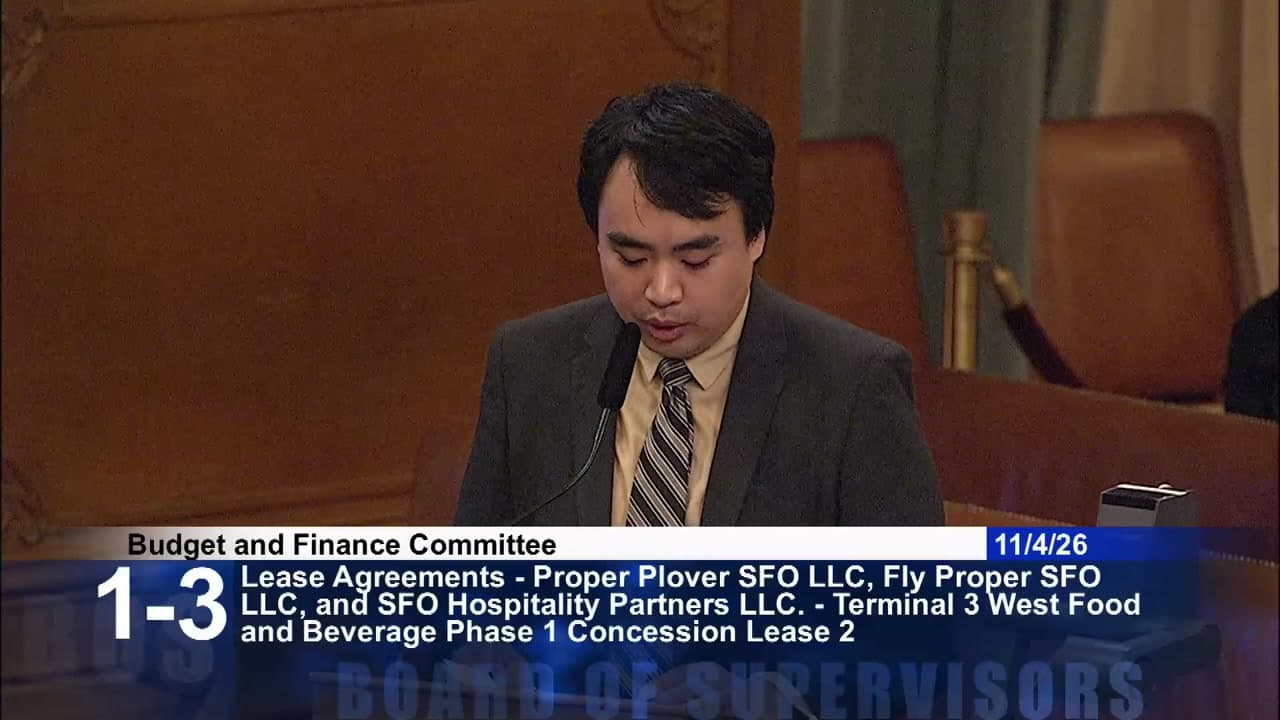
- SFO concessions: Three 14-year leases, each with a two-year option, were forwarded 3-0. Analysts project $24.5 million in airport revenue, with 15% going to the general fund each year. The operators are Andytown Coffee Roasters, Proper Food, and Peet's with Red Bay Coffee.
- 101 Gough Street: A $15.85 million loan to San Francisco Safe House Holdings LLC was continued 3-0 to Nov. 18. The loan would fund 23 units for people experiencing trauma-related homelessness; Dorsey cited unspecified analyst concerns.
Looking Ahead
The committee returns Nov. 18 to take up the Gough Street loan. Most of the forwarded items are expected on the full Board's Nov. 10 agenda.