Budget Committee - Aug 20, 2026 - Meeting
Budget Committee • LouisvilleAugust 20, 2026
Locunity is a independent informational service and is not an official government page for this commission.We use AI-assisted analysis and human editorial review to publish information.
Louisville Budget Committee Advances $13.5M in Federal Earmarks, Grills Gun Violence Nonprofit on Unmet Demand
Louisville's Budget Committee cleared a packed legislative calendar without a single dissenting vote on Aug. 20, but not before a pointed 23-minute interrogation of the nonprofit that relocates gun violence survivors — a program so cash-strapped that it turned away roughly 20 families last year. The committee also authorized the mayor to accept $13.47 million in congressionally directed federal spending, including $7 million from Sen. Mitch McConnell for the Belvedere project.
- $13.47M in federal earmarks authorized, including $7M from McConnell and $250K from Rep. McGarvey for the Belvedere
- Gun violence relocation nonprofit scrutinized over how $100K Metro contract leaves only $51K for direct services — and 20 families unserved
- Emergency creek stabilization moves forward with $136K local match unlocking $2.6M to save homes teetering over eroded Herds Creek
- Revolving loan cleanup spans two decades, consolidating 15 federal small business lending product lines into four accounts
- District budget shuffles reveal operational strain, as Districts 3 and 9 tap neighborhood development reserves to keep offices running
Only $51K of $100K Violence Prevention Contract Reaches Families Directly
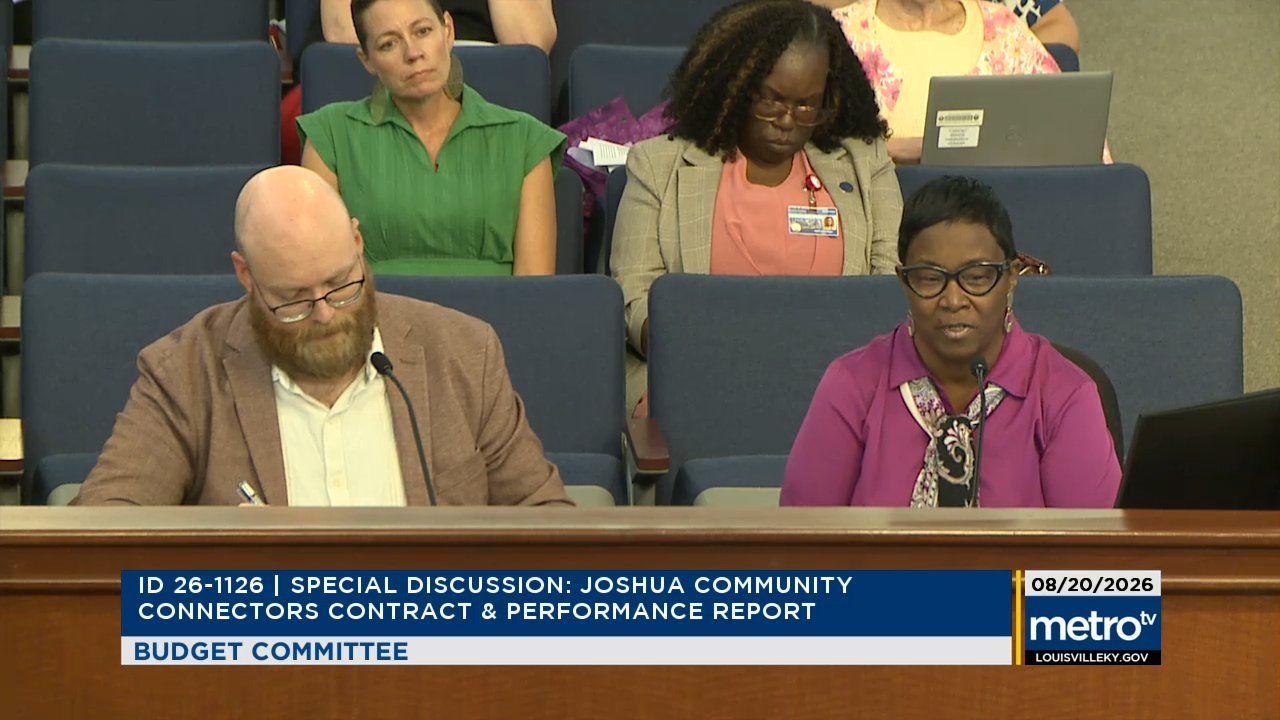
The committee's longest discussion centered not on any vote but on an informational deep dive into the Joshua Community Connectors, a small nonprofit that relocates victims of gun violence out of dangerous neighborhoods. The session was prompted by unanswered questions during the original budget hearing, when the contract had just been transferred between Metro departments and the prior department head could not adequately address council inquiries.
Why it matters: Metro's $100,000 represents 23% of JCC's $460,000 total budget — but after staffing, therapy and overhead, just over half reaches the people the program is designed to help. With relocations costing up to $22,000 per family, the math constrains the program to serving roughly a dozen families while demand far exceeds capacity.
Where things stand: Kimberly Moore, CEO of Joshua Community Connectors, walked the committee through the numbers: "My employee ate up 27,000. Therapy ate up 12,000, and office supplies and travel ate up 10,000." That leaves approximately $51,000 for direct relocation services. JCC housed 12 families, relocated three people, and has three individuals in college during the contract period.
Councilwoman Hawkins pressed on contract accountability, asking about tracking mechanisms for relocated families and what happens when Moore is unavailable. Moore said her executive assistant provides 24/7 backup coverage.
Vice Chair Markus Winkler pushed on unmet demand, asking for scale: "Are there 10 that you got asked that you weren't able to serve? Are there 30?" Moore confirmed approximately 20 additional requests were turned away last year — some because the violence victims themselves bore responsibility for the violence. Moore emphasized that JCC does not assist everyone: "You can't use your money for what you want and use our money for what you need. We need to know what you're bringing to the table and what kind of skin do you have in the game."
Moore also underscored the personal danger of the work: "I don't think sometimes people understand the danger that goes along with this work." She noted her own life has been threatened and LMPD sometimes instructs her to stand down from cases.
Councilwoman Purvis offered a different lens, sharing a success story of a constituent relocated by JCC: "He's doing well and he just had twin daughters and he's working two jobs and he's out of the streets."
Decisions: No formal action was taken — this was an informational discussion. James Tatum, Director of the Office of Violence Prevention, confirmed the new contract is ready for execution with new KPIs and quarterly fiscal and programmatic compliance reviews: "The quarterly fiscal reports will be coming in. They'll be verified by our fiscal compliance team. Only then will the reimbursements be made." Tatum also noted that Maryhurst mental health services funded through OVP provide additional trauma resources citywide.
What's next: The new JCC contract is expected to be executed within days, subject to the new reporting requirements. The committee will be able to track outcomes through quarterly programmatic and fiscal compliance reports.
$13.47M in Federal Earmarks Headed to Full Council
Belvedere Gets $7.25M; Funds Span Behavioral Health to Transportation
The committee authorized the mayor to accept $13.47 million in congressionally directed spending from three federal appropriations acts.
Why it matters: This resolution is Louisville's formal mechanism to deploy earmarks secured by the city's congressional delegation. The largest single allocation — $7 million from Sen. McConnell and $250,000 from Rep. McGarvey — targets the Belvedere project, with additional funds spanning behavioral health, transportation, and other departments.
Where things stand: Seth Drake, from the Mayor's Government Affairs team, laid out the funding sources. "The Belvedere is a part of it. Senator McConnell allocated 7 million for it. Congressman McGarvey, 250,000." Drake noted complications from HUD's changing community project funding processes and federal executive order compliance requirements.
Vice Chair Winkler confirmed the scope: "In terms of the money coming in from the federal, it's 13 million and change."
Staff identified a technical error — Facilities and Fleets had been omitted from the list of receiving departments — requiring a formal amendment rather than a simple correction. Beth Stenberg flagged the issue, and the amendment was approved by voice vote before the full resolution passed unanimously. Because it was amended, R-110-26 heads to old business rather than the consent calendar.
What's next: The resolution advances to full council through old business for final approval.
$136K Local Match Saves Homes Hanging Over Eroded Creek
Why it matters: Louisville's $136,336 local share unlocks a $2.6 million emergency stabilization project at Herds Creek, where severe flooding left homes literally teetering over a cliff. Federal and state agencies are covering the vast majority: approximately $2 million from the federal government and $500,000 from the state.
Christina Britz, OMB Executive Director of Accounting and Business Operations, explained that the funds come from unallocated Bipartisan Infrastructure Law grants already in Metro's capital budget.
Vice Chair Winkler, who visited the site, described the scene: "Having driven by here, it's shocking to see — essentially these houses are now hanging on a cliff because the entire back of their property is washed away with the flooding." He praised EMA and engineering teams for their response.
Decisions: O-222-26 passed unanimously (For: 9, Against: 0, Absent: 1) and was sent to the consent calendar.
Two-Decade Loan Fund Tangle Finally Untangled
The committee approved an amended ordinance consolidating revolving small business loan fund balances that have accumulated across capital budgets dating from FY2007-2008 through FY2026-2027.
The basics: Federal grants were originally dispersed as small business loans, repaid, re-loaned, and repaid again — cycling through approximately 15 product lines over nearly two decades.
Chair Kevin Kramer explained the history: "We got a grant from the federal government a bunch of years ago to offer as loans for small business. We did that. Those loans got repaid. The federal money was gone because we dispersed it. But it came back to us and then we loaned it again and it came back to us and we loaned it again."
The ordinance consolidates these balances into four streamlined categories. Beth Stenberg presented an amendment developed with the county attorney's office that restructured the whereas clauses to address moving balances rather than budgets and added a reference to the FY26 budget ordinance.
Decisions: Both the amendment (voice vote) and the amended ordinance (For: 9, Against: 0, Absent: 1) passed unanimously. Because it was amended, O-226-26 goes to old business rather than the consent calendar.
Minor Items
-
District 9 budget transfers: Two companion ordinances (O-233-26 and O-234-26) moved $70,000 from District 9's Capital Infrastructure Fund to its Neighborhood Development Fund, then $50,000 of that to general council operations. Both passed 9-0. Legislative Assistant Regina Guard presented on behalf of Councilman Andrew Owen.
-
District 3 budget transfer: O-213-26 transferred $35,000 from District 3's Neighborhood Development Fund to general operations to sustain council office functions through the fiscal year. Councilwoman Shameka Parrish-Wright presented. Passed 9-0. Both Districts 3 and 9 are drawing down neighborhood development reserves to cover basic operational costs — a pattern that raises questions about whether district operational budgets are adequate.
-
District 15 capital project reallocations: Councilwoman Jennifer Chappell redirected $83,555 in savings from under-budget Bluegrass Avenue sidewalk and Iroquois Amphitheater projects to a new sidewalk connection in the St. Joseph neighborhood and a Building our Blocks improvement fund (O-231-26). Passed 9-0.
-
Capital project title corrections: O-232-26 renamed three FY27 projects — expanding the Southwest Parkland Acquisition to include Districts 13, 24, and 25 alongside the original Districts 12, 14, and 15; changing District 26 sidewalk "repair" to "improvement" to allow construction; and broadening the Lee's Lane sidewalk project scope. Passed 9-0.