
Budget Committee Advances FY27 Property Tax Levy as Urban-Suburban Equity Debate Flares
Budget Committee • LouisvilleSeptember 3, 2026
Locunity is an independent informational service and is not an official government page for this commission. All information is sourced from public footage and an analysis of official agendas with the aid of responsible, fact-checked AI. to report an error or omission.
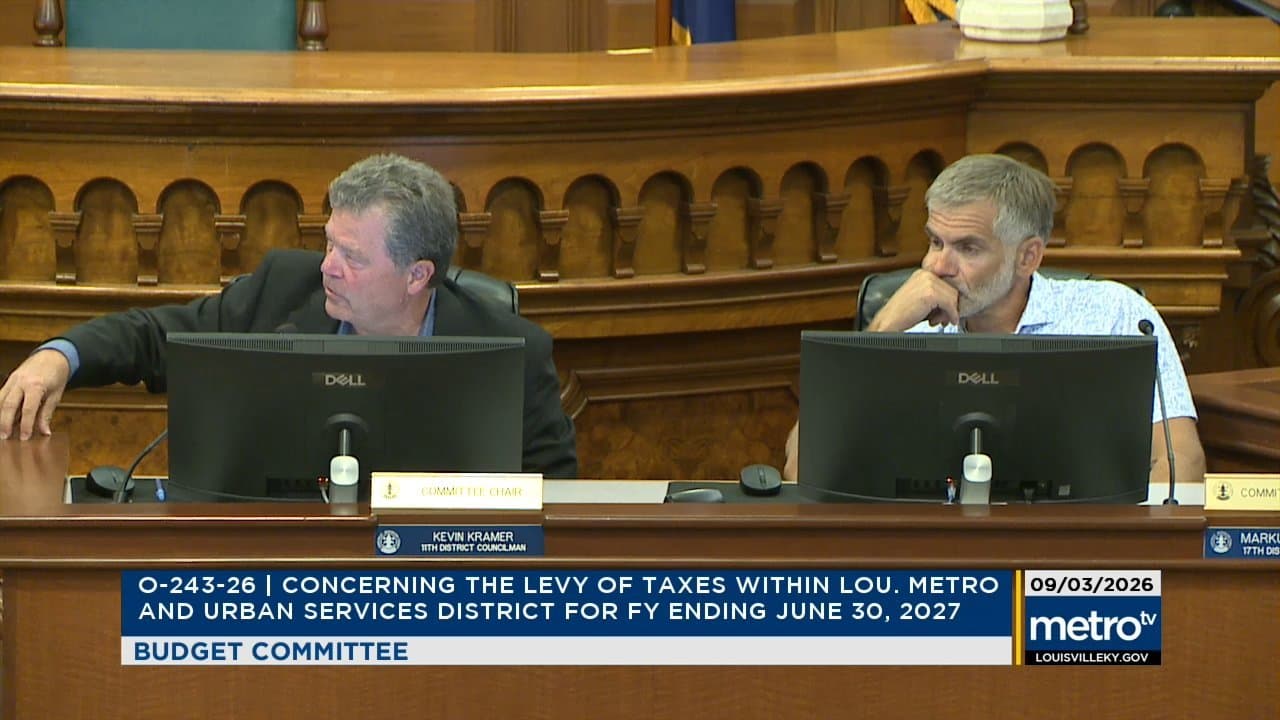
Louisville's Budget Committee approved the FY2027 property tax ordinance on Sept. 3, but not before a pointed exchange over whether the Urban Services District is effectively subsidizing the rest of the county — a tension that could shape the city's tax policy advocacy in Frankfort for years to come. The committee also unanimously approved nearly $1.9 million in historic tax credits for the Main Library renovation.
- FY27 property tax rates approved: Metro-wide real property rate drops to 11.64 cents per $100 while the Urban Services District rate rises to 32.76 cents, both within the 4% revenue growth cap
- $106.2 billion in total assessed property value — a 6.9% jump — drives the rate adjustments under House Bill 44
- Councilwoman Chappell challenges USD equity, arguing the urban core generates $6 million more in tax revenue than it receives in services and drives Louisville's tourism economy
- Chair Kramer invites joint Frankfort advocacy to reform state tax law so local governments can better capture tourism revenue
- $1.88M in historic tax credits approved for Main Library renovations, sent to consent calendar
The Tax Rate Puzzle: Why Metro Goes Down and the USD Goes Up
The basics: Under Kentucky's House Bill 44, local governments can grow total property tax revenue by no more than 4% annually (excluding new construction). When overall assessments rise faster than 4%, rates must drop. When they rise slower, rates can increase.
Why it matters: These rates land on every property tax bill in Louisville/Jefferson County. The metro-wide real property rate will fall from 11.80 to 11.64 cents per $100 of assessed value — still above the compensating rate of 11.20 cents. But the Urban Services District rate climbs from 31.90 to 32.76 cents, above its compensating rate of 31.50 cents. Both rates capture the full 4% revenue growth Louisville Metro is allowed under state law.
Where things stand: Chief Financial Officer Angela Dunn presented the ordinance, reporting that overall real property valuation for Louisville Metro hit $106.2 billion — a $6.8 billion or 6.9% increase from the prior year — with $568 million in net new property additions. The FY27 budget anticipates approximately $209.2 million in combined real and personal property tax collections.
OMB analyst Larry Linehan explained the mechanics driving the split in rate direction: "All the property in the county, including the USD, grew about over 6%. Thus the rate goes down. The area within the USD actually only had a small area that was reassessed, the Oxmoor area. So within the USD the assessment growth was far less than 4%. Thus the rate is going up."
Vice Chair Markus Winkler (D-17) underscored an important caveat for homeowners: "An individual homeowner could see more than a 4% increase. It is the countywide total that is 4%." In other words, the cap is a systemwide control — not a guarantee for any single property owner.
Councilman Piagetini pressed on technical details, confirming that net new properties are excluded from the 4% growth calculation and that motor vehicle tax rates remain set at statutory maximums.
Personal property, bank deposit, and life insurance share rates remain unchanged at their statutory maximums.
Decisions: The ordinance passed on a roll call vote. Three audible votes were recorded — Councilwoman Parish Wright, Councilwoman Parker, and Councilman Reno Weber all voting yes. The chair noted the ordinance would go to old business due to one "present" vote, suggesting at least one member declined to vote yes or no, though the full roll call was not captured in the transcript.
A public hearing on the proposed rates is set for Sept. 9 at 11 a.m. at Metro Hall.
The USD Equity Fight: Who's Subsidizing Whom?
Why it matters: Beneath the rate-setting mechanics, a substantive policy debate erupted over whether the Urban Services District — Louisville's urban core — pays more than its fair share.
Where things stand: CFO Angela Dunn reported that the USD is estimated to generate roughly $99 million in FY27 revenue against projected service costs of approximately $93 million, while noting that certain Central Business District expenditures are excluded from that calculation.
Councilwoman Jennifer Chappell seized on the $6 million gap: "Would you want it to balance out? Obviously you want revenue so we can invest in other things. But is it responsible to tax the urban services district more under that understanding?"
Chappell went further, making a forceful case that the urban core's economic contribution extends well beyond what property taxes measure: "I don't think that we're going to have hundreds of thousands of people coming in for Bourbon and Beyond and Louder Than Life and going into Anchorage and tearing that up. I don't think the Kentucky Derby happens in Fern Creek. So I can't help but sit here and be a fierce advocate for the Urban Services District when we are a very large economic driver beyond what we pay in our property taxes."
The other side: Vice Chair Winkler countered that the revenue-versus-expense comparison is misleading: "You do have the CBD in on the revenue side. You do not have it in on the expense side." He argued that urban services are consumed across the county regardless of where residents live, making a dollar-for-dollar comparison unreliable.
Chair Kevin Kramer (R-11) added that Metro absorbs significant USD-related expenses — fire apparatus, public works trucks used for both salt and garbage collection — that aren't counted in the USD calculation, further complicating any simple accounting.
But Kramer also validated Chappell's broader point, pivoting to a constructive offer: "We will count on your support when we go to Frankfort and ask for changes to tax law because we agree with you entirely. If we're going to move our economy so far into tourism, our tax structure, the way that the current state tax structure is established, doesn't allow for local governments to benefit very much from tourism."
What's next: The exchange signaled a potential bipartisan push — Kramer, a Republican, inviting Chappell to jointly advocate in Frankfort for state legislation that would let Louisville capture more tourism-generated revenue locally. Whether that materializes will depend on General Assembly appetite for local government revenue reforms — historically a hard sell in Kentucky.
$1.88M in Historic Tax Credits Headed to Main Library
Why it matters: The resolution unlocks nearly $1.9 million in state funding for the Main Library renovation using a mechanism Louisville Metro has deployed before — selling historic preservation and IRA tax credits it cannot use directly as a government entity.
Where things stand: Executive Director Heather Lowe of the Louisville Free Public Library explained that the credits were earned from existing investment in the Main Library: "This is historic tax credits that we have earned from the existing investment in the main library, and we are asking for them to be available for us to complete the project."
Vice Chair Winkler clarified the mechanics for the public record: because Louisville Metro, as a government agency, cannot directly receive historic tax credits, it sells the rights to a third party through a contracted agency — netting approximately $1,424,000 in historic credits after costs, with IRA tax credits coming directly to the metro government. Winkler noted this same mechanism was previously used for the Portland Library project.
Decisions: The resolution passed unanimously by voice vote and was sent to the consent calendar. Councilman Ken Herndon (D-4), the primary sponsor, expressed support, noting the Main Library is in his district.
Minor Items
- Roll call: Quorum established with eight members present; Councilwoman Chappell and Councilman Reno Weber joined after the meeting was called to order.
- OMB analyst Aaron Jackson confirmed that budget forecasting assumes the 4% revenue growth rate permitted under House Bill 44.