
Board of Zoning Adjustment - Apr 20, 2026 - Meeting
Board of Zoning Adjustment • LouisvilleApril 20, 2026
Locunity is a independent informational service and is not an official government page for this commission.We use AI-assisted analysis and human editorial review to publish information.
Mid-City Mall Grocery Redevelopment Wins All Approvals After Marathon Hearing
Louisville's Board of Zoning Adjustment plowed through 16 cases in a nearly six-hour session April 20, capping the night with unanimous approval of the largest commercial redevelopment Bardstown Road has seen in decades — a grocery-anchored transformation of the 10.5-acre Mid-City Mall site. Along the way, the board tightened the screws on two transitional home operators, greenlit 127 units of affordable senior housing, and shot down an oversized gas station sign.
Mid-City Mall site cleared for grocery-anchored redevelopment with four variances, six waivers, and a Category 3 plan all passing 6-0
127-unit affordable senior living facility approved as the first phase of the Dosker Manor campus overhaul
Unlicensed transitional home operator given six months to obtain permits or lose its conditional use approval
Second transitional home CUP delayed after board members questioned operator's credentials and management plan
Speedway's oversized sign request denied unanimously, board says existing options are sufficient
Neighborhood groups line up for and against Mid-City Market's treatment of Baxter Avenue and alley access
Bardstown Road's Biggest Bet: Mid-City Market Clears Every Hurdle
The basics: Branch Properties proposed replacing the aging Mid-City Mall at 1250 Bardstown Road with "Mid-City Market" — a 56,000-square-foot grocery store, four retail buildings, an office and library building, and a new public amenity area called Rosewood Park. The 10.5-acre project required four setback variances and six waivers covering loading docks, parking placement, building facades, glazing, and landscaping buffers.
Why it matters: The project transforms a declining strip mall into a walkable, grocery-anchored center that adds 3,700 feet of new sidewalks (up from 750 currently) and reduces impervious surface by nearly one acre. A new public library branch is part of the plan.
Where things stand: Developer representatives Jesse Shannon, president of Branch Properties, and attorney Cliff Ashburner of Dinsmore & Shohl told the board the project went through 27 site plan iterations and 34 stakeholder meetings with 17 neighborhood organizations.
"We're balancing the community needs, we're balancing site constraints because right now Raising Cane's on this particular site and Heine Brothers are on long-term leases and we can't impact that real estate," said Shannon.
Support was broad and organized. Ben Botkins, co-founder of Friends of Bardstown Road and owner of the nearby Bellwether Hotel, urged approval:
"We need this development more than the developers need this project. And I wish that wasn't the case, but it is."
Nick Morris, Vice President of the Highland Commerce Guild, Rob Willy of the Cherokee Triangle Association, and Brian of Friends of Beechwood Park all spoke in favor.
The other side: Opposition clustered around three issues. Patty Claire argued Baxter Avenue should not be treated as the rear of the development. Charles and Carol Swanson insisted alleys remain one-way and demanded six-foot residential screening. Sarah Almy, a Rosewood Avenue resident, cited a 30-year-old BOZA decision denying alley ingress and egress for the former Baxter Avenue Theaters as precedent.
Jack Trewick delivered the most pointed critique, arguing the plan fails multiple traditional marketplace corridor form district provisions:
"It does not reinforce the quarter's traditional visual character. It does not promote alternative modes of travel. It does not provide linkages between commercial development and the corridor with adjacent residential uses."
Todd Martin, a Rosewood Alley resident, raised safety concerns about a potential two-way alley conversion and requested speed humps and lighting shielding.
Ashburner responded that Rosewood Alley would remain one-way from Baxter and that the development adds nearly an acre of new green space.
Decisions: All three motions — four variances, six waivers, and the Category 3 development plan — passed 6-0 (For: Horton, Ford, Lewis, Rodriguez, Vozos, Bond; Against: none).
What's next: Branch Properties can now proceed with demolition and construction of the grocery-anchored center.
Senior Housing Rises on Dosker Manor Campus
Why it matters: A 127-unit independent living facility for seniors aged 55 and older at 30–80% of area median income will be the first phase of the long-awaited Dosker Manor public housing campus redevelopment at 431 E. Liberty Street.
Where things stand: Co-developed by LDG Development and Louisville Metro Housing Authority, the building required relief from downtown form district requirements because its U-shaped courtyard design did not maintain the required three-story street wall along the full lot frontage. Attorney Cliff Ashburner of Dinsmore & Shohl and architect Cameron Acheson of David Baker Architects presented the project. Construction is expected to take 18 months, with financing through the Kentucky Housing Corporation. No one testified in opposition.
Decisions: All components — a variance, two waivers, and the Category 3 development plan — were approved unanimously, 6-0.
Six Months or Else: Transitional Home Operator Put on the Clock
The basics: Flip the Script Recovery has been operating a transitional home at 432 S. 16th Street for roughly five years without the shelter licenses and permits required under Louisville Metro Code of Ordinances Section 115. The conditional use permit (21-CUP-0139) was originally granted in October 2021 but was never formally "exercised" because the applicant failed to complete licensing within the two-year window.
Why it matters: The board's decision to compress the exercise deadline from two years to six months — and staff's warning that the property could face daily zoning enforcement citations — signals stricter oversight of group housing compliance.
Where things stand: Co-owner Dwayne Nathaniel testified passionately that the home is in the house where he raised his children. He claimed that he and co-owner Star Allen were unaware of the licensing requirements despite having completed the process at their other location on McHenry Street.
Opposition speaker Ann Ramser challenged that account directly, presenting enforcement history and citing the original 2021 board record:
"The staff report and the minutes both say the applicant is aware of the requirements. Failure to read a staff report in the minutes and then claiming I didn't know is not acting in good faith."
Staff confirmed that the existing conditions prohibit operation without a license, and legal counsel Laura Ferguson clarified that zoning enforcement could cite the property daily if it continues operating unlicensed.
Decisions: The board approved the CUP exercise with a modified condition requiring compliance within six months, 6-0 (For: Horton, Ford, Lewis, Rodriguez, Vozos, Bond; Against: none).
What's next: Flip the Script Recovery must obtain all required licenses within six months of April 20, 2026, or the CUP becomes null and void.
Robin Hood Lane Group Home Delayed Over Operator Credibility
Why it matters: The board's decision to continue this case reflects growing skepticism toward transitional home operators who begin operations before obtaining required permits — a pattern also seen in the Flip the Script case earlier the same evening.
Where things stand: Staff recommended approval of a conditional use permit (26-CUP-0029) for a transitional home at 6014 Robin Hood Lane, operated by Saybah Glay of House of Favor, with updated conditions including a 30-day licensing deadline. But the hearing exposed significant gaps.
Property owner John Flynn of The Property Group acknowledged fines and unlicensed operations. Glay testified that she has three to four additional homes in the pipeline. Opposition speaker Ann Ramser presented enforcement history dating to November 2024 and raised concerns about the property's proximity to Slaughter Elementary School, noting the intake form referenced sex offenders.
Board Member Yani Vozos compared the application unfavorably to past cases:
"In cases like this in the past, we would hear about the organization and their credentials and their process, their procedure, and go into serious detail about that."
Decisions: The board voted to continue the case to May 4, 2026, directing the applicant to return with a detailed management plan, organizational structure, description of residents served, and on/off-site activities.
Speedway Sign Denied: Board Says Move the One You've Got
Why it matters: The unanimous denial shows the board holding the line on sign standards for collector roads, even for national brands.
Where things stand: Smart LED Signs sought a variance (26-VARIANCE-0039) on behalf of Speedway to install a freestanding sign on Hudson Lane exceeding maximum allowable area by 19.6 square feet and height by six feet. Staff recommended denial, finding the variance would alter the character of the vicinity and did not arise from special circumstances. An installer, Paul, testified that other signs across the street blocked visibility, but board members pointed out Speedway could relocate its existing Bardstown Road sign closer to the corner for visibility from both directions.
Board Member Marilyn Lewis noted that the applicant had not demonstrated a special circumstance unique to the property.
Decisions: Denied 6-0 (For denial: Horton, Ford, Lewis, Rodriguez, Vozos, Bond).
Minor Items
Hanover Road variance (26-VARIANCE-0027): Three-foot setback variance at 3500 Hanover Road approved 6-0; all adjoining owners signed off.
Moulder residence (26-VARIANCE-0040): Side yard setback variance of 1.47 feet approved 5-0; Board Member Bond abstained.
Empire Tires (25-VARIANCE-0067): 140-foot setback variance at 6702 Southside Drive approved unanimously to allow a storage shed for tires currently stored outdoors. Neighbor Roddy McDowell complained of tires piled to fence height creating rodent hazards; Ann Ramser challenged the applicant's account of a fire that destroyed a previous structure.
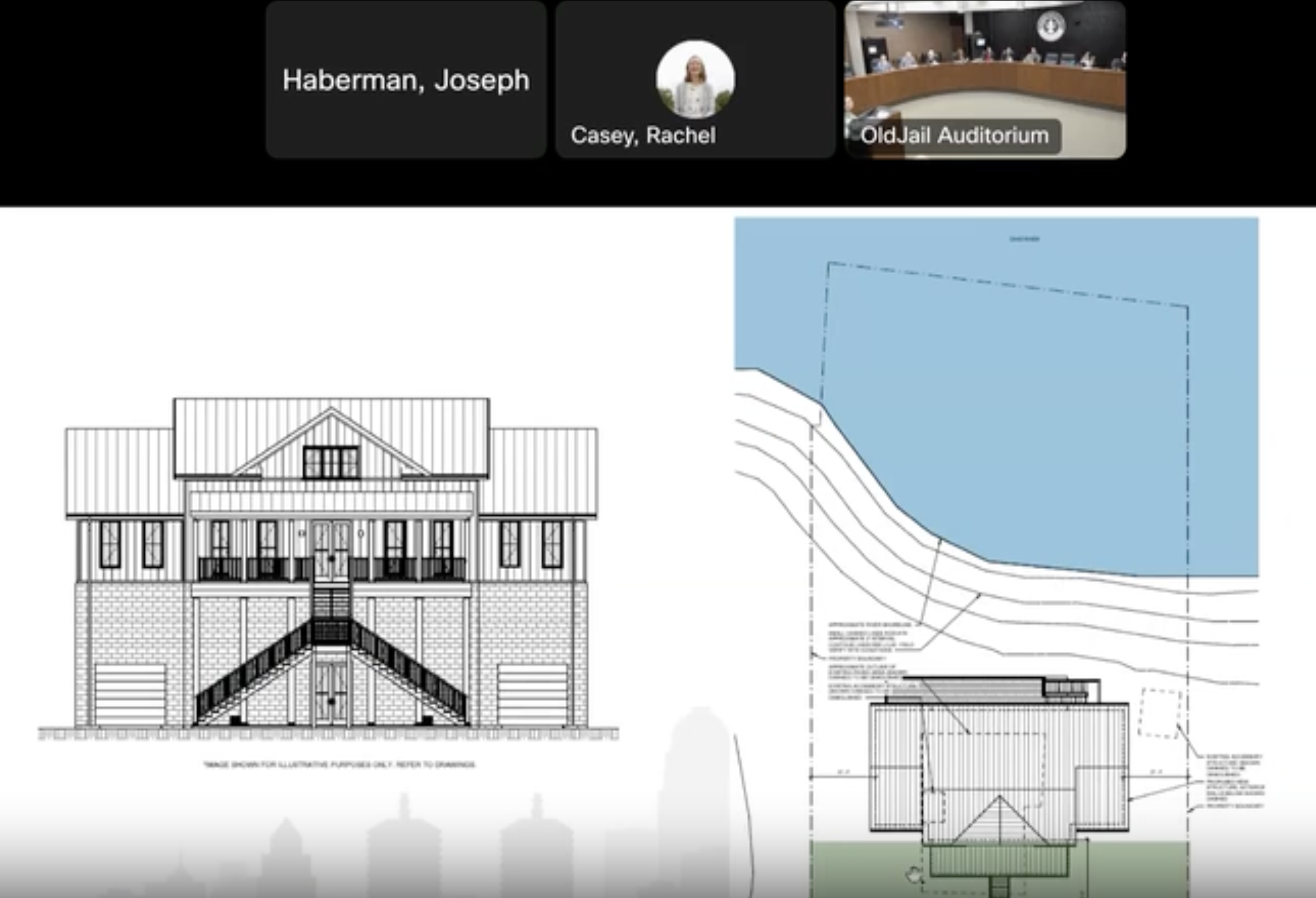
VanHoose home (25-VARIANCE-0073/26-VARIANCE-0035): Height and setback variances approved for an Ohio River-adjacent lot where MSD-mandated flood elevation raised the home 4.5 feet, triggering a two-foot height variance above the 35-foot maximum.
Old Louisville fence (26-VARIANCE-0004): Continued to May 4 because the applicant was absent; Helga Ulrich testified the fence was built without a variance or certificate of appropriateness.
Portland fence (26-VARIANCE-0021): V&N Imperial Properties fence variance at 2801 Montgomery Street approved; applicant Vildan Ahmic cited drug activity in an adjacent park as the reason for taller privacy fencing.
Hawk Realty warehouse (26-VARIANCE-0022): 20-foot front yard setback variance approved after a construction easement was misinterpreted; value engineering moved the building up slope, reducing cost from $5.6M to $3.6M.
St. Matthews carport (26-VARIANCE-0036): Three-foot side yard setback variance approved.
The Nine Louisville (26-VARIANCE-0038): 4.7-foot front yard setback variance approved to correct an as-built encroachment discovered during a new buyer's due diligence survey.
Old Louisville short-term rental (26-CUP-0043): CUP for a non-owner-occupied STR in a carriage house approved despite opposition; the owner lives in the main house on site, exempting the unit from the 600-foot separation rule.