
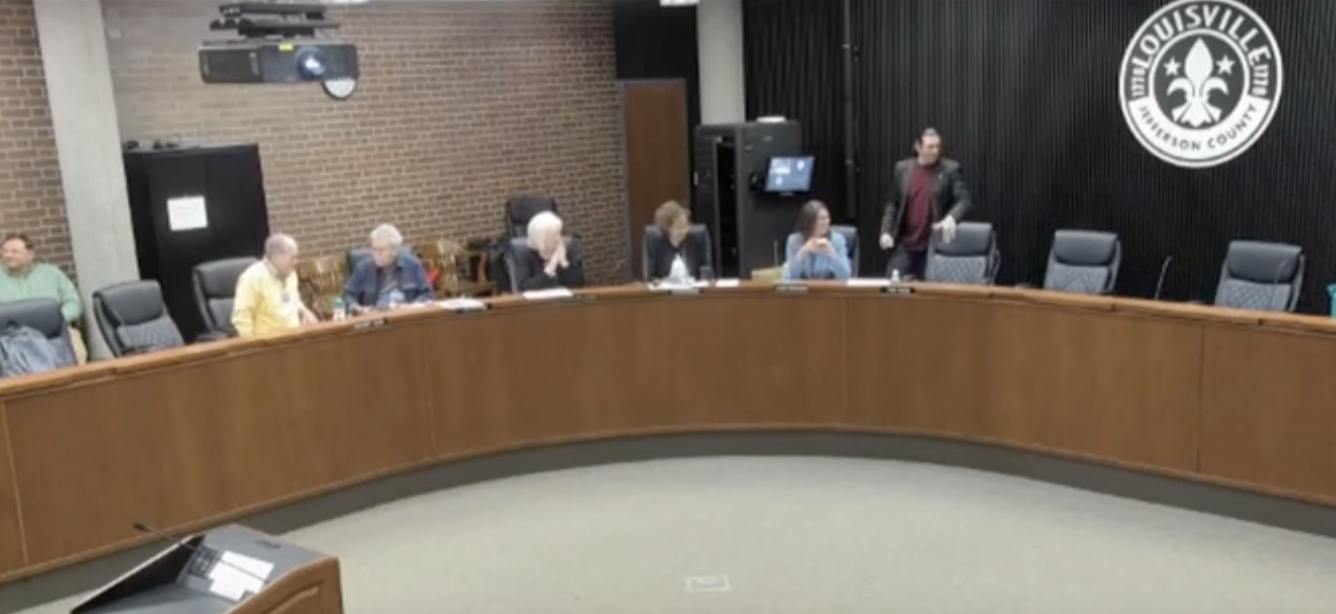
Board of Zoning Adjustment - Mar 30, 2026 - Meeting
Board of Zoning Adjustment • LouisvilleMarch 30, 2026
Locunity is a independent informational service and is not an official government page for this commission.We use AI-assisted analysis and human editorial review to publish information.
Airbnb Approved 3-2 as Neighbors Plead; Victorian STR Blocked by Buffer Rule
Louisville's Board of Zoning Adjustment tackled a packed docket of 10 cases March 30, but two short-term rental fights consumed the bulk of the meeting — one ending in the board's only split vote of the day and the other exposing the rigid limits of the city's 600-foot buffer rule. Seven variance cases sailed through unanimously, but the STR debates laid bare the growing tension between property rights and neighborhood opposition in Louisville's residential corridors.
Airbnb at 3629 Windward Way approved 3-2 after four neighbors testified about safety, parking and the loss of a multi-generational community; Board Members Horton and Ford voted no
Short-term rental denied unanimously at 4803 S 6th St despite a major Victorian restoration; another STR permit approved within 600 feet weeks earlier triggered the buffer rule
New 5,400 sq ft convenience store and gas station cleared for 2708 Dixie Highway, with five waivers recommended to Shively and a tree-relocation compromise
Unpermitted garage built in 2018 retroactively approved at 407 Westwood Dr, resolving a four-year zoning enforcement case
Seven variance cases — fences, setbacks, screening walls — all passed 5-0 with Board Member Rodriguez absent for the entire meeting
Windward Way Airbnb Splits the Board
Why it matters: The 3-2 vote — the only non-unanimous decision of the meeting — signals that board members are increasingly uncomfortable rubber-stamping non-owner-occupied short-term rentals, even when the legal framework gives them little basis to deny.
Where things stand: Kristen Charles, representing Florida-based owner Kristine Timmes, sought a conditional use permit to operate a short-term rental at 3629 Windward Way. Planner Mollie Share recommended approval: no other CUP-approved STR exists within 600 feet. Charles described noise monitoring devices, security cameras, Airbnb guest vetting, minimum three- to five-day stays, and a local handyman within five minutes for emergencies.
"We have a noise monitoring device and local contact as mentioned if any issues arise. The home will also be professionally cleaned and inspected regularly," said Charles.
She cited data showing only about 1.1% of Louisville's housing stock is listed as short-term rentals, arguing the neighborhood impact is negligible.
The other side: Four Windward Way residents showed up to fight the permit. Robert Keisler, an adjacent neighbor, did the math on what 600-foot spacing means for a narrow street: "Since it's 600 apart on short-term rentals, you could have a short-term rental every 10 houses because our lots are 60 foot wide." He pointed to weekend congestion — 25 cars on a street not built for the traffic — and the challenges of third-party management by an out-of-state owner.
Betty Hansell, 81, a resident of Windward Way since 1956, delivered the evening's most emotional testimony. "I'm not comfortable with looking out my window and finding groups of up to 10 people that I don't recognize," she said, voicing fears about security, property values, and the permanent nature of a CUP that runs with the property regardless of who owns it.
Kaylee Mitchell, a seven-year resident, said the original application letter described use for social gatherings, concerts and parties. She described the neighborhood meeting as contentious and said residents never received contact information for the property's co-host or maintenance person. Timothy Brown argued STRs undermine community building and his grandmother's sense of security, noting Airbnb requires no background checks for guests.
Decisions: During deliberations, Chair Sharon Bond zeroed in on management accountability. "I'm not seeing where the buck stops in terms of management," she said. That prompted the board attorney to walk the panel through the regulatory framework: "The host is responsible for everything. So they're going to have to assign a host. The host doesn't necessarily have to be that local person that's always available, but that's the person that is responsible for communicating with neighbors."
Board members expressed sympathy with residents but concluded there was no legitimate legal basis for denial since no CUP existed within 600 feet. The CUP passed 3-2 with conditions including a maximum of 10 guests and a 30-day registration requirement. Board Member Marilyn Lewis, Board Member Yani Vozos and Chair Bond voted yes. Board Member Jan Horton Sr. and Board Member William Ford voted no. Board Member Miguel Rodriguez was absent.
What's next: The CUP runs with the property and cannot be time-limited or tied to a specific owner. Neighbors can file substantiated complaints if violations occur, which could trigger revocation proceedings.
Victorian Restoration Can't Overcome 600-Foot Buffer
Why it matters: The case illustrates how Louisville's STR buffer rule can produce outcomes that frustrate even the board members enforcing it — blocking property owners who invest heavily in historic restoration simply because a nearby CUP was granted first.
Where things stand: Alonza Anderson, a Jacksonville, Fla.-based small business owner, purchased a 120-year-old Victorian at 4803 S 6th St in late 2022 and extensively renovated it. He sought a conditional use permit to operate a short-term rental, arguing the investment supports the comprehensive plan's goals for housing preservation and economic development.
Staff initially recommended approval. But on March 2, 2026, another STR permit was approved within 600 feet — triggering the buffer rule and flipping staff's recommendation. Anderson submitted updated justification seeking relief, but the board could not identify any qualifying exception under Metro Council's enumerated reasons.
"It's kind of hard to put forth the investment that it takes to do that, to put forth a quality home and then to sell that as affordable housing without subsidy," Anderson told the board.
Real estate professional Tyrza Howard and next-door neighbor Corey Cochran both testified in support, with Cochran praising the quality of the renovation. Ann Ramser, a District 21 resident, testified in opposition, questioning the affordability argument and expressing concern about Anderson's reluctance to share contact information at the neighborhood meeting.
Decisions: Board members were openly sympathetic. "I'd love to find a way to approve this. I think they've done a magnificent job on restoring this home," said Chair Bond. But no legal path existed. The board attorney confirmed that a CUP cannot be time-limited or conditioned to a specific owner: "You can revoke it at some point, but you can't put an automatic trigger where it's only good for X period of time, or it's only good for this property owner."
The board voted unanimously 5-0 to deny the CUP (For: Bond, Horton, Ford, Lewis, Vozos; Absent: Rodriguez).
What's next: The board recommended Anderson explore medium-term rentals of 30 days or more, which do not require a CUP — a potential revenue path to recoup his restoration investment.
Dixie Highway Convenience Store Gets Green Light
Why it matters: A new 5,400 square foot convenience store with a gas canopy will replace the former Clark gas station at 2708 Dixie Highway, consolidating two lots — including a demolished house — into a larger commercial development. BOZA approved the variance, but final authority on the five associated waivers rests with the city of Shively.
Where things stand: Planner Mollie Share presented the request for a variance from the Land Development Code's 5-foot building setback requirement. The new building will sit 114 feet from Dixie Highway — a 109-foot variance. Five waivers addressed parking location, gas canopy placement, buffer reduction, traffic circulation, and a blank wall.
Staff's primary concern was waiver 3, which proposed eliminating required trees from a reduced landscape buffer. Jason Hall of Prism Engineering, representing the applicant, agreed to relocate four trees elsewhere on the site and provided a conceptual planting plan. The board attorney recommended three separate votes to memorialize the tree commitment.
Decisions: All three motions passed 5-0 (Rodriguez absent). The variance was approved outright; the five waiver recommendations go to Shively for final action.
Unpermitted Garage Finally Regularized
Planner Abby Bills presented the case of a detached garage at 407 Westwood Dr built in 2018 without proper permits and under zoning enforcement since 2022. The garage encroaches 13 feet into the 30-foot street side yard infill setback. Property owner Jason Baldridge said the garage was built for vehicle security after break-ins, and the installer implied permits were handled.
Chair Bond questioned whether the 17-foot distance from the garage to the sidewalk left enough room for parked vehicles: "My concern was if we allow the variance of the garage being in the setback, then that pushes, that shortens the parking space of a car in front of the garage to not block the sidewalk." Staff confirmed that vehicles in driveways leading to garages are permitted and that the variance also covers a 25-foot garage-door setback rule. Approved 5-0.
Minor Items
Fence variance approved (5-0) for a 6-foot wooden fence at 13900 Beeston Blvd, exceeding the 4-foot street side yard maximum by 2 feet; the homeowner needed the height partly to contain chickens. Two neighbor support letters were submitted.
Setback variance approved (5-0) for a carport and covered patio at 1016 Cherokee Rd, a historic property with an existing certificate of appropriateness. Architect Emily Fisher Paprocki explained the steel-frame structures will sit atop an existing 8-foot brick wall, aligning with the carriage house.
Masonry fence variance approved (5-0) at 130 W Ormsby Ave in Old Louisville, replacing a dilapidated 8-foot wooden fence with a 7-foot masonry fence. The Old Louisville Architectural Review Committee had already issued a certificate of appropriateness.
62-foot setback variance approved (5-0) for an 18x20 metal storage garage at a construction yard at 3103 Herman Street; the structure aligns with existing buildings on the property.
Screening wall variance approved (5-0) at 141 Chenoweth Ln in St. Matthews for a 7-foot wall that grew taller than permitted during construction. Ted Bernstein of Land Design & Development explained the wall exceeded the 4-foot limit for aesthetic reasons; St. Matthews' code official directed the applicant to regularize it through the variance process.
March 16 meeting minutes approved 5-0.