Board of Commissioners - Apr 15, 2026 - Meeting

Board of Commissioners - Apr 15, 2026 - Meeting

Board of CommissionersSan Mateo County Harbor DistrictApril 15, 2026

Sources:

Locunity is a independent informational service and is not an official government page for this commission.We use AI-assisted analysis and human editorial review to publish information.

Harbor Board Celebrates Landmark Beach Restoration, Adopts $15.8M Budget Facing Tax Headwinds

The San Mateo County Harbor District board met April 15 with a rare mix of good news and fiscal caution — declaring a decade-in-the-making beach restoration project a resounding success while adopting a preliminary budget clouded by property tax disputes, a vacant anchor tenant, and proposed state legislation that could cut into investment returns.

  • Surfers Beach dredge pilot declared a success after 96,000 cubic yards of sand widened the beach and restored surfing conditions for the first time in years — setting regulatory precedent inside the National Marine Sanctuary

  • $15.8M preliminary budget adopted with $430K in revenue reductions from a delinquent tenant, Genentech tax disputes, and lower interest income; final adoption set for June

  • 2.2% rate hike and five new fees approved to close longstanding gaps where the district absorbed costs for services like forklift operations and hazardous waste cleanup

  • Draft RFP for three vacant restaurant spaces tabled as the general manager recommended resolving ongoing tenant negotiations in closed session first — each month of vacancy costs the district up to $20,000

  • First Flush water quality data flags persistent pollution at West Point Ditch, with copper and zinc exceeding ecological health limits for multiple years running

  • State legislation could divert local investment funds, with Vice President Chang Kiraly warning that AB 2214 would siphon 5–10% of LAIF deposits into a state-managed community reinvestment account


A Decade of Sand: Surfers Beach Dredge Pilot Delivers

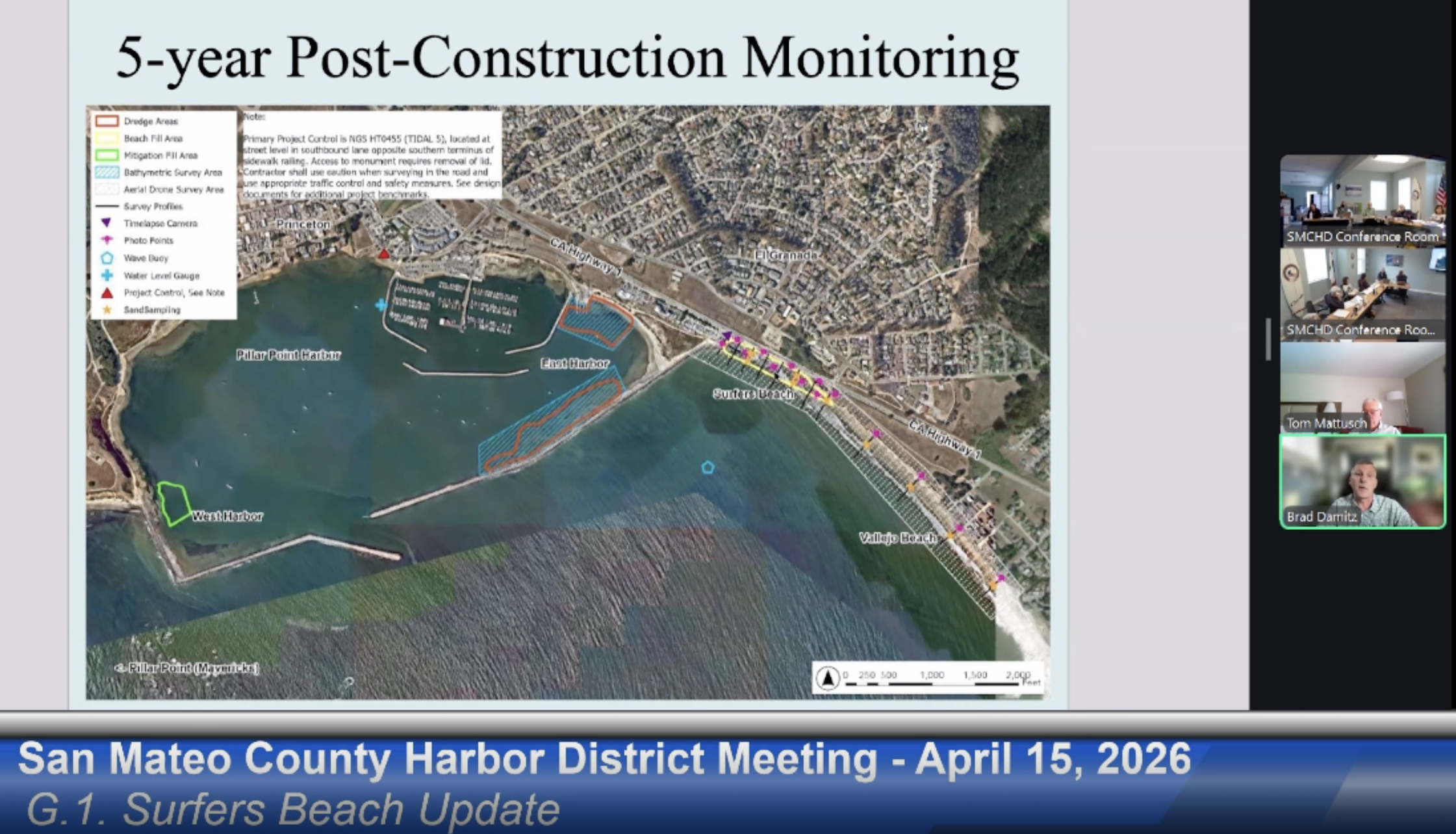
Between July and October 2025, the district pumped 80,000 cubic yards of sand dredged from Pillar Point Harbor's east basin onto Surfers Beach — the first-ever beneficial reuse of dredged material inside the Greater Farallones National Marine Sanctuary. Consultant Brad Damitz returned to the board with before-and-after photography, drone surveys, and satellite imagery showing dramatically wider beaches and waves breaking farther offshore.

Why it matters: The project's success establishes regulatory precedent that could cut future dredging timelines in half. Because the Coastal Development Permit is already in hand, the district won't need to repeat the decade-long planning process for future sand placement episodes.

Where things stand: A five-year monitoring program is underway, led by Environmental Science Associates (ESA) for physical monitoring and Marine Taxonomic Services for biological surveys. A wave buoy, sediment sampling, drone topography, and surfline camera analysis are all part of the program, with eelgrass surveys starting soon. The first annual report to the Greater Farallones Sanctuary is due in September 2026. Damitz told the board no permit violations occurred during the project.

"We demonstrated the feasibility of a small-scale beneficial reuse project of dredged material at a high-energy coastal site and also a sensitive marine environment. This is something that's never been done in the National Marine Sanctuary, and we were able to successfully do that without any environmental impacts or issues," said Damitz.

Commissioner Kathryn Slater-Carter urged the board to stop hedging its language.

"I don't think it's too early... I think we should start talking about the positive things that are happening," she said, arguing that confidently framing the environmental benefits would strengthen future funding applications.

Vice President Virginia Chang Kiraly pushed the board to think beyond the pilot, asking how dredge can be more regular to defer maintenance costs and other issues. Damitz responded that the existing Coastal Commission CDP would allow future dredge episodes without a new permit.

"We've got everything figured out with the sanctuary. So I think if there were to be another dredge in the future, it could be done much quicker," he said.

The dredging cycle is estimated at every five to eight years.

President George Domurat noted the mild 2025–26 winter helped sand stay in place, a favorable early sign for the monitoring data.

What's next: The district will share results with the Coastal Commission and explore grant funding for the next dredge episode — expected to be far easier now that the project is proven and fully permitted.


Budget Adopted, but Headwinds Are Building

The board unanimously adopted a $15.8M preliminary budget for FY 2026–27 — $15.766M in revenues against $13.728M in expenditures, with $2.038M flowing to working capital. But the numbers have deteriorated since the March first look.

Why it matters: Three revenue hits arrived in quick succession: a $246,000 reduction tied to a delinquent Pillar Point Harbor tenant, a $59,133 property tax cut from a Genentech assessment dispute settlement, and lower projected interest income ($250,000, down from $500,000) after large real estate purchases and capital projects reduced investable cash.

Where things stand: Operating revenues are expected to rise just 1.3%, while non-operating revenues fall 7.3%. Salary and benefits costs are up 4%, which is less than the normal 5% due to eliminating a position. The budget includes $600,000 reserved for two potential open commissioner seats and a conservative $300,000 capital improvement program. Working capital is projected $8.57 at fiscal year-end, with $3.7M in required reserves, leaving roughly $5M available for capital projects. The five-year forecast shows a potential budget imbalance in 2031, though staff noted that date keeps getting pushed out.

Commissioner Kathryn Slater-Carter warned the Genentech problem could grow.

"The county of San Mateo says there is a property tax dispute between the county assessor and Genentech, and that the settlement will result in a reduction of the property tax received by the district in the amount of $59,133," she said, flagging additional reassessment appeals in the pipeline with countywide implications of $4–5 million.

The LAIF threat: Vice President Virginia Chang Kiraly raised a new concern — proposed state legislation AB 2214 that would mandate the state treasurer set aside 5–10% of funds in Local Agency Investment Fund (LAIF) and divert them into a community reinvestment account.

"The legislation that's been proposed is to mandate that the state treasurer set aside 5 to 10% of the funds in LAIF, which is our tax dollars that we've invested, for deposit into a 'community reinvestment account,'" she said, urging the board to explore alternative investment vehicles like CLASS at the May finance committee meeting.

Decisions: Passed 5-0 by roll call (For: Domurat, Chang Kiraly, Mattusch, Slater-Carter, Zemke). Final budget adoption is scheduled for June.


Three Vacant Restaurant Spaces — and No Resolution in Sight

The board tabled a draft RFP for three vacant retail and restaurant spaces at Pillar Point Harbor after General Manager James B. Pruett recommended holding off until ongoing negotiations with a former tenant are resolved in closed session.

Why it matters: Each month the spaces sit empty costs the district up to $20,000. The ambitious timeline — advertisement in late April, lease approval by August — now appears likely to slip further.

Where things stand: The Finance Committee (Chang Kiraly and Mattusch) had reviewed the draft RFP the prior week. It proposed a five-year initial lease term with two five-year extensions requiring board approval, and scoring criteria weighted toward financial stability (40 points), rent and improvements (35 points), and business concept (25 points). An evaluation committee of two commissioners, Pruett, and the assistant director, plus a hired consultant, would review applications.

Commissioner Kathryn Slater-Carter expressed confusion about the document and requested a meeting with the Pruett before any vote. Commissioner Tom Mattusch urged that the RFP be issued promptly once negotiations conclude, underscoring the revenue urgency.

The board later returned from closed session with no reportable action.


First Flush: Bacteria High, but a Pollution Hotspot Emerges

Clifton Herrmann from the San Mateo County Resource Conservation District presented 2025 First Flush results — annual stormwater sampling from the first major rainstorm of the wet season across 16 sites from San Pedro Creek to Kelly Avenue in Half Moon Bay.

Why it matters: West Point Ditch showed persistent multi-year exceedances for copper and zinc, flagging it as a priority site for closer investigation into the pollution source. Herrmann noted that because both West Point Ditch and Vassar Outfall drain to the outer harbor they warrant continued scrutiny.

Where things stand: E. coli was elevated at all but three sites — the first time three sites met health limits, a positive trend. Enterococcus exceeded limits at all sites, which is typical for first-flush conditions. Lead and nitrate showed zero exceedances. Copper exceeded ecological thresholds at four sites. Orthophosphate exceeded thresholds at five sites, though that is common given the low detection limit.

President George Domurat asked about adding microplastics testing; Herrmann said the methods differ but it would be an interesting addition. Vice President Virginia Chang Kiraly praised the partnership and noted the data helps counter public criticism that the harbor itself is a major polluter.


Rates Rise 2.2%, Plus Five New Fees

The board unanimously adopted Resolution 2603, raising district rates and fees at Pillar Point Harbor, Oyster Point Marina, and for special events by 2.2% — tied to the Consumer Price Index per a 2017 board policy. Five new fees were also introduced:

  • Admin office parking pilot permit for designated stalls

  • Security deposit for trailer/boat storage lot tenants (new tenants only)

  • Transient trailer storage fee for weekend visitors at a newly purchased Princeton lot

  • Forklift operation fee to recoup costs when staff assist commercial crabbers or move abandoned items

  • District cleanup fee for hazardous waste disposal beyond what deposits cover

Commissioner Tom Mattusch thanked staff for designing fees that recover actual costs the district had been absorbing. President George Domurat clarified that existing storage lot tenants would not face a new deposit.

Decisions: Passed 5-0 by roll call (For: Domurat, Chang Kiraly, Mattusch, Slater-Carter, Zemke).


El Niño Batters Salmon Season

Commissioner Tom Mattusch reported that while the salmon season officially opened, ocean conditions are working against local fishermen.

"In a kind of cruel blow, we had a salmon season that opened. Due to ocean conditions, we're not finding many salmon, but we're doing great on bonita. So this El Niño is kind of wreaking havoc with the salmon fishery," he said.

Mattusch noted that Half Moon Bay was particularly hurt by not getting May in the fishery — a month when salmon are typically right offshore.

A public commenter, Sherry, a fishing shop operator at the harbor, reported five charter boats now operating out of her shop — Queen of Hearts, Salty Lady, Newan, Hog Heaven, and Amethyst — with a sixth declining due to rough weather.


Minor Items

  • Consent calendar approved by voice vote (5-0) after pulling Item 5 (parking enforcement) for separate discussion.

  • Parking enforcement update: 205 tickets issued between June 2025 and March 2026, peaking during fall fishing season. GM Pruett said the district prioritizes safety over revenue: "We don't want to be seen as a ticket factory or discourage people from coming to the coast by giving them tickets." Staff are updating the 2021 parking ordinance to reflect ADA spaces, loading zones, and passenger zones — targeting a May or June board presentation.

  • Coastal Commission coordination: GM Pruett reported positive reception from Commission staff on draft C4 parking plans at Pillar Point, Caltrans parking requirements, and the Deer Creek rerouting/bioswale project.

  • Life insurance update: Board approved the first update to employee life and AD&D insurance in 25 years, raising caps from $250,000 to $300,000 for OE3/Teamsters employees and from $200,000 to $600,000 for management — at an annual cost increase of just $2,400. Passed 5-0.

  • GM contract amendment: Board approved Amendment 5 to GM Pruett's employment contract, setting salary at $260,854 with a $400/month stipend if he opts out of district health coverage. Passed 5-0.

  • Salary schedule updated to reflect the new GM compensation. Passed 5-0.

  • Oyster Point dock replacement: Director of Operations John reported the west docks 1–6 gangway replacement at Oyster Point Marina is on track to wrap up by end of May.

  • SamTrans transit survey deadline is April 30 — staff encouraged participation, noting it could shape future bus service to Oyster Point.