
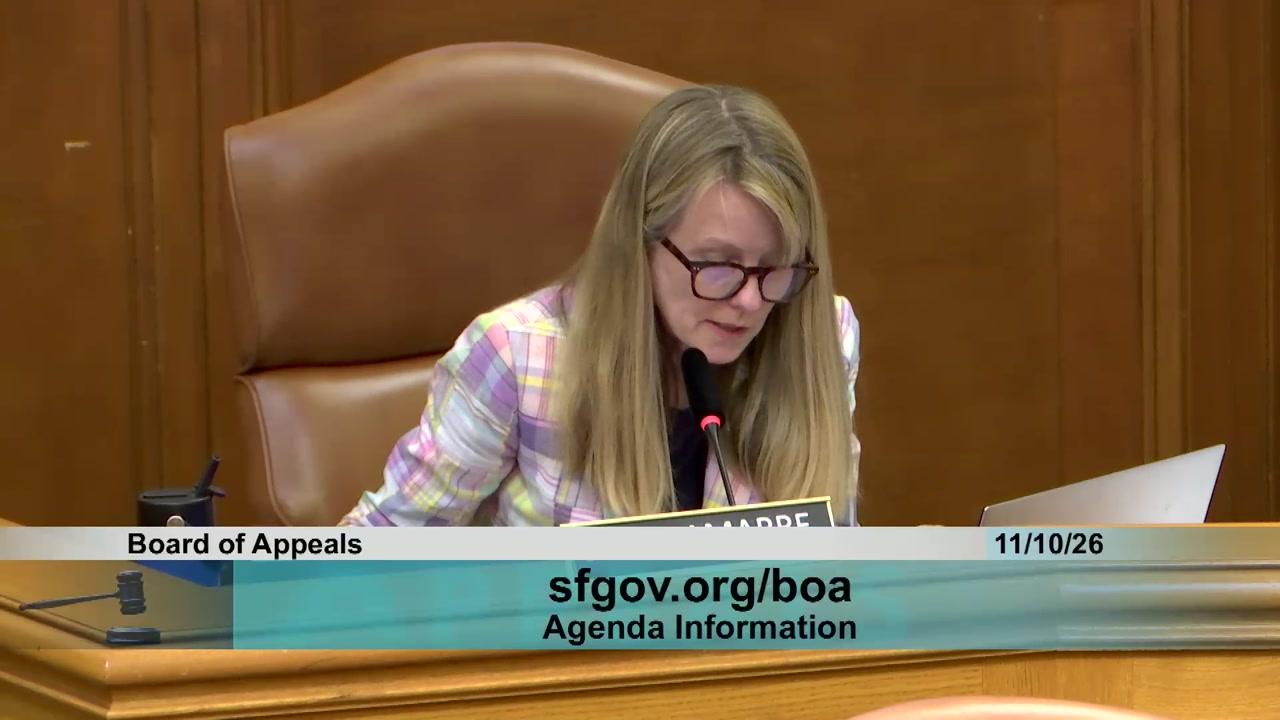
Appeals Board Delays Peru Avenue Rehearing, Demands Written Lead and Asbestos Plan
Board of Appeals • San FranciscoNovember 10, 2026
Locunity is an independent informational service and is not an official government page for this commission. All information is sourced from public footage and an analysis of official agendas with the aid of responsible, fact-checked AI. to report an error or omission.
San Francisco's Board of Appeals stopped short of reopening a tenant's case at 888 Peru Avenue. Instead, it gave the permit holder until Dec. 10 to put its safety promises in writing, including lead and asbestos swabs. The 90-minute special meeting on Nov. 10, 2026, also brought a Planning Department warning that large-cap office space is scarce and tied to the city's lagging affordable housing production.
- Peru Avenue rehearing continued to Dec. 16. The permit holder must submit a written environmental and demolition plan by Dec. 10.
- Credibility over code: Commissioners weighed the permit holder's unfulfilled verbal assurances against DBI's finding that no testing is required.
- Office cap squeeze: About 240,000 sq ft remains in the large cap, against a queue near 540,000 sq ft.
Peru Avenue: A Promise the Board Wants in Writing
The basics: Appellant Andrew Linton asked the Board to rehear Appeal No. 26-046. On Oct. 7, the Board voted 5-0 to uphold a permit to remove a non-permitted rear patio structure at 888 Peru Avenue. Student Reach holds the permit. A rehearing reopens a decided case, and commissioners weighed whether anything materially new had surfaced.
Why it matters: Commissioners signaled that assurances made at a hearing can carry weight even when the building code does not require them. The tenant household includes a newborn.
Where things stand: Linton said the permit holder had promised an environmental safety plan. He said it then served a 24-hour entry notice without one. He asked the Board to require a certified lead and asbestos inspection and a written hazardous materials plan. "If they really mean to do it, a condition costs them nothing," said Andrew Linton, appellant.
Mr. Montez, contractor for the permit holder, said debris would go out the rear rather than through the tenants' home. He said the addition is newer fiber-cement construction. After repeated questioning from President John Trasviña, Montez agreed to swab for lead and asbestos: "Yes, I will do it."
The other side: The Department of Building Inspection (DBI) said the rehearing standard was not met. It also said this alteration requires no certified inspection or written plan, and that the addition dates from roughly 2010 to 2015. "DBI respectfully requests the board deny the rehearing request, as the appellant's concerns regarding hazardous materials, while valid, are addressed by local and federal hazardous material handling regulations," said Carrie McElroy, Senior Building Inspector, DBI.
A split bench finds middle ground: Trasviña called the case close. "That suggests to me a reason to call into question the credibility of the permit holder," he said. Commissioner Robin Abad Ocubillo at first saw nothing new: "I'm not sure that I can find that there's anything new this evening that would give us grounds to grant a rehearing." Commissioner Lily Wong said the permit holder's failure to follow through on the report tipped her: "I would lean more towards the tenant side." Commissioner Jose Lopez argued against a full rehearing: "granting the request seems like — I think it's a heavy-handed remedy for the deficiency that I see before us this evening."
Decisions and stakeholder impacts: Lopez moved to continue the request to Dec. 16. His motion asks the permit holder to develop written environmental and demolition plans, including lead and asbestos swabbing and containment measures, and to share them with the appellants. The continuance also lets Vice President Rebecca Saroyan, who was absent, take part in the vote. In the roll call, Trasviña, Abad Ocubillo and Wong voted yes, and Saroyan was absent. Lopez, the mover, was not called, and no final tally was announced. The tenants get a written plan before any final ruling. Student Reach takes on obligations beyond what its permit requires.
What's next: The written plan is due by 4:30 p.m. Dec. 10. The Board will take up the matter Dec. 16, and no oral presentations are planned.
Office Cap Tightens as Housing Goals Lag
The basics: Zoning Administrator Corey Teague briefed the Board on the Office Development Annual Limit Program. The program covers office projects of 25,000 sq ft or more. It was created by the 1985 Downtown Plan and 1986's Proposition M, and only a voter initiative can change it.
Why it matters: The Board is the appeal body for office allocations and revocations. Teague said more revocations may come.
Where things stand: The program provides 950,000 sq ft per year: 75,000 in the small cap and 875,000 in the large cap. Space that goes unallocated rolls over. Proposition E (2020) scales the large cap to the city's progress on RHNA, the Regional Housing Needs Allocation goals for affordable housing. This year the city received under 220,000 sq ft rather than 875,000. Teague said RHNA attainment has ranged from roughly 11% to the low 20s in percentage terms since the first year.
Proposition C let the zoning administrator add back 2.3 million sq ft from past conversions. About 642,000 sq ft remains in the small cap. The large cap is far tighter. "In the large cap, we only have about 240,000 square feet, which is not a lot," said Teague. That space faces a queue near 540,000 sq ft, plus about 2.5 million sq ft planned at the Port.
Decisions and stakeholder impacts: The Board took no action, and no one spoke during public comment. Commissioners asked how "office" is defined, what is exempt and how appeals work. The Planning Commission has adopted a tiered revocation policy. That puts developers holding stalled allocations on notice, while projects in the queue compete for limited space. Appeals have been rare so far. "It's not a common occurrence that we see these get appealed," Teague said. The last appeal of an allocation came in 2013, and it was withdrawn.
Minor Items
- 401 Main Street: Appeals 26-054 and 26-055 were continued to Dec. 16. The appeals challenge commercial and valet parking permits issued to Douglas Parking LLC. SFPD filed its brief a day late, and Planning comments are due by 4:30 p.m. Dec. 10. The vote was 4-0 (For: 4, Against: 0, Absent: 1, Saroyan).
- 3355 Pacific Avenue: Executive Director Julie Lamarre announced that Appeal 26-060, an electrical permit challenge, was withdrawn.
- Minutes: The Board adopted its Nov. 4, 2026, minutes 4-0, with Saroyan absent.
- Demolition rules: Georgia Schutish, public commenter, submitted a 40-year Section 317 timeline. She said violations of demolition calculations are rarely caught and cited the loss of Noe Valley starter homes.
- Exhibit correction: Jay Martin, public commenter, asked the Board to correct or redact a court-opinion exhibit that is missing two pages. "I believe it serves no legitimate purpose for that to have been even submitted," he said.
Looking Ahead
Dec. 16 is now a crowded date for the Board. It will hear the Peru Avenue rehearing request and both 401 Main Street parking appeals, with written submissions on each due Dec. 10.