
Zoning Board Delays 35-Unit Church-Land Apartments, Approves Broad Street Offices
Zoning Board of Adjustment • BloomfieldNovember 19, 2026
Locunity is an independent informational service and is not an official government page for this commission. All information is sourced from public footage and an analysis of official agendas with the aid of responsible, fact-checked AI. to report an error or omission.
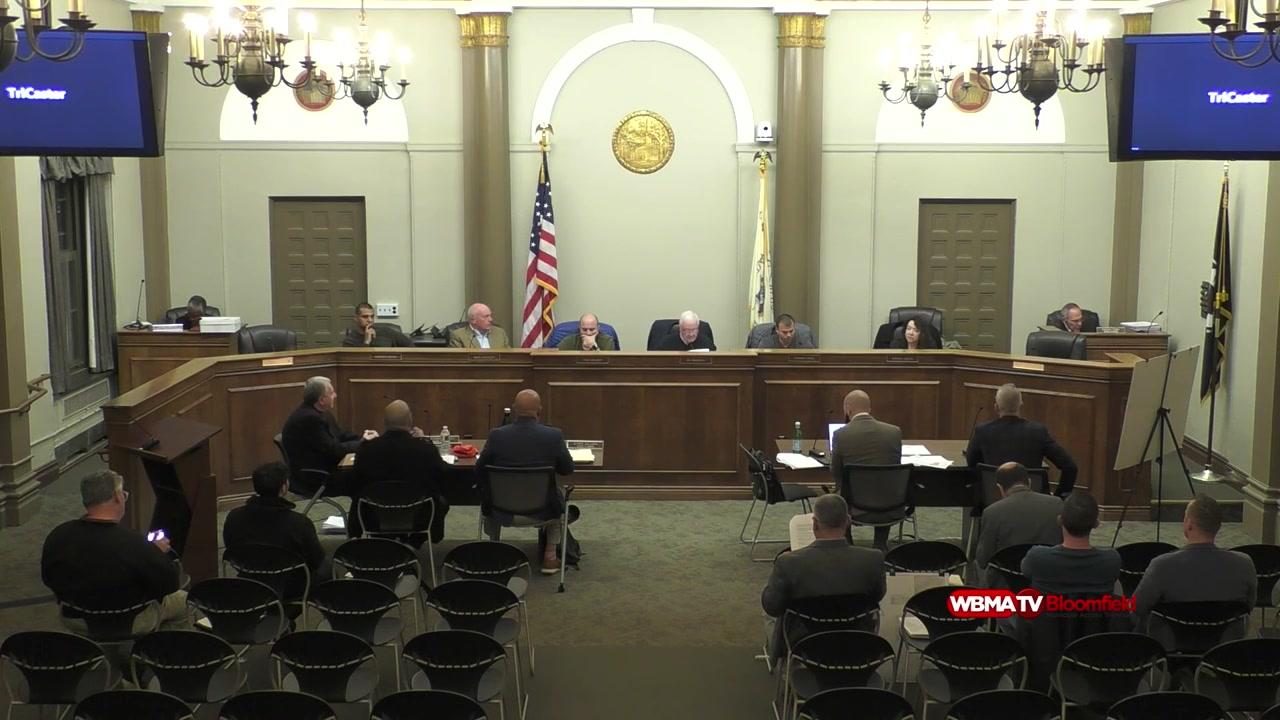
Bloomfield's Zoning Board of Adjustment spent more than two hours Nov. 19, 2026, on a 35-unit apartment building proposed for land leased from the Church of St. Valentine. The board continued it to Jan. 28, 2027, with questions on density, parking, the fence and lease terms still open. Earlier, the board voted 6-0 to approve a dental lab and counseling office at 1012 Broad Street. The approval was framed as a "professional office," a definition that will shape what tenants can follow.
- 35-unit 160 East Passaic Avenue hearing continued to Jan. 28, 2027; planner and traffic testimony remain
- Developer drops height and side-yard variances, but board engineer flags higher effective density
- 1012 Broad Street approved 6-0 as professional office with three engineer conditions
- Neighbors press on traffic, drainage and counseling clients near schools
Church-Land Apartments Hit the Brakes
The basics: 160 East Passaic Avenue, LLC seeks three types of variances, which are permissions to depart from zoning rules: a D(1) use variance, a D(4) floor-area-ratio variance and a D(5) density variance. It also seeks site plan approval in the R-2B zone. The project would sit on land owned by the Church of St. Valentine.
Why it matters: The project tests how much density the board will allow on church-owned land and whether a shared parking setup works for neighbors.
Where things stand: Applicant attorney Steven Joseph said a redesign eliminated the height and side-yard setback variances and flipped the lobby. Architect William Weckenmann described a 40-foot, L-shaped building with 35 units, a 56-space adjacent lot, a trash enclosure and a sliding gate.
"It's a land lease with the church maintaining ownership of both the property and the eventual building," said Weckenmann. He added that the building "occupies just 25% of the lot."
The managing member of the LLC, Zachary Levin, said the deal is a 59-year lease with a 49-year option. The lease has not yet been executed. "We will never buy a property from the church," said Levin. He described the fallback this way: "And if we don't take the option, they keep the building and everything on the property."
Density math: Board Engineer Anthony Marucci said the project's numbers look different if only the developed portion of the site counts, rather than the whole church lot. "Your FAR and your density is higher than what you're actually asking for," he told the applicant.
Members also questioned interior den walls that could function as extra bedrooms. "Happy to remove it completely. Would prefer to have a half wall," said Joseph. Members raised siding, snow removal, loading and the fence as well.
The other side: Two neighbors focused on spillover effects. "You're still going to have probably over 70 cars coming in and out of that development," said Renee Miranda, a public commenter. She was pointing to the awkward Hoover Avenue intersection. Miranda also called the all-white building a "white whale" and asked about varying the colors. The architect declined.
Ted Lawless, a public commenter, cited flooding on Kennedy Drive. "Has there been any testing of what drainage would be like," he asked. He also raised replacement of vegetation, the fence, setbacks, visibility of the firehouse and use of the whole lot.
Decisions and stakeholder impacts: Board Attorney Michael Rubin stressed that whatever is approved is binding. "That site plan is going to be what they are going to build," he said. On the shared lot, he added: "If they lose spaces, they got to come back."
Rubin urged the applicant's engineer and the board's experts to talk before the next session: "Perhaps there could be some conversations about the fence and the loading areas and all that kind of stuff."
The church stands to gain a building on its land. Nearby residents on Kennedy Drive and Hoover Avenue are pressing on drainage and traffic. The developer's model depends on an unsigned lease.
What's next: On a motion by Board Member Ryan Wangner, seconded by Board Member Barbara Brown, the board continued the hearing by voice vote to Jan. 28, 2027. That session will be held in person. Testimony from the applicant's planner and traffic expert is still to come.
Broad Street Office Approval Sets Use Boundaries
Why it matters: The ruling clarifies that a 2007 variance for a real-estate office covers similar professional offices. Medical offices would face separate parking rules.
Where things stand: Vitmar Realty, LLC, represented by attorney Ari Karozian, sought D(1) use variances and minor site plan approval for 1012 Broad Street in the R-1A zone. A counseling office has operated upstairs for about 13 years under the 2007 real-estate-office variance.
The applicant dropped a planned third tenant. That leaves a dental prosthetics lab on the first floor and a counseling center on the second. Testimony showed 13 parking spaces provided, two more than the 11 required.
The sticking point was how to define the use going forward. "I'm trying to figure out how to write this resolution," said Rubin. He pressed on whether a medical office could later move in.
The applicant's planner, Michael Passolano, conceded the point: "It appears that we can be included as the same type of use that the real estate office was." The board's planner and engineer said a "professional office" label would control intensity. A medical office would require more parking.
The other side: Miranda, who identified herself as a 48 Pitt Street resident, welcomed new small businesses. She asked whether the dental lab counts as manufacturing. She also worried about counseling clients, including those in anger management and domestic violence therapy, near schools. "There's also places where young children congregate in this area," she said. She asked that the counseling service tell patients not to loiter on adjacent properties or streets.
On the manufacturing question, Board Planner George Wheatle Williams said the reframing settled it: "Now that it's a professional office, that does alleviate the problem."
Decisions and stakeholder impacts: The board approved the application as a professional office with two uses. Marucci's three conditions apply:
- A trash enclosure in the rear by the accessible parking space
- No human habitation of the basement, which is limited to storage
- Ongoing maintenance of the stormwater detention system in the parking lot
The motion was seconded by Wangner. Vote: For: 6 (Board Chair Ray McCarthy, Brown, Board Member Mark Santasieri, Wangner, Board Member Edgardo Perez, Board Member Narindra Mohan). Against: 0.
Both small businesses can proceed. Any future medical tenant would face a separate review of parking.
Minor Items
- Extra January meeting: The board added Jan. 14, 2027, by voice vote to ease the year-end backlog of applications. McCarthy said the date leaves the last two weeks of the month open.
- Five resolutions adopted: Approvals were finalized for 50 Overlook Terrace (5-0), 190 Broughton Avenue (4-0), 30 Lowell Terrace (5-0), 69 Jacob Street (5-0) and 15 Lobell Court (4-0).
- Planner review ordered: The board voted 6-0 to retain a planner, but no traffic expert, for 488 Broad Street's built rear addition. It also voted 6-0 to retain a planner for a finished basement at 205 North 16th Street.
- Annual variance report: Rubin said the state-required review of variance decisions goes to the Dec. 3 agenda for possible adoption. He noted that individual members cannot speak for the board beyond the resolution.
- Minutes: Nov. 12 minutes approved 6-0.
Looking Ahead
The board meets Dec. 3 to consider its annual variance report and adds a Jan. 14, 2027, session. The 160 East Passaic Avenue hearing resumes Jan. 28, 2027.