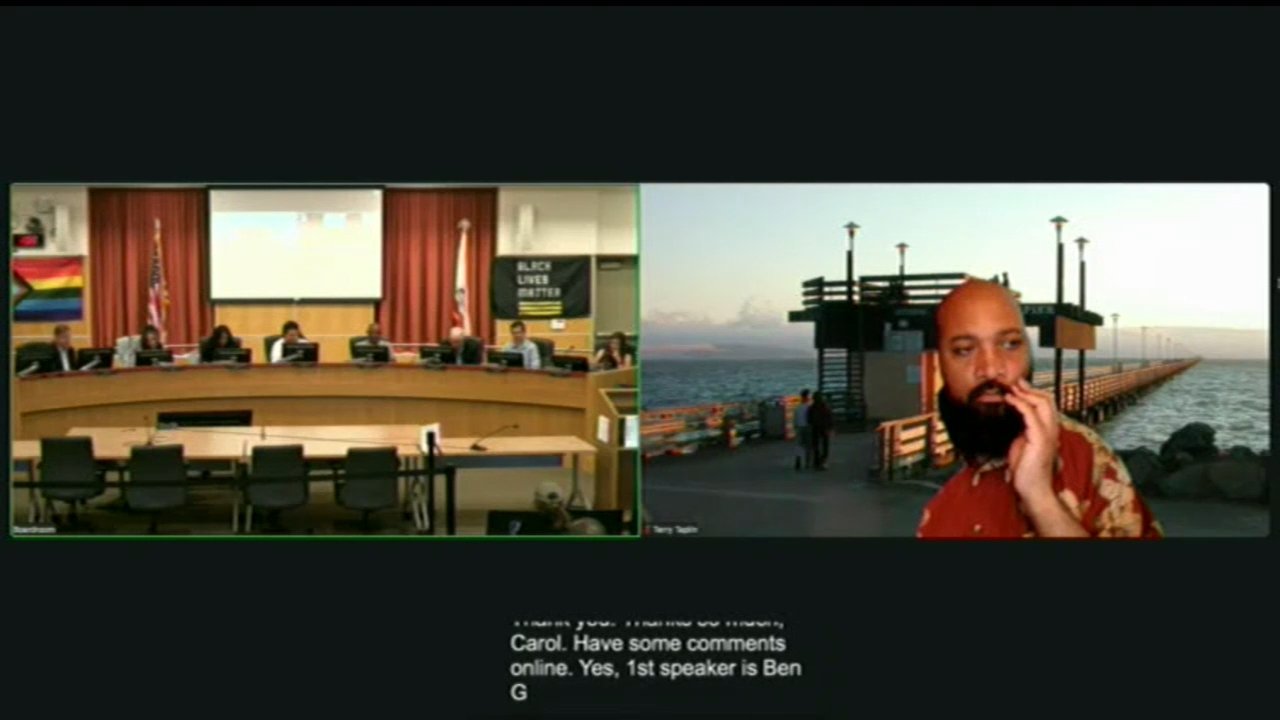
City Council - Jul 14, 2026 - Regular Meeting
City Council • BerkeleyJuly 14, 2026
Locunity is a independent informational service and is not an official government page for this commission.We use AI-assisted analysis and human editorial review to publish information.
Council Splits 5-4 to Expand Police K9 Authority Despite Unanimous Public Opposition
Berkeley's City Council approved a contentious overhaul of 44-year-old restrictions on police dog and helicopter deployments in a razor-thin 5-4 vote that drew more than 30 public speakers — every one of them opposed. The marathon meeting also sent three citizen-led tax measures to November voters and confirmed a new Public Works director.
- Council narrowly expands police K9 deployment authority, 5-4, over fierce opposition citing racial disparities and civil rights history
- Three ballot measures head to November 2026 voters: an arts parcel tax ($6M+ annually), a public bank parcel tax, and a doubled soda tax
- City auditor warns public bank measure mandates audits without funding, setting a "really bad precedent"
- Jamie Parks confirmed as Public Works director at $270,000; outgoing interim director praised by full council
- Tear gas reinstatement debate punted to September 15 after contentious 6-3 scheduling fight
- Berkeley among first cities to formally oppose ACA 22, a state measure that would require supermajority votes for local special taxes
The K9 Vote That Split the Council
The basics: Councilmember Rashi Kesarwani introduced a resolution to rescind Berkeley's 1982 Resolution No. 51,408-N.S., which required city manager pre-approval before police could request helicopter or K9 support through mutual aid — a process that created 20- to 30-minute delays during critical incidents. The new policy replaces that with watch commander approval and post-deployment reporting.
Why it matters: The vote replaces restrictions adopted during the Cold War era with a modernized framework that expands the circumstances under which police dogs can be deployed to apprehend suspects — while the fierce public backlash signals this will be a defining issue in November elections.
More Than 30 Speakers, Zero in Support
Every public speaker opposed the resolution. Residents, former first responders, and advocacy groups drew parallels to Birmingham-era civil rights abuses and cited ACLU data on disproportionate racial impacts of K9 deployments in California cities.
"Every dollar spent on force tools is a dollar taken from staffing the emergency communications center," said Tasha Baptiste, a former EMT, who detailed the clinical and fiscal costs of K9 bite injuries.
Moni Law, a longtime Berkeley resident and former member of the Fair and Impartial Policing work group, presented exhibits tracing the history of police dogs from slavery through modern-day deployment data showing disproportionate racial impacts in Richmond, Fairfield, and Bakersfield.
The Police Accountability Board submitted a letter opposing the resolution, arguing BPD had not demonstrated a single instance where the existing pre-approval process had negatively impacted outcomes. The PAB chair told the council the board was not invited to participate at the table and questioned the evidentiary basis for the change.
"The item cites approximately 8 to 10 K9 requests a year. But it does not provide incident-level evidence showing how many requests were delayed, how many were denied, what harm resulted from these denials, or why narrower amendments would be insufficient," said Councilmember Ben Bartlett, who voted no.
The Peace and Justice Commission presented a competing item (23b) urging the council to retain all existing bans and commission an academic health impact study. Commissioner George Lippman raised concerns about removing city manager pre-approval given what he described as a broader pattern of reduced civilian oversight. The council ultimately took no action on the commission's proposal.
The Policy Fight
Under the new resolution, K9 units may be deployed for violent felony suspects, armed suspects, residential burglaries in progress, and high-risk warrants. The policy maintains explicit prohibitions on crowd control and low-level offenses and adds a new ban on use during homeless encampment sweeps.
Councilmember Kesarwani framed the change as long overdue modernization. "We are bringing this item forward because it modernizes a 1982 resolution that governs when Berkeley police can request helicopter and canine support through mutual aid. The 44-year-old policy was written in a different era and its restrictions no longer reflect current operational realities or best practices," she said.
Chief Lewis testified that K9 deployments follow a careful escalation process with announcements and leash control. "We've never had a bite in the last 10 years that I can think of in any of the deployments we've had with canines, if not farther back," the chief said.
Councilmember Brent Blackaby, who voted yes, argued the council now has accountability tools that didn't exist in 1982. "Yes, there are some expansions to meet the moment in terms of what modern policing is. But we also have more accountability tools, more camera coverage, more report back," he said.
Councilmember Mark Humbert made the motion to adopt, arguing the existing framework rested on outdated assumptions. "The current approach, which requires prior approval, seems to rest on a fundamental assumption of disagreement and distrust between the police chief and the city manager and the city council. And I don't believe we currently suffer from that level of distrust," he said.
The Other Side
Mayor Adena Ishii proposed friendly amendments — adding "deadly weapon" language, requiring residential burglaries to be "in progress," and explicitly prohibiting encampment deployments — which Councilmember Kesarwani partially accepted. But the mayor ultimately voted no.
"I think it's really unfortunate that in bringing this item, I think that it did impact the trust of the people. And that feeling that now to bring these items during a time where we're seeing our federal government misuse them and abuse them," Mayor Ishii said.
Councilmember Igor Tregub requested severing the helicopter and K9 votes and voted no on K9 provisions, citing the PAB's assessment and a lack of demonstrated need. He abstained on helicopters.
Councilmember Cecilia Lunaparra voted no on both provisions.
Decisions
Councilmember Tregub's motion to sever succeeded, producing two separate votes. Helicopter provisions passed 7-1-1 (Councilmember Lunaparra no; Councilmember Tregub abstain). K9 provisions passed 5-4, with Councilmembers Kesarwani, Terry Taplin, Shoshana O'Keefe, Blackaby, and Humbert voting yes, and Councilmembers Bartlett, Tregub, Lunaparra, and Mayor Ishii voting no.
What's next: The narrow vote and organized community opposition virtually guarantee this issue will resurface in November campaigns. The tear gas and OC spray reinstatement item — a closely related policing debate — is now scheduled for the Sept. 15 regular meeting.
Tear Gas Debate Deferred After Procedural Brawl
Why it matters: Item 24a, which would reinstate limited tear gas use for critical life-threatening incidents and lift the COVID-19 moratorium on smoke and OC spray, was not heard due to time constraints — but the fight over when to hear it exposed deep divisions.
Where things stand: Councilmember Kesarwani moved to schedule a special meeting for July 21. Mayor Ishii strongly opposed, arguing the item should wait until after the broader use-of-force policy (Policy 300) discussion expected in late September. The mayor noted students were out of session and that Councilmember Lunaparra emphasized students should be part of the conversation.
A PAB representative noted three proposed changes to Policy 300 — covering when force can be used, de-escalation requirements, and deadly force standards — that directly intersect with the tear gas decision.
Decisions: After a contested procedural sequence that included a motion to reconsider, the council voted 6-3 to schedule items 24a and 24b for the Sept. 15 regular meeting. Councilmembers Bartlett, Tregub, and Mayor Ishii voted no. Notably, Councilmember Lunaparra switched from no to yes between procedural votes.
Three Ballot Measures Head to November Voters
Berkeley's consent calendar sent three citizen-initiated tax measures to the November 2026 General Municipal Election, each with significant fiscal implications.
Arts Parcel Tax: $6M+ Annually for Cultural Organizations
The measure would generate more than $6 million annually for nonprofit theaters, music organizations, museums, community festivals, and individual artists. Tom Parish of the Berkeley Arts Coalition told the council that 93% of Berkeley voters polled said arts are critical to what makes Berkeley special.
Public Bank Parcel Tax: Auditor Sounds the Alarm
The measure would fund the East Bay's first public bank. But the city auditor raised significant concerns, warning that the measure mandates independent audits by her office without providing funding.
"Imposing audit requirements without additional funding will curtail the scope of other audits we are able to execute. Other priority issues may be left unaddressed. This sets a really bad precedent," the city auditor said.
Debbie Notkin, chair of Friends of Public Bank East Bay, supported the measure and agreed with the auditor's request for resources. Jeff Lomax urged opposition, citing the city's $30 million deficit and no guarantee funds would be spent in Berkeley.
Doubled Soda Tax
The third measure would replace the existing 1-cent-per-ounce general sugar-sweetened beverage tax with a 2-cent-per-ounce special tax earmarked for public health, nutrition, and water access programs.
All three measures passed the consent calendar 9-0.
New Public Works Director Confirmed at $270K
Why it matters: The council unanimously confirmed the appointment of Jamie Parks as Director of Public Works, effective Aug. 17, at $270,000 annual salary, filling a critical infrastructure leadership vacancy.
Where things stand: Multiple council members used the item to heap praise on outgoing Interim Director Wahid Amiri. Councilmember Lunaparra called him "impressively responsive." Vice Mayor Shoshana O'Keefe said he "really nailed it."
A representative of Walkway Berkeley spoke in support of Parks, saying he has the background the city needs to advance safe, accessible streets.
Minor Items
- FY 2027 budget finalized: The $922 million Annual Appropriations Ordinance was adopted on second reading as part of the consent calendar, 9-0.
- Berkeley opposes ACA 22: Councilmember Tregub authored the item formally opposing the state constitutional amendment that would require a two-thirds supermajority for certain local special taxes, making Berkeley among the first cities to take a position.
- ICRI lease approved: A five-year lease at 125-127 University Ave. for the International Child Resource Institute, a child development nonprofit, passed unanimously after a public hearing with no public comment.
- Street lighting assessments approved: FY 2027 assessments passed 9-0; public commenter Kelly Hammergren urged dark sky-compliant lighting standards.
- Electric fleet purchases: The consent calendar included purchase orders for 10 electric trucks ($790,000) and nine parking enforcement vehicles ($550,000).
- Community land trust contract: $400,000 contract approved on consent.
- State public health grants: $2.7 million in state grants accepted.
- AI pilot floated: Councilmember Blackaby flagged the after-hours answering services contract (item 15) as a candidate for AI technology, noting the city manager was open to exploring it.
- PAB appointments and discretionary donations: Two Police Accountability Board appointments confirmed; council members donated a combined $1,200 to the Bertha Brown Memorial (item 18) and $1,350 to the RISE program (item 20).
- Disability Pride Month: The council proclaimed Disability Pride Month; Emily, executive director of BORP Adaptive Sports and Recreation, celebrated the organization's 50th anniversary.
- Peace and Justice Commission item 23b (counter-proposal to retain police dog bans and commission a health study) received no action after passage of item 23a.