City Council - Jul 28, 2026 - Regular Meeting
City Council • BerkeleyJuly 28, 2026
Locunity is a independent informational service and is not an official government page for this commission.We use AI-assisted analysis and human editorial review to publish information.
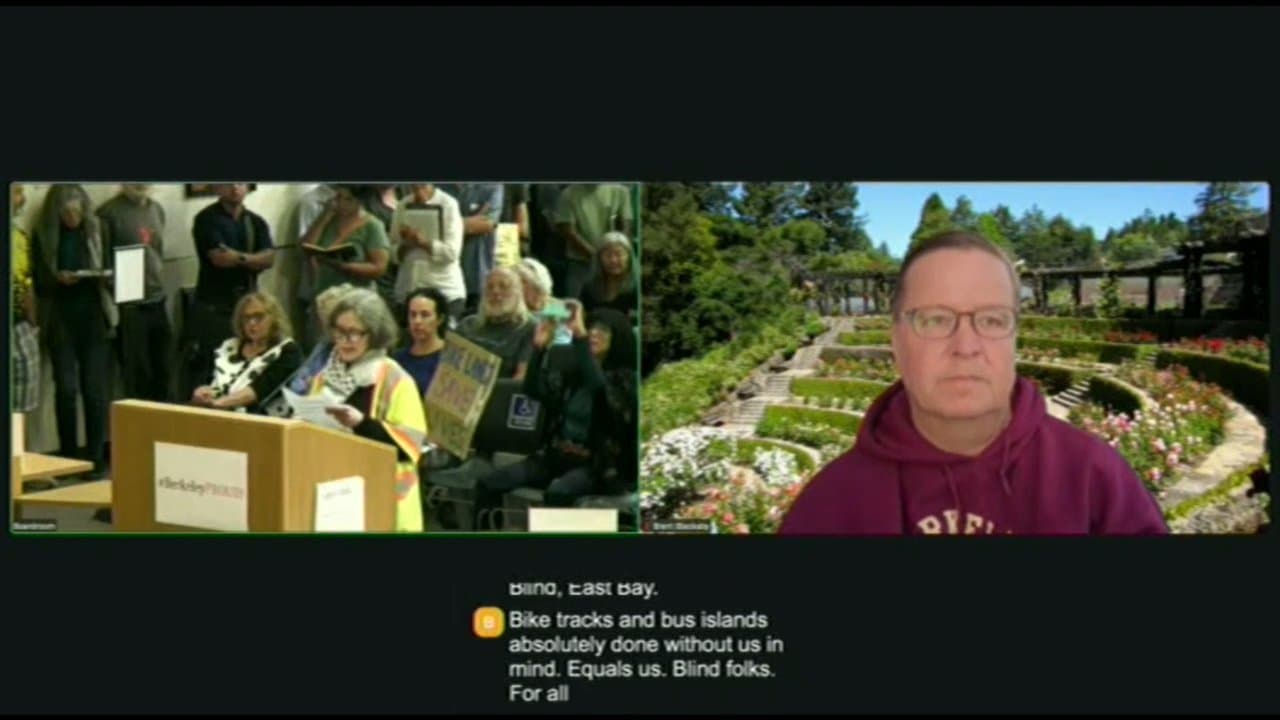
Council Approves Protected Bike Lanes on Hopkins After Marathon Debate
Berkeley's City Council ended a decade-long transportation fight Tuesday night, voting 7-2 to direct staff to build Class IV protected bikeways on Hopkins Street — then stayed past midnight to do it, drawing more than 100 public speakers who split sharply over parking, safety, and the city's climate commitments.
- Protected bike lanes advance on Hopkins Street after 6+ hours of debate, two failed substitutes, and a 7-2 final vote
- Hotel workers urge Council to back their union drive — and get a unanimous resolution of support ahead of Friday's vote at the Graduate by Hilton
- Single-family inclusionary housing fees increase as Council lowers the floor-area deduction from 5,000 to 2,500 sq ft
- RENAISSANCE initiative targets downtown blight, directing staff to develop enforcement tools for 17 stalled housing projects and vacant storefronts
- Berkeley joins legal challenge to EPA's rollback of vehicle greenhouse gas standards under the Clean Air Act
Hopkins Street: Safety vs. Parking in Berkeley's Biggest Bike Fight
The basics: Hopkins Street, a roughly seven-block corridor connecting the Ohlone Greenway to the Alameda, has been the most contested piece of transportation infrastructure in Berkeley for years. The street is home to Monterey Market, King Pool, Evangel Bible Church, and multiple schools — and has logged three pedestrian and cyclist fatalities and 46 crashes over 15 years. The road badly needs repaving.
Why it matters: The question was never whether to repave Hopkins, but what to build when they do. Councilmember Rashi Kesarwani (District 1) authored the main referral calling for Class IV one-way separated bikeways from the Alameda to Peralta Avenue/Ohlone Greenway, Class 2 buffered bike lanes from Sutter Street to the Alameda, raised intersections, bus boarding islands, traffic calming, and a comprehensive curb management plan. The vote sets precedent for how Berkeley builds out its adopted bicycle plan citywide.
Where things stand: Kesarwani grounded her case in crash data. "A pedestrian was killed at Hopkins in Monterey in April 2017. Four cyclists suffered severe injuries on Hopkins, at Carlotta, Monterey, the Alameda and Albina between April 2016 and November 2023," she told the Council. She clarified that the project would be funded from restricted paving and safety accounts, not the city's strained general fund: "If you look at our paving item from July 7, those are primarily special funds that can only be used for paving and safety infrastructure."
A coalition of advocacy groups — Walk Bike Berkeley, East Bay for Everyone, Sierra Club — organized heavily in support. Ben Gerhardstein, representing Walk Bike Berkeley, spoke for a coalition of seven-plus organizations backing Kesarwani's proposal and opposing alternative motions as delay tactics. Jacob Dadman of the Sierra Club called protected bike lanes essential for climate goals, noting transportation is California's largest source of greenhouse gas emissions. Sam Greenberg of East Bay for Everyone argued sharrows — the painted shared-lane markings opponents preferred — actually make streets less safe. Jean Walsh, an AC Transit Board member speaking personally, noted that Line 12 carries 3,000 daily riders on Hopkins and supported bus boarding islands.
Councilmember Mark Humbert (District 8) framed the vote in moral terms. "No parking spot on Hopkins is worth a human life, and you know that. That's not hyperbole," he said, after systematically questioning staff to confirm that no adopted city policy prioritizes car parking over pedestrian and bicycle safety, climate action, or alternative transportation.
Councilmember Cecilia Lunaparra (District 7) was equally direct: "Every fatality from traffic violence on our streets is a policy choice."
Two Alternatives Rejected
The other side: Vice Mayor Shoshana O'Keefe (District 5), whose district includes Hopkins, introduced a substitute motion that would have stripped out the Class IV bike lanes entirely, keeping only Class 2 markings and sharrows while adding a referral for a Rose Street bicycle boulevard as an alternative route. "I'm primarily concerned about the loss of parking spaces required by their proposal. Namely 100% of the parking between McGee and Peralta slash Ohlone Greenway," she said. In closing remarks, she made an emotional appeal: "Please do not force this expensive, disruptive, unwanted plan on District 5. We do not want it. And there are other alternatives."
O'Keefe's substitute failed 3-6 (For: O'Keefe, Blackaby, Bartlett; Against: Kesarwani, Taplin, Tregub, Lunaparra, Humbert, Mayor Ishii).
Councilmember Brent Blackaby (District 6) then offered a middle path: a substitute directing staff to develop two alternative plans side-by-side, with a 20% parking-loss cap. "I respectfully suggest that Council would be well served to seriously consider multiple options before settling on one," he said. That substitute also failed, narrowly, 4-5 (For: O'Keefe, Blackaby, Bartlett, Tregub; Against: Kesarwani, Taplin, Lunaparra, Humbert, Mayor Ishii).
Opponents across both votes cited the loss of roughly 145-190 parking spaces, impacts on Monterey Market and Evangel Bible Church, disability and senior access challenges, cost estimates of $5-6 million beyond the base paving, and the fact that no detailed design, parking impact study, or AC Transit coordination had been completed.
Staff Cautions and Open Questions
Key staff testimony added nuance to both sides. Interim Public Works Director Waheed Amiri acknowledged "operationally there are challenges" with the narrowed travel lanes for buses and garbage trucks, but said the configuration would be workable. He estimated the cost differential between O'Keefe's plan and Kesarwani's at $5-6 million for concrete separation and related elements.
Fire Chief David Sprague offered a significant caveat: "For the new proposed configuration that you're discussing tonight, we have not, there is not a design yet. So we have not seen that, we have not reviewed it." He said the department would need a complete design set to evaluate emergency response implications.
Councilmember Igor Tregub (District 4) ultimately voted yes on the main motion, but signaled some discomfort: "I would like to provide our staff, especially our fire department and transportation division, with the greatest possible flexibility and trust."
Decisions
Kesarwani's main motion passed 7-2 (For: Kesarwani, Taplin, Bartlett, Tregub, Lunaparra, Humbert, Mayor Ishii; Against: O'Keefe, Blackaby). During deliberations, Kesarwani amended her item to soften language around tree impacts and clarify that placemaking elements are secondary to paving and safety. She declined Councilmember Terry Taplin's supplemental to extend protected lanes to Stanage Avenue, citing the data: "When we looked at the data for the 15 years that we have in our report, there were no serious injuries that occurred on that segment for bicyclists."
What's next: Staff will now develop detailed engineering designs, including stakeholder outreach, ADA parking plans, fire department review, and AC Transit coordination, with construction targeted for the FY2028 paving cycle.
Hotel Workers Win Unanimous Council Support Ahead of Union Vote
Why it matters: Workers at the Graduate by Hilton in District 7 are voting this Friday on whether to join Unite Here Local 2, and the Council sent a unanimous signal of solidarity.
Councilmember Lunaparra introduced the urgent resolution, which was accepted onto the consent calendar and approved 9-0. Multiple hotel workers testified — some through translators — about cleaning 18 to 22 rooms per day and experiencing disrespectful treatment.
Rosala Rodriguez, a housekeeper at the Graduate for two years, described the excessive workloads as she urged the Council to support the organizing effort. Several councilmembers noted they had walked the picket line the previous Friday.
What's next: The union vote is scheduled for Friday.
Single-Family Inclusionary Housing Fee Gets Tougher
Why it matters: Builders of large single-family homes will now pay more into Berkeley's affordable housing trust fund after the Council unanimously reduced the residential unit floor area deduction from 5,000 to 2,500 square feet for detached single-family homes. That means any new single-family construction above 2,500 sq ft triggers inclusionary fees on the additional area — a lower threshold than the 5,000 sq ft deduction that applies to multi-unit projects.
Housing Advisory Commission Chair Sarah Bell testified that even the reduced deduction was too generous for luxury single-family construction and should be eliminated or greatly reduced. Councilmember Humbert praised the approach as a fair way to ensure large homes contribute to affordable housing.
Decisions: The resolution was adopted 9-0 after a public hearing.
RENAISSANCE Initiative Takes Aim at Downtown Blight
Councilmember Tregub introduced the RENAISSANCE (Revitalizing Enterprise and Neighborhoods through Activation, Investment, Safety, Streamlining, Accessibility, Networking, Collaboration, and Equity) referral, co-sponsored by Mayor Ishii, Councilmember Blackaby, and Vice Mayor O'Keefe. The item adds "unmitigated prolonged commercial vacancy" as a blight factor, reaffirms the city's permit revocation authority, and establishes performance standards for properties with prolonged demolition.
John Kaner, executive director of the Downtown Berkeley Association, noted that 17 housing projects are currently stalled in the downtown area and supported the initiative.
Decisions: Approved on the consent calendar, 9-0.
Minor Items
- Berkeley joins amicus brief challenging EPA's rescission of the greenhouse gas endangerment finding under the Clean Air Act, authorizing the city attorney to join a Columbia Law School brief. Mayor Ishii authored the item; Councilmember Blackaby was added as co-sponsor during the meeting. (Item 21, consent calendar)
- $372,901 HOME-ARP contract awarded to Berkeley Food Network for food security services targeting housing-insecure community members. Berkeley Food Network Executive Director Andrew Crispin and Board Chair Pam Gray attended to express gratitude. (Item 13, consent calendar)
- $3.69M contract approved for QLM-Inc. to convert the Santa Fe Trackbed into parks, community gardens, a dog park, and playground from Blake to Ward Street. (Item 16, consent calendar)
- Up to $1M contract with Swifthawk Consulting for wildfire mitigation coordination across Alameda County. (Item 9, consent calendar)
- Police Accountability Board reaches full membership plus alternate with a new appointment nominated by Councilmember Taplin. (Item 3, consent calendar)
- Councilmembers pool discretionary funds for the 16th annual Berkeley School Supply Distribution & Resource Fair, serving approximately 1,300 BUSD students at San Pablo Park on Aug. 8. (Item 22, consent calendar)
- Adult-oriented business zoning update (Item 28) — which would broaden definitions to include vape shops in downtown — was referred back to the Land Use Committee.
- Downtown social service outreach coordinator funding (Item 23) was withdrawn by Councilmember Tregub.