
Berkeley Adopts San Pablo Avenue Plan With 7-Story Base Height
City Council • BerkeleySeptember 29, 2026
Locunity is an independent informational service and is not an official government page for this commission. All information is sourced from public footage and an analysis of official agendas with the aid of responsible, fact-checked AI. to report an error or omission.
Berkeley's City Council rewrote the rules for 2.3 miles of San Pablo Avenue on Sept. 29, 2026, voting 9-0 to adopt a specific plan built around 7-story base zoning. The unanimous vote came after hours of public comment and a failed 2-7 attempt to cap the base at five stories. The council also endorsed a statewide housing bond, approved tax-exempt financing for affordable units and moved two surveillance items through the consent calendar over public objections.
- San Pablo Avenue Specific Plan adopted 9-0 with a 7-story base and a minimum of 100 units per acre
- 5-story substitute fails 2-7, with Councilmembers O'Keefe and Blackaby in the minority
- Two surveillance items moved to consent with added audit language and a revised reporting schedule
- Council backs Prop 1 housing bond and opposes Prop 43 before ballots drop Oct. 5
- Up to $25M in tax-exempt bonds approved for the 54-unit Ashby Lofts rehabilitation
San Pablo Goes to 7 Stories
The basics: Jordan Klein, Director of Planning and Development, called the plan "the culmination of a 3-year community planning process." It replaces the 1993 West Berkeley Plan and the San Pablo Avenue Public Improvements Plan, which capped non-housing projects at 3 stories, or 40 feet. The plan creates a new San Pablo Commercial (CSP) district.
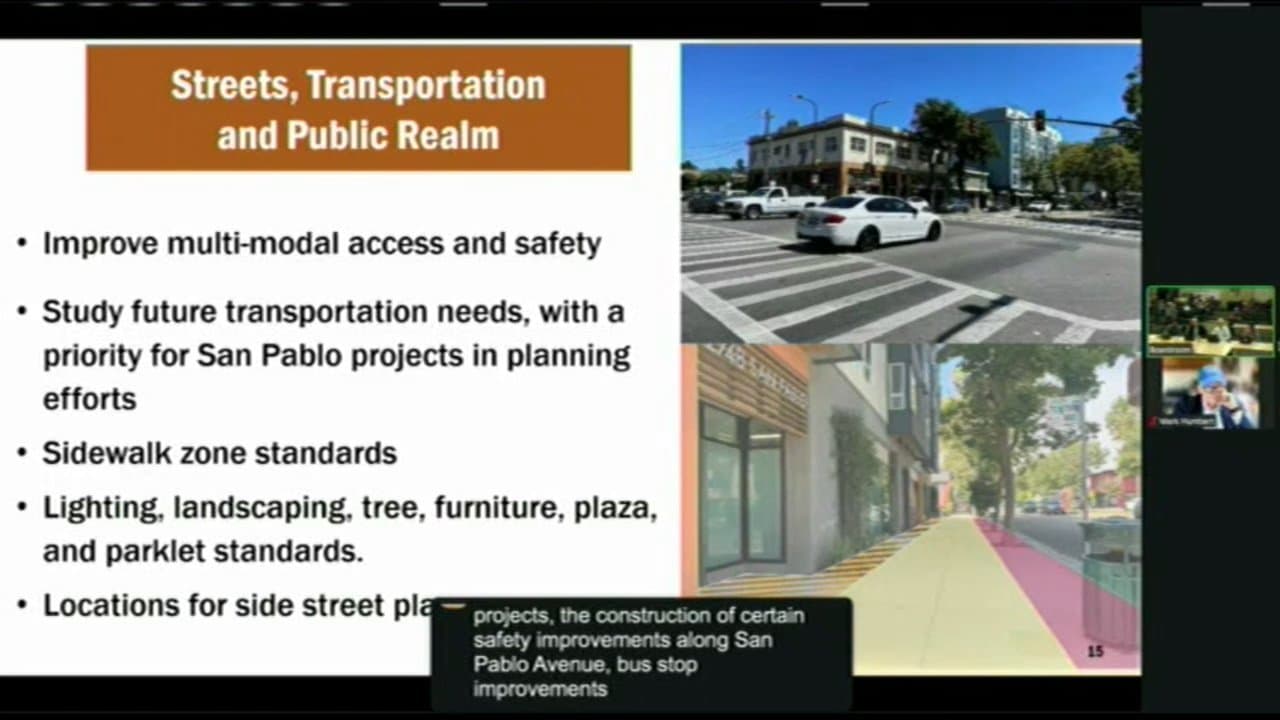
Where things stand: Staff proposed 7 stories, or 75 feet, for projects that include housing. The plan also sets active ground-floor frontage rules and design standards, outlines public-realm and side-street plaza ideas, and opens a few Mixed-Use Light Industrial (MULI) parcels to affordable and family housing. On environmental review, Justin Horner, Principal Planner, said "the analysis in the addendum in the 2023-2031 housing element EIR adequately analyzed the potential impacts" of taller non-residential buildings.
Councilmember Rashi Kesarwani of District 1 made the main motion with four amendments:
- A 75-foot, 5-story limit for non-residential buildings
- A minimum density of 100 units per acre, down from the staff-recommended 145
- Corrected wording in the ground-floor frontage rules
- Flexible affordability terms on MULI parcels, with 35% of units family-sized
"I want to require 35% family-sized units instead of the 20% I had proposed earlier," Kesarwani said. On height, she said, "I think that the 7 stories base zoning is very appropriate for this major transportation and commercial corridor with the width that it has."
The other side: Councilmember Brent Blackaby of District 6 offered a substitute motion: 55 feet and 5 stories for residential, and 55 feet and 4 stories for non-residential. "We start with the base of five and then let the density bonus do the work," Blackaby said. Councilmember Shoshana O'Keefe of District 5 backed five stories on economic-integration grounds.
Opponents argued that a lower base would push developers to use the state density bonus, which typically means 15% very-low-income units on site. A taller base, they said, makes it easier to pay an in-lieu fee instead. Christopher Kroll of the Berkeley Neighborhoods Council and architect Dietmar Lorenz made that case. Donald Simon, President of Save Berkeley Shops, said the plan would cause commercial loss. Housing law teacher Leah Simon-Weisberg asked the council to wait. Other speakers, including Noah Broad, supported the plan but opposed the minimum density, saying it would exclude co-housing and small projects.
Supporters included renters, young residents and Housing Advisory commissioners. The commission's chair, speaking personally, urged a 7-story vote that night and cited needs at the Housing Trust Fund.
Decisions and stakeholder impacts: The substitute failed (For: 2, O'Keefe and Blackaby; Against: 7). The main motion then passed (For: 9, Against: 0, Absent: 0). "I think 7 stories base height is the right way to embrace this diversity," said Councilmember Cecilia Lunaparra of District 7. Councilmember Mark Humbert of District 8 rejected the argument that 7 stories here obliges the same on every commercial corridor.
Small businesses won anti-displacement language from Councilmember Igor Tregub of District 4, O'Keefe and Blackaby. That includes O'Keefe's call for "the evaluation of a business license tax waiver for businesses who are displaced by developmental projects." Much of the affordability is expected to come through fees and the Housing Trust Fund rather than on-site units.
What's next: The vote was the ordinance's first reading. It must return for a second reading.
Surveillance Changes Bypass Debate
Why it matters: The changes shape what surveillance data the council sees and when it sees it.
Where things stand: Item 13 adds vendor accountability requirements to the city's surveillance technology law, Chapter 2.99 of the Berkeley Municipal Code. It was amended from the dais so the November 2026 report stays on schedule. The next report will cover Oct. 1, 2026, through Dec. 31, 2027, and is due in March 2028.
Blackaby moved Item 36, the Mutual Aid Air Support policy, from the action calendar to consent. His motion adopted the Police Accountability Board's request to "direct the police department to insert the actual surveillance technology ordinance language about audits verbatim into the policy."
The other side: An Open Government Commission member, speaking personally, said the consent calendar is meant for items without changes. A second speaker objected to moving both items without discussion.
Decisions and stakeholder impacts: Both items passed within the amended consent calendar (For: 9, Against: 0). Oversight advocates get the audit language and keep the November report, but face a longer gap before the following report. Item 13 was a first reading.
Housing Dollars: Prop 1 and Ashby Lofts
Where things stand: Mayor Adena Ishii, joined by Lunaparra, Blackaby and Tregub, brought two urgency resolutions. One supports Prop 1, an $11.25 billion state affordable housing bond. The other opposes Prop 43, a constitutional amendment that would limit voters' ability to raise local revenue. "These items are supported by Cal Cities, which is how we brought them here today," Ishii said. The council added both to the consent calendar (For: 9, Against: 0).
Separately, the council held a TEFRA hearing, the public hearing required before these tax-exempt bonds are issued. It then approved up to $25M in California Municipal Finance Authority bonds for Ashby Lofts, a 54-unit rehabilitation by Satellite Affordable Housing Associates (For: 9, Against: 0).
Decisions and stakeholder impacts: The bonds carry no financial obligation for the city. The ballot positions put Berkeley on record before voting begins Oct. 5.
Infrastructure Referral Sparks Censure Calls
Item 26 directs the City Manager to build an updated program plan and strategic asset management plan under the Realize Vision 2050 Plan. Tregub welcomed it. It passed on consent.
Public commenters called Councilmember Terry Taplin's reply to a Vision 2050 task force member dismissive and sought censure. One asked why the plan follows a $300M bond placement. "I am actually allowed to disagree with people who write to us," said Taplin, who represents District 2.
Minor Items
- Mary Oppler was approved as Director of Police Accountability at a $230,000 salary, effective Oct. 5. Departing director Kathy Lee will advise during the transition.
- A $1.76M window replacement contract for 1947 Center St. was pulled after the contractor withdrew. The work must be re-bid.
- The City Auditor said restaurant inspection data has been offline since 2024. Humbert wants it fixed "by the beginning of the next calendar year at the latest."
- The council accepted a $97,000 alcohol policing grant after a commissioner urged adding fire and EMS data.
- The council reaffirmed its sister city tie with Palma Soriano, Cuba, for clean-water projects funded by Green Cities Fund at no city cost.
Looking Ahead
The Affordable Housing Preference Policy update was continued to Oct. 13 (For: 9, Against: 0) after the council extended the meeting to 11:30 p.m. The council also issued proclamations for John Koerner and Julie Sinai and adjourned in memory of Jean Nakamura.