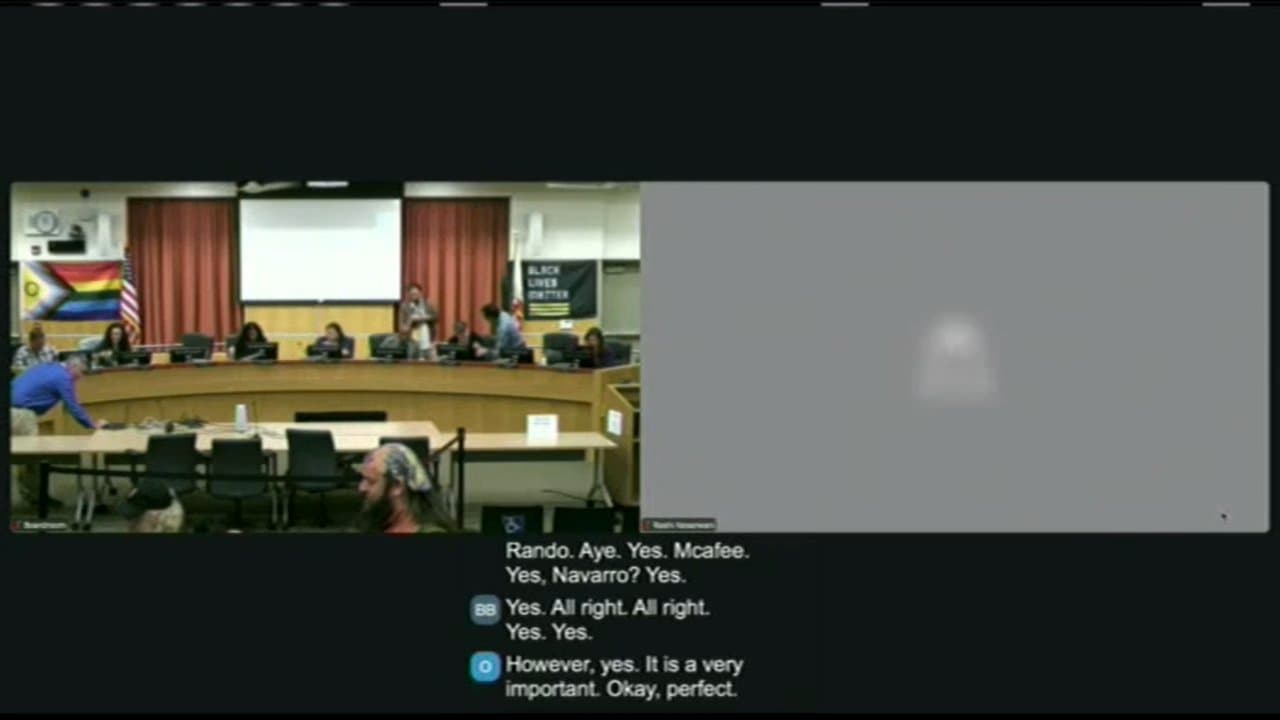
City Council - Sep 15, 2026 - Regular Meeting
City Council • BerkeleySeptember 15, 2026
Locunity is a independent informational service and is not an official government page for this commission.We use AI-assisted analysis and human editorial review to publish information.
Council Punts Tear Gas Vote After Hours of Unanimous Public Opposition
Berkeley's council ran headlong into the clock Tuesday night after every public commenter opposed lifting the city's 2020 ban on police tear gas, pepper spray, and smoke grenades. The marathon session — consumed by four-plus hours of testimony on Items 21a and 21b — ended without council deliberation when a motion to extend past midnight failed 5-4, forcing the high-stakes vote to a special meeting Sept. 29.
- Every public commenter opposed restoring tear gas authority for Berkeley police; council deferred the vote to a Sept. 29 special meeting after running out of time
- Harrison Street encampment closure began amid federal court battles and fierce community criticism; Berkeley Homeless Union fights the action while speakers demand a sanctioned alternative
- Council backed a resolution opposing coal and petroleum coke in the Bay Area and supporting AB 40, with strong environmental group turnout
- Eight wildfire resiliency bills sent to the governor before Sept. 30 deadline as 600+ ember zone homes near compliance
- Commercial vacancy strategy referred to city manager but criticized as lacking deadlines and accountability
- Neighborhood decarbonization pilot advances with PG&E offering partnership under SB 1221
Tear Gas Ban: Four Hours of Testimony, Zero Votes
The basics: In 2020, Berkeley banned police use of tear gas, pepper spray (OC spray), and smoke grenades after the nationwide protests following the murder of George Floyd. Item 21a, authored by Councilmember Rashi Kesarwani, would partially lift that ban — allowing the BPD Special Response Team to deploy tear gas only during barricaded suspect incidents, hostage rescues, and high-risk warrant service involving significant risk of death or serious injury. Crowd control use would remain expressly banned. Item 21b, from the Peace and Justice Commission, proposed retaining all bans and commissioning an academic health study from UC Berkeley, UCSF, or Stanford before any policy change.
Why it matters: The outcome will determine whether Berkeley police regain access to chemical agents banned since 2020, with direct implications for protest rights, public health, and police accountability. The issue has mobilized an unusually broad coalition — from UC Berkeley students to the Berkeley Rent Board chair — and will define the city's public safety politics this fall.
Where things stand: Councilmember Kesarwani framed the request as narrowly tailored, telling colleagues: "Over more than 40 years, BPD Special Response Team has used tear gas exactly once during a barricaded subject incident in the early 2000s." She added: "Our police chief has told me that she is not aware of any other agency with the ban on the use of tear gas for an armed barricaded suspect, which is the only use we are asking for tonight."
Councilmember Brent Blackaby presented a supplemental amendment developed jointly with the Police Accountability Board that further narrowed the resolution's language. "We sort of eliminated the other potential high-risk situations," Blackaby said. "It's just suspect shooting at officers during warrant service, hostage rescue situations, and armed barricaded suspects."
BPD Captain Okes described three incidents since 2020 where tear gas would have been considered had it been available — though all were ultimately resolved without it. He argued the tool creates distance that reduces risk: "One way to influence a suspect's behavior, to get them to come out on our terms is to use this tool. When they come out, we have the benefit of distance, and we're able to dictate some of the terms of how that person is going to come out."
The other side: The Peace and Justice Commission, represented by George on behalf of Chair Dwayne Phillips, urged the council to retain all existing bans. "CS and OC are dangerous weapons that are properly considered less lethal, not nonlethal, and we should use the correct language," George told the council. He recounted the 2014 Black Lives Matter protest on Telegraph Avenue, describing how BPD command directed officers to "get them running" — resulting in baton strikes and roughly 50 cans of CS gas fired into the crowd, nearly exhausting the department's supply.
Public comment was unanimously opposed to Item 21a. Dozens of speakers — including UC Berkeley students, Berkeley 350 Hub, Berkeley Friends Meeting, Berkeley Cop Watch, and multiple council candidates — urged the council to vote no.
Berkeley Rent Board Chair Solly Alpert warned that when police have tools, they use them on peaceful protesters, citing the 2020 city manager's emergency declaration without council approval. Moni Law Calum, a peace activist and attorney who was a plaintiff in the federal class action Law v. City of Berkeley, described being clubbed during the 2014 protest and said tear gas escalates violence. Glenn Turner of the Berkeley Behavioral Health Commission argued the probability of a barricade scenario is extremely low and called for investment in crisis intervention training instead.
Speakers cited health risks of aerosolized chemical agents, disproportionate impacts on people with disabilities and respiratory conditions, international bans on chemical weapons in warfare, and reproductive health risks.
Decisions: The council never reached deliberation. Technical audio failures compounded the time crunch. A motion to extend past midnight failed 5-4 (For: Kesarwani, Taplin, O'Keefe, Blackaby, Humbert; Against: Bartlett, Lunaparra, Ishii, Tregub) — falling short of the six-vote supermajority required.
What's next: The council voted unanimously (9-0) to schedule a special meeting on Sept. 29 at 4 p.m. for Items 21a and 21b. Every council vote will be closely watched by an unusually mobilized public.
Harrison Street Encampment Closure Draws Fierce Community Backlash
Why it matters: The city began clearing one of Berkeley's most visible encampments the morning of Sept. 15, affecting some of its most vulnerable residents — even as the Berkeley Homeless Union fights the action in federal court and appeals the broader ruling to the Ninth Circuit. Multiple speakers warned of deaths this winter without a sanctioned alternative.
Where things stand: City Manager Budenhagen reported that the closure affects all Harrison Street residents except seven individuals with disability accommodations ordered by Judge Chin, plus RV dwellers. The city is required by court order to offer replacement survival gear, packing assistance, and storage of nonhazardous belongings. He emphasized the city's position: "The city does not suggest locations for people to camp. We know that living outside lowers life expectancy, and our goal is to end unsheltered homelessness by moving people indoors, not moving them around on the street."
The Berkeley Homeless Union filed emergency motions to stop the abatement, which the court denied. The city is appealing the broader ruling to the Ninth Circuit.
The other side: Community response was intense. Multiple public commenters — including Alana, Cheryl, Andrea, Yessica of the Berkeley Homeless Union, Jesse Sheehan, and Aiden Hill — condemned the sweep. Speakers described the process as traumatizing, alleged violations of the court order regarding disability accommodations, and called for a sanctioned Safe Stay encampment as an alternative. One commenter who identified as a regular presence at the Harrison encampment described the June 2025 smoke bomb incident and criticized the council for not being present during the closure.
Councilmember Blackaby acknowledged the tension but said the status quo was untenable: "We're deeply committed to supporting our unhoused neighbors. But the situation is not sustainable. We had a serious public health and safety crisis in Harrison that had to be addressed."
What's next: The Ninth Circuit appeal will shape whether and how Berkeley can continue encampment closures. Advocates continue to press for a sanctioned encampment site.
Council Opposes Coal Terminal, Backs AB 40
Why it matters: Mile-long coal trains through Berkeley's dense neighborhoods would expose residents to toxic particulate matter; the resolution targets a proposed Oakland coal terminal that environmental groups call an attempt to prop up a failing industry.
Item 19, authored by Councilmember Igor Tregub and co-sponsored by Councilmember Kesarwani, Councilmember Taplin, and Mayor Adena Ishii, adopted a resolution opposing the handling, storage, and transport of coal and petroleum coke in the San Francisco Bay region and supporting AB 40.
"We're expressing our opposition to the handling, storage, and transport of coal and petroleum coke in the San Francisco Bay region and the East Bay," Tregub said. "We're also expressing our strong support for AB 40, which will require stronger environmental protections against coal projects like the one being proposed in Oakland."
Ariella Grenette of Berkeley 350 Hub spoke in support, as did Megan Wachspros, a parent of two children living near the rail line who cited health risks from coal dust and solidarity with West Oakland environmental justice communities. Anne Marks of PG&E also praised the resolution. The item passed as part of the consent calendar without objection.
Wildfire Bills and Home Hardening Push
Councilmember Blackaby brought an urgent item requesting the mayor send eight letters urging Gov. Gavin Newsom to sign wildfire resiliency bills before the Sept. 30 deadline. The bills cover homeowner financing, home hardening, innovation, and community wildfire mitigation. Blackaby noted 250 District 6 residents co-signed a letter over the weekend. The item was added to the consent calendar and approved without objection. Anne Marks of PG&E spoke in support.
Separately, Item 5 increased the Fire Aside software contract by $150,000 to $410,000 for tracking defensible space inspections and chipper management. Blackaby reported strong progress: "Of the 1,400 homes in the ember zone, more than 600 are already on the path to Zone 0 and home hardening compliance, which is amazing." The chipper program has completed 2,400 pickups removing 6,000 cubic yards of vegetation.
Public commenter Ian Camps raised privacy concerns about the Fire Aside contract, citing Article 1, Section 1 of the California Constitution and arguing the software stockpiles private property data in a third-party database with inadequate protections.
Commercial Vacancy Strategy Advances, but Critics Want Deadlines
Item 20, authored by Councilmember Tregub and co-sponsored by Councilmember O'Keefe and Councilmember Blackaby, refers an eight-part integrated strategy — dubbed RENAISSANCE Part 2 — to the city manager covering storefront subdivision, flexible mixed-use occupancy, warm shell requirements, cold shell prevention, and utility undergrounding.
Why it matters: Downtown Berkeley faces persistent vacancies, boarded storefronts, and stalled construction pits. The referral attempts to address cold-shelling — where developers leave storefronts empty after demolition — and utility undergrounding delays, but sets no return date.
Donald Simon of Save Berkeley Shops applauded the investigation but urged the city not to upzone further until solutions are in place, recommending the city require proof of financing before issuing demolition permits. Other commenters criticized the referral as lacking deadlines and accountability mechanisms. The item passed as part of the consent calendar.
Minor Items
- Neighborhood decarbonization pilot: Council adopted a resolution under SB 1221 supporting a neighborhood electrification pilot, with PG&E publicly offering to partner. Mayor Ishii noted Berkeley's greenhouse gas emissions have declined 41% since the 2000 baseline. Councilmember Tregub credited Commissioner Daniel Tahara for initiating the effort.
- Whistleblower report on workplace relationships: City Auditor Jenny Wong presented findings that Berkeley lacks disclosure and recusal requirements for romantic relationships intersecting with hiring and supervision. "We found that Berkeley's current policies do not address romantic, dating, or cohabitating relationships when they intersect with hiring, supervision, and other employment decisions," Wong said. Recommendation 3 may lead to new nepotism provisions in the Municipal Code.
- $500,000 state grant application for Community Resilience Center planning to fund seismic retrofits of the Maudelle Shirek Building and Veterans Memorial Building.
- $150,000 contract for Addison Street catenary lighting in the Downtown Arts District.
- Loan Administration Board dissolved after two years without a quorum; Revolving Loan Fund oversight moves to the city manager. Councilmember Ben Bartlett eulogized the board during consent comments.
- Housing fee study referred to produce a comprehensive comparison of Berkeley's development fees, impact fees, and parcel taxes against peer cities. Councilmember Humbert and Councilmember Lunaparra added as co-sponsors.
- Public safety technology RFP concerns: Two public commenters — Katherine Hookting and Kit Saginor — questioned why required criteria in the public safety technology RFP, including data ownership, CJIS compliance, and sanctuary policy adherence, are being scored on a point system rather than treated as pass/fail. The city manager was asked to follow up.
- Evans Manor tenant Derek Wallace described extreme mold, asbestos, rats, and security failures at the Berkeley Student Cooperative property, reporting one tenant death and hospitalizations.
- Consent calendar of 20-plus items approved by voice vote without objection.