
Belmont Splits 4-1 on Donor Naming Rules, Overhauls City Fees
City Council • BelmontSeptember 22, 2026
Locunity is an independent informational service and is not an official government page for this commission. All information is sourced from public footage and an analysis of official agendas with the aid of responsible, fact-checked AI. to report an error or omission.
Belmont is setting the rules for who gets their name on public buildings as fundraising for a new community center begins, and the debate showed that councilmembers want the final say. On Sept. 22, 2026, the City Council approved a citywide naming and donor recognition policy 4-1 with amendments. It also unanimously adopted its first comprehensive fee overhaul in nearly 11 years and advanced a 6.09% garbage rate increase.
- Naming policy approved 4-1. Pools, courts and playgrounds now need council approval.
- Fee overhaul passes 5-0. It covers more than 400 fees and raises the planning appeal fee to $5,000.
- Garbage rates set to rise 6.09%. A Proposition 218 protest hearing is proposed for Nov. 24, 2026.
- Fee study aims to end a $1M–$1.5M yearly subsidy from the General Fund to development services.
Who Names Belmont's Buildings? Council Wants the Final Word
Why it matters: Until now, Belmont has handled naming requests one at a time. The new policy decides who can put a donor's name on public property, and who can take it off, as the Belmont Community Foundation prepares to raise money for a community center.
Where things stand: Staff asked the council to adopt the policy and to authorize the city manager to administer procedures, sign donor agreements and work with nonprofit partners. Under the draft, the council would approve major facilities and exceptions, and the city manager would handle routine recognition. The policy lists sample dollar ranges, such as $10 million for a campus, but staff described those as guidelines. The city keeps the authority to rename a site or end recognition.
Parks and Recreation Director Kevin Kobayashi said the policy is a framework only. Each specific naming would still go through its own approval process.
Councilmembers focused on who holds the power.
"I'm just trying to figure out about not being locked into certain dollar amounts when we approve this?" asked Vice Mayor Cathy Jordan. Staff answered that the dollar ranges are illustrative guidelines, not fixed prices.
"I want to make sure that whatever gets named in our city is done with the full approval of the council, the elected council," said Councilmember Robin Pang-Maganaris.
The city manager said major donations would likely come to the council. He later offered to send most asset categories to the council in response to members' concerns.
The other side: Karen Shane, a public commenter, opposed naming opportunities at the higher tiers. She raised two risks: the city might have to repay a donor if a name is later removed, and a donor could harm the city's reputation. "But anything above the $250,000 tier level, I think if people want to give money, they can give money to the city and then we can do it ad hoc," she said.
The president of the Belmont Community Foundation supported the policy. "This kind of policy is really helpful to us in our working with potential donors on talking through possible recognition opportunities," she said.
Councilmember Tom McCune said he could go either way. "If we want to send it back to staff for some of the proposed adjustments and take another look at it later, that's okay with me," he said.
Decisions and stakeholder impacts: Councilmember Gina Latimerlo moved approval with three amendments:
- Pools, courts, playgrounds, gardens and similar amenities move to council approval.
- The policy adds an "approval/removal" column.
- The campus and major civic facility tier adds "council discretion."
A friendly amendment also requires the city manager to report namings he approves administratively. "I do think we need to move the pool, court, playground, garden to city council level," Latimerlo said.
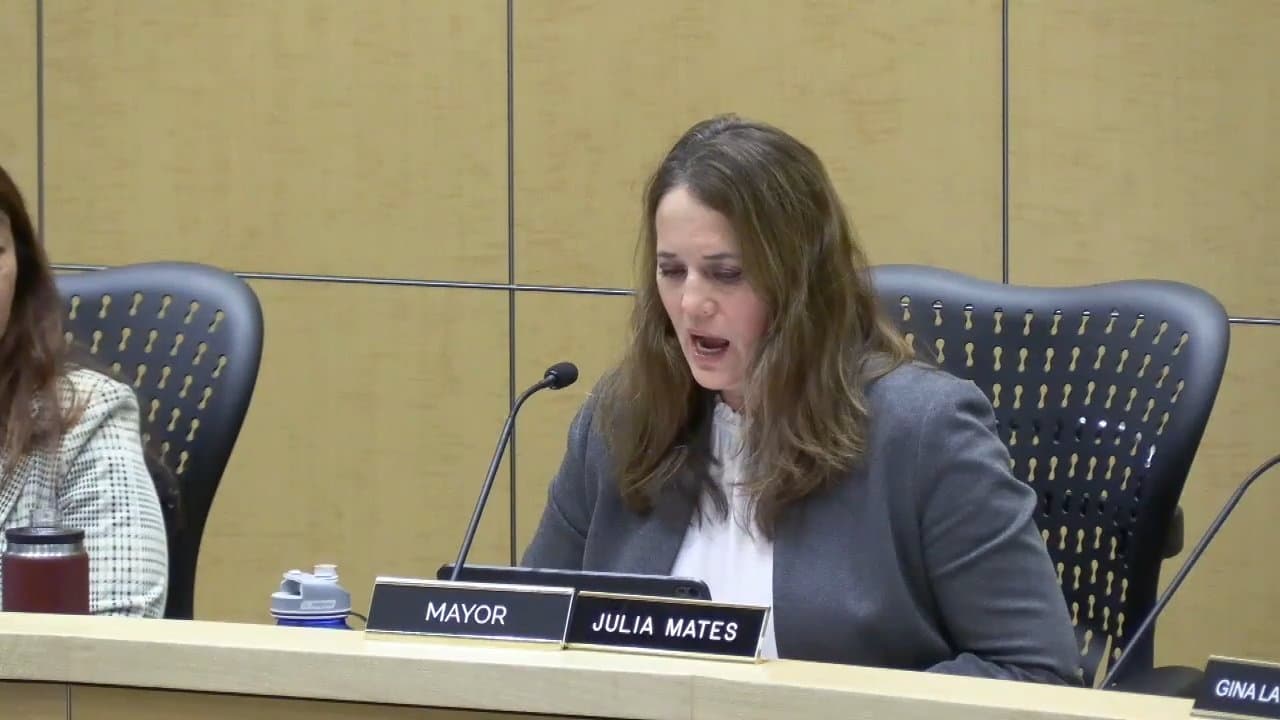
Mayor Julia Mates backed the framework. "I think the framework and I think the general naming idea, I think is fine, and I think we should be doing this," she said.
Pang-Maganaris cast the lone no vote. "I agree that those things need to be added, and I trust that staff is going to make those changes, but I'm a no right now because this just feels too messy to me," she said.
Vote: For: 4 (Mates, Jordan, Latimerlo, McCune), Against: 1 (Pang-Maganaris), Absent: 0.
Donors and the foundation now have a playbook for recognition. Elected officials gain direct control over the most visible public spaces.
What's next: Staff will revise the policy to reflect the amendments, including clarifying who has authority to remove a name.
Fee Overhaul Targets Full Cost Recovery
Why it matters: Staff said that without changes, the General Fund would keep covering $1 million to $1.5 million a year of the Development Services Fund's costs. Under the new schedule, fees for most projects aim to cover the full cost of city work. Some fees for small projects actually go down.
The basics: Matrix Consulting Group led the nine-month study. It used a "bottom-up" method, which multiplies the staff time each service takes by fully burdened hourly rates (salary plus overhead). Forty-two staff members reviewed more than 400 fee lines.
Where things stand: Key changes include:
- Building fees will be based on square footage instead of fixture counts.
- Geologic and historic reviews get separate small and large categories.
- Some single-family design reviews shift from Tier 3 to Tier 2, cutting the cost from about $10,000 to about $4,800.
- Complex projects move to deposit-based fees: consultant costs plus 15% for administration.
- New fees cover inspection no-shows and EV charging.
"I am happy to say that the driveway improvement is going to go down to $950," said Vice Mayor Jordan.
Several services will stay priced below cost by design: police reports requested by crime victims, e-bike storage, false alarms, planning appeals, master sign programs, temporary street closures, Ralston banners and tree removal permits.
The other side: Councilmember Pang-Maganaris asked whether higher appeal fees could discourage residents from challenging city decisions. The current appeal fee is $1,683. "We estimate the cost of actually doing that work at about $9,500," said Community Development Director Laura Russell. Staff proposed:
- $5,000 for appeals from the Planning Commission to the City Council
- $3,000 for zoning administrator appeals
- $2,000 for another appeal category
Appeals to the council average fewer than one a year. "I feel okay about the $5,000 for appeals because it's roughly half, right?" said Councilmember Latimerlo.
A councilmember questioned whether ADA and red-zone parking fines were high enough. Police Lieutenant Hussey said the city's hands are partly tied. "We're required by law to set our fees consistent with surrounding jurisdictions," he said. He added that fines for fire lane violations were raised.
Karen Shane welcomed the lower street closure fee and the approach to tree removal permits, but questioned a $771 charge. She warned that high fees push some residents to skip permits. "There are a lot of people doing construction projects without permits," she said. She urged outreach so residents who do pull permits don't carry the burden.
Decisions and stakeholder impacts: Vote: For: 5, Against: 0, Absent: 0.
- Homeowners doing small additions get cheaper design review.
- Developers of complex projects pay actual consultant costs.
- Appellants pay more, but still well below the city's cost.
McCune asked for a clear definition of "square footage." Staff said the building official will issue an administrative memo.
What's next: Most development fees take effect after a 60-day implementation period. The city manager will compile the changes into the master revenue schedule.
Garbage Bills Climb Toward 2027 Protest Hearing
Why it matters: Most residential customers would pay about $2.53 to $3.02 more per month. Staff cited fuel costs, depreciation of the collection fleet and rising disposal fees as the drivers.
The basics: Proposition 218 is California's rule for property-related fees. It requires the city to mail notice to property owners and hold a public protest hearing before rates can rise.
Where things stand: Rates follow a formula set in the city's franchise agreement with Recology, the garbage hauler. Rate year 2027 is the seventh year of the amended agreement.
- Standard carts and cans (Schedule L) would rise 6.09%.
- Additional services (Schedule Q) would rise 3.8%, tied to the Consumer Price Index (CPI-U).
Base payments to Recology rose about 5.37%. The 0.37% above the agreement's 5% cap will not be carried forward to future years. Staff said the 6.09% increase applies equally to residential and business customers.
"The net increase is a little bit more than we've seen the last couple of years, so I don't want to take it lightly," said Councilmember McCune. Councilmembers asked about fleet depreciation and flagged a possible error in the table for 96-gallon carts. No members of the public spoke.
Decisions and stakeholder impacts: Vote: For: 5, Against: 0, Absent: 0. The council approved the staff recommendation to start the Proposition 218 process. Ratepayers will receive notice and can file written protests.
What's next: Staff and consultant HDR recommended holding the protest hearing on Nov. 24, 2026.
Minor Items
- Executive raises: The council approved 4% cost-of-living increases for the city manager and city attorney, effective July 1, 2026 (5-0).
- Consent calendar: Three routine items passed 5-0, with no items pulled and no public comment.
- Measure Y: Resident Tanya Beat asked for a multi-year spending plan for the roughly $7.1 million a year the tax would raise: "A $7 million annual revenue stream deserves a $7 million annual plan."
- Council reports: McCune said a drunk driver hit the Hallmark barricade again; staff are repairing it. He also linked rising local recycling costs to China's import restrictions.
- Proclamations: The mayor recognized Hispanic Heritage Month (Sept. 15–Oct. 15) and Fire Prevention Week (Oct. 4–10), which focuses on lithium-ion battery safety.
Looking Ahead
- Waterdog Run: Sept. 26.
- Fire Station 28 open house: Oct. 3.
- Belmont Historical Tour: Oct. 18.
- Centennial Fest: Oct. 24, from 1:30 to 7:30. The day includes a parade, a car show, 50-year and 100-year time capsules, and a roughly 15-minute Skyworks drone show. Girl Scout Troop 61541's Community Impact Map, which marks local Bronze, Silver and Gold Award projects, will be featured. Volunteers and time capsule items are welcome at centennial@belmont.gov.
- Garbage rate protest hearing: Proposed for Nov. 24, 2026.