
Belleville Adopts Late 2026 Budget 7-0 After Residents Grill CFO
Township Council • BellevilleNovember 23, 2026
Locunity is an independent informational service and is not an official government page for this commission. All information is sourced from public footage and an analysis of official agendas with the aid of responsible, fact-checked AI. to report an error or omission.
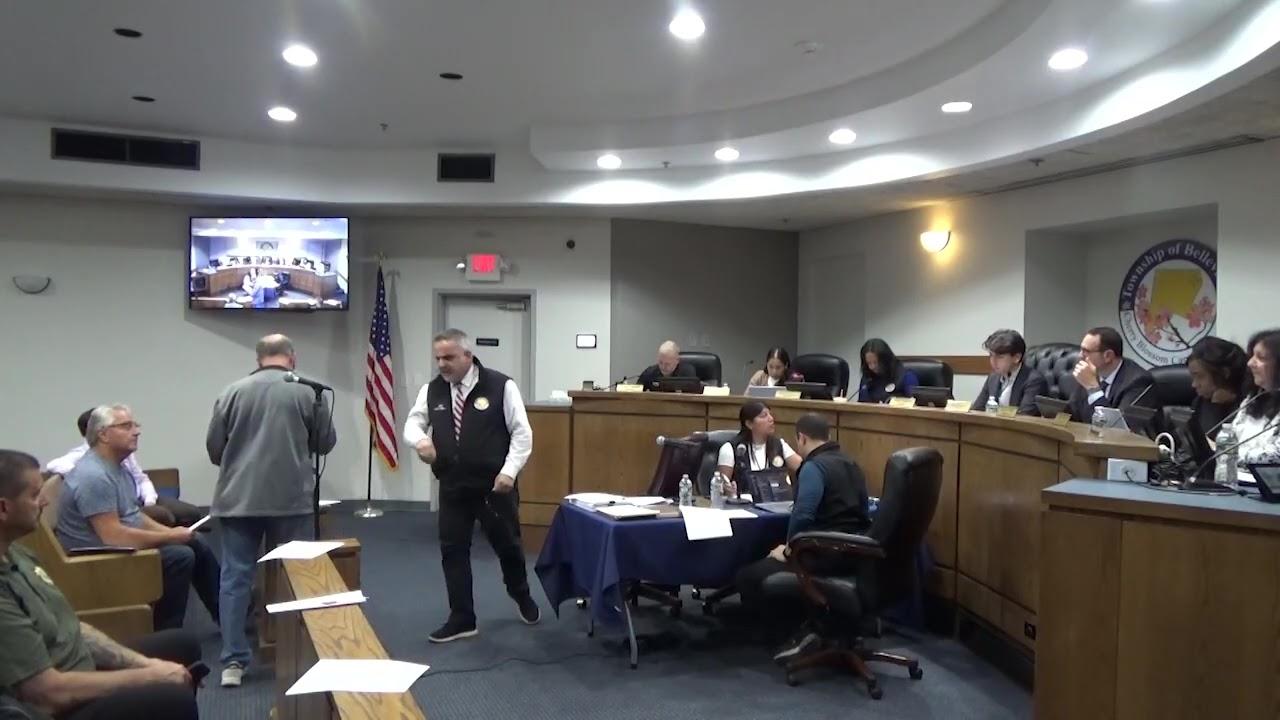
Belleville's Township Council adopted its amended 2026 municipal budget on Nov. 23, 2026, with roughly 40 days left in the year, after a hearing of more than an hour in which residents pressed the township's chief financial officer on missing revenue, surplus use and the delay itself. Two unanimous roll calls, on Resolution #323-2026 and Resolution #324-2026, let the county set the tax rate so fourth-quarter bills can go out.
- Amended 2026 budget adopted 7-0; CFO says tax impact holds at $175 per $300,000 assessment
- $7.19M in deferred charges covered by surplus, not taxpayers, CFO says; about $7.6M remains
- State reporting changes, not lost occupancy, explain falling PILOT lines, CFO says
- Late budget draws resident anger; Mayor Frank Velez III pledges an earlier cycle and more frequent audit updates
- Fourth-quarter bills come with a 25-day grace period once mailed, a resident explains and the CFO confirms
Budget Passes Unanimously, Tax Impact Unchanged
Why it matters: The budget amendment raised appropriations by more than $6M. But the CFO told residents their bill impact did not change from July.
Where things stand: The council voted 7-0 to enter the public hearing on the amendment. Mayor Frank Velez III set open-ended rules for testimony: "residents, as long as they stay on the topic of the amendment to the budget, they can speak for as long as they'd like."
The first question set the tone. "I'm just trying to understand how this is going to affect my finances," said Jessica Lozano, public commenter.
The answer from Chief Financial Officer DiMaria held steady through the night: "It's still $175 on a $300,000 assessment." Half of that was already collected in the third quarter, so only the increase lands on the fourth-quarter bill.
The other side: Frank Antoni, public commenter, argued that falling revenue and expense lines could not be squared with a budget that grew by more than $6M. "It just doesn't make any sense," he said.
DiMaria attributed the increase to more than $3M in new grants plus additional surplus. He said the tax levy was off by only about $7,000 and that revenues match appropriations.
Surplus under scrutiny: One resident, who did not give a name, read seven questions generated with Google Gemini and emailed in advance. The questions focused on $7,194,134.22 in deferred charges added after the July introduction. They also asked why surplus anticipated rose $2.44M, from $6.3M to $8.742M.
DiMaria said the charges were not overspending. He said state reviewers applied AI to prior transfer resolutions and read timing limits strictly, which forced revisions of earlier reports. Each deferred charge generates matching surplus. "So in the amendment, we're not going to pass $8 million worth of deferred charges out to the taxpayers," he said.
He put restated fund balance at about $16.33M, with $8.7M used. "That's going to leave in the $7.6 range," he said, plus $1.5M in appropriation reserves expected to lapse into surplus. The commenter urged adoption that night.
Decisions and stakeholder impacts: The council voted 7-0 to close the hearing and adopt Resolution #323-2026. It then voted 7-0 on Resolution #324-2026, adopting the 2026 approved budget. Both votes drew support from Mayor Velez, Deputy Mayor Tracy Juanita Muldrow and Councilmembers Vincent Cozzarelli, Thomas Graziano, Diana Guardabasco, Michelle Rodriguez and Danyale Wells.
Homeowners get a stable 2026 bill. The open question is 2027: drawing $8.7M from surplus leaves a smaller cushion for next year's budget.
What's next: The budget goes to the county for rate-setting, then to fourth-quarter billing (see below).
PILOT Lines Drop on Paper, Not in Practice
The basics: A PILOT, or payment in lieu of taxes, is a negotiated annual charge that developers pay instead of conventional property taxes. A share of each payment goes to the county.
Where things stand: Mario Frost, public commenter, asked why the Essex line at 78-102 Washington Avenue jumped from $100,000 to $273,000. He also wanted to know what happened to a $650,000 payment expected by Oct. 15. "Where in the amendments did that $650,000 come in?" Frost asked.
DiMaria walked through the math. The Essex gross annual service charge is $287,756. Subtracting the 5% county share of $14,387.80 leaves $273,368.20, and those amounts are anticipated a year behind.
The bigger change came from the state Division of Local Government Services, which now wants only the municipal portion anticipated. Current-year cash payments are no longer added. "They don't want the check being charged to surplus. They want the revenue reduced," DiMaria said.
The other side: Antoni challenged figures for 608 Mill Street and 630 Washington Avenue. DiMaria acknowledged that one figure had another payment added by mistake. He said the rest reflected the format change.
Another resident followed up during public comment on the Main Street warehouse PILOTs. DiMaria said the 30-year clock started with the certificate of occupancy, but no PILOT revenue has been triggered yet. Land taxes are being paid in the meantime.
Decisions and stakeholder impacts: The format change makes year-over-year comparisons hard for residents and budget watchers. Developers' obligations are unchanged; what changed is how Trenton wants the revenue booked.
Late Budget Draws Fire; Mayor Pledges Faster Cycle
Why it matters: Adoption in late November compressed tax billing into the year's final weeks and drew some of the night's sharpest criticism.
Where things stand: Antoni called the delay an insult. He said the budget should have been introduced in February or March. "This budget should have been prepared on time," he said, adding: "It's got to stop, and somebody got to take control."
DiMaria blamed a 4.5-month review process with Trenton, not local failure. "It is not that anyone here, myself, Brian, or Amber, didn't do their job or didn't do it timely," he said.
Transparency fight: Nancy Blavell, public commenter, objected that "other expenses" lines carry no breakdown. She also questioned salaries, including the CFO's, and called the document "Smoke and mirrors."
DiMaria said the state format allows only two lines per department: salaries and wages, plus other expenses. He added that engineering was bundled with community development until January. Itemization can be requested, he said, and the format has "Been in place since 1935." He suggested residents raise the issue with the governor.
Decisions and stakeholder impacts: Before adjournment, Mayor Velez said the council inherited the delay. "I am glad that we are finally done with this process, which should have been done in spring of 2026," the mayor said. Velez pledged to work with the CFO and township manager on more frequent audit and document updates and an earlier budget next year.
What's next: No dates were set for the 2027 budget timeline. Residents can hold officials to the pledge as the 2027 process begins.
Fourth-Quarter Tax Bills: Know the Grace Period
Why it matters: Bills mailed late could push the interest deadline into January. That timing matters for household cash flow and for tax deductions.
Where things stand: Michael Sheldon, public commenter, laid out three steps that follow adoption:
- The township posts the user-friendly budget and sends it to DLGS by Wednesday, Nov. 25.
- The budget is certified to the Essex County Board of Taxation within 15 days.
- Fourth-quarter bills are mailed once the county sets the rate.
Sheldon said late bills trigger a grace period: "no interest can be charged until the 25th calendar day after the bills are mailed." Miss that window, he warned, and interest applies retroactively. Taxpayers seeking the SALT deduction, which covers state and local taxes on federal returns, must pay by Dec. 31.
DiMaria said the information was correct and that online bills would arrive first. The discussion indicated fourth-quarter taxes would not enter the tax sale.
What's next: Sheldon asked the township to post the guidance on its website. Watch for bills once the county sets the rate.
Water and Recreation Lines Questioned
Where things stand: The bulk water purchase was cut from $6.62M to $6M. "Why are we paying $6 million for water?" Blavell asked, saying residents cannot drink it because of lead.
DiMaria said the line is sufficient: "through October of 2026, we're at $3.6 million expended." He also cited an $800,000 standing credit on one meter.
On recreation, Antoni asked why senior services fell from $125,000 to zero. DiMaria said the program moved into the recreation department. Recreation fees bring in about $197,000 against roughly $900,000 in spending, and Antoni argued the township should make recreation free. He later relayed reports that families cannot afford the fees.
Jerry D'Ambracio, public commenter, asked about a $75,000 recreation cut: "Where are these cuts coming from?" DiMaria said the manager reduced the summer kids program.
Decisions and stakeholder impacts: Families who rely on summer programming face a smaller offering. Seniors' services continue, now under recreation.
Minor Items
- Delivery noise and cannabis: Lozano described Dunkin' Donuts trucks backing up at 4:45 a.m. "I don't want to hear heads nodding. I want to see action," she said. An official suggested patrols, summonses or contacting the business, and promised to review ordinances on public cannabis smoke.
- Dark streets: Antoni reported unlit municipal parking lot lights and out streetlights and suggested solar lighting.
- Second River: Officials said funds are set aside for the Fairway Playground ball field and walkway, with cleanup proceeding as far as the DEP allows. Mayor Velez said FEMA funding has qualification requirements and federal water funding "is expected to increase." The mayor knew of no fines on an illegal landfill.
- Public safety salaries: Responding to Blavell, DiMaria said seed money for police and fire contract settlements was pushed to next year. On an abandoned tension wire on her property, an official advised sending a legal letter to Comcast.
- Contracts ending: DiMaria said both contracts a resident asked about, including AlphaGo, are being terminated Dec. 31, 2026.
Looking Ahead
The township manager said he would email a resident an update on a Main Street matter promised by Nov. 7. Residents should watch for budget certification to the county within 15 days and for fourth-quarter bills after that.