
Partners Warn MTC's $360M OBAG 4 Regional Pot Is Spread Too Thin
Bay Area Partnership Board • Metropolitan Transportation CommissionAugust 21, 2026
Locunity is an independent informational service and is not an official government page for this commission. All information is sourced from public footage and an analysis of official agendas with the aid of responsible, fact-checked AI. to report an error or omission.
The Bay Area's biggest pool of flexible federal transportation money is being divided among about 20 programs, and on Aug. 21, 2026, the region's transportation partners pushed back. The Bay Area Partnership Board took no action on the One Bay Area Grant (OBAG 4) proposal, but its feedback goes to the Metropolitan Transportation Commission (MTC) ahead of planned adoption in October. Members also previewed Plan Bay Area 2060 and a draft Transit Priority Network that will shape bus funding through 2027.
- $360M OBAG 4 regional program draws support for transit priority, along with fears it is spread across too many programs
- Active transportation funding drops from $15M to $5M as staff shift money toward strategy and technical assistance
- Draft Transit Priority Network open for comment through Sept. 30, with a $20M–$25M Bus Aid round expected in mid-2027
- Plan Bay Area 2060 kicks off in October while SB 1087 faces building industry opposition on the Assembly floor
OBAG 4: Many Programs, Not Much Money
The basics: OBAG "is the Bay Area's primary program for investing our federal highway funds," said Mallory Atkinson, MTC staff. The proposed $360M regional program splits into three parts: community investments (more than half), network performance, and shared information and services. A separate $360M county program runs through the county transportation agencies (CTAs).
Why it matters: The regional pot is finite. The chair warned that spreading it across roughly 20 programs may not produce measurable results.
Where things stand: Staff said OBAG III needed more transparency. Their answer for OBAG 4 is "a mix of competitive grants, more collaborative and performance-driven investments," along with ongoing region-wide services, Atkinson said. Staff also plan to group calls for projects to reduce the burden on applicants.
Members broadly backed transit priority. Asked where to go big, Board Member Scott Haywood said, "I would say transit priority would be where I'd start." Board Member Sal Llamas argued, "I think the more we invest on making corridors not only safe but desirable, people will ride transit more."
Other members made the case for their own priorities:
- Board Member Bouchard said "station access, curb management, and parking management issues are really starting to enlarge."
- Board Member Chong prioritized El Camino Real and asked for more technical assistance for jurisdictions short on staff.
- Board Member Chang said "we do need excellent data," backing the Bay Area Travel Survey.
- Board Member Carolyn Clevenger argued for early coordination among CTAs, transit agencies and MTC: "If we can work together, we could probably be able to deliver a lot more."
The other side: Carolyn Gonot, Board Chair, was the sharpest skeptic. "I'm really nervous about how many programs there are," she said. She later added, "I'd love to see more money in transit priority."
Alex Bachleman, MTC staff, responded that "the OBAG III list was a lot larger." He cited bike share as an example of measurable results, noting "ridership is up 50%."
One member questioned the cut to active transportation, from $15M to $5M. Atkinson said staff were "recognizing that there was limited funding this cycle and trying to focus on where it made sense on this regional component to focus on strategy, policy, technical assistance, versus capital."
Matt Maloney, MTC Deputy Executive Director, clarified that the transit-oriented communities (TOC) incentive, "a $45 million incentive program," is funded with federal transportation money.
Decisions and stakeholder impacts: This was an information item, so no vote was taken. Transit agencies and cities with transit corridors stand to gain if the chair's call for more transit priority money takes hold. Bike and pedestrian advocates lose capital dollars at the regional level, though the county program remains a separate source. Smaller jurisdictions could benefit from technical assistance. Public commenter Alita Dupree urged looking beyond the zero-emission mandate to the broader benefits of electrification, and supported renewable energy for charging and rail, as well as fare integration.
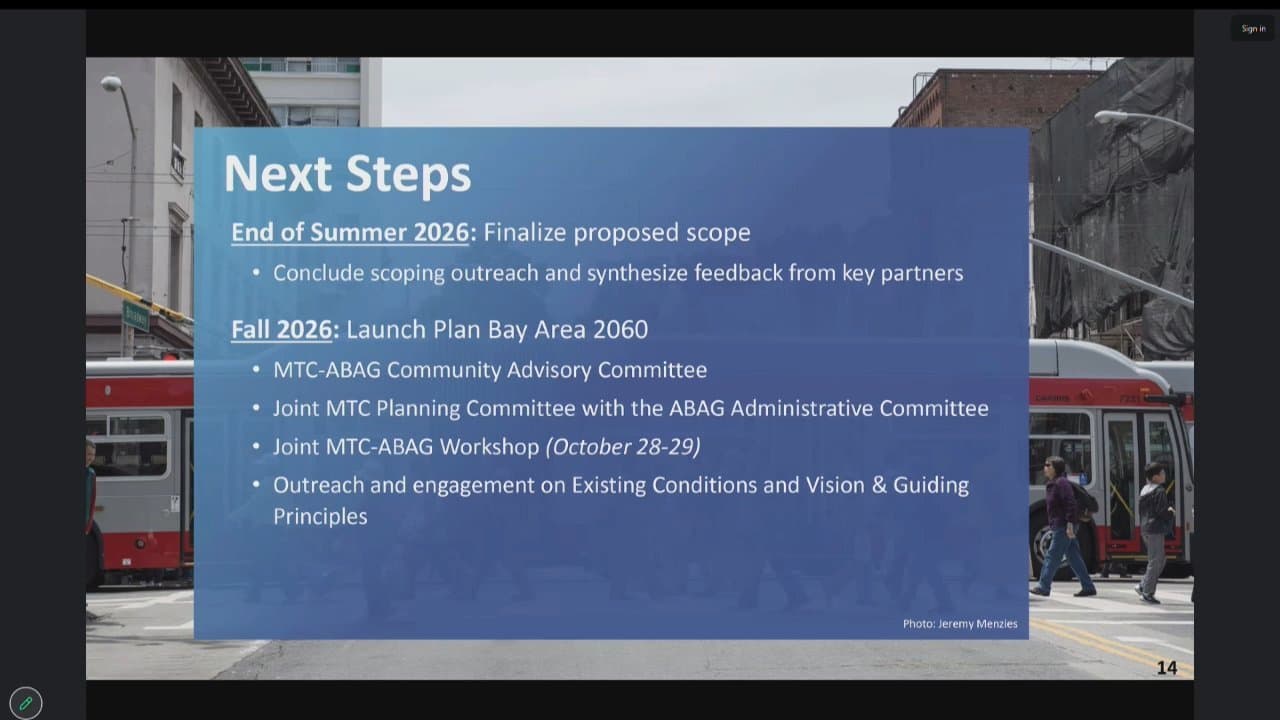
What's next: The proposal goes to MTC's Programming and Allocations Committee in September, with Commission adoption planned for October.
Transit Priority Network Gets Teeth
Why it matters: Once the network is adopted, projects on listed streets must improve transit, not just avoid harming it. The network also becomes a scoring criterion for Bus Aid grants.
Where things stand: MTC's Transit Priority Policy for Roadways took effect in January 2026 and is applied through the Complete Streets Checklist. "We have reviewed more than 140 projects," said Britt Tanner-Thiesen of MTC's Regional Network Management Section. So far, 17 of 19 transit agencies have been affected. The assessment relies on a region-wide Swiftly dataset. Staff are taking comments on the draft network "through September 30th." Finalization is expected in winter or spring 2027, along with an implementation strategy and a roadway design toolkit.
Deal math: "We anticipate having about $20 to $25 million available for that funding round," Tanner-Thiesen said of the mid-2027 Bus Aid call. The money would come from about $19M in leftover funds plus possible OBAG 4 dollars. Transit agencies, local jurisdictions and CTAs could apply, but they would need support from all agencies involved. Eligible projects would take one to five years, and some planning work would qualify. Tanner-Thiesen was clear about the program's limits: "It's definitely not going to deliver a BRT project."
The other side: One board member asked whether the policy covers the state. "Yes, the policy does apply to Caltrans when they're applying for MTC discretionary funding," Tanner-Thiesen replied. Cameron Oaks, Caltrans Deputy District Director for Transportation Planning and Local Assistance, said, "We find that it aligns quite well with what we're saying in our District Transit Plan."
Members also raised concerns about funding the full project pipeline and the cost of replacing old traffic signals. Llamas warned that "agencies need to incentivize training and engagement to ensure consistent adaptation."
Decisions and stakeholder impacts: No vote was taken. Cities and CTAs face new design obligations on listed streets, while bus riders and operators stand to benefit. Melanie Choi, MTC Director of Regional Network Management, framed the central challenge as "how can we leverage all of the resources in our region through the various funding sources."
What's next: Comments on the draft network are due Sept. 30. The Bus Aid call follows in mid-2027.
Plan Bay Area 2060 Starts Amid State Reform
The basics: Plan Bay Area serves as both the region's federal Regional Transportation Plan and its state-required Sustainable Communities Strategy under SB 375. The 2060 update will move through four phases: foundations, outlook, blueprint and final plan. White papers will examine the economy, congestion management and toll bridges.
Why it matters: "It will align with RHNA Cycle 7," said Chirag Rabari, MTC Assistant Director of Major Plans. That refers to the state's regional housing needs allocation (RHNA), and the regional housing determination is expected in early 2028.
Where things stand: SB 1087 is co-sponsored by MTC/ABAG and the other "Big 4" metropolitan planning organizations. "It would move from a 4-year cycle to an 8-year cycle," said Georgia Gandorman, MTC staff. The bill would also streamline state review. It is on the Assembly floor.
The other side: Gandorman said the California Building Industry Association has not dropped its opposition, and that "they are now actively lobbying against the bill on the assembly floor."
Members pressed for more ambition in the plan itself:
- Llamas said "Plan Bay Area 2060 should include more of a service vision."
- Board Member Guerrero said "how we incentivize jobs closer to where the housing is also going to be important."
- Chair Gonot said, "I'm curious about the plan having some resiliency." Maloney replied that "scenario planning is kind of the way that that takes place."
- Rabari flagged a key open question: "what are our assumptions around AV penetration?"
Other members asked for clearer regional outcomes, shared mobility tools and engagement on the white papers.
Decisions and stakeholder impacts: No vote was taken. An eight-year cycle would free staff time for implementation and change workloads for partner agencies. That is why the building industry's opposition matters for every city planning department.
What's next: The formal plan kickoff is set for October.
Minor Items
- Consent calendar: Minutes from April 29, 2026, and Aug. 29, 2025, passed by voice vote with no tally announced. The 2025 minutes were re-approved to correct vote-count discrepancies.
- Governor's transit order: Llamas asked how MTC will track Executive Order N-7-26. Staff said they will fold updates into existing regional meetings.
- Federal reauthorization: The current federal transportation law, IIJA, expires Sept. 30, 2026. Answering Vice Chair Richmond, Gandorman said staff assume a clean extension at fiscal year 2026 levels.
- Rail pitch: Public commenter Roland LeBrun described a $20B, 110 mph Gilroy-Emeryville line with a new Transbay Tunnel. He proposed splitting the cost evenly between federal and private funds under a 50-year concession.
- Quorum strain: With membership topping 40, the chair noted "we need 24 for quorum at these meetings." Low-participation memberships will be reviewed.
Looking ahead: Board Member Barnes asked for a future agenda item on lessons from major events. Chair Gonot agreed, saying of the World Cup games, "We actually carried more riders than New York or Boston did to their games." Members also announced the Salesforce Transit Center's eighth anniversary, a planned Bay Area Transportation Softball Tournament and a Carquinez Bridge closure.