Bay Area Air Quality Management District - Jul 01, 2026 - Regular Meeting
Bay Area Air Quality Management District • Bay Area Air Quality Management DistrictJuly 1, 2026
Locunity is a independent informational service and is not an official government page for this commission.We use AI-assisted analysis and human editorial review to publish information.
Air District Ends Email Comments on Rulemaking, Launches Landmark Air Toxics Study
The Bay Area Air Quality Management District (BAAQMD) opened its new fiscal year July 1 with a pair of governance overhauls and a scientific initiative that could reshape how the region understands — and regulates — toxic air pollution. The board unanimously adopted a policy eliminating email as a submission channel for public comments on rulemaking and planning, requiring all electronic input to flow through a new online portal, then loosened its remote meeting rules while adding enforcement teeth.
Board mandates online portal for all public comments on regulations, ending email submissions to combat AI-generated mass campaigns that have swamped other agencies
$4M BREATHE program will create Bay Area's first comprehensive air toxics cancer risk maps, modeled on South Coast AQMD's decades-old MATES study
Flood of public commenters demand action on the proposed Oakland coal export terminal, calling for a new environmental impact report and support for AB 40
Remote meeting policy loosened — board members can now participate from hotels or out of state, but face compliance enforcement through the Finance and Administration Committee
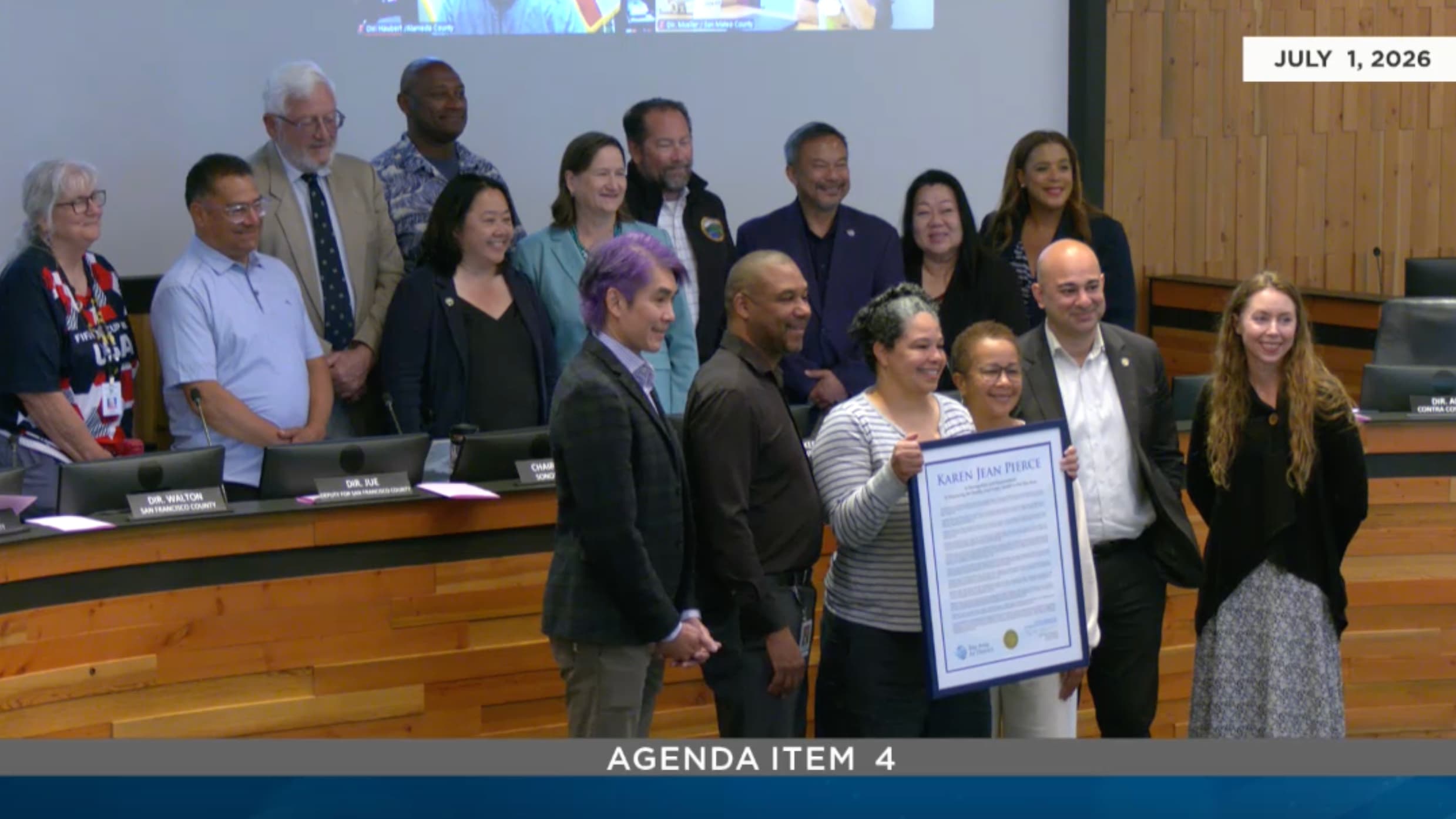
Environmental justice leader Karen Jean Pierce honored for pioneering Bayview-Hunters Point protections that shaped the Air District's community engagement framework
Earthjustice-led coalition pushes for warehouse indirect source rule to curb diesel pollution in frontline communities
No More Emails: Board Adopts Portal-Only Policy for Rulemaking Comments
The board unanimously approved a policy that will fundamentally change how the public weighs in on the Air District's regulations. Going forward, all electronic comments on rule development or planning matters must be submitted through a dedicated online portal — not email.
Why it matters: The policy is a direct response to the growing threat of AI-generated mass comments. South Coast AQMD received more than 40,000 fake emails during its gas appliance rule proceedings, overwhelming staff and undermining the integrity of the public record. Staff warned the same tactics could easily target Bay Area rulemaking.
Where things stand: Executive Officer Phil Fine rejected industry characterizations of the portal as a staff screening mechanism.
"This being characterized as staff screening, I think is incorrect interpretation of what we're trying to do here. We're trying to bring order to a process that is a little chaotic at the moment," he said.
The portal will collect commenter information in structured fields that can be automatically redacted for privacy, create a searchable public database of all comments, and send confirmation emails to submitters.
Industry groups pushed back. Peter Okorowski, representing the California Council for Environmental and Economic Balance, urged the board to delay adoption, arguing
"CEEB's concerned the staff is adopting a new and never discussed role of being a gatekeeper for public comments."
Bob Brown of the Western States Petroleum Association sought clarification on how regulated entities' comment letters would be transmitted. Kathy Kerridge, of the Benicia Community Air Monitoring Program, supported the portal concept but agreed with industry that comments should reach board members without intermediary screening.
Board Member John Gioia raised pointed concerns about both the portal's effectiveness and its equity implications.
"First, I'm not certain that the portal is going to solve the problem because AI will figure out how to do mass messages. Second, we're all elected officials and we get emails from individuals in our districts who want to comment on a rule," he said.
He questioned whether residents who lack internet access could still participate meaningfully.
General Counsel Alexander Crockett clarified the legal stakes: under the new policy, emails on rulemaking matters that are not resubmitted through the portal would not become part of the administrative record and could be deleted under existing retention policies.
"This policy would say we are only going to consider and we're only going to make part of the record things that come in electronically through the portal, plus mailed documents and oral comments," he explained.
Vice Chair Vicki Veenker framed the portal as a practical improvement for board members.
"If I'm preparing for a board discussion on a particular rule, I can go to this point. You will send me a link where I can get the comments on that rule," she said.
Decisions: Board Member Ray Mueller secured an amendment requiring that the portal not collect metadata or identifying information from anonymous users. The policy passed 18-0 (For: 18, Against: 0, Absent: 5). Chair Lynda Hopkins emphasized the need for stakeholder check-ins during implementation to address concerns raised by industry and community members alike.
What's next: Staff will build and deploy the portal, with the board expected to revisit implementation progress at a future meeting.
Bay Area Gets Its First Cancer Risk Maps: The $4M BREATHE Program
The board received an informational presentation on the Bay Area Regional Evaluation of Air Toxics and Health Effects (BREATHE) a $4M program that will, for the first time, map cancer risk from toxic air pollutants across the region at the zip code level.
The basics: Modeled on South Coast AQMD's MATES program, which has run since 1986, BREATHE will deploy exclusively continuous air monitoring technologies at five representative sites, enabling real-time detection of pollution spikes that traditional lab-based sampling misses. The program is fully funded through existing reserves.
Why it matters: Unlike Southern California, which has decades of MATES data showing a 50% reduction in air toxic cancer risk between 2012 and 2018, the Bay Area has never had a baseline understanding of regional air toxic exposure. Dr. Andrea Polidori, Deputy Executive Officer of Science described it as:
"A unique opportunity to conduct the very first comprehensive air toxic exposure study in the Bay Area and the first ever to use exclusively continuous air toxic monitors."
Where things stand: BREATHE will proceed in three phases: planning (mid-2026 to mid-2027), measurement and modeling (mid-2027 to mid-2028), and analysis and reporting (mid-2028 to mid-2029). A Technical Advisory Group including academics, government representatives, community members, and industry will guide the work. Executive Officer Phil Fine explained the program's critical value:
"You don't know it's a hotspot unless you know what's not a hotspot. We don't have that context in the Bay Area. We need this data to be able to evaluate that."
He cited South Coast AQMD's experience, where MATES uncovered previously unknown pollution sources like hexavalent chromium from cement manufacturing.
The other side: Community advocates pressed the board to ensure the data drives action, not just more study. CAC Co-Chair Patrick Messac was direct:
"Data for data's sake does nothing to protect the communities that are in our sacrifice areas. As we think about monitoring, it's monitoring in the service of blank, and I'd love to see more of a focus on that."
Kathy Kerridge of the Benicia Community Air Monitoring Program requested monitors in refinery communities and near railroad lines. WSPA representative Kevin Buchan requested a seat on the Technical Advisory Group.
Vice Chair Vicki Veenker praised the program's iterative design:
"It sounds like this one is pretty adjustable as we learn."
Board Member Dionne Adams expressed interest in expanding monitoring to Pittsburgh, which currently lacks Air District monitoring.
What's next: The board is expected to approve instrumentation contracts at its September meeting.
Oakland Coal Terminal Draws Intense Public Opposition
Over a dozen public commenters dominated the non-agenda comment period with urgent demands for Air District action on the proposed Oakland Bulk and Oversized Terminal coal export facility.
Why it matters: The Trump administration has committed $75M under the Defense Production Act to subsidize the terminal's development, escalating the urgency for local regulators. The project's existing environmental review dates to 2002 and 2012 — and never analyzed coal shipments.
Where things stand: Commenters representing themselves, environmental organizations, and public health groups made three consistent demands: hold the developer accountable to zero-dust commitments made to a federal judge, including covered rail cars and underground dust collection; require a new or supplemental environmental impact report; and support Assemblymember Mia Bonta's AB 40, the Community First Coal Review Act. CAC Co-Chair Patrick Messac urged the board to update its fugitive dust rule with enforceable controls, citing the CAC's findings from the Crown Hill Materials case study showing existing rules are unenforceable. Quanah Parker Brightman, Executive Director of United Native Americans, called for stringent regulations including underground offloading and air monitoring at the Port of Oakland and all coastal ports and rail lines.
Executive Officer Phil Fine indicated the district is tracking the situation through two channels: permitting — no application has been received yet — and fugitive dust rule development.
"definitely received comment and intend to address situations like this in that fugitive dust rule, including requirements for facilities such as the one that has been mentioned," he noted.
Staff said the district is still evaluating AB 40 and may not have a position before the September meeting.
A separate coalition led by Earthjustice attorney Colleen Fitzgerrell urged the Air District to continue developing a warehouse indirect source rule. Commenters characterized warehouses as magnets for diesel truck pollution in already-overburdened communities and praised staff's concept paper, but pressed for transparency on the rule development timeline and whether planned summer workshops would proceed.
Chair Lynda Hopkins announced a procedural change in response to community feedback:
"Let's go ahead and put public comment at the start of the agenda. After closed session, we can cap it at half an hour so that if it goes over, we're still able to move forward with our agenda items."
Board Eases Remote Meeting Rules, Adds Accountability
The board unanimously approved amendments to its remote teleconferencing policy, removing restrictions adopted in June that required board members to participate remotely only from public buildings within California.
Why it matters: The June amendments were intended to reduce Brown Act violation risk, but the Finance and Administration Committee found them overly restrictive. The revised policy restores maximum flexibility — board members can now participate from hotels or out-of-state locations — while creating a new compliance enforcement mechanism.
Where things stand: Under the new framework, staff will report all policy violations to the chair quarterly. If a board member commits two violations of the same policy element, the chair will refer the matter to the Finance and Administration Committee to consider revoking remote hosting privileges. That referral mechanism was amended at the meeting itself: Board Member John Gioia suggested that it go to just the Finance and Administration Committee instead of the full board — a change adopted to avoid public shaming for what may be logistical missteps. Board Member David Haubert noted the practical absurdity of the previous rules, including posting agendas 72 hours in advance at a hotel on the other side of the country. Chair Lynda Hopkins emphasized the broader behavioral concern of board members leaving meetings without notice, creating quorum risks.
Decisions: The policy passed 18-0 (For: 18, Against: 0, Absent: 5), effective Aug. 1. Public commenter Dan Stegging opposed the changes, warning about a "slippery slope" and suggesting board members should be barred from hosting remote meetings at properties owned by campaign donors.
Board Honors EJ Pioneer Karen Jean Pierce
Board Member Shamann Walton read a proclamation honoring the late Karen Jean Pierce, San Francisco's first environmental justice manager at the Department of Public Health. Pierce played a pivotal role in shaping the Air District's environmental justice framework and advocated for protections in the Bayview-Hunters Point community for decades.
"As someone who has personally benefited from her work, I am proud and happy and dignified to be able to do that this morning," Walton said. Board Member Tyrone Jue shared personal memories of Pierce mentoring him as a city intern more than 24 years ago, recounting how she would challenge city officials in community meetings — not out of personal anger, but frustration with institutional failures. Board Member Mark Salinas honored her as a fellow San Francisco State University graduate.
Pierce's daughter, Michelle Pierce, spoke emotionally about her mother's legacy and relationships with board members. Chair Lynda Hopkins credited Pierce with advancing the institutional relationships with community advocates that the Air District relies on today, including the Community Advisory Council.
Minor Items
Consent calendar (Items 5-22) approved unanimously (For: 19, Against: 0, Absent: 4), including a $420,000 strategic plan implementation contract, a $700,000 Caltrans commuter benefits grant, and Community Advisory Council term extensions.
Closed session on labor negotiations with the BAAQMD Employees Association yielded no reportable action; direction was given to staff.
Board Member Steve Young discussed a recent tour of PG&E's Diablo Canyon nuclear plant and its potential relevance to Bay Area energy policy.
Executive Officer Phil Fine previewed two upcoming items: a socioeconomic impact analysis policy heading to the Stationary Source Committee on July 8, and continued progress on the Permitting Efficiency Task Force.
Public commenter Jared Manning urged the board to keep open minds on gas water heater Rule 9-6 ahead of the November decision, citing declining heat pump installation costs and new health data.
Next board meeting: Sept. 2, 2026, at 10 a.m.