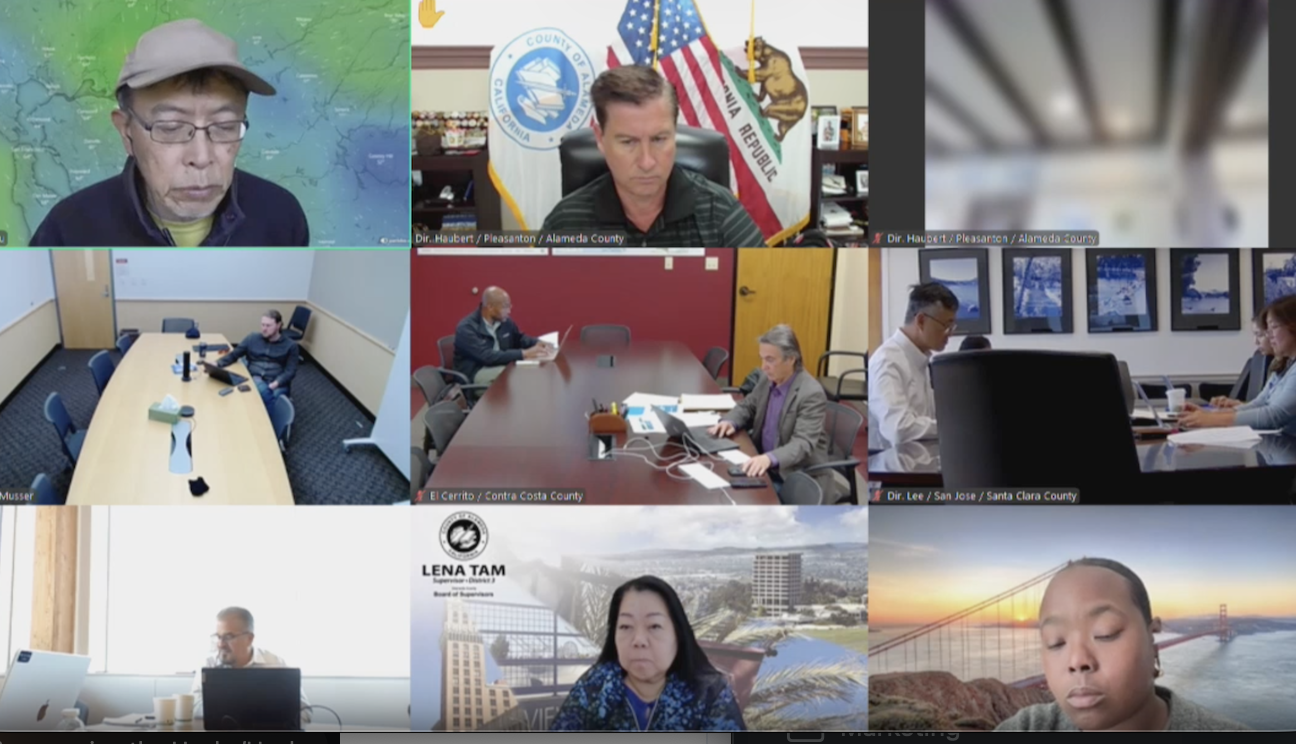
Bay Area Air Quality Management District - Mar 04, 2026 - Regular Meeting
Bay Area Air Quality Management District • Bay Area Air Quality Management DistrictMarch 4, 2026
Locunity is a independent informational service and is not an official government page for this commission.We use AI-assisted analysis and human editorial review to publish information.
Zero Dust Penalties in Five Years: Board and Community Advisors Confront Air District's Enforcement Gap
The Bay Area Air Quality Management District held a rare joint session with its Community Advisory Council on March 4, wrestling with an uncomfortable reality: rules designed to protect refinery-corridor neighborhoods from flaring and fugitive dust have produced zero financial penalties for concrete batch facilities in half a decade. The nearly two-hour exchange — featuring blunt testimony from CAC members, coordinated advocacy from environmental attorneys, and pointed disagreements among board members over economic impacts — set the stage for two of the district's most consequential upcoming rulemakings.
CAC analysis reveals zero financial penalties for concrete dust violations across the entire district in five years, fueling demands for enforceable, prescriptive rules
Board members clash over economic impacts of tighter air rules, with one director calling affordability concerns "exactly what polluters want"
Director Gioia argues flaring is the single highest AB 617 priority, citing 25 years representing refinery communities
Chevron complains permit delays undermine flare reduction, saying applications for vapor control equipment sit unanswered for months
Environmental groups push for a strong warehouse indirect source rule, citing South Coast's WEAR program results
Board adopts 2026 legislative platform 10-0-1, including support for statewide CARB authority on warehouse pollution
Retired employee calls out executive officer's 23% raise while the largest worker classification lacks a cost-of-living adjustment
Five Years, Zero Penalties: The Enforcement Gap That Defined the Meeting
The centerpiece of the March 4 meeting was a joint informational session between the board and members of the Community Advisory Council on two rulemaking tracks under AB 617: flaring minimization (Rules 1211 and 1212) and fugitive dust (Rules 6-1 and 6-6). AB 617 is the state law that directs air districts to develop community-specific emission reduction plans for neighborhoods burdened by pollution; the Bay Area district's plans have identified flaring and dust as top priorities for communities in Richmond, Benicia, Vallejo, Martinez, and other refinery corridors.
Why it matters: More than 200,000 Bay Area residents live near refineries and industrial facilities that routinely produce visible flaring events and fugitive dust. The district's existing rules rely on opacity and visible emission standards that, as the discussion made clear, inspectors struggle to enforce in real-world conditions.
Where things stand: Brad Cole, the district's Regulatory Development Division lead, presented two rulemaking concepts. The flaring rules are in an early concept phase, exploring annual flare emission limits modeled on the South Coast AQMD's approach. The framework would distinguish between emergency, maintenance, and planned flaring and improve causal reporting requirements. A concept paper is expected in Q2 2026. The fugitive dust rules are further along, moving toward prescriptive best management practices — specific, checkable requirements for facilities — to replace the current reliance on opacity readings that are difficult to measure and enforce.
Executive Officer Dr. Philip Fine framed the district's position directly: "Let me start by unequivocally stating that the current position of this district is not to shut down refineries with our rulemaking. We obviously have our concerns about climate change and the impacts of fossil fuels, but our rulemakings are designed to protect public health."
He also explained the mechanics of flaring, noting that much of it comes from maintenance and turnaround work where engineering solutions can reduce emissions: "There's things you can do within those plans and physical configurations within the plant to minimize the amount of flaring."
The Number That Changed the Room
The sharpest testimony came from Patrick Messac, a CAC member from Alameda County, who presented his own analysis of five years of enforcement data. His finding: "In those five years for Rule 6-1, Rule 6-6, and Rule 1301, there had been zero notices of violation tied to a financial penalty for any of the concrete batch facilities in the entire BAAQMD jurisdiction."
Messac went further, warning the board that engagement without enforcement erodes trust: "Listening sessions that do not lead to material changes in policy and observable improvements in the lives of fence-line communities can risk actually further marginalization and distrust with constituents all too familiar with empty promises."
He also challenged the notion that polluters lack a seat at the table, citing public lobbying disclosures: "In 2023, 2024 alone, Chevron spent $10 million in California lobbying, including tens of thousands of dollars in Belmont to unseat the previous chair where there's no refinery."
Flaring: "Not All Flaring Is Created Equal"
Director John Gioia, representing Contra Costa County (District 1), drew on 25 years representing 150,000-200,000 residents near refineries. He argued that flaring is the single highest priority in the AB 617 Path to Clean Air plan and that the board must honor that commitment: "If we don't respect the priority that a community places after spending multiple years on a clean air plan and say we're just not going to do one of the highest priorities in your plan, then what was the whole purpose in AB 617?"
He pushed back against treating all flaring as inevitable: "There is no issue that brings together conservative Republicans and liberal Democrats than to see and smell a flare. We have to get beyond this notion that all flaring is a cost of business. No, it isn't."
Ken Szutu, a CAC member from the Citizen Air Monitoring Network in Vallejo, called for a fundamental shift from reactive to proactive enforcement — including video cameras on flare stacks rather than relying on community members to call in complaints. He also urged the district to treat its refinery rules as a coordinated framework rather than isolated rulemakings: "Right now, the community notices there's a fire and then they call in to the Air District. The order is reversed. The Air District is supposed to protect the community."
The Economic Impact Divide
The board's sharpest internal disagreement centered on whether tighter rules risk economic harm to communities already struggling with affordability.
Director David Haubert, representing Alameda County (District 1), argued for broader inclusion of labor and industry voices: "The number one concern that I hear is around affordability and truly being represented. I think there are lots of members of the community that feel overburdened by the economic impacts of the rules that we make."
Director Ray Mueller, representing San Mateo County (District 3), pressed staff to deliver the economic impact analysis framework that a board majority has requested but has not yet seen, and called for labor to participate as a distinct voice separate from industry.
Director Brian Barnacle, representing the City of Petaluma, rejected the economic framing outright: "I really take issue with blaming air regulations for the affordability crisis because I think that's exactly what polluters want. Gas prices are influenced by many factors, including foreign wars and corporate greed."
Chevron's Permit Complaint
Todd Osterberg, representing Chevron, offered a different perspective on the enforcement equation, arguing that the district's own permitting delays are blocking industry from reducing flaring: "Our vendors are submitting applications to use portable vapor control devices and the district staff is sitting on those applications for months, months, months. There are weeks that go by with no action taken at all on these permits."
Kathy Kerridge, a board member of the Benicia Community Air Monitoring Program, praised the district for bringing community members into rulemaking earlier but noted that monitoring equipment at Martinez Refining Company is currently offline.
Decisions: No formal action was taken — the item was informational — but the discussion produced strong board signals favoring enforceable, outcome-based rules with prescriptive best management practices.
What's next: Staff will publish a flaring minimization concept paper in Q2 2026. Fugitive dust rule amendments continue to progress toward prescriptive standards. Chair Lynda Hopkins closed by emphasizing the need to close the loop with communities: "Engaging communities includes reporting back about the actions that have been substantively taken. It's not just about gathering input, but closing the loop and saying these are the changes that we made."
Environmental Groups Rally for Warehouse Pollution Rule
A coordinated bloc of environmental organizations used the public comment period on Item 22 to press the board on a separate but related priority: an indirect source rule targeting warehouse operations.
Why it matters: Warehouses generate truck traffic that concentrates diesel particulate matter in surrounding neighborhoods — often the same communities already burdened by refinery emissions.
Where things stand: Three Earthjustice attorneys — Colleen Fitzgerald, Tyler Szeto, and Katrina Tomas — along with representatives from the Greenlining Institute, Communities for a Better Environment, and the Sierra Club delivered coordinated testimony calling for facility-based emission reduction targets, zero-emission technology requirements, regular public monitoring and reporting, and equity provisions accounting for proximity to sensitive receptors.
Fitzgerald cited the South Coast AQMD's WEAR program as proof the approach works, noting it already reduces 1.47 tons of NOx and 770 pounds of diesel PM per day. Kaitlin Alcontin of Communities for a Better Environment noted that data shows neighborhoods with the highest particulate matter pollution also have the fastest warehouse expansion.
What's next: The indirect source rule connects directly to the board's adoption of the 2026 legislative platform, which includes support for AB 1777, the California Clean Centers Act — legislation that would give CARB authority to implement indirect source rules statewide.
Legislative Platform Adopted as Quorum Slips Away
The board adopted its 2026 legislative platform and associated bill positions on a vote of 10 in favor, 0 against, and 1 abstention, but the process was visibly strained by the marathon Item 22 discussion.
Why it matters: The platform includes support for AB 1777, which would expand CARB's authority to implement indirect source rules statewide — a key tool for warehouse pollution — and opposes federal rollbacks of California's clean air authority.
Where things stand: With many members having departed during the lengthy rulemaking discussion, the board was on the verge of losing quorum. Staff waived its presentation to enable a vote.
Director Haubert abstained, telling the board: "I'm supportive of this. I just don't know what — these all are so lacking. The presentation. Not having the presentation. I'm just going to abstain." Vice Chair Vicki Veenker, representing the City of Palo Alto, seconded the motion, noting the PGT Committee had reviewed the positions carefully.
Decisions: Passed 10-0-1 (For: 10, Against: 0, Abstain: 1 — Director Haubert; Absent: 12).
Retired Employee Challenges Executive Pay During Labor Impasse
During public comment on the closed session calendar, Geraldina Grundbaum, a former 20-year Air District employee, submitted testimony sharply criticizing the executive office's negotiation posture with the Employees Association.
Why it matters: The Employees Association represents the district's largest worker classification and currently has no memorandum of understanding, leaving rank-and-file workers without a cost-of-living adjustment.
Grundbaum highlighted that Executive Officer Dr. Philip Fine received a 23% pay increase over three years with a guaranteed COLA of up to 5% annually for the next three years — a benefit denied to the largest class of workers. She called on the board to push for a fair contract.
The board provided direction to staff on closed session Item 5 but reported no other action.
Minor Items
Consent calendar (Items 7-21): All 15 items approved unanimously by roll call (For: 18, Against: 0, Absent: 5). No items were pulled for separate discussion.
New employee introductions: Five new hires were welcomed, including Dr. Azima Zare Haroftah, Martina Morelli, Sarah Raskin, Aisha Oliver, and Dr. Harold Rickenbacker, in air quality engineering, compliance and enforcement, and administrative roles.
Martinez Refining Company penalty: Dr. Fine reported a penalty had been announced against Martinez Refining Company, with funds to support community benefits.
Gary Hughes of Biofuel Watch flagged that 7 of the 10 most recent flaring incidents on the district's website are associated with biofuel refineries, urging special focus on that emerging sector.
Jared Manning, a parent of asthmatic children, criticized a proposed delay of gas water heater standards, arguing an exemption for low-income applicants is better than indefinitely delaying a rule that would achieve 90% compliance immediately.