Bay Area Air Quality Management District - May 13, 2026 - Regular Meeting
Bay Area Air Quality Management District • Bay Area Air Quality Management DistrictMay 13, 2026
Locunity is a independent informational service and is not an official government page for this commission.We use AI-assisted analysis and human editorial review to publish information.
Bay Area Air Board Narrowly Advances Zero-NOx Water Heater Rule Despite Deep Affordability Divide
The Bay Area Air Quality Management District's board split 10-8 in a pivotal straw poll, directing staff to move forward with amendments to Rule 9-6 — the nation's first mandate requiring zero-NOx water heaters in homes — while adding low-income exemptions and a nine-month compliance delay. The razor-thin margin exposed a board deeply divided over whether roughly 3 million Bay Area households can bear the cost of electrification in today's economy.
Board gives narrow 10-8 direction to advance zero-NOx water heater rule with low-income exemptions, project-specific waivers, and a nine-month compliance delay to approximately October 2027
Affordability dominates debate as eight board members push for a one-to-two year pause or voluntary program, citing economic conditions, grid reliability, and city budget crises
San Francisco pilot data enters the record: 100+ heat pump water heater installations in low-income homes averaged $8,850 with zero electrical panel upgrades required
120-volt heat pump water heaters hit the market from A.O. Smith and Rheem, a technology shift supporters say the 2023 rule helped create
$890 million in annual health care costs from NOx pollution cited as the price of inaction
Staff directed to map subsidy gaps across all nine Bay Area counties and return with final rule language in October
The Rule That Could Reshape 3 Million Kitchens
The Basics
Regulation 9 Rule 6, adopted by the district in 2023, requires Bay Area residents to install zero-NOx (nitrogen oxide) water heaters — effectively heat pump water heaters — when their existing unit fails. It is the first rule of its kind in the nation. Staff returned to the board with five proposed amendments to address affordability and implementation concerns raised since adoption: a low-income exemption for households at or below 250% of the federal poverty guidelines, contractor-verified project-specific exemptions for homes with space or electrical constraints, a limit of one project-specific exemption per address, a processing fee of approximately $150, and a nine-month compliance delay to roughly October 2027.
Staff explained that the delay would apply equally to new and existing construction, since the current building code already strongly encourages electrification for new buildings.
Why It Matters
This rule touches every homeowner and renter in the nine-county Bay Area. When a gas water heater breaks — something that happens unpredictably — residents will be required to replace it with a zero-NOx unit or apply for an exemption. Staff estimated that roughly 38–40% of households may qualify for exemptions. The policy sits at the intersection of climate, public health, housing affordability, and energy infrastructure — and the 10-8 split signals the final October vote will be fiercely contested.
Where Things Stand: Two Camps, One Board
The debate consumed virtually the entire two-hour-plus meeting, with every board member weighing in.
The opposition bloc — eight members — coalesced around timing, cost, and process concerns.
Board Member Mark Salinas (City of Hayward) argued the rule would effectively exempt the communities it's supposed to help most. "The people who are going to take exemptions will likely take exemptions and the people that are mandated to do it — they're going to do it. Middle class, upper middle class families are going to do it," he said, adding that low-income residents in AB 617 communities — areas already overburdened by pollution — would be left behind by the exemption structure rather than helped by the mandate.
He called for a one-to-two year pause: "I think we should pause. I think we should kick this back for at least another year or two. And let's think this through."
Board Member Steve Young (City of Benicia) questioned grid reliability, pointing to the January storms. "We've had a lot of brownouts, rolling brownouts, during the storms in January. There were two and a half million customers from PG&E who lost power for days or weeks in that storm," he said, adding that he preferred a voluntary incentive-based approach over a mandate. He compared the rule to the unfunded state mandates local officials routinely oppose: "At the local level at least, most of us rail against state mandates, unfunded mandates, where the state passes a law and says it's up to the city to institute this law and to pay for the impacts of the law."
Board Member David Haubert (Alameda County) requested a sliding scale for the low-income exemption rather than a hard cutoff, raised concerns about costs being passed to renters in cities without rent control, and said the community should be polled after an education campaign before any mandate takes effect.
Board Member Ken Carlson (Contra Costa County) supported the amendments conceptually but proposed delaying implementation to January 2029 to align with the district's upcoming HVAC rule. "What I would propose is that we actually move implementation of this rule to January of '29, because we're going to be duplicating the work. And why aren't we doing it together?" he said.
Board Member Ray Mueller (San Mateo County) proposed a 21-month pause and a randomized housing stock study across all nine counties, arguing the district's existing cost data relied on self-selected projects. He warned about legal risk from the current federal administration: "I can't think of a worse time to do that from a legal perspective in terms of what could happen with respect to a legal challenge and the precedent that could be set, and a rollback of all of the powers that we want the district to maintain."
Board Member Gabe Quinto (City of El Cerrito), citing his role as president of the League of California Cities, warned of severe local government budget constraints. "I see this as most Californians will not be able to afford this. A state with deficit years ahead will not be able to afford this," he said.
Board Member Dionne Adams (City of Pittsburg) asked staff to consider making the program voluntary and investing instead in education and market transformation. Board Member Monica Brown (Solano County) also favored a voluntary approach, citing personal affordability concerns.
The Other Side: Health Data, Pilot Results, and Market Momentum
The supporting bloc — ten members — argued the data now supports moving forward, and that delay would cost lives and market certainty.
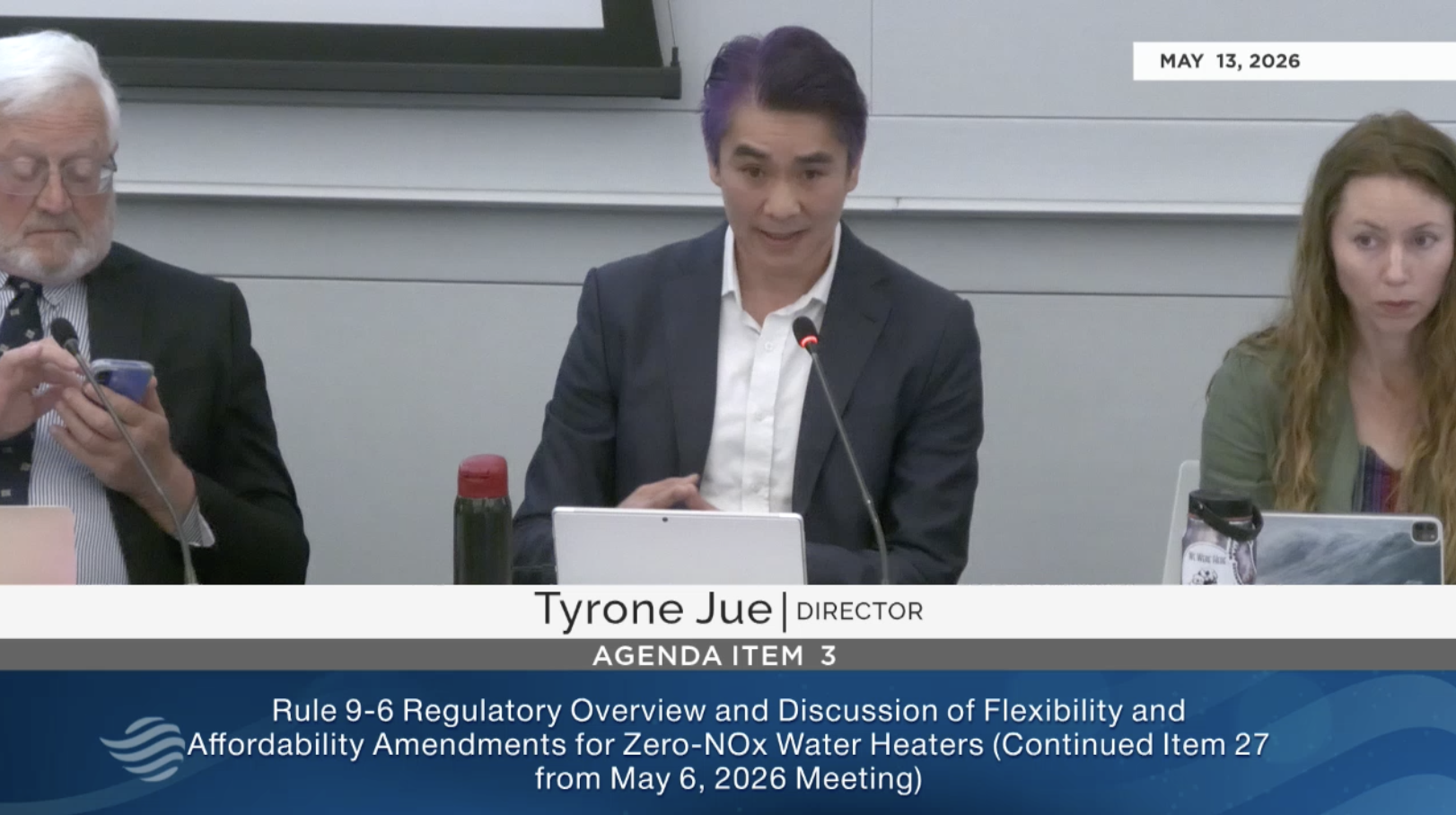
Board Member Tyrone Jue (City & County of San Francisco) delivered the meeting's most data-dense testimony, drawing on San Francisco's Climate Equity Hub pilot. "Over the 100 heat pump water heaters we replaced over the last two years, I want to be clear that we did not turn any households away because of cost. So we didn't cherry pick projects," he said. The pilot targeted low-income homes at 80% of area median income, found average total project costs of $8,850, and required zero PG&E service capacity upgrades.
He also challenged the grid reliability argument, noting modern gas water heaters with electronic ignition also fail during power outages, and that electric systems recover faster after seismic events: "It will take up to six months to restore the natural gas systems within our neighborhoods when all of these natural gas pipelines break, versus a matter of weeks or days to bring back the electrical delivery to homes."
On the broader policy question, he was blunt: "None of that progress has ever been done through voluntary action alone. When we have individual choices that create shared health impacts — this is kind of what we have this board to deliberate and to talk about."
Vice Chair Vicki Veenker (City of Palo Alto) cited data from her city showing only 5% of heat pump water heater projects needed an electrical panel upgrade. She framed the health stakes in dollar terms: "The cost of health care has been calculated at $890 million every year. And every Bay Area resident will realize those savings every year, regardless of whether their water heater has burned out yet."
She drew a pointed analogy: "Our homes and other buildings are emitting secondhand smoke, secondhand nitrogen oxides. They are affecting nitrogen oxides that affect their neighbors, not just in their immediate community, but throughout the Bay Area."
Board Member John Gioia (Contra Costa County) pointed to a market shift the rule itself helped create. "When we started this process several years ago, there were no 120-volt heat pump water heaters. There are now two on the market," he said, referring to units from A.O. Smith and Rheem that plug into standard outlets without panel upgrades. He also urged the district to develop a model streamlining ordinance for local permitting across the Bay Area's 99 cities and nine counties: "We as an Air District should develop a model streamlining ordinance. I think a real concern is the permitting." Staff confirmed that BayREN, the regional energy network, is already developing one.
Board Member Noelia Corzo (San Mateo County) drew on personal experience living in both gas and all-electric buildings, arguing the health benefits outweigh potential cost increases. Board Member Clark, identified as a new board member, urged colleagues to provide market certainty: "Most importantly, I think the package before us provides something that everyone on all sides of this issue craves, and that's certainty."
Board Member Joelle Gallagher (Napa County) supported the amendments but asked for tighter definitions around emergency replacements and exemptions for high heat demand situations. Board Member Otto Lee (Santa Clara County) supported the recommendations and asked about how the exemption process would work for multifamily properties. Board Member Lena Tam (Alameda County) emphasized the health care cost connection and called for robust community outreach with multilingual access. Board Member Sell also voiced support for moving forward.
Decisions
Chair Lynda Hopkins (Sonoma County) tallied the straw poll at the close of deliberations: "We do have majority support from the board members present to move forward with bringing staff recommendations back in October. And based on my tallies, we had eight board members requesting either a pause or a voluntary program. We had 10 members, if you include myself, which I am including, to move forward with staff recommendation."
No formal vote was taken — the straw poll provided direction to staff. The 10-8 margin, with nearly half the board dissenting, signals the final rule language will need to thread a narrow needle.
What's Next
Staff will return with final Rule 9-6 amendments in October 2026 for a formal vote. Chair Hopkins directed staff to complete several tasks before then: map existing rebate and subsidy programs across all nine counties and identify gaps, explore community benefit fund opportunities for underserved areas, consider presenting the BayREN model streamlining ordinance at a Stationary Source Committee meeting, and report on community engagement and outreach efforts.
"My request is that we actually map out those subsidies, we find out if there are gaps, and then we figure out how to fill those gaps," Chair Hopkins said. "Because I don't want to hear that Contra Costa has been hung out to dry."
Minor Items
Public comment cut short: Only two speakers were heard during public comment on non-agenda items before the board lost quorum and adjourned. Fernando Gaetan of Earthjustice urged caution on a separate socioeconomic policy revamp the district is considering, warning that overly complex analytical requirements could delay urgently needed air quality rules. A second commenter, Dawn of Campbell, asked whether NOx is the Bay Area's top health priority.
Several agenda items not reached: Board member comments, the Executive Officer's report, and the Chair's report were all skipped due to loss of quorum.
Next meeting: June 3, 2026, at 10 a.m. at the Bay Area Metro Center. Speakers who could not be heard will be directed to that session.